
(Reading time: 2 minutes)
Although my biggest concern about a data center possibly setting up shop in Staunton has been the enormous amount of water such centers consume, their voracious consumption of electricity also is top of mind. It’s notable, therefore, that the North American Electric Reliability Corp. yesterday issued its highest level of warning about the risks that data centers pose to the electric grid. The rare Level 3 alert followed several incidents over the last two years in which more than a gigawatt of data center load simultaneously and unexpectedly disconnected, destabilizing the grid and creating a potential blackout.
The North American Electric Reliability Corp. (NERC), often described as the continent’s “grid watchdog,” issued its alert after analyzing disruptions of electric service in Virginia and Texas caused by data centers abruptly pulling the plug in 2024 and 2025. Such disconnects may occur when data centers respond to relatively minor grid disturbances, such as a local lightning strike or line fault, by switching to backup power supplies so they can maintain consistent voltage flow to sensitive computing equipment—but the sudden load loss stresses grid infrastructure, like transformers, that consequently may shut down as well, triggering a cascade of system failures.
Currently, data centers don’t have to follow the rules that require power plants to inform grid monitors when they are going on- and off-line, even though some centers can add or subtract as much or more power than a power plant. And while the data center contemplated for Staunton is hardly on that scale—measured in megawatts rather than gigawatts—it could be part of a wider network of such centers triggered by a common disruption. An analysis by dozens of scientists from the largest AI companies warned last year that their industry’s power swings could physically damage the grid.
Yesterday’s Level 3 alert was only the third in NERC’s history. It was followed by the corporation’s call for transmission planners to develop a detailed list of “modeling data, settings and parameters needed from computational loads” and to study the grid stability “margin” at least annually in areas with large AI infrastructure, such as Virginia.
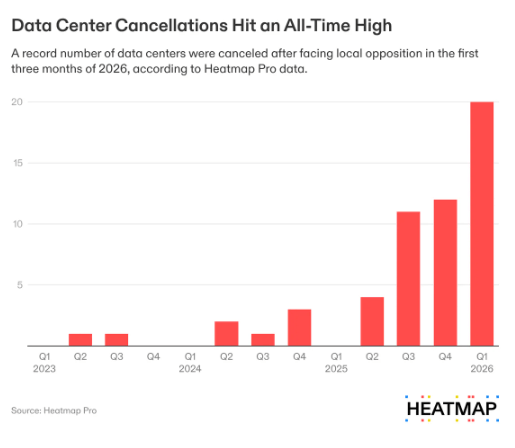
Such developments don’t happen in a vacuum. As evidence of the outsized negative impact of data centers on communities, electricity rates, water supplies and the electric grid become unavoidably in your face, resistance to new centers is snowballing. At least 20 proposed new centers were canceled the first three months of this year due to local pushback, as tracked by Heatmap, with more than a hundred new fights added within the same time frame. Recruiting a data center for Staunton, in other words, means inviting a whole lot of problems the city can do without.
 Looking askance