Public input is so messy, you know?

(Reading time: 6 minutes)

When publicly-traded companies have bad news they’re forced to share with the public, such as plunging revenues or earnings losses, the time-honored strategy is to release it late on a Friday afternoon. That way, goes the forlorn hope, some of the shock will have dissipated by the time stock trading resumes Monday morning.

That seems to be pretty much the thinking behind Staunton’s promised taking-of-the-pulse for Staunton Crossing. Eight months after the city’s consultant on the massive economic development project, Tim Davey, told city officials that the project’s master plan is overdue for a reevaluation, the people who live in the city finally will be asked to chime in with their thoughts on the subject. Well, sort of—if that’s what you call an online survey consisting largely of multiple-choice questions issued in the holiday-frenzied weeks between Thanksgiving and Christmas. But to me, that reads more like a pro forma Friday-afternoon corporate release of bad tidings.

Not that there’s anything surprising about the move. Davey’s contempt for public input was clearly telegraphed at the October meeting of the city’s Economic Development Authority (EDA), which has oversight of Staunton Crossing’s development, when he revealed unsuspected soothsaying powers by counseling against public information sessions because they wouldn’t yield any new thoughts or insights. An online survey, on the other hand, would be “easy, quick and nimble,” which is consultant-speak for “avoiding messy public emotions and objections.”

The desire to tamp down public input was repeated at yesterday’s brief and sparsely attended EDA meeting (three of seven members were absent), at which Amanda DiMeo, the city’s director of economic development, said there was “nothing to show yet” because the survey is still being drafted. Still, she added, it would consist largely of multiple-choice questions because “we didn’t want to slow up the process too much” by having it “too open” –in other words, by posing open-ended questions that might require fresh analysis of new ideas. Far better, in the interests of “easy, quick and nimble,” to have a fixed universe of acceptable issues and defined responses.

The decision to forego any public hearings, to rely for public feedback solely on an online survey, and to release that survey at precisely the time of year when the public is most distracted from civic issues, is an uncharacteristically cynical posture for Staunton. It is, however, entirely consistent with Tim Davey’s unrelenting advocacy of recruiting a data center for Staunton Crossing. Public support for data centers has plunged all across the country, for numerous and well-known reasons, but Davey has been undeterred and keeps flogging them in one public appearance after another. And make no mistake, data centers are at the center of all this fretting about a plan “update.”

Typically, the pitch has been either “Gee, everyone else is doing data centers, you don’t want to be the only municipality in Virginia to miss out,” or the more blatant dangling of ginormous tax revenues that Staunton could be collecting—as much as $26 million a year if Staunton Crossing were to be carpeted with the things, as Davey observed last month. Not, of course, that he would suggest such a thing. Just saying. . . .

Often obscured by the data center fixation is the original reason behind Staunton Crossing, which was primarily to generate well-paying jobs for a city too disproportionately tilted toward the lesser paying service sector. Aside from the initial construction phase, data centers—which are little more than glorified warehouses—fall remarkably short on that measure, so Davey’s relentless pursuit of that option is at least questionable, and all the more so in the context of an industry that is all too fond of non-disclosure agreements as it pursues new sites.

To get the best bang for the buck—that is, to get the largest number of decent jobs while also maximizing the taxbase—almost certainly calls for recruiting light manufacturing plants, because of their combination of large capital investment and skilled trades. But on that score Davey is remarkably myopic, leaning heavily on pharmaceuticals because that apparently is the latest “it” thing in the state’s economic development, pointing to multi-billion-dollar projects in Albemarle, Richmond and Elkton.

Well, maybe—although it’s worth observing that any development comes with trade-offs, and any chemical-dependent industry has significant environmental implications that deserve a discussion that has yet to take place. But aside from his superficial broaching of the possibilities, Davey’s bigger failing is that he’s so fixated on what others are doing and so obviously uninterested in being progressive or forward-looking. What are the industries of the future, where Staunton has a chance of getting in on the ground floor? What will be the next “it” thing, not this year or next, but in 2030? How can Staunton Crossing take advantage of its location along major road and rail transportation links, which it touts so widely in its promotional material but about which data centers care not one bit?

Instead of feeding the same hackneyed development menu to city planners and officials, how refreshing would it be if Davey and the EDA explored the possibilities of solar or other green industries, from solar panels to batteries to geothermal equipment or wind turbine manufacturing? Or how about picking up on fast-moving changes, both legislatively and technologically, in home manufacturing, with modular housing poised for explosive growth? What could be more fitting, for a part of the state that suffers from a growing shortage of affordable housing, than a manufacturing plant that cranks out wall panels, modular bathrooms and kitchens, and entire housing blocks that could be assembled at a fraction of the cost of site-built homes?

There undoubtedly are numerous other possibilities worthy of discussion, but community discussion clearly is the last thing Davey and the EDA want. The Staunton Crossing plan is nearly a decade old, but talk of “updating” it is window dressing for those who put it together in the first place, and who have locked into its main features. A sincere effort to solicit public input might provide the imagination and vision that is so conspicuously missing at the moment, but that would be too much like work. It wouldn’t be “quick, easy and nimble,” which have become today’s watchwords.

On being numbed by numbers

(Reading time: 9 minutes)

Halloween is not only about goblins and ghouls. It’s also the starting gun in the sprint to Thanksgiving and Christmas, when charities and social welfare agencies lean into the charitable impulses such holidays inspire. But this also is the season when shorter days and colder nights bring human needs more to the forefront, so there’s a push as well as a pull to the seasonal tugging at heartstrings and wallets.

There are several trusted strategies deployed to support such imploring. One is to tell stories of people in need, suffering because of fate’s fickle finger rather than as a result of personal failings. Another is to highlight the ever-greater cruelty of the grasping Orange Man, laying waste to Medicaid, food stamps and housing subsidies. A third is to cite reams of statistics to summarize not just how bad things have become, but to show how rapidly they’re deteriorating.

And that’s a problem. Most people don’t do numbers so good.

The Blue Ridge Area Food Bank (BRAFB) inadvertently provided proof of this innumeracy a couple of weeks ago, jumping the gun on the charitable-giving season with a Zoom presentation on hunger in Virginia. The Oct.14 session, which drew 77 participants, proceeded with the observation that most people in the food bank industry expected demand to peak in the years immediately after the 2020 Covid pandemic. Instead, food demand has kept growing, year after year, and “we’re very concerned about the wave we see coming,” explained BRAFB chief executive Kari Diener.

To buttress that concern, lots and lots of numbers got tossed around, from poverty stats to SNAP enrollment figures to financial pressure points forcing people to skimp on life’s other essentials to keep from starving to death. The bottom line, however, could be summarized in just one statistic: that 42% of Virginia households face food insecurity, meaning they don’t have enough food to eat or don’t know where their next meal will come from. Forty-two percent is a lot; 3.7 million people.

Well, maybe.

THE PROBLEM WITH NUMBERS, as I’ve written before, is that they seem so damn authoritative. People’s emotions are squishy and changeable, but we all have them and so tend to think we’re experts when it comes to examining or questioning feelings.

Numbers are different: angular, sharp-edged, resistant to interpretation. Or so they seem, never mind the confusion of Boolean algebra allowing 1+1=0 or the profound (and profoundly disturbing) complexities of quantum physics that enable things to simultaneously exist and not exist. Throw a lot of numbers at most people and their critical faculties seize up, unable to question even the most obvious incongruities, either for fear of seeming stupid or simply because they don’t actually see what’s being shown. Numbers are taken at face value in a way that people rarely are.

That’s pretty much what happened with the food bank presentation on hunger, based on a statewide survey conducted this past May by NORC (formerly the National Opinion Research Center) at the University of Chicago. To be fair to the Zoom call’s participants, neither the survey itself nor its methodology were shared on the call, just its interpreted results. To see the actual data one had to visit the website of the Federation of Virginia Food Banks, headquartered in Richmond, which apparently commissioned the survey on behalf of the seven food banks that serve the state. (BRAFB, for example, covers 25 counties in the western end of Virginia.) Yet even that wasn’t very rewarding in terms of getting basic information.

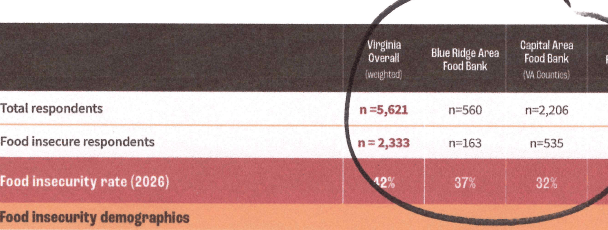
Despite the federation’s website claim that its survey “offers a new level of precision that captures the extent of food insecurity across the state,” a link purporting to explain the survey’s methodology does no such thing. It simply provides a summary of conclusions. The survey’s supposed precision, meanwhile, is encapsulated in a one-page data sheet that in mid-October waved a very noticeable red flag by claiming to have interviewed the same number (560) of respondents in the BRAFB area as in the much more heavily populated Capital Area Food Bank region. Moreover, while the study states that it surveyed a total of 5,621 Virginians, the individual totals for the seven food bank areas at that time added up to just 3,975.

Oct. 14: An unbelievable—literally unbelievable—duplication of numbers.

The identical number of respondents for two greatly disparate food bank areas should have caught the eye of anyone at BRAFB preparing for the Zoom call, but apparently no one looked. Worse yet, a second data row, reporting how many respondents were food insecure, had the same problems: identical numbers of the food insecure (163) in both the BRAFB and Capital Area Food Bank. Meanwhile, the food-insecure total for all seven food banks, 1,474, fell far short of the 2,333 claimed for the state as a whole—yet that’s the number from which 42% food insecurity was computed.

My questions to BRAFB about these inconsistencies resulted in several email exchanges and three different versions of the data. The duplicated numbers were attributed in Richmond to an “administrative error” that, when corrected, increased the number of Capital Area respondents to 2,206 and the number of the Capital Area food-insecure to 535. With that change, the state total for all respondents matched the sum of the seven food bank areas—but even with the Capital Area increase in the number of food-insecure respondents, the total for the seven food banks in that category was still 486 less than the 2,333 claimed statewide.

Oct. 22: An unheralded number change, but without modifying state totals.

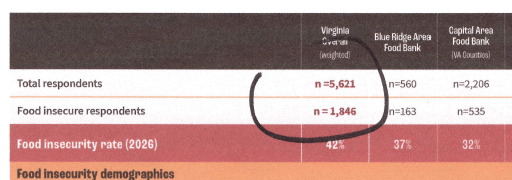
Was that a problem? Apparently not in Richmond, which in response to my further questions to BRAFB simply changed the statewide number of food insecure respondents to 1,846. No explanation was provided for the change, which now matched the total of the seven food banks. And no reason—“administrative error” or otherwise—was provided for why this error had occurred in the first place.

Currently: Fudging the numbers, but without changing the calculations that follow.

Here’s the thing, though: these changes have only dug a deeper pit of uncertainty for the food bank’s statistical claims. When the survey initially asserted that 2,333 of its respondents were food insecure, that worked out to 41.5% of its sample pool. Lowering that number to 1,846 drops the percentage of food insecure respondents to a tad less than 33%, yet the data sheet that’s still online clings stubbornly to its claim of 42%. That’s a big discrepancy. Huge, even.

DOES ANY OF THIS MATTER? These are just numbers, after all, and mistakes happen, and . . . and.

It matters for the same reason that it would matter if BRAFB were to present a heart-tugging story of a single unemployed mother suffering from a debilitating illness for whom a local food pantry had meant she could feed her three children, only to find out that the single mother was as healthy as a horse or that she had a cushy job or that the three kids were her neighbor’s, provided as photo-op props. The story’s coloration changes. A third of all respondents is still a lot of people facing food insecurity, but it’s not as dramatic as 42%, so why not go with the better story? Meanwhile, the data sheet that offers “a new level of precision” about hunger in Virginia has 30 more rows of percentages about hunger, both statewide and for each of the seven food bank areas, all of which should now be questioned.

None of this is to suggest there’s anything nefarious going on, or that BRAFB is guilty of deliberate deception. If anything, BRAFB is the unwitting victim of sloppy data manipulation by others, compounded by its own lack of attention to detail. But BRAFB also is a participant in a game of pass-the-buck, serving as a go-between to the Federation of Virginia Food Banks but deflecting questions about data manipulation to NORC, which responded to my inquiries about who prepared the original data sheet by suggesting I contact . . .  the Federation of Virginia Food Banks. Which, to date, has not responded to several inquiries that started more than two weeks ago.

The problem is not only that a potentially powerful message about hunger in Virginia has been undercut by an unexplained butchering of fundamental facts. The wider problem is that local social service agencies keep shooting themselves in the foot with an essentially cavalier approach to numbers generally and to numbers that keep them financially accountable specifically. I’ve written about this before, excoriating SAW Habitat for Humanity for fudging its tax reports in such a way as to obscure a lack of accounting for 12 months of receipts and expenses. And I returned to this problem more recently by questioning the apparent disappearance of more than a million dollars over several years at the Verona Community Food Pantry.

In those cases, too, the response has been to admit to nothing and to stonewall any inquiries. And while BRAFB can sidestep questions about the data it presented mid-October by asserting that it was simply a conduit for others, it has been just as quick to take a hands-off approach to the Verona food pantry’s accounting problems by noting that the food bank and the food pantry are separate legal entities. That’s true as far as it goes, but it obscures the legal relationship between the two organizations that defines financial terms, operational responsibilities and compliance requirements.

At a most fundamental level, all these agencies are part of a social welfare ecosystem that is highly dependent on public support and public trust. Trust is built on transparency and accountability, which in turn depend on accurately presenting facts and figures so that the public understands what’s going on. Lose that trust in one area, whether because of guile, heedlessness or just telling a story too well, and you weaken the entire structure.

A cry from the heart goes unheard

(Reading time: 5 minutes)

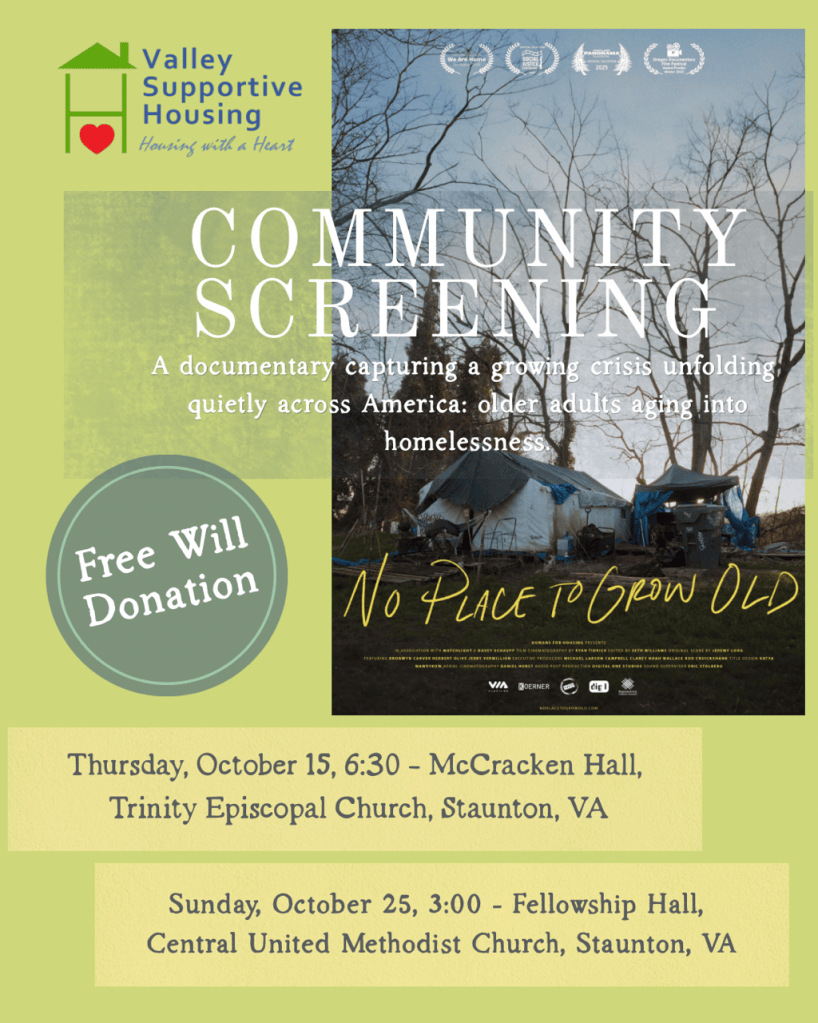
“No Place to Grow Old,” a cri de cœur on behalf of society’s most vulnerable members, was screened Thursday night at Trinity Episcopal Church in downtown Staunton. For all the ears, eyes and hearts it reached, it may as well have been screamed into a well or from a wind-whipped cliff. No more than a score of people showed up, at least half of whom already work locally with the homeless—which is to say, this was a gospel being preached to the already converted.

What a sadly lost opportunity that was.

“No Place to Grow Old,” although filmed in Portland, has been shown hundreds of times across the U.S. in school auditoriums, church basements, service organization halls—wherever a handful of people touched by its portrayal can cobble together a screening. The story it tells is not particular to Oregon but is replicated in one community after another, including ours. Its main protagonists are uniquely distinctive voices that nevertheless describe an increasingly universal experience, providing an unflinching look at the stark realities of being old and homeless in a society that prefers not to see its failures in such raw close-up.

The biggest difference in homelessness between Portland and Staunton? The tents in Portland are right out there on the sidewalks. Here they’re hidden away, tucked into overgrown lots behind shopping centers, allowing us to maintain the fiction that this really isn’t that big a problem.

To dispel that myth, here are some of the numbers that came out of the after-movie panel discussion on Thursday. Within the SAW region of Staunton, Augusta County and Waynesboro, at least 250 homeless people have been counted in the annual census known as the Point in Time (PIT) count, and the people doing the counting agree this is an undercount. Three years ago, Valley Supportive Housing—which provides subsidized housing to local residents with a mental illness, intellectual disability or substance abuse issues—had a waiting list of 15 to 20. Today, that list has grown to 107.

Valley Mission, the only local emergency shelter for the general population, served 649 people in 2016 but only 247 in 2025—not because demand has gone down, but because of a sharp decrease in local affordable housing for people in the shelter to move into, which means the shelter’s revolving door is turning more and more slowly, and fewer people who need it can get in. The Mission, too, has a waiting list, of approximately 100. Ironically, 20 of the homeless shelter’s clients are earning a paycheck but can’t find an apartment they can afford, contributing to the logjam.

While Valley Supportive Housing historically has served people who are psychologically or mentally fragile, both that population and the homeless generally become even more vulnerable as they get older. People who are already homeless age much more rapidly than their housed counterparts, with people in their 50s having the bodies of someone 20 or more years older. Roughly 35% of the Mission’s residents are at least 55, and with each passing year that percentage grows. Meanwhile, the number of freshly minted homeless old people also is growing, as people who managed to keep a roof over their heads for most of their lives get squeezed out of their homes by rising rents, illness, or other life circumstances that outstrip their reserves.

Nationally, single adults over 50 now make up half of the homeless population.

In crude economic terms, this is a huge social burden. Valley Supportive Housing, for example, reports that its residents have one-third the annual number of psychiatric crises they had suffered before getting into a home, resulting in far fewer emergency room visits—at more than $2,200 a pop—arrests or mental hospital commitments. With jail costs of $120 a day and a single day at a mental hospital coming in at $700, the savings in taxpayer dollars due to the organization’s activities run into six and seven figures.

But those are just numbers, and while data are important to understand the full extent of a problem, it’s the personal stories told in “No Place to Grow Old” that give it depth and emotional resonance. These are people who have or had parents and children, who held responsible jobs and looked after other people, who had and have dreams and passions and fears. They’re not lazy or parasites or too stupid to do better. They’re people who may have been your neighbors or the clerk who helped you at a store down the street or a local handyman or groundskeeper, but who, through a turn of bad luck—a divorce, a death in the family, a broken hip—have been ejected from one life and into another, much less privileged one.

The problem with listening to these stories and to looking into the eyes of those who tell them is that once you’ve done that, it’s so much harder to carry on with your normal life without doing something in response. Some things are hard to unsee—and shouldn’t be. But that’s exactly why “No Place to Grow Old” should be seen more widely, and especially by those who might be able to do something in response: our city council members, who establish the city’s priorities. City planners and managers who will be preparing the next municipal budget. The members of our newly formed housing commission, who are charged with planning for the city’s housing needs. Planning board commissioners and members of the Economic Development Authority and the guiding lights behind the heretofore mute Valley Program for Aging Services.

Local clergy, who should be thundering about the least among us from their pulpits.

All these people, as well as the public at large, do have one more—but just one more—chance to see this film, which will be shown next Sunday (Oct. 25) at 3 p.m. in the fellowship hall of Central United Methodist Church, also in downtown Staunton. Come and bear witness.

The “No Place to Grow Old” trailer can be seen here.

Data center: sh*t or get off the pot

(Reading time: 4 minutes)

This past week, the lead outside consultant for developing Staunton Crossing finally said the quiet part out loud.

Appearing before the Economic Development Authority at its monthly meeting, Tim Davey of the Timmons Group rattled through a long-awaited 30-minute update of the industrial park’s master and marketing plans, first promised this past spring. There were Power Point slides and lots of numbers that have yet to be made publicly available. Different scenarios were mentioned, mixing and matching various combinations of land uses. Pharmaceutical centers, first flagged by Davey for the city council in April, got prominent mention as the next big thing, with nods to recent multi-billion-dollar projects in Albemarle, Richmond and Elkton.

It was all a bit breathless. Davey speaks in complete sentences and unbroken paragraphs, without pause or verbal tics, information pouring out of him in an unbroken stream. Let your mind drift and you’ll suddenly find yourself several miles downriver, struggling to get reoriented. Through it all, however, one thread became discernible: In the central tension between Staunton Crossing as a generator of good jobs vs. Staunton Crossing as a contributor to the city’s tax base, the balance clearly has shifted—at least in Davey’s mind—toward the latter.

Whereas the original plan called for 1.9 million square feet of development to provide up to 3,250 quality jobs, generating more than $4 million in annual tax revenues, the revision calls for 1.2 million square feet with 2,900 quality jobs and $9.8 million in tax revenues. Less land used and 11% fewer jobs created, but with more than twice as much money for the city’s coffers.

Key to that shift, aside from the possibility of capital-intensive drug manufacturing, remains (of course!) the holy grail of a data center. Mentioned almost tangentially at several points in Davey’s  firehose of a presentation, a data center was listed as one of five recruitment targets and as a “nice revenue generator.” At more than $200,000 an acre in tax returns, a data center occupying the entirety of the Staunton Crossing site would provide the city with more than $26 million in taxes a year—not something Davey was recommending, he stressed, just something he was mentioning to show what was possible.

Uh-huh.

But then came the quiet part. The Economic Development Authority and the City Council should “decide on terms to include data centers as a target use going forward,” Davey’s presentation advised. Among other things that includes the advice to “update zoning to allow all target land uses ‘by right’” because, quite frankly, potential prospects “want to avoid public hearings.” Of course they do—and none more than developers of data centers, which are now opposed by 70% or more of the American public.

Here’s the scary part. The six other members of the Economic Development Authority, as frozen by Davey’s rat-a-tat presentation as deer in an illegal hunter’s headlights, sat without a response to authority chairman Billy Vaughn’s “any questions?” prompting. Instead, the silence dragged on after Davey finished his presentation, the members looking back and forth at each other as if to say, what now? And then, at what might have been the last possible moment before Davey folded up his tent and went away, City Council member Jeff Overholzer—there not as an EDA representative but as the council’s liaison—piped up. Would Davey give a more specific explanation of the bullet-point about “data centers as a targeted use”? What, exactly, was Davey looking for?

“Yes or no,” came the succinct reply.

Which was to say, is Staunton serious about pursuing a data center or not? And if it is, would it take the necessary steps to land one?

That opened up the flood gates a wee bit, resulting in another 20 minutes of back and forth about the data center vision, as well as its dark side. Noise, air pollution, water and power consumption were all mentioned, as was the inevitability of on-site gas-fired back-up generators that would further exacerbate the noise and air pollution produced by this otherwise “clean” industry. Were the city to finally get serious about data center recruitment, the EDA should probably put out a summary of what it wants to see and follow that up with an on-line community survey. Davey counseled against public information sessions or hearings, warning they would simply result in people saying the same four things over and over again.

A survey, on the other hand, would be “easy, quick and nimble.”

No mention was made of the long-promised need to amend the city’s zoning code to actually permit data centers, “by right” or otherwise—and that would involve public hearings, yes, and people saying the same four things over and over. But that would be a cross for the Staunton planning commission to bear, and then the city council, and the EDA members would be out of the firing line.

And that apparently suits the EDA just fine. As EDA member Terry Holmes explained at the tail end of the discussion, there’s a lot of public misunderstanding about data centers. The only thing that’s really changed about data centers since 2019 is people’s opinions about them.

Uh-huh.

In Staunton, too, no place to grow old

(Reading time: 12 minutes)

There aren’t a lot of U.S. tax dollars coming into Staunton these days, and less all the time, thanks to—well, you know. So the little bit that does trickle in should be scrupulously measured and dispensed where it can do the most good, and that includes the approximately $323,000 that comes our way each year via the federal Community Development Block Grant (CDBG) program. That’s the program whose No. 1 “overarching objective” is to “provide decent affordable housing.”

It’s therefore perplexing to read, in Staunton’s annual CBDG action plan for 2026, that the Valley Program for Aging Services (VPAS) was one of eight local social service agencies that were consulted by the city when it assessed how that money should be spread around. Specifically, VPAS was sought out because of its presumed understanding of “non-homeless special needs” of the elderly, which, fair enough. But according to the action plan, VPAS also was consulted for a “housing needs assessment,” which is nonsense.

VPAS does many good things for local residents who are getting on in years, including Meals on Wheels to deliver food and a transportation program enabling non-driving seniors to keep medical and other appointments. (Each of those programs stands to get a modest CDBG grant.) But VPAS has absolutely nothing to do with either assessing or meeting anyone’s housing needs. As I wrote in February, the organization’s strategic plan for 2025-2027—optimistically headlined “Charting a New Course”—never once mentions housing, and executive director Beth Bland, citing limited resources, said that isn’t about to change. Indeed, she added, “We are not prepared to be, nor would it be appropriate for us, to take the lead on this issue.”

City planners clearly don’t understand that, their misrepresentation of VPAS’s expertise attesting to the compartmentalization of critical information that can occur even in as small a community as Staunton. Not that the assumption was unreasonable. VPAS is one of more than 600 Area Agencies on Aging across the country that were established decades ago by Congress under the Older Americans Act, and given its broad mandate to serve the needs of older Americans, it’s not far-fetched to think that those needs would include housing.

That it doesn’t, says something about the Older Americans Act. That city planners don’t know that says something about Staunton.

WHILE MOST PEOPLE are aware of, if not knowledgeable about, Medicaid and Medicare, which were passed at the same time as the Older Americans Act, the latter has had a much lower profile. To some extent that may be indicative of a general American attitude toward old people, perhaps the most easily overlooked demographic segment of our society. Much is made (appropriately) of the high cost of day care and the burden it places on working families. Public schools claim a significant chunk of every locality’s taxes and of its electoral attention. Affordable housing for the working class is a hot topic, as are labor force participation, unemployment rates and other issues that affect people well into middle age.

But old people tend to fade into the background. They ask less of society, and society expects less from them. Historically, most have owned their homes after decades of paying off their mortgages. Others live in housing complexes designed specifically for the elderly, with varying degrees of supportive care. Either way, all those people tend to disappear from view, and the kinds of services that the Older Americans Act underwrites have similarly limited visibility in the wider community. In some ways, therefore, the more successful the Older Americans Act and its programs have been, the more invisible its target population has become.

Yet times change. The Older Americans Act is supposed to be reauthorized by Congress every four years but was last reupped in 2020, so it’s already two years overdue. Although the Senate got around to passing a reauthorization bill this past July, the House of Representatives went home without following suit, leaving a zombie in its wake: a service organization sustained by annual appropriations (at least so far), but unable to update its programs in response to changing needs.

And that’s the other half of the equation: those needs are not only changing, but changing at a growing clip as the U.S. population ages. Back in 1965, and for most of the decades since, the act’s focus has been on helping older Americans age in place, through case management services, Medicare counseling, respite and transportation services, and health and wellness programs. Housing was hardly on anyone’s radar. But between 2013 and 2023 the number of people 65 or older renting their homes grew nearly 30%, making them increasingly vulnerable to market forces. Some of that increase is due simply to more people getting older, but some of it is due to people selling their homes as they age.

Today, one in five older adults is a renter, and of that number half are cost-burdened, meaning they spend more than 30% of their income on rent. But whether they’re renting or living in their own home, elderly people face several challenges that make their continued independence problematic. Trips and falls, more likely if a home hasn’t had the elder equivalent of toddler-proofing, are the leading cause of injuries among those 65 and older, sometimes—as with a fractured hip—with devastating consequences. Failing memories can make management of personal finances, including payment of rent or mortgage and utility bills, a game of Russian roulette.  And married couples inevitably become widows or widowers, which further isolates the survivors even as they themselves grow more vulnerable.

No surprise, then, that old people can be just a physical or financial stumble away from becoming homeless.  Adults 55 and older now comprise 20% of the homeless population, with two of every five older adults experiencing their first episode of homelessness after the age of 50. This is a population, in other words, of people who for most of their adult lives were mostly self-sufficient contributing members of society but suddenly found themselves unable to care for their basic needs. Add their numbers to the cohort of long-term homeless people who are aging into senior citizen status and you have what Ann Oliva, chief executive of the National Alliance to End Homelessness, describes as “the fastest growing and least visible trend in homelessness.”

A piece of federal legislation that was crafted to help senior citizens “age in place” is ill-equipped to help them when that place is gone. But if the Older Americans Act is frozen by Congressional inaction, rendered incapable of adapting to changing circumstances, what—or who—will pick up the slack?

FAILURE TO RECOGNIZE the growing mismatch between the housing needs of its oldest residents and the resources available to them through VPAS means, in some respects, that Staunton is off the hook. From a cynic’s perspective, the existence of a federally- and state-funded organization to take care of the needs of the elderly means one less worry for budget-constrained municipal leaders. And if VPAS doesn’t accept a role of housing advocate for the elderly, as Beth Bland’s comment underscores, city leaders can’t be held accountable for their oversight.

But the grim reality is that whatever the national trends may be, they are more pronounced here in the Queen City. Not only does Staunton have a higher percentage of old people than is true nationally, but it also has a slightly higher poverty rate, a higher proportion of rental housing and a higher percentage of old people living alone. One obvious inference is that the city has a higher than national average of elderly people who either already are or are in danger of becoming homeless, a problem made more acute by the city’s lack of social services specifically targeting that population.

Yet one of the biggest obstacles to Staunton successfully addressing the problem of elderly homelessness is its lack of hard data—you can’t fix something you can’t document as broken. The evidence of Staunton’s housing needs is often similar to the evidence for planets circling stars many light years away, deduced from slight spectral shifts but always portrayed in an artist’s rendering because no one’s actually seen such a thing.

Local efforts to enumerate the homeless have been halting and piecemeal. The usual measuring stick nationally, as well as locally, is a one-night census in January known as the Point in Time (PIT) count, which is widely criticized for its limited scope—made even more so this year by an extreme winter storm that limited the count to people already in shelters. Even with that limitation, however, this year’s PIT count identified 45 homeless people 55 and older, or 31% of the local tally and up from 39 in 2025. There’s no telling how many people sleeping in their cars, in a tent or on a Good Samaritan’s couch went uncounted. Meanwhile, a separate but suggestive finding was that 39% of those identified by the PIT count reported they were homeless for the first time.

Nevertheless, the implication of both such limited data and of broader national trends is that we face a growing storm, one made more threatening by the federal government’s retreat from the promises it made decades ago. That doesn’t mean there’s nothing we can do, however—as long as we face up to the situation, and provided also that we acknowledge that doing anything will require spending local dollars. The federal cavalry simply is not coming, and state support is questionable, at best.

Consider San Diego County, for example, which created a shallow rental subsidy program in 2023 to provide rental assistance to low-income adults 55 and older who were at risk of eviction. Initially set up as a pilot program, the approach is now entering its third cycle and is being replicated elsewhere. “Our biggest aha! moment was, for those who are experiencing housing insecurity, a simple $300 to $500 a month of rental assistance would have kept them housed,” Melinda Forstey, president and CEO of Serving Seniors, told a Shelterforce reporter. “If you compare that to some estimates where it can be $50,000 a year for one individual experiencing homelessness, it’s not only the ethical thing to do, it’s clearly the more economic thing to do as well.”

Assuming something similar were undertaken in Staunton, that would mean an outlay of $7,200 could keep someone in his or her home for 18 months instead of living on the street, hopefully long enough to get back on their feet. In any rational universe, that’s a no-brainer.

If homelessness is not prevented, swift intervention to help the elderly becomes more critical than for any group other than the very young. Living on the street exacerbates every aspect of aging. People stop getting older on a human schedule, their life spans instead whittled away in giant gulps—a process that anyone working with local homeless people has observed. Federal estimates are that a 50-year-old homeless person has the health profile of a 70- to 80-year-old; 70% of that population has visited an emergency room within the last year, compared to 19% of all older adults nationally.

Those kinds of statistics underscore the urgency of providing shelter space that can quickly meet the more specialized needs of old people, such as Denver’s push to create emergency shelters that are age restricted to those 55 or older. Locally, however, the only homeless shelter is the Mission, which has a waiting list but which in any case is incompatible with the needs of people too old to clamber into bunk beds, who have special dietary needs because of their age, or who feel threatened by a younger, sometimes predatory population. And while there are limited—and much needed—shelter spaces elsewhere in our area for abused women, there has been no comparable recognition of the emergency shelter needs of this equally vulnerable group.     

Where would the money come from to provide such a shelter? That’s a fair question, but one without an answer until the social agencies closest to the problem start ringing the alarm bell. That could include the Mission itself, which is sitting on a nest egg that could make a significant dent in creating a new facility. It definitely should include VPAS, which Staunton has already declared is responsible for assessing the housing needs of the elderly. It also could include the Valley Homeless Connection and its parent organization, the Valley Community Services Board, the local lead in the federally subsidized Continuum of Care system that is designed to end homelessness by coordinating services across multiple sectors.

Above all, it requires someone to sit up and take notice. And for city planners to get out of their information silos.

Data is important, but even more important are the stories that put a human face on an otherwise abstract problem. In that regard, I urge everyone reading this to see a free local  screening of a tremendously evocative 50-minute documentary on the subject of older adults aging into homelessness, ‘No Place to Grow Old.’ You can see the trailer here.

Sponsored by Valley Supportive Housing, ‘No Place to Grow Old’ will be shown Thursday, Oct. 15 at 6:30 p.m. at McCracken Hall, Trinity Episcopal Church in downtown Staunton; and again on Sunday, October 25 at 3 p.m. in the fellowship hall of Central United Methodist Church, also in downtown Staunton.

A million-dollar food pantry mystery

(Reading time: 8 minutes)

Private social service agencies—the kind that are fueled by donor dollars, government grants and volunteer labor—often share a dirty little secret that the broader public rarely learns about: they get captured by the people who run them. Paid (usually poorly) or unpaid, those who give their time, labor and waking thoughts to running an organization that exists to help others often start identifying more with the organization than with the public it serves, then eventually view the organization as an extension of themselves.

When that happens, be it at a local volunteer fire department, food pantry or shelter, people can become possessive and territorial. Questions about an organization’s operations or bookkeeping are interpreted as challenges of personal integrity. “Doing good” outweighs “doing right,” leading to rationalizing of all kinds of questionable behavior.

Bad things follow.

Certainly we’ve seen examples of this dynamic locally. The erstwhile local United Way is the poster child for charitable organizations going astray, permanently closing its doors a couple of years ago because of misfeasance. The SAW Habitat for Humanity came close to meeting the same fate and is still not making a clean breast of things, refusing to account for 12 months of revenues and expenses over the past few years. Now it appears the Verona Community Food Pantry may be joining those ranks—and it couldn’t be at a worse time.

THANKS TO A LETHAL combination of steadily rising prices and the Trump administration’s war on social benefits of all kinds, one of the agriculturally most productive countries in the world is being ravaged by growing food insecurity. That means food pantries and the food banks that support them have seldom been as critically important to community welfare.

Just how bad are things getting? According to the recently released results of a statewide survey commissioned by the Federation of Virginia Food Banks and the Virginia Department of Social Services, more than half (51%) of Virginia families with children are food insecure. That compares with the 42% of Virginians who reported they were food insecure in last year’s U.S. Department of Agriculture’s (USDA) annual hunger survey, a figure so stark that the USDA thereafter ended decades of data collection on the subject.

(The USDA announced the survey’s termination last September by explaining that “these redundant, costly, politicized, and extraneous studies do nothing more than fear monger.” Past studies were “initially created by the Clinton administration as a means to support the increase of SNAP [food stamps] eligibility and benefit allotments,” but “failed to present anything more than subjective, liberal fodder.” Who knew that facts leaned left, or that collecting them would result in fear mongering?)

Ironically, “food insecurity” used to be an official USDA term. It refers to people who don’t have enough to eat and don’t know where their next meal will come from, and has grown in tandem with cuts in social benefits. More than 100,000 Virginians have lost their SNAP benefits over the past year, and more losses are expected in the year ahead, making food pantries an increasingly critical lifeline for growing numbers of local residents.

Food pantries, which in our region coordinate their efforts through the Blue Ridge Area Food Bank, freely redistribute food donated by supermarkets, bakeries, local farmers and other sources, including hunters who contribute game. They also distribute surplus USDA food (think cheese, but also much more), whose recipients must qualify under federal poverty income guidelines. But while the food itself is free, gathering, storing and distributing it is not. There are expenses. How much and how that’s paid is where things can get dicey.

The Verona Community Food Pantry, which has been operating rent-free out of an Augusta County-owned building in Verona since 2006, presents itself as a low-overhead example of a lean operation. Boasting that it has an all-volunteer operation with no payroll and no paid outside contractors, it rolls along year after year on not much more than $50,000 in annual expenses for such basics as insurance, postage, and truck gas and repairs. On that threadbare budget it manages to distribute more than a million pounds of food each year, supplying hundreds of local residents with groceries it calculates are worth an estimated $250 to $300 per visit. Again, keep in mind: most of that food has been donated.

In addition to food, and like all other pantries, the Verona pantry also pulls in cash gifts and donations to fund its operations, and raises additional money through yard sales, concerts and other fund-raisers. And while a chunk of that money goes to the Blue Ridge Area Food Bank (BRAFB) to purchase sharply discounted food, such as meat, that is less available from the usual sources, such spending is only a fraction of the cash that the pantry brings in each year.

Specifically, as reported in the pantry’s federal 990 tax filings, those cash contributions amounted to $858,092 in 2024, $493,576 in 2023, $520,140 in 2022 and $501,041 in 2021. That adds up a four-year total of $2.4 million, following a huge surge of post-pandemic support for all kinds of charitable organizations. Of that $2.4 million, $417,624 went to food bank purchases and another $161,293 for those lean operating expenses.

The other $1.8 million?  Good question.

Some of it—a hefty amount, actually—has been squirreled away, although to what purpose is unclear. Excess revenue in the pantry’s early years was used for much needed capital improvements, including freezers, a truck, a forklift and bathrooms at the warehouse, but such spending has become infrequent this decade. The cash instead has been piling up, reaching $758,146 at the end of 2024—enough to generate nearly $29,000 in investment income in just that one year. Putting aside the question of why the pantry needs cash reserves of 15 times its annual operating expenses, that still leaves more than a million dollars unaccounted for. Where did it go?

The pantry’s managers, alas, are not saying.

NON-PROFIT 501(c)3s like the Verona Community Food Pantry can be notoriously opaque—until red flags start popping up. Maybe especially when red flags pop up.

One such flag may get waved by governing board members jumping ship, which may be nothing more than a consequence of otherwise benign organizational changes or of multiple personal reasons coinciding. But several near-simultaneous resignations also may signal something more troubling—and few things are more troubling to board members than financial impropriety, forcing them to balance their fiduciary duties against a desire not to harm the reputation of an organization whose mission they’ve embraced. One way out of that dilemma is to just walk away.

 It’s noteworthy, therefore, that some unknown number of the Verona pantry’s board members reportedly have let it be known they’re resigning, although how many and for what reasons has not been made public.

A second red flag may appear when information about an organization dries up. For example, the most recent post on the pantry’s Facebook page, which previously had been updated on a regular basis, was in March. Its federal 990 tax form for 2025, which had a filing deadline in May, is nowhere to be seen, which means the pantry’s most recent publicly available financial information is more than 20 months old. (Although this isn’t the first time the pantry missed a filing: it apparently also didn’t file for 2015.) And the pantry is on thin ice with the State Corporation Commission, where its corporate status is “pending inactive” because “annual registration fee past due and/or penalties unpaid and annual report past due—not in good standing.”

 It’s possible these are mere paperwork oversights because the pantry has a new board president, but its executive director, Ike Moore, has been at the helm since 2017.

But a third and most damning red flag is run up the pole when an organization stonewalls reasonable inquiries. Asked about people quitting the board, former president Cecil Wright—the last board president to have his name appear on a form 990—confirmed that resignations are expected but that as of last week no letters of resignation had been received. Who those members might be or why they are quitting, he would not say. Nor would he provide any contact information for anyone in the pantry’s leadership. Meanwhile, several attempts over the past week to get answers to a detailed set of emailed questions, sent to Moore and to the new board president, Chris Terrell, went unanswered, despite a phoned assurance from Terrell that he would do so.

That’s altogether too many red flags, and all the more so in the context of financials that don’t add up.

The Blue Ridge Area Food Bank, although it’s an entirely separate organization, has some oversight of its constituent pantries. But Robin Swecker, BRAFB’s “partner engagement manager,” downplays any problems at the Verona pantry, describing them as merely a “bump in the road” that “has been resolved for now.” The nature of that bump? “It was mostly growing pains” she wrote in an email, of an organization that has been around for 20 years.

Follow-up questions about that assessment also went unanswered.

Virginia goes where Staunton falters

(Reading time: 11 minutes)

Why are local land-use decisions, as defined by building codes and zoning ordinances, left up to cities and counties? Why do federal and state governments generally relinquish their claim over this aspect of our lives?

The answer is seemingly obvious. The residents of Staunton (and Waynesboro and Augusta County) are far more aware of their local land-use needs than a bunch of politicians in Richmond or Washington, D.C. City councils and county boards of supervisors are closer to their constituents, and thus more responsive to their concerns at the grassroots level—and what is more grassroots than the homes we live in and the businesses we support? Local control is democracy in its purest form.

And yet. . . .

In just a couple of weeks we’ll reach the three-year anniversary of the first SAW Housing Summit, followed six months later by a second such assembly, the two events attracting scores of participants seemingly united by their concern over the area’s homeless population and its lack of sufficient affordable housing. Working groups were created, ideas were brainstormed, regular public luncheons on housing topics were scheduled. The city of Staunton assembled a housing strategy group that met for more than a year, culminating in the creation of . . . a housing commission that meets four times a year, apparently to continue talking.

That’s hardly gangbusters. All those consultant-driven meetings and community energy and self-satisfied hype produced not one additional affordable home, failed to remove even one homeless person from the streets. If local control is rooted in the idea that the lowest levels of government are most sensitive to the needs of their constituents, what Staunton’s political leadership has demonstrated is an understanding that its constituents need to talk about problems but not necessarily do something about them.

It’s sobering, therefore, to realize that the Virginia Assembly seemingly is more attuned to our local housing needs than we are. While we dithered locally, our state’s political leadership stepped into the breach this past year by adopting three bills that revoke local authority over certain housing issues and pass the initiative to the private sector. By doing so, the state essentially has concluded that local authorities are more of an obstacle than a constructive force in meeting their local constituents’ housing needs. The irony is that local officials are still waking up to the implications of what that means and of what lies ahead.

Here’s the rundown:

a) Manufactured Housing

An amendment to the Code of Virginia, effective as of this past March 31, explicitly prohibits localities from regulating manufactured homes more strictly than traditional “sticks-and-bricks” site-built homes. That means manufactured homes now may be placed on any lot that already permits single-family use; prior to this amendment, manufactured homes were restricted primarily to agricultural zoning districts, which is why you see them in the county but not in the city.

That could now change, and to the extent that “manufactured homes” are synonymous with “travel trailers,” the results may not be to everyone’s liking. Although the city’s planners are recommending a code amendment to require such homes be affixed to a continuous perimeter foundation, eliminating the unsightly skirting that conceals the space beneath them, the state’s amendment otherwise opens the door to single-, double- and even triple-wide trailers to be moved into residential neighborhoods. And while the state change limits issuance of certificates of occupancy to five years following the date of manufacture—meaning you couldn’t bring in a 10-year old trailer and try to have it approved as a permanent residence—the fact remains that many house trailers are constructed according to the CATNAP principle: Cheapest Available Technology Narrowly Avoiding Prosecution.

On the other hand, the state change also opens the door to innovative construction methods that can be faster, cheaper and more efficient than traditional on-site construction. “Manufactured home,” as defined by state law, simply means a structure that is transportable in one or more sections, each eight or more feet wide and 40 feet or longer, that is designed to be used as a single-family dwelling. That definition includes not just conventional house trailers, but prefab housing that is built in panels or modules in a controlled environment before being transported and assembled at their final destination.

That sort of thing is still a novelty in the U.S., thanks in part to the kind of zoning restrictions that are now struck down, but is far more common overseas. About 15% of Japan’s new housing is built this way, as are nearly 80% of the homes in Sweden, a country that has refined its approach out of climatic necessity. A factory setting offers numerous possibilities for automation, standardization and quality control, and there are some fledgling efforts in the U.S. to adopt this model for obvious reasons of lower cost and product consistency. Whether prefab housing will get a local foothold is an altogether different question—although as an aside, it sure seems worth investigating, by someone with just a bit of vision, as a possible manufacturing tenant for Staunton Crossing.

b) YIGBY housing

Officially known as the Faith in Housing Act, the “yes in God’s backyard” legislation requires that localities permit qualifying affordable housing developments “by right”—meaning no special permits or review are required—on properties owned by tax-exempt religious organizations and 501(c)3 nonprofits. The new law will become effective Jan. 1, when it will supersede any local restrictions on building density, height or setbacks, in an effort to help declining church congregations make better use of their underutilized property. (It should be noted that the law sunsets after four years.)

The problem of once-robust congregations struggling to maintain buildings and property they can no longer afford is particularly acute in Staunton, which has 76 churches by one local count, or roughly three times the national per capita ratio. Some, like the Marquis Memorial United Methodist Church, have multiple vacant buildings and sit on a couple of acres of lawn and parking lots devoid of more than a handful of cars. But Marquis Memorial is hardly singular, and the Central Shenandoah Planning District, which encompasses the SAW area, has 970 parcels owned by faith-based organizations, totaling more than 2,700 acres.

The new state law smooths the way for congregations wanting to build housing on their property, providing that at least 60% of the homes are reserved for affordable housing, defined as no more than 80% of the median income for rental units and 120% of the median for homes that are sold. With Staunton’s median household income at approximately $66,000 and “affordable housing” defined as no more than 25% to 30% of household income, that would result in monthly rents of no more than $1,100 to $1,320.

Those are still relatively high housing costs for individuals at the low end of the wage scale, but manageable for working couples. But as with the manufactured housing initiative, there are aspects of this code change that may irk some Staunton residents. For example, the city will have to allow a minimum of 20 housing units per acre, as well as building heights of 45 feet (with exceptions in historic districts), regardless of surrounding land use. The developments also may use up to 30% of their floor area for publicly accessible non-residential uses that are “ancillary” to the organization’s mission, including child-care centers, health clinics, coffee shops, fund-raising thrift shops, and so on.

The Staunton planning commission, presented with these changes in state law, authorized city staff at its Sept. 17 meeting to draft the necessary zoning code amendments, so watch for more developments here.

c) Accessory Dwelling Units

If there was one housing initiative that the city’s nascent housing commission seemed to take seriously, albeit in the same ponderous manner with which the city has approached all housing issues, it was the idea of breathing life into accessory dwelling units (ADUs). Incredibly, the state proved itself more nimble in getting there first.

Virginia’s authorization of ADUs basically doubles the carrying capacity of almost all residential land by allowing a second single-family dwelling on the same property, regardless of other zoning limitations. An ADU can be an attached or detached dwelling, must provide facilities for sleeping, eating, cooking and sanitation, and must be allowed under the same site plan and other approval procedures already required for traditional single-family homes. The state law permits localities to exercise only a few discretionary options, including the possibility of requiring that ADU leases must be for 30 days or more—in other words, seeking to ensure that ADUs can’t be built simply as income-generating short-term rentals.

The law also quite clearly states that localities may not “require compliance with any other requirements except as provided in this section,” a prohibition that the Staunton planning commission apparently decided to ignore.

Having wrestled with the ADU provisions for the past three months, the commission this past Thursday decided to ban short-term rentals in a primary dwelling “if the property contains an ADU.” That restriction, planning commission members contended, is a necessary “clarification” of the state law that closes the “loophole” created by the commission’s decision to ban ADUs from being used for short-term rentals. After all, what would prevent a homeowner from building an ADU—then moving into it as his own residence and turning his primary residence into a short-term rental? If the logic works in one direction, why not the other?

There are at least a couple of problems with that reasoning, starting with its disregard of the express prohibition on adding restrictions the state hasn’t already enumerated. But the bigger problem is that Staunton doesn’t have a permitting process for short-term rentals—nor, for that matter, does it have much of anything at all to say about the practice, in keeping with the city’s general aversion toward addressing housing issues. The only thing you need to operate an Airbnb in Staunton is to fill out a quaintly named, one-page “Homestay Registration” form with the city’s revenue commissioner and pay a $50 annual registration fee. Even that low hurdle may be getting ignored.

While the planning commission’s possibly impermissible amendment was offered on the pretext of honoring the intent of allowing ADUs—to create more permanent housing, a problem about which the planning commission has previously had little to say—both the commission and the city have  avoided paying any attention to the root problem. It’s been nearly a decade since Staunton reluctantly addressed the issue of short-term rentals, and the number of Airbnbs in the city has proliferated ever since. Revisiting the phenomenon is certainly worthwhile, since short-term rentals indeed are whittling down the city’s available housing stock, but shoe-horning a limited backdoor limitation on them in this manner is just asking for a legal challenge.

Meanwhile, as planning commission members obsess over details over which they have no control, it appears they’ve been completely oblivious to the honking big problem in the language they’ve approved regarding ADU size. The state’s legislation does not cap the size of an ADU but does allow localities to do so, provided they allow a minimum of either 350 or 500 square feet, depending on lot size. That’s enough for a comfy cottage. Staunton’s ADU language, however, states simply that the ADU’s size “shall be less than” that of the primary dwelling—which is to say, there’s nothing to prevent the owner of a single-family home of 2,000 square feet from building a second home (lot size permitting) of, say, 1,990 square feet.

Interesting.

The ADU law won’t go into effect until July 1 of next year, so the planning commission has time to continue poking at the thing and doubtless will, regardless of how futile that might be. Then again, no one else seems to be paying much attention. No one spoke at Thursday’s public hearing on the matter, suggesting that the default mode on housing issues at the local level is indeed inaction—but just wait. Wait until the first single-wide pops up on one of those nice half-acre lots in Baldwin Acres. . . .

The data center runaround continues

(Reading time: 5 minutes)

Just one week after the chairman of Staunton’s Economic Development Authority tried to assure city residents that when it comes to data centers they have nothing to worry about, Staunton’s mayor followed suit. Michele Edwards’s three-page calming of the waters, read into the record (see here, starting around the 49-minute mark) at the Sept. 10 city council meeting, was considerably longer than the brief remarks offered Sept. 3 by Billy Vaughn, but otherwise covered the same ground:

  • There is no data center being built at Staunton Crossing, nor has an application for such a center been received;
  • The idea of recruiting a data center for Staunton Crossing dates back to 2019 (in reality, 2018), when it became part of the city’s marketing plan for the industrial park;
  • Despite the marketing plan, the city’s zoning code does not permit data centers and would have to be amended to allow such a project;
  • Any necessary changes to the zoning ordinance would have to go through an appropriate review process, including public hearings—so, in essence, no need for Staunton residents to be concerned about a data center sneaking into town.

If only it were so simple.

In addition to the above similarities, Vaughn’s and Edwards’s assurances both ignored the fundamental question of why a data center is being pursued in the first place—thereby raising all the angst to which they have half-heartedly responded. It’s as though the two of them were poking at an ant hill while simultaneously saying “Don’t worry—they won’t bite. Look at the length of my stick!” But why poke it in the first place?

The “stick” in this analogy is the city’s zoning code, which is more of a slender reed than either Vaughn or Edwards will admit. Staunton Crossing is zoned partially B-2, General Business District, and partially I-2, Heavy Industrial District. Both classifications incorporate the permitted uses of their more restrictive counterparts, which means that any use permitted in I-1, Light Industrial District, is also permitted in I-2. None of these district ordinances make any reference whatsoever to data centers. Indeed, Staunton’s entire zoning code is silent on the subject, presumably because such centers were never envisioned as a possibility.

That’s important to remember when Vaughn states that Staunton Crossing’s zoning “does not permit data centers,” or when Edwards echoes with the assertion that “data centers were not, and still are not, a permitted use in the City of Staunton.” The agnostic zoning code neither allows nor disallows such centers. It simply turns a blind eye to the very idea, leaving the whole thing open to speculation and wild-assed interpretation.

By comparison, Staunton has had no problem articulating just what kinds of industries it does not want. The I-2 zoning description includes 53 prohibited uses, much of it reading like a century-old inventory of industrial processes, from candle and gunpowder manufacture to fat rendering and leather tanning. Yet for all that specificity, there is not one prohibited use that can be associated with high tech, such as semiconductor manufacturing. In most respects, the zoning ordinance is an antiquated tool that hasn’t kept up with the times.

(As an aside that speaks to the sensibilities of those who crafted these rules: among the permitted uses in the I-1 district are “adult businesses,” which receive a page-and-a-half of rules micromanaging their operations—far more than for any other endeavor.)

There also are various loopholes carved out for the heavy industrial district, starting with the caveat that its “regulations are designed to permit the development of the district for almost any industrial uses”—an invitation so broad that it presumably led to the highly specific list of exceptions. The industrial ordinance also asserts that, after review, “other uses of the same general character and compatible with those uses” already permitted in the ordinance also may be allowed. It’s worth noting, therefore, that those permitted uses include public utility service yards or electrical receiving or transforming stations—uses one could claim are analogous to a building full of electrical switches, which is one definition of a data center. Other potentially analogous permitted uses include warehouses and solar energy facilities (a rare contemporary note).

A general business district, meanwhile, allows “processing and manufacturing establishments that are not objectionable because of smoke, odor, dust or noise when the processing and manufacturing activity is conducted entirely within a completely enclosed building and where there is no storage or supplies or equipment on the premises outside the building.” It doesn’t take a lot of imagination to see how that passage alone could undergird an argument about processing establishments—data centers—that are never mentioned by name or specific function within the city’s guidelines.

The point here is not to provide a road map for someone seeking to build a data center in Staunton, but simply to point out the hollow nature of the reassurances our local officials are providing. In doing so, they frittered away an opportunity for leadership on an increasingly contentious issue—one so of the moment that Congressional candidate Beth Macy, for example, recently pledged to work toward a moratorium on new data centers until new guardrails can be built around their development.

“Up and down the Shenandoah Valley, big tech developers are coming into rural communities, getting local officials to sign non-disclosure agreements, and steamrolling local opposition,” she wrote on her campaign Facebook page following a visit to Shenandoah County, where a hotly contested 2-million-square-foot data center has been approved for construction by the Strasburg town council. That project is being planned for the town’s 80-acre industrial park, which is a third the size of Staunton Crossing.

Our local officials can tell us until they’re blue in the face that we don’t need to worry about that sort of thing happening in Staunton because our zoning ordinances protect us. But that claim becomes at least questionable to anyone who reads the ordinances, and it becomes farcical in the context of a Staunton Crossing marketing plan that promotes itself as “the perfect destination for businesses in a range of industries, including . . .  data centers.”

That’s perfect, all right. Just perfect.

Renting in Staunton? Caveat emptor

(Reading time:14 minutes)

There are government agencies to ensure that the gallon of gas you pump at a service station is actually a gallon. Multiple government agencies assess—however imperfectly—whether the food you buy is safe for human consumption. Government agencies license barbers and hairdressers so you have some assurance they won’t accidentally cut your throat. Cars, airline flights, prescription drugs, amusement park rides, restaurants—almost anything or anyone to whom you entrust your body has some degree of government oversight for your safety and well-being.

Everything, it seems, except for rental housing.

Rent a house or an apartment and you must take it on faith that your new home won’t harm you or your family. That it’s not a fire trap because of faulty wiring, or a petri dish of mold and mildew, or that rotten floorboards won’t give way as you cross a room, or that cockroaches won’t be swarming your kitchen after the lights go out. In Staunton (or Waynesboro or Augusta County), there is no seal of good housekeeping from an inspector who has evaluated rental premises to determine that they’re decent, safe and sanitary. What you see is what you get, and if you don’t see something objectionable when you sign a lease, you’re on your own when trouble develops.

And it will. Not always, of course, but often enough. “Sewer leak in basement, decaying subfloor bathroom, broken/bowing flooring bathroom,” a city building inspector wrote in July last year about a single-family home in Staunton. “Electrical hazard—stove plugged into extension cord,” a Staunton inspector noted the previous month about a local apartment. “Gutters, paint, fascia, soffits, porches, windows,” reads a May, 2025 drumroll of nonspecific but failed inspection items at yet another single-family home.

Those and other reports, alas, came after the fact. They resulted from complaints, not as part of a proactive approach to identifying housing problems before someone was placed at risk. It’s as though we had decided that the best way to ensure a healthy food supply is to wait for people to get sick before inspecting food processing plants and agricultural operations. Or that public health is best served by letting pharmaceutical companies put whatever drugs they want on the market and then see what seems to work and what doesn’t—even if that means people die.

Put in those stark terms, most people will conclude that it makes sense to test and review for safety and efficacy before releasing any number of products and services on the market. Except for rental housing. Rental housing is the inexplicable exception.

THERE ARE LOTS OF REASONS to be concerned about the condition of Staunton’s rental housing, starting with its age. Roughly 40% of city residents live in rented quarters, which exceeds both state (33%) and national statistics. Staunton also has an above-average number of old homes: one-fifth of its housing predates 1939, and 41.6% of all Staunton homes are 65 or older. Age alone is not an indicator of problems, of course, but according to this year’s report from the Joint Center for Housing Studies at Harvard University, nearly 50% of renter-occupied units built before 1939 have repair needs, as do 46% of rental units built between 1940 and 1969.

Staunton’s approximately 4,600 renter-occupied dwellings therefore may reasonably be expected to include upwards of a thousand homes that need some amount of repair. That isn’t merely a matter of discomfort—it’s a health issue. Homes in disrepair can result in people getting sick, and rental homes are far more likely to fall into that category than owner-occupied dwellings. The 2025 Augusta Health assessment of community health needs, for example, found that 14% of local residents reported living in unhealthy or unsafe housing during 2025, a proportion “significantly higher” than in 2019. But a closer look at the responses reveals greater extremes: 19.5% of renters reported unsafe conditions, or double the proportion of homeowners. And very-low-income respondents were even more likely to fall into that category, at 31.4%.

The National Low Income Housing Coalition released in June a national renter survey that found 49% of the nation’s 46 million renter households were cost-burdened last year—and 26% were severely cost burdened, meaning they were paying more than 50% of their income for shelter. Moreover, two of every five of those renters lived in homes that needed at least one repair, according to the survey, while nearly 8% lived in homes with multiple physical deficiencies. Leading the list of top complaints: pests (cockroaches, mice, rats, bedbugs), electrical problems, and broken or missing essential fixtures, including sinks, bathtubs, windows, doors, locks and steps.

Alarming though that is, one of the coalition survey’s more illuminating findings was that despite these problems, nearly a third of renters avoid asking a landlord for help when they have a problem. (And more than a quarter of those who did complain said their landlord either responded but didn’t do anything or failed to respond altogether.) Why the reluctance to complain? Simple economics. Renters who wouldn’t raise their concerns said they feared the landlord would respond by raising the rent (18%) or would actually charge the tenant for fixing a problem (14.2%).

People with relatively comfortable incomes simply might opt, under those circumstances, to look for someplace else to live, but that’s a far less likely option for the economically disadvantaged. Not only is the local rental market extremely tight, with few listings and high rents, but more than three-quarters of all low-income renters are burdened by low or no credit scores, according to the coalition. A significant fraction, 15.7%, also have an eviction history—often for missing rent payments—which further limits their mobility.

So what’s a renter faced with substandard and even potentially hazardous living conditions to do? Most, unsurprisingly, will just suck it up and tolerate their situation, regardless of threats to their health and safety. A few—a very few—will complain to city officials, with mixed results, as noted in a section below. And the great majority presumably will nod in agreement with the coalition’s survey finding that “about four in every five renters (79.9%) agreed that rental homes should be required to pass periodic inspections conducted by an authorized agency to ensure those homes are safe to live in.”

Just don’t look for that in Staunton.

IT’S NO LONGER REVELATORY to observe that Staunton has a long tradition of a hands-off attitude toward housing issues. This remains true even where Virginia has loosened its regulatory grip, as with its provision in the Statewide Uniform Building Code that empowers state localities to adopt a rental inspection ordinance “to promote safe, decent and sanitary housing for its citizens.”

To be sure, only 18 Virginia localities, as assessed by Charlottesville Tomorrow in a recent series by  Erin O’Hare, have in fact taken up that offer. State history suggests that rental inspection is a political hot potato that most municipalities either quickly drop—as Waynesboro did three years ago—or that can take decades to enact. Roanoke, for example, took almost two decades to adopt an inspection program, in 1996, and did so only after an apparently preventable fire swept through a house divided into apartments, killing four children and their grandmother. The blaze broke out just months after a group of 72 landlords, owning a total of more than 3,000 properties, had banded together to oppose such inspections, declaring they would fight the city all the way to the Supreme Court to protect their property rights.

Adding to those difficulties are the law’s attempts to walk a regulatory tightrope by imposing various restrictions that discourage some officials from pursuing the idea. Most notable among these is the  requirement that an inspection program cannot be applied to an entire locality but only to a specified “inspection district” within a city or county—presumably a blighted or lower-income neighborhood deserving of such government scrutiny. Just defining such a district therefore can become a politically charged exercise, and even if that’s accomplished, the law is vague on just what kind of compliance can be required from the district’s landlords.

Yet whether these obstacles are worth tackling in Staunton in pursuit of a greater good is not part of any conversation. Instead, the city’s attitude was summed up by John Glover, before his recent retirement as Staunton’s Building Official, when he wrote in an email that such a program “has been explored in the past and staff decided it was not necessary.” A rental inspection program would require additional city staffing and possibly result in higher rents, “which is detrimental to affordable housing,” Glover contended, adding: “We think our complaint-based enforcement of the Virginia Property Maintenance code (which is optional in the state of Virginia) is adequate to ensure safe sanitary rentals to our residents. . . . This approach has proven to be very effective for many years.”

There are, however, at least three problems with these assertions, the first two already identified above. The first is that a complaint-based system is not prophylactic. It allows an adverse situation to develop to the point at which it creates a hazard, threatening health and safety, instead of seeking to nip such hazards in the bud.

The second is that a complaint-based system requires some of society’s most vulnerable members to call attention to themselves in a way that many will find threatening. As already noted, people with marginal incomes, often with physical limitations because of poor health or old age, are unlikely to risk losing their homes in the forlorn hope that the city will compel a remedy of their unsafe or unsanitary living conditions—and are even less likely to do so when a likely outcome is that they’ll end up on the street.

But the third and biggest problem with Glover’s rationale is that it’s made without any factual evidence to back it up. There are no city statistics about the extent or severity of housing deficiencies—indeed, the city still has no inventory of vacant homes, much less occupied homes that have serious deficiencies. A claim that Staunton’s approach to property code enforcement “has proven to be very effective for many years” is akin to saying that the city’s wolf eradication campaign has been a smashing success: we have no unaddressed problems of unsafe and unsanitary rentals, and we have no wolves. The statement is absurd on its face, but say it loudly enough and with sufficient conviction and you’ll win over those who are just looking for an excuse not to do anything.

IF THERE’S ONE THING at which Staunton excels when it comes to housing, it’s the city’s ability to avoid gathering data that might force some kind of reckoning. So if, for example, one were seeking to determine just how many complaints of violations of the state’s Maintenance Code have been filed by renters, under the city’s “very effective” complaint-based enforcement policy, the answer would be—a null set. The city does not “keep or document who makes the complaint,” according to David Smithgall, Glover’s successor as Building Official as of July 1, nor does it record who’s a renter. On the other hand, he added, the number is undoubtedly very low—on the order of 1% to 3%, according to an estimate from Matt Sheaves, the city’s property maintenance inspector.

As it turns out, the city keeps remarkably little documentation of any kind about its inspections, and the little it was logging became even more limited late last year, when apparently it changed the reporting format. So, for example, a request for all property maintenance inspection records for a 12-month period produces one kind of spreadsheet through early August 2025 and a second spreadsheet thereafter. The more recent, more concise spreadsheet no longer includes a brief description of the complaint, such as those quoted at the start of this report, restricting itself to one-word categories like “unsafe” or “sanitation.” The new format also  completely eliminates any reference to the source of a complaint, how a complaint was made or anything identifying the complainant.

Most critically, the newer spreadsheet identifies the name but no longer provides the address of the property owner.

That last point is important because it offers a way, albeit an imperfect one, to identify most rental properties. Any house owned by a limited liability company is all but guaranteed to be an investment property. So is a house owned by someone who doesn’t live in it. Fortunately, while those addresses are no longer conveniently provided in the building department’s spreadsheets, they can be obtained from the city’s GIS website. It just takes a little work.

So what can be gleaned from the city’s complaint investigation spreadsheets? Starting on Feb. 10, 2025 and ending Feb. 6, 2026, the city received a total of 187 complaints of possible violations of the maintenance code. More than half were for “grass and weeds,” and approximately a dozen were for non-residential properties. Stripping both those categories out of the spreadsheets and concentrating on the more serious alleged deficiencies leaves 77 residential complaints over those 12 months—and of those, 44 met the criteria of likely rental properties. In other words, far, far more than 1% to 3%.

How serious were the violations? Hard to say since last summer, because that information is no longer recorded, but the excerpts quoted at the start of this report from the first few months of this study suggest some can be very serious indeed. How have the violations been remedied? Also hard to say, because while some were marked as coming into compliance, others didn’t have an inspector assigned even a year later—even, in a couple of cases, two rental houses marked simply “unsafe.”

But here’s another notable finding to be extracted from this mishmash of data: plot the 44 likely rentals on a map, and 26 of them fit squarely within the confines of the West End study area. Which, of course, is where the preponderance of Staunton’s oldest homes are located. A potential rental inspection district for Staunton couldn’t be more obviously designed.

IT’S NOT A STRETCH TO STATE that 44 rental properties with alleged maintenance code violations are just the tip of the iceberg. Staunton’s aging housing stock suggests as much, as do national statistics, as does Augusta Health’s assessment—indeed, as does common sense. Yet building officials who one might think would be closest to the problem seem most deeply in denial, low-balling the numbers, cutting back on documentation and declining to question the obvious deficiencies in the city’s record-keeping.

The two main arguments against a rental inspection program that John Glover advanced—that the city would need more inspectors and that inspections might drive up rents—are from a standard playbook that is quoted by municipal employees every time such a proposal is made. Indeed, those were exactly the main points made by Waynesboro’s city manager in 2023, when that city’s chapter of Virginia Organizing was calling for a rental inspection program and thought it had the city manager’s support—right up to the moment he cut their legs out from under them.

Of course, both those arguments could be made about any program that safeguards the public. Programs cost money and staff to implement. Compliance requirements affecting the private sector often will increase costs that may then be passed on to consumers. Yet those increased costs, both public and private, are rarely as extreme as opponents would have us believe. And whatever incremental costs are incurred should be balanced against the benefits derived, although that’s hard to do fairly when those expected benefits are dismissed out of hand as negligible.

Virginia cities both larger and smaller than Staunton, recognizing that they have an obligation to their most vulnerable residents, have implemented rental inspection programs, from Colonial Heights (population 18,200) and Hopewell (23,100) to Winchester (28,000), Petersburg (33,000) and Roanoke (100,000). But if concern for one’s neighbors isn’t sufficient motivation to follow the path these cities have taken, maybe a more self-serving one will do the job: failing to ensure that homes are adequately maintained inevitably leads to urban blight and lower property values for everyone nearby, in an ever-widening gyre. Maybe enlightened self-interest can show the way where compassion falters.

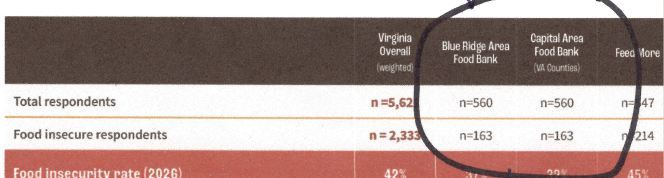
On having a cake and eating it, too

(Reading time: 7 minutes)

Staunton has a coming-of-age problem. Like a teenager who desires to be one of the cool kids by hanging out with a fast crowd, while simultaneously being repelled or frightened by what that might entail, city leaders are tying themselves up in knots over just what they should do about data centers. And as anyone familiar with teenage angst can tell you, getting all wobbly about core values usually doesn’t end well.

Here’s where we are right now:

Just shy of eight years ago—on Nov. 8, 2018—a group of 30 city and business leaders was convened by the  Timmons Group, a civil engineering consulting firm, to come up with a plan for developing a 300-acre economic development site on the east end of Staunton. After a second, similar meeting that tweaked the results of the first, a resulting master plan for Staunton Crossing was approved by city council. The plan envisioned a mix of advanced manufacturing, office, and small retail use—and, yes, a data center.

Eight years later, the master plan remains unchanged even as data centers have fallen into public disfavor, their size and numbers exploding across the American landscape. As loud, voracious consumers of electricity and water, such centers have become widely stigmatized as an environmental burden that exists primarily to serve an artificial intelligence industry viewed with even greater public apprehension. And while the primary purpose of Staunton Crossing ostensibly is to create well-paying jobs, data centers require shockingly few employees once they’re up and running, which begs the question of why the city is pursuing them in the first place.

To be fair, little of that was understood in 2018, when data centers still enjoyed a reputation as a clean industry. But as they’ve proliferated and their hidden costs have become better understood, public concern and opposition have grown nationally and locally. Alarms have sounded, red flags raised. Although the plan for Staunton Crossing contemplates a data center of less than a million square feet, or just a fraction of the size of hyperscale centers capturing today’s headlines elsewhere, that’s still a lot of stress on a city with an aging water infrastructure and on an electric utility with dependability problems. (See here for a good overview of Dominion Energy.) So why even go there?

Moreover, this isn’t a one-and-done. Newly recognized problems associated with data centers keep cropping up, such as the recently announced results of an Arizona State University study that found that the cooling plumes emitted by data centers can raise surrounding community temperatures by four degrees. Or consider industry efforts to deal with the cooling issue by going to two-stage heat exchangers that use far less water—by relying on Pfas “forever chemical” gases. Although the gases are contained in closed-loop systems with no direct emissions, fugitive emissions and the possibility of industrial accidents resulting in environmental releases are raising numerous legal challenges.

Within that context, Staunton’s approach to data centers has been downright two-faced. On the one hand, the city’s marketing materials continue to promote Staunton Crossing as “a prime location for data centers” because of the city’s low risk of natural disasters, as well as the availability of “low-cost and reliable electrical service” from Dominion Energy”—which may come as a surprise to the folks at the Central Shenandoah Planning District, who recently updated  the local hazard mitigation plan and noted just how unreliable electric service has become in our area.

On the other hand, city officials repeatedly try to soothe public concerns by observing—correctly, but misleadingly—that the city’s zoning code doesn’t include data centers as a permissible use in its light industrial and general business areas, which is how Staunton Crossing is zoned. So, for all you nervous nellies out there—no reason to worry. Right?

How weirdly passive-aggressive is that? The city recruits data centers for Staunton Crossing—but placates local concerns about data centers by noting that such uses aren’t allowed at Staunton Crossing.

Such reassurances are obviously superficial, since zoning limitations can be undone by amending the code or via a special use variance. But by clinging to such a hollow rationale for maintaining the status quo, city leaders maintain a “having our cake and eating it, too” position, leaving open the possibility that a data center might fall into their laps without their having to take a position on whether that’s actually a good idea. Were that to happen the zoning issue would then have to be addressed, of course, which would mean public hearings and passionate arguments and lots of hard feelings, but with all that sturm und drang overshadowed by the dangling bait of a multi-million-dollar development proposal that the city itself had solicited.

That sounds an awful lot like a strategy ripped from a teenager’s playbook—the one about begging for forgiveness rather than asking for permission,.

Just such juggling was on display at this past Thursday’s meeting of the Economic Development Authority, which had been expected to include a presentation by the Timmons Group of an updated Staunton Crossing business plan. Such an update was teased in early April, when Tim Davey, the group’s director of economic development, conceded to city council that much had changed since the plan was first approved and that it was long overdue for a face lift. But while he acknowledged that data centers have become enormously controversial, Davey nevertheless urged city leaders to leave the basic marketing mix unchanged, suggesting that there are workarounds for perceived problems—workarounds like, say, a small nuclear reactor to meet data center energy needs.

Davey also assured the city council that a refreshed business plan could be ready in as little as 90 days. Five months later, however, the update won’t be aired before the EDA’s next meeting, on Oct. 8, ostensibly because the Sept. 3 meeting had an overly subscribed agenda. Indeed, the data center question would not have arisen at the meeting at all if not for a short statement read at the end of the public session by authority chairman Billy Vaughn, who opened by acknowledging that there have been “numerous inquiries, comments, and questions regarding the current or potential siting of a data center in Staunton Crossing.”

Without describing those concerns, Vaughn went on to claim that since the business plan and its inclusion of a data center “was prepared after public input, the document should not change until public input has been provided.” Repeating the rationale that Staunton Crossing’s zoning is industrial, “which does not permit data centers,” Vaugh concluded that any zoning change would require “public hearings by the Planning Commission with final decision by City Council.”

In other words, let’s kick this can down the road just a wee bit more.

That this kind of temporizing unnecessarily increases stress and anxiety among those paying attention to such things should be obvious, so here’s an idea: why not seek an amendment to the city’s zoning code now, before civic sensibilities get clouded by high-pressure utility and AI lobbyists promoting a data center already recruited by the city’s economic development staff? Why not make the Staunton Crossing pitch for data centers meaningful by holding public hearings to remove the chief regulatory hurdle such a center must clear before one gets enticed to the city? And if those hearings instead unleash widespread and vociferous opposition to making data centers a permitted use, in business or industrial zones or anywhere else, why not amend Staunton Crossing’s marketing plans accordingly? And. Stop. Wasting. Everyone’s. Time.

Such a preemptive move might require political courage and leadership, but one developmental benchmark that marks the transition from bewildered adolescence to adult maturity is the recognition that everything has a price. That there is no free ride. That a crucial trick to living well comes from divining, as best we can, the true cost of something before taking it on.