The housing squeeze, part one

(Reading time: 7 minutes)

To the casual observer, it must seem that we’re in the middle of one heckuva residential building boom—and indeed we are. In Staunton, several dozen apartments have been carved out of what were once commercial buildings, 130 apartments have been built off Middlebrook Avenue, and the planning commission is reviewing an application to build 267 single-family homes in a planned residential development at the end of Richie Boulevard. All that pales when compared to what’s going on in Waynesboro, however, where more than 1,200 new apartments, town homes and single-family homes are being built or have been recently completed, and several hundred more are being discussed.

So what’s with all the local angst about a lack of affordable housing? Aren’t we being swamped by new homes and apartments?

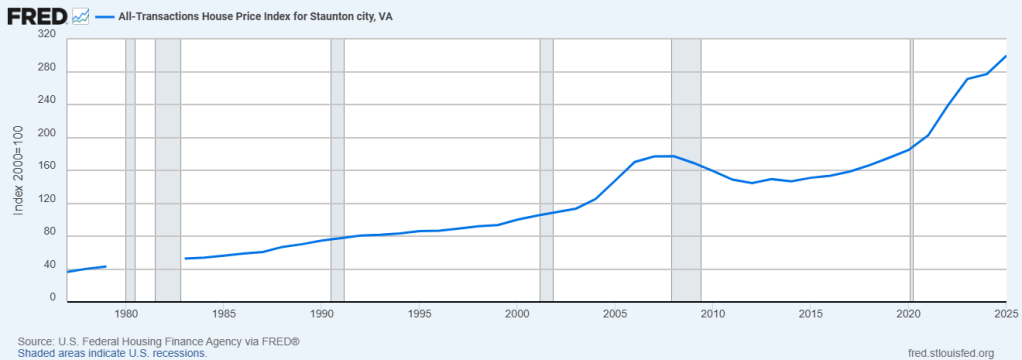
The answer to that lies in the word “affordable.” Yes, there’s a lot of ongoing construction, but all of the examples mentioned above are of homes that will be sold or rented at market rates—and the market is a beast. The house price index in Staunton, for example, rose from 100 in the year 2000 to 185 in 2020, which is to say, home prices rose 85% in that period, or an average of just over 4% a year. But by 2025 the index had jumped to 299.48, zipping along at a brisk 23% average annual increase. Translated into dollars, that boosted the February median home sales price in the Staunton-Augusta-Waynesboro (SAW) area to $330,000, according to local realtor Rick Kane, who’s been tracking these stats for a couple of decades.

Nor is renting a bargain. According to the city’s most recent consolidated plan, prepared as a requirement for receiving federal community development block grants, the fair market rent for a two-bedroom apartment—appropriate for a family with at least one child—in 2024 was $1,149 a month. Apartments.com, meanwhile, currently shows Staunton rents as averaging $$1,151 for a one-bedroom and $1,264 for two bedrooms. (Parenthetically, it’s noteworthy that 45% of all Staunton households with children have only one parent present, according to latest U.S. Census Bureau statistics.)

To put those numbers in perspective, consider that the federal standard for housing affordability is less than 30% of household income. Spending more than that puts you in the “cost-burdened” category, while spending more than 50% pushes you into “severely burdened” territory. To reasonably afford that market-rate two-bedroom apartment, a household would have to be earning $46,000 a year. Homeownership, no surprise, is even pricier: the $330,000 median home sales price will require a six-figure annual income unless the buyer comes in with a downpayment upwards of $66,000—and even then he or she will need an annual income of roughly $80,000.

Now consider this. The median annual wage income for Staunton’s full-time, year-round workforce, according to the most recent U.S. Census report, is $55,023. See the problem?

Unless a household has two wage earners, local homeownership is out of reasonable reach for most. So are rentals for the 1,651 full-time workers in Staunton that the U.S. Census says make less than $35,000 a year. A look at the city’s job openings illustrates how new employees almost invariably will be forced into the rental market: elementary school teachers, for example, start at $53,000, police officers at less than $51,000. The starting wage for a water treatment plant operator is $20 an hour, which works out to affordable rent of just $1,000 a month. Good luck finding such a place.

Many households, of course, have more than one wage-earner, which is why Staunton’s household median income is $11,000 higher than the median for wage-earners. And, of course, there is nothing ironclad about the 30% rule. People routinely pay more than 30% of their income to put a roof over their heads—but that’s the problem. The more someone spends on housing, the less there is for all of life’s other essentials, including food, transportation, health care, clothing and childcare. Small wonder, then, that the 2025 Community Needs Health Assessment prepared by Augusta Health reported that 25.8% of Staunton residents don’t have enough cash on hand to cover a $400 emergency expense.

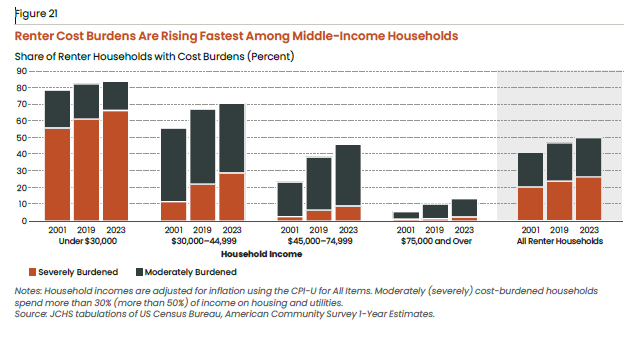
One of the problems with such statistics is that they paint with a broad brush, glossing over the glaring disparities among various subgroups. This is especially true in any discussion of housing affordability, as illustrated by the graph above. Relatively few people making more than $75,000 a year will have trouble finding affordable housing, not only because they make more money but also because the housing market will have more choices for them. Conversely, those who make less than $30,000 are overwhelmingly cost-burdened, not only because they can’t afford much of a home but because they’ll be lucky to find anything in their price range. As a result, two-thirds of them get pushed into the “severely burdened” category, putting them one misstep away from being homeless.*

(While these bar charts are for the U.S. as a whole, they track the local situation pretty closely. For example, a statistically dated Central Shenandoah Planning District housing study released last year reported that more than 42% of Staunton and Waynesboro renters were cost-burdened, or roughly the percentage for 2019 shown above for “all renter households.”)

All of which raises the question: who’s going to be buying or renting all those new homes that are popping up in our two cities? And the obvious answer is: for the most part, not people who are already here. They can’t afford it.

Some of the new housing in Waynesboro undoubtedly will be snapped up by employees of Northrup-Grumman, which has a new plant that is filling more than 300 new jobs paying an average of $94,000 a year—but an estimated 80% of those jobs require four-year college degrees or more, suggesting many if not most will be filled by employees from elsewhere. But Waynesboro also has become increasingly attractive to a better-paid Charlottesville workforce searching for housing that’s more affordable on this side of Afton Mountain—and once you’ve crossed the Blue Ridge, Staunton is just an additional 20 minutes down the road. So presumably the developers behind all the new construction have looked at all that and concluded there’s a market demand they can meet.

The unmet market—the housing market for median wage earners already here—is another story. As the above analysis should illustrate, there are two sides of the affordable housing equation that can be addressed to make things equal: pay people more money, or build cheaper housing. Neither is about to magically happen, but there is a workaround: subsidize housing builders so they can sell or rent at below-market prices.

Unfortunately, that strikes some people as being, um . . . too much like socialism?

*The statement about homelessness is not hyperbolic. The usefulness of this year’s Point in Time (PIT) count of homeless people in the SAW region was limited because it coincided with the extreme ice storm that paralyzed the region, preventing census takers from seeking out those who were unsheltered. But even surveying just those who were in shelters underscored some troubling trends: 39% of the 157 respondents were homeless for the first time, and 29% were 55 or older. Unemployment and eviction were the two most common reasons they provided to explain their homelessness.


Next up: The housing squeeze, part two. Waynesboro leads the way toward a socialist utopia. Can trouble be far behind?

Housing worries are making us sick

(Reading time: 7 minutes)

Tax season is fully upon us, so it’s only natural for people to grumble about the Internal Revenue Service. But here’s one undeniably good thing for which the taxman can take credit: because of an IRS rule dating back more than a decade, tax-exempt hospitals are required to periodically assess the health needs of the communities they serve. That’s the good news. The bad news, for anyone reading Augusta Health’s report card from last year, is that our health in some key areas has declined steadily since 2016, and a significant reason for that decline is housing affordability issues that weren’t even on the radar a decade ago.

Indeed, the most recent Community Health Needs Assessment (CHNA) provides a sharp contrast to the first in a series dating back to 2013. That freshman effort took a notably upbeat approach by noting that Augusta was the 31st most healthy county in the 20th healthiest state in the country. “Augusta County is living up to its motto ‘Let the ages return to the first golden period,’ referring to a period of simplicity and happiness,” it rhapsodized, in less than scientifically detached fashion. “In general, the Augusta County, Staunton, Waynesboro area outperforms the state averages for health status. Where local results fall at or below those levels, we see an opportunity for combined actions that result in improved community ratings.”

But then, in a prescient turn of phrase, it added: “There are several lifestyle gaps that need to be closed to move Augusta County toward greater overall health.”

Fast forward a dozen years, and last year’s CHNA indicates that those gaps not only were not closed, but that some grew into chasms.  While the 2012-13 assessment ranked chronic disease management, as well as health behaviors (“particularly related to obesity and physical activity”) as its top two health priorities, the 2025 ranking vaults mental health to the top spot. And although physical activity and weight retain their number two ranking, right on their heels as number three is housing, which scarcely registered in the earlier assessment.*  Meanwhile, chronic diseases, led by diabetes, trail behind in importance.

To be sure, the 2013 assessment was significantly more superficial than the reports that started coming out in 2016, when the grunt work was handed over to Professional Research Consultants and a 28-page report metastasized into a document nearly nine times as long. Moreover, the greater detail was complemented by a consistency of format, enabling comparisons across the three-year intervals that followed. The problem is that this consistency also highlights just how much backsliding has occurred.   

AMONG THE ASSESSMENT’S housing-related findings for Staunton (anyone wanting to focus more on Waynesboro or Augusta County can peruse the complete assessment here), nearly a third (32.1%) of residents worried or stressed over their rent or mortgage payments in the previous year—apparently with good reason, as 12.3% reported they had been displaced from their housing within the past two years, and 9.9% said they’d been homeless in that same time period. Another 11.2 % said they were living in unhealthy or unsafe conditions.

For the SAW region as a whole, the incidence of unhealthy or unsafe living conditions jumped significantly from 2019 to 2025, from 9.9% to 14%—but even more sharply for renters, to 19.5%, compared to 10.5% of homeowners. An even wider disparity between renters and homeowners was found in response to the question of housing instability, with 17.8% of renters in the SAW region saying they had to find emergency housing in the previous two years, compared to 4.8% of homeowners. Meanwhile, the overall incidence of housing instability in the SAW region doubled, from 5% in 2016 to 10.2% in 2025.

Homelessness in the SAW region—defined as adults reporting “a time in the past two years when they lived on the street, in a car, or in a temporary shelter”—was zero in 2016, then climbed steadily through each reporting period, to 6.8% in 2025.

The health consequences of being homeless or of living in unsafe housing can be intuited by most people, but less immediately obvious is the toll on mental health taken by persistent anxiety over losing the home one already has. And while there are numerous reasons for depression or suicidal ideation, the parallel growth of deteriorating mental health and of insufficient affordable housing strongly suggests a link. Indeed, as housing stress has grown significantly over the past decade, the area’s mental health has taken a dive:

  • Asked to rate their overall mental health, 21.9% of SAW adults believe it is only “fair” or “poor,” a 150% increase since 2016. Staunton leads the way on that metric, with 27.8% reporting fair or poor mental health.
  • A total of 41.7% of SAW adults (and 50.4% of Stauntonians) say they have had two or more years in their lives when they felt depressed or sad most days. The open-ended nature of that measurement would dilute its significance, were it not for the fact that it is nearly double the 21.8% reading in 2016.
  • More than a third (35.5%) of SAW adults say they have been professionally diagnosed as having a depressive disorder, a 138% increase from the 14.9% reported in 2016. Moreover, that incidence jumps to a whopping 47.1% of Staunton’s adults, which is more than twice the 20.4% incidence for Virginia overall.
  • Local residents aren’t just depressed; 17.2% of SAW adults say they feel that most days are “very” or “extremely” stressful—a percentage also up significantly from the 10.5% recorded in 2016. Staunton leads the pack on this metric as well, with 22.1% reporting they feel stressed out.

Such ailments, alas, afflict some demographic groups far more severely than others, with low income and LGBTQ+ respondents greatly over-represented in all negative ratings—demographic groups that also have less visibility within the larger community, and less political clout with which to address the issues that are making them sick. Nor, once they do get sick, are there adequate mental health and related services to provide the care that’s needed.

The CHNA includes literally scores of comments from local doctors, social services providers, community leaders and others, detailing what they believe are the reasons for this intractable morass. To be blunt, there isn’t much that’s revelatory, although some of the anecdotes—a 35-year-old father, working two jobs to house his family in a motel room, dying from a stress-induced heart attack—get at the human cost of the illness permeating our body politic.  And then there’s the occasional assessment item that further drives the point home, such as the finding that 19.3% of local adults acknowledge they have been “hit, slapped, pushed, kicked or otherwise hurt by an intimate partner.” That rate, too, has doubled since the 9.7% reported in 2016.

The problem with health exams, as all too many physicians know, is that patients will yes them to death—exercise, stop smoking, eat more nutritionally, cut down on the booze, yadda-yadda—and then go blithely on as though no red flags had been raised. So it seems with the 2025 CHNA’s section marked “evaluation of past activities.” Number two on its list of previous strategies was meeting the health care needs of the homeless through a four-pronged approach, all of which were implemented in 2023—and all but one, and then only minimally, going unaddressed in 2024, due to a vacant RN Health Educator position.

Vacant since November 2023, that is, or almost two years prior to the 2025 CHNA’s release.

It’s a near certainty that Augusta Health’s unfilled position is a result of budget constraints, but as with all such cuts, choices reflect priorities. Short-term rewards have a way of biting us in the ass down the road, and a high-salt, high-cholesterol diet almost invariably morphs into diabetes and obesity. But what are you going to do when it’s your doc who’s ignoring sound medical advice?

Meanwhile, it’s clear we have to move beyond discussing the lack of sufficient affordable housing simply in economic terms, or of viewing housing issues through a policy-making lens that bogs down in abstract philosophical differences. The lack of sufficient housing for city residents earning what passes for a living wage locally is a serious health issue every bit as insidious as lead poisoning, seeping into the populace largely unseen and unremarked until it explodes in seemingly inexplicable violence, depression and apathy. The 2025 CHNA waved several red flags. How many more such studies will we need to awaken us to the epidemic that’s underway?


* “Scarcely registered,” indeed. The single mention of housing in the 2013 CHNA was in a graph showing the SAW region’s top three health and community issues, in which “affordable housing” came in at no.21 of 22 issues overall.

Thinking of giving? Think carefully

(Reading time: 9 minutes)

At a time when an increasingly frayed “safety net” is in danger of collapsing altogether, starved of funds and overseen by a vastly hollowed out federal bureaucracy, it’s only to be expected that social service agencies will step up their fund-raising efforts. At our household, for example, we get a plea for donations to the Blue Ridge Area Food Bank at least once a month, to which we respond as we’re able. But the line of those in need cuts across all of life’s essentials, and seems to get only longer, and you have to wonder how it will all end.

One thing about which we should not have to wonder, but which is rarely addressed publicly, is the level of institutional need. Yes, people are hungry, and in need of shelter, and wanting for adequate medical care or school supplies or decent clothing. But are the agencies working to help such people equally needy? How well do they apply the funds they raise, and how accountable and transparent are they with their donors? Do some have more than they need to help their constituents? Or have some squandered the donations they’ve received, as was so blatantly true of the now defunct local United Way a couple of years ago? How many local affiliates of national organizations coast on the latter’s reputations, rather than on their actual accomplishments?

These are tough questions to pose, because they threaten to tarnish institutions seen as local champions of the downtrodden. But the reality is that the pot of community goodwill and financial support is finite, and likely to shrink even as the need keeps growing. Giving money to Agency A means there’s less money to give to Agency B. Yet the few local institutionalized sources of such help—such as Community Development Block Grants, the Community Action Partnership of Staunton, Augusta and Waynesboro (CAPSAW) or the Community Foundation of the Central Blue Ridge—pay scant attention to the financial statements of their grant applicants, showing more concern for how many people their contribution might benefit.  Private contributors, meanwhile, are even less likely to do their homework when responding to the latest tug at their heart strings.

SAW Habitat for Humanity

One prominent example of muddled financial accountability is provided by the SAW Habitat for Humanity, which a couple of years ago was roiled by scandal involving its then-executive director, Lance Barton. Initial accusations of sexual assault by Barton were followed by reporting in the Augusta Free Press of years of Barton’s alleged verbal abuse of staff, temper outbursts, uncomfortable conversations about sex, substance abuse, drunken behavior at work and supposed financial irregularities. By late spring of 2024, Barton was out of a job, Habitat’s board of directors had virtually a complete makeover, and an interim director was brought on to manage the transition until a permanent replacement could be recruited.

That replacement was Brad Bryant, a widely respected local builder, teacher and former Habitat board member who was hired almost ten months ago. To be fair, Bryant inherited a mess—but it’s also fair to question his lack of public progress thus far in setting Habitat’s financial house in order. Although Bryant says the organization recently completed its first financial audit on his watch, its findings have not yet been publicized. Meanwhile, the most recent Form 990 tax return posted on Habitat’s website—the IRS form all non-profit organizations are required to submit to maintain their non-profit status, a form that potential contributors can consult before giving their money—is for the fiscal year that ended June 30, 2022. That was almost four years ago.

More recent Form 990s have been filed with the IRS, but Bryant had not seen them before this week. One was for the fiscal year that ended June 30, 2023. A second, following an apparent decision by the interim executive director to change Habitat’s fiscal year to a calendar year, was filed for the year ending Dec. 31, 2023. Depending on how diligently someone in the public searches for financial accountability, then, there’s been a lack of reporting for more than two years, and possibly quite a bit longer.

Some of that gap may get filled when the recent audit results are published, but even then, the report will be notably deficient in at least one material aspect. Among the financial assets in Habitat’s possession are nearly 300 pieces of poster art that were purchased by the disgraced Barton on a junket to Poland, ostensibly as an investment that could be sold to American collectors at a hefty mark-up. The art was purchased with Habitat funds, on a trip underwritten by Habitat that was rationalized as an unconventional but potentially lucrative fund-raiser. The art now sits in a locked room. It has never been shown to the public, and it has yet to be professionally appraised. Whether it’s a significant if unrealized financial asset, or whether it’s just a lot of worthless paper, the product of Barton’s feverish imagination, remains unknown.

In Bryant’s assessment, any fuss over the Polish art is a tempest in a teapot, much ado about nothing at a time when he’s struggling with more substantive issues to make Habitat “viable again.”  He may be right. He may also be markedly wrong. The point is that a somewhat bizarre aspect of Habitat’s bookkeeping is a black box that the organization doesn’t want anyone looking into. When I asked Habitat’s new chairman of the board, Charles Edmond, for an explanation of the Polish art fiasco, his terse response was to say that “due to ongoing litigation, our attorney has advised us to not talk about this issue at this time.”  Yet as Bryant conceded, there actually isn’t any litigation, just repeated failed attempts at getting the Commonwealth’s Attorney to look at the possibility.

There’s no question that Habitat was left in tatters by its departed executive director, and that restoring its luster—not to mention its effectiveness at actually building affordable housing—is a monumental task. But that task is not made easier in the face of financial inscrutability. Not when organizational viability is dependent on the public’s willingness to open its wallet.

Valley Mission

A diametrically opposite set of circumstances is provided by Valley Mission, which provides long-term shelter and case management for our area’s homeless population. It is perpetually over-subscribed, with a waiting list that can stretch for months, and even though the Mission ostensibly has a six-month window within which its clients are encouraged and worked with to obtain permanent housing, the reality is that a year or more of residency is not unusual. There just isn’t enough affordable housing to meet the need.

It may seem paradoxical, therefore, that the Covid pandemic was very good to the Mission’s financial fortunes. Money poured in from various sources, so even as expenses climbed, revenue far outstripped what was needed, jumping from a more or less normal $1.3 million in 2019 to $2.5 million in 2020 to $3 million in 2021. And although income declined somewhat thereafter, it remained significantly higher than pre-pandemic revenue.

Give the Mission a thumbs-up for showing restraint in the face of this bounty: although expenses have continued to climb every year, they have not outstripped the Mission’s two main sources of regular income, contributions and grants, and the income generated by its thrift stores in Staunton and Waynesboro. The surplus has instead been banked, some in cash and some in investments, where it has been generating an enviable amount of interest income: $103,909 in 2023, for example, and an additional $121,642 in 2024.

All told, then, the Mission ended 2024 (its 2025 financials have not been filed yet) with just a tad less than $3 million in cash, $1.6 million in investments, and a total of $5.4 million in unrestricted assets. To put that in context, the Mission’s total expenses in 2024 were $2.3 million—which is to say, the organization is now sitting on enough liquid assets to operate for two years without a single additional dollar coming in the door. It is, in one sense, functioning like an investment bank, which may not be what potential donors want their contributions to fund.

A possibly bigger problem is that even as it hoards a lot of cash, the Mission continues seeking and receiving funding from the same sources used by other local social service agencies, many of which are also trying to help people meet their housing needs. That includes Waynesboro Area Relief Ministries (WARM), Valley Supportive Housing, New Directions Center, and Renewing Homes of Greater Augusta, all of which operate on a shoestring. Meanwhile, in recent years the Mission has been receiving approximately $7,940 annually from Staunton’s Community Development Block Grant, was awarded $11,500 from the Community Foundation in 2024 and $161,000 in 2023, and in the year ending June 30, 2025, received $36,622 from CAPSAW. That’s all money that would have had a far more meaningful impact elsewhere.

There’s another aspect of the Mission’s growing wealth that is problematic. Not only is the Mission not meeting the full demand for the services it already provides, but there are numerous adjacent needs of the homeless population that remain completely unaddressed.  Among the most prominent, for example, is the lack of a day center in the SAW region to provide shelter and services to people who otherwise are left wandering the streets in search of winter warmth, summer shade and refuge from rain and other extreme weather in all seasons.  There are several reasons why this state of affairs exists, but among the most prominent is a lack of adequate funding.

Providing a day center is not the Mission’s responsibility. On the other hand, it’s not unreasonable to think that perhaps the Mission could expand its efforts to answer an unmet need that is entirely aligned with its core mission.  Perhaps it will.

The Mission’s executive director, Susan Richardson, left open that possibility by asserting that the Mission’s board and leadership “makes financial and strategic decisions based on what we believe is best for Valley Mission and the residents we serve.” So . . . not saying no either to expanding the Mission’s facilities to provide more shelter space, or to filling in other holes in the safety net provided to the same generalized population. But also not saying no to bellying up to the financial water hole frequented by all those other critters in the social services ecosystem, which after all is how the system works.

It’s a jungle out there.

Public housing faces multiple attacks

(Reading time: 5 minutes)

As far as the U.S. Department of Housing and Urban Development (HUD) is concerned, March came in like a lion.

Starting in late February and continuing into this week, the federal agency responsible for most public housing fired off a volley of proposals guaranteed to make its tenants miserable. The timing, as the economy teeters on the edge of a downturn, affordable housing remains more mythical than real and the war on immigrants continues unabated, couldn’t be more heartless.

The first assault came Feb. 20, when HUD published a proposal to prohibit immigrants who are ineligible for housing assistance from living with family members who are eligible, as is the current policy. The ineligibility list includes immigrants who are otherwise in the U.S. legally, such as immigrants with student visas or those with Temporary Protected Status. Such mixed-status families currently receive prorated housing assistance that covers only the eligible members, which means the family as a whole pays proportionally higher rent than fully eligible families. If adopted, the proposal would force mixed-status families to separate or to leave their homes altogether.

A second shoe dropped just a week later, when HUD took steps to repeal a requirement that public housing agencies and private homeowners accepting vouchers provide their tenants with a 30-day notice before filing for eviction for non-payment of rent. The Feb. 26 announcement was designated an “Interim Final Rule,” which in a ready-fire-aim twist, means that despite a comment period that runs through April, the repeal will go into effect March 30. Although HUD’s notice acknowledges that the 30-day eviction notice “provided tenants with longer runways to undertake remedial actions to become current with their rent,” the agency contends that too many tenants simply took advantage of the additional time to go deeper into arrears.

Besides, HUD added, dropping the 30-day window will improve housing access by “opening up housing opportunities” for people on waitlists for affordable housing. Which fits right in with the Orwellian phrase, “War Is Peace. Freedom Is Slavery. Ignorance Is Strength.”

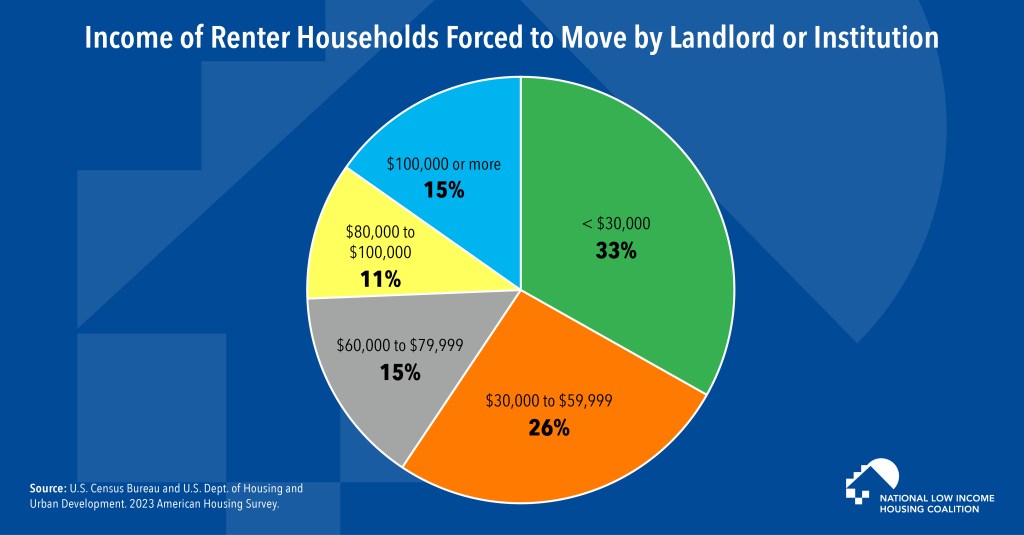
Consider the graph at the top of this page, which shows that a third of all evicted renters have incomes of less than $30,000 a year. Even at the top of that range, monthly rent of more than $750 pushes a tenant into the “rent burdened” category, which leaves little wiggle room for other necessary living expenses or emergencies. Falling behind on rent by even a month creates a nearly insurmountable financial hurdle for catching up.

But that’s not all. While an estimated 80,000 people would lose their housing assistance because of the mixed-status family rule change, and more than 2 million HUD-assisted households will be impacted by the loss of the 30-day eviction notice, an estimated 3.3 million would lose their rental assistance as a result of a March 2 proposal to impose work requirements and time limits on housing assistance. The estimate, based on an analysis by the Center on Budget and Policy Priorities, includes 1.7 million children who could lose their homes.

The proposed work requirement, long embraced by political conservatives who fret about welfare queens, would require “work eligible” adults to put in up to 40 hours a week at programs and projects that “address local needs and goals.” Failure to comply with work requirements would be grounds to terminate housing assistance. But potentially even more onerous is the proposal to allow PHAs and housing owners to establish two-year limits on housing assistance for non-elderly, non-disabled families.

All of these proposals are more nuanced than these brief summaries reflect, but the bottom line is that there are more than 10 million people in the United States who have a roof over their heads primarily because of federal rental assistance programs. Most people in HUD-assisted housing who can work do work: in Virginia, 81% of non-disabled people without young children worked in the past year, according to the National Low Income Housing Coalition. With the minimum wage in the state set at $12.41 an hour, and Virginia’s fair market rent for a two-bedroom home coming in at $1,749, it should be obvious why subsidized housing is the only way many state residents can have a roof over their heads. Now that’s at increased risk.

Nehemias Velez, executive director of the Staunton Redevelopment and Housing Authority, says he knows of no local families that will be threatened by the proposed mixed-status family proposal. The local effects of the other two proposals, however—not to mention other shots HUD might take in the weeks ahead at the people it ostensibly serves—remain to be seen. But it’s already quite clear that the fragile existence of people depending on federal tax dollars to survive is becoming ever more precarious. And as more of them inevitably get pushed out of their homes, it’s going to be up to municipalities like Staunton to pick up the pieces.

That’s not good. We’re not meeting current demand as it is, with long waiting lists at the housing authority, the Valley Mission and Valley Supportive Housing, so where will the new waves of suddenly homeless people go? How many more emergencies like the one we had in late January will it take before we get serious about developing an adequate supply of affordable housing, as well as providing sufficient transitional emergency shelter spaces to tide people over in the short term? Where is the political leadership we need to start beating the drum on these issues?

The homeless population is graying

(Reading time: 7 minutes)

As the number of people pushed into homelessness keeps growing, a worrisome subset of that population is expanding at an even faster pace. Locally, we’re not paying nearly enough attention.

Nationwide, there are more than 16 million people 65 or older living by themselves. That represents 28% of our oldest age group, and the older you are, the higher the likelihood you’re living alone: more than half of households with someone 75 and older consist of only one person.

Being old and alone doesn’t necessarily result in homelessness, of course, but it does increase the odds considerably. Living alone is riskiest for the elderly, who tend to have more accidents, are more prone to neglect their health and are frequent targets of financial scams, all of which can result in the loss of a home. And while many Baby Boomers are living in comfortable retirement, 5 million people over 65 live below the poverty line and an additional 2.6 million were classified in 2020 as “near poor,” meaning their incomes were less than 25% above the poverty line—and far below the amount needed to rent an apartment.

Put it all together, and the number of elderly people becoming homeless for the first time is swelling. Add that to the number of chronically homeless people who are “graduating” into the older population, and the ranks of elderly homeless people are growing to levels not seen in decades. The 2024 national Point in Time (PIT) census, the most recently available, found more than 146,000 homeless people who were 55 or over, or 18.9% of the 771,480 total. And here’s the kicker: more than half of those elderly homeless people were unsheltered, compared with just 36% of the overall homeless population.

Locally, the percentages are even more skewed, in keeping with a population that on average is older than at either national or state levels. (In Staunton, we have more people over the age of 65 than we have under 18.) That same 2024 PIT count, conducted by the Valley Homeless Connection, found 47 people ages 55 and older who were homeless, or roughly 26% of the total. Eight were unsheltered, sleeping in cars, a church vestibule and other make-shift accommodations.

Why do elderly homeless people sleep on the street rather than in a shelter? One obvious reason is that there aren’t enough shelters to go around. In recent weeks, for example, the emergency shelter space offered by the Waynesboro Area Relief Ministry (WARM) has been fully subscribed, with 60 or more people filling both primary and overflow churches.  But even when shelters are available, they often aren’t a good match for a population with mobility and other health issues. Getting in and out of bunks, such as those used at Valley Mission; managing medications, like insulin, that might need refrigerating; or making it to a shared bathroom in time for those with incontinence issues, are just some of the major challenges facing older people.

Conversely, older people are more wary of entering shelters because they recognize how vulnerable they are, and because of their generally lower tolerance for conditions that a younger, more resilient population can handle more readily. The National Alliance to End Homelessness, for example, cites the biggest reasons given by people for avoiding homeless shelters as overcrowding (37%) and the related issues of bugs (30%) and germs (22%).

But recognition of the special needs of an elderly homeless cohort has been slow in coming. The national PIT count, for example, only recently started breaking out the age demographics of those it surveys, after years of lumping everyone older than 24 into one giant category. USAging, a national organization that issues periodic assessments of services for the elderly, as recently as 2020 limited its housing focus primarily to home modifications and repairs that help older adults stay in their homes, thereby preventing homelessness. Last year’s report, on the other hand, finally acknowledged a deeper problem, observing that “more older adults are experiencing housing instability or even homelessness,” the insertion of “even” suggesting a previously unimagined condition.

USAging’s findings are based on a national survey of what are known as Area Agencies on Aging, or AAAs, which were established throughout the country by Congress in 1973 to respond to the needs of Americans age 60 and older. Its 2025 Chartbook includes a new “spotlight” on housing issues that charts “the top housing-related challenges facing older adults.” Number one on the list, submitted by 94% of the AAAs, is a lack of affordable housing, while more than a third (35%) cited “increasing homelessness” as among their top dozen concerns.

That concern, however, has yet to filter down to this part of Virginia in any meaningful way. Our local AAA is the Valley Program for Aging Services (VPAS), which serves a five-county area and its cities, including Augusta, Staunton and Waynesboro. Among its better-known programs are Meals on Wheels, but VPAS also helps the elderly with case management services, Medicare counseling, respite and transportation services, and health and wellness programs. When it comes to housing, however, VPAS comes up blank. Its strategic plan for 2025-2027 doesn’t even mention the word.

VPAS executive director Beth Bland said last week that her agency is “certainly aware” of the housing issue, but contended that the problem is “bigger than any one organization can tackle” and added that VPAS doesn’t have the financial or staffing resources to make a difference. Asked why VPAS doesn’t at least provide leadership in bringing community attention to the problem, Bland demurred. “We are not prepared to be, nor would it be appropriate for us, to take the lead on this issue,” she replied, suggesting that the Community Fund is already doing this. The Community Fund, alas, while it has tried to put a spotlight on the overall lack of affordable housing, has had little to do with homelessness.

Putting aside Bland’s unwillingness to have VPAS take the lead on an issue that clearly falls within the AAA mandate, it’s only fair to acknowledge that the local agency is squarely within the national mainstream. As documented in the 2025 Chartbook, only 8% of the nation’s AAAs have a formal partnership with homelessness or emergency shelters, 7% with coordinated entry systems for the homeless and 6% with an affordable housing coalition. The problem of old people living on the streets apparently will have to become much more egregious before we start paying attention.

There is one slim ray of hope locally, although it’s still many, many months from fruition. The Staunton city council last week approved a rezoning request for a property on West Beverley that has been vacant for at least the past 40 years, changing it from an R-4 to a B-5 zoning category. The R-4 category had frustrated multiple development proposals over the years because of its parking requirements—requirements that are much looser in a B-5 zone, so poof! a bureaucratic hurdle was vanquished just like that. Sometimes all it takes is someone with vision to make things happen.

The rezoning clears the way for the former Dunsmore Business College to be redeveloped as 15 one-bedroom apartments for “extremely low-income” senior citizens. The project is being led by Stu Armstrong, a former Staunton resident who owns the brick building and has a history of renovating other residential properties in the Newtown area. Although he estimates the renovation will cost at least $3 million, Armstrong says he can raise sufficient capital through multiple layers of grants, federal housing programs and private equity funding—and a good thing, too, because if he had to cover his costs through rent income, the apartments would have to list for approximately $2,000 a month.

To be sure, were those apartments available today, they would make only the slightest dent in demand. The Staunton Redevelopment Housing Authority, which is lending its support to Armstrong’s efforts, has a waiting list for its subsidized apartments that includes 137 elderly people with annual incomes, on average, of slightly under $14,000. That’s not enough to rent anything in today’s market. But even if Armstrong’s project reduces the housing authority’s waiting list by just 10%, that’s 15 people who otherwise could very well end up on the street.

And maybe, just maybe, Armstrong’s success could point the way for others to follow suit. Let’s wish him well, because the need he’s addressing is only going to keep growing as all of us keep aging.

We’re not moving the needle

(Reading time: 5 minutes)

Maybe it’s just the cold that’s slowing everything down, with much of Staunton still sheathed in so much ice it could be the setting for “Dr. Zhivago.” Nearly two weeks after a devastating winter storm hit the region, we’re still digging out and only weakly reestablishing life’s normal routines. A lot of important things have been put on hold.

But attention fatigue and disengagement with issues of affordable housing and homelessness, of such prominent concern in 2023 and 2024, had already set in before the storm.  Where once scores of people attended the two housing summits hosted by the Community Foundation of Central Blue Ridge and the Community Action Partnership of Staunton, Augusta and Waynesboro, only a few dozen soldiered on in two working groups that were spun off to address issues of housing stability and housing stock. Monthly workgroup meetings soon bogged down into every-other-month events, attendance dwindled, the focus blurred.

Most recently, when the oncoming storm threatened a housing stock working group meeting scheduled for last week, the meeting was scrubbed altogether. Not postponed for a week or two, which one might expect if weather were the only problem, but canceled outright. That created a four-month gap between meetings, but it’s doubtful anyone views that as a problem—not when there’s so little to show for the past two years.

Then there’s the much-heralded Staunton Housing Commission, which after a similarly lengthy gestation, was scheduled to meet for the first time in early January. Instead, supposedly because just six of its nine members have been appointed to date, the commission’s inaugural meeting will occur later this month. Or maybe in March. With only four meetings per year, there’s really no rush—although it’s fair to ask how this leisurely pace fits in with the city’s “housing strategy,” for which an 18-month clock started ticking last July 1, and for which the housing commission was to be the lead advisory board.

And here’s an ironic twist: the Point in Time (PIT) count, which attempts to enumerate all the homeless people who can be found on one specific night per year, was scheduled for last Wednesday. But because of the extreme cold and generally impassable roads, any homeless people who might have been stuck in their cars, tents or other improvised shelters were given a pass—the only ones who (were) counted were those who reached homeless shelters, like Valley Mission or that week’s WARM emergency facility, which was in Waynesboro. So the “good news” in this year’s PIT count will be that 100% of those who are homeless were sheltered—no unsheltered people were found!

We may hope there will be an asterisk after those numbers.

One good thing that did come out of the storm was a last-minute, hastily assembled temporary emergency shelter thrown together by Staunton Mayor Michele Edwards—although she did so, she struggled to explain, as a private citizen and not as a city official. At least I think that’s the distinction she was trying to draw. Housed in the basement of the Central United Methodist Church, the emergency shelter was full to its limited capacity right up until it closed this past Monday morning, when presumably the emergency was over and the “temporary” aspect of its existence kicked in.

Anyone looking at a landscape torn from Boris Pasternak’s novel might have been puzzled—local schools wouldn’t reopen for another couple of days, after all—where the people who had stayed at the Central United shelter would go that day, or even that night, but that’s how the icicle crumbled. As Edwards emphasized, “temporary means temporary.”

The thing that’s clearly not temporary is Staunton’s ongoing lack of sufficient affordable housing, which persists despite the two years of chin-wagging mentioned above. Also not temporary is the lack of additional resources to cope with the inevitable consequences of that housing shortage. The emergency shelter program operated by WARM has an increasingly shaky roster of local churches willing to have their facilities used for a week at a time. The Mission continues to be backed up, as its supposedly short-term residents are unable to find permanent housing. And despite months of shambolic efforts at creating a day shelter for the homeless, we’re no closer to having one today than we were a year ago.

All that talking and meeting and feel-good assertions of what we’re going to do have made not one bit of progress in either stemming the tide of homelessness or of providing for the most basic needs of the unsheltered. We’ve just been treading water.

The online meeting that came up with an eleventh-hour plan to create an emergency shelter for the homeless took place two weeks ago today. There was much agreement, among the dozen or so participants, that this stop-gap measure should serve as a teaching moment—that the lessons learned from this intervention should result in better planning for the next emergency. Doing so, it was remarked both at the meeting and in subsequent emails, would be best served by sharing insights and observations as soon as possible after the fact, while memories were still fresh.

Two weeks later, and a week after the emergency shelter was closed, that conversation has yet to take place. The temperature tomorrow night is predicted to drop back into single-digits, and the ice and snow won’t melt significantly until mid-week, when the climate rollercoaster we’re riding may push us into the 50s. It is not outside the realm of possibility that when the melt occurs it will uncover someone who did not make it to a shelter, who was not found by a non-existent PIT count, who believed with good reason that there really was no refuge to be had.

That would be depressing, if, we may hope, unlikely. What’s more depressing, precisely because it is more likely, is the thought that a year from now essentially nothing will have changed.

What we should be learning

(Reading time: 9 minutes)

Four degrees this morning, according to my outside thermometer, which with a mild breeze of six miles per hour pushes us into sub-zero wind chill territory. That white stuff on the ground stopped being snow—if it ever was that—several days ago, compressing into an ice cap you can walk across without breaking through the crust. The city finally realized that this is not your normal snowstorm and brought in massive farming and road-building machinery to break up the ice still coating most roads, impervious to workaday snowplows mounted on pickups and garbage trucks. The deep freeze will extend into next week.

And yet, this could have been far worse. Had we had a widespread power outage, caused by storm-toppled transmission poles or a fried substation, many hundreds of city residents would have faced a life-threatening situation. No heat, no light, and often no way to get out of the house to seek help—if any help could be found. In many cases, the extreme cold would have resulted in burst pipes, which not only would have meant no water now but too much water later, when a thaw eventually arrives. And those in greatest danger, as always, would have been the most vulnerable: the elderly and disabled, those relying on medical devices, families with small children.

What would they have done? Who could they have called, and what help would have been provided?

A day before the storm hit, the city put out a press release announcing that it had declared a state of emergency. This apparently was intended to provide some kind of assurance that matters were well in hand, with references to the activation of an Emergency Operations Plan and a claim that it “removes any barriers to our response efforts and allows us to mobilize additional resources, if necessary.” Just what that was supposed to mean for the average Staunton resident was never explained, however, and aside from advising people to call 911 in an emergency, the only direct communication to the public was a stern reminder about shoveling out the sidewalks. As if!

Meanwhile, the city’s lack of foresight and advance emergency planning was captured in microcosm by its response to the unsheltered residents who live on our streets—which is to say, no municipal response at all. Whatever resources are unleashed by the Emergency Operations Plan, apparently none are extended to people sleeping in their cars or huddled in a tent somewhere. If a declared state of emergency is in any way meaningful, that umbrella doesn’t cover those who need it most.

That’s not to say nothing was done. To her enormous if paradoxical credit, Michele Edwards spearheaded a mobilization effort last week to find, transport and shelter the homeless before they froze to death—but she did so as a private citizen, not as the city’s mayor. Edwards’ initial outreach was an email, written “with urgency and with hope,” to approximately 40 local religious leaders, homeless advocates and social service agencies, seeking their help “in an 11th-hour effort to protect life and dignity.” But as Edwards also made clear, “I am writing as a local government leader, and I’m not representing the City of Staunton. So, I am not writing with local government solutions.”

Why this official hands-off policy was necessary was not explained. Equally inexplicable was the distinction Edwards drew between acting as a local government leader and as a representative of the City of Staunton: is not the local government she leads that of Staunton?

That confusion aside, Edwards’ outreach resulted in roughly a dozen participants meeting online Friday night to brainstorm a last-minute response to a humanitarian crisis. Thanks to their efforts, an emergency shelter was thrown together at Central United Methodist Church (CUMC), under the direction of the Rev. Won Un. Food donations were received, as were 17 cots on loan from the Boy Scouts at Camp Shenandoah. The YMCA made a large donation of bedding, sleeping bags and pillows, and others also donated blankets. Volunteers to staff the shelter were recruited from Mary Baldwin University (MBU), and Edwards recruited a friend, Bill Woodruff, to supervise them for the first three nights.

All good, right? Five homeless people were housed by the shelter Saturday night, including one who was transported from the current WARM shelter in Waynesboro because it’s at full capacity. (Another three people were provided emergency shelter at the Valley Mission, a high-barrier shelter that serves people working toward permanent housing and does not normally offer transient services.) The headcount Sunday night increased to nine, including one woman and a Vietnam vet that Staunton’s own Spiderman—who was walking home after volunteering at the shelter the first night—found in the snow and escorted back to the church. Two-dozen or so volunteers, many from MBU, signed up for eight-hour shifts at CUMC.

But as with most such reflexive volunteer mobilizations, interest and commitment wane with time. People eager to help at the outset of an emergency become distracted by other, more pressing needs on the home front—driveways to shovel out, children who must be tended because schools remain closed—or believe the situation is well in hand and they’re no longer needed. Communications begin to break down, with group chats suddenly funneled through a single person—supposedly in the interests of efficiency—but with daily updates becoming first scarce, and then non-existent. Energy dissipates, and the few people still working at the center of it all become over-stretched and frazzled.

The danger here is not that the current effort will crumble, although that’s certainly a possibility, but that nothing changes going forward—that the next time we’re in a similar situation, the people who stepped forward this time will be a little less eager to do so again. For that not to happen, we have to learn that extreme conditions must be met with advance planning and an organized response, and that’s really a government function. No church or nonprofit social agency has either the resources or the authority to marshal what’s needed when the general population is fragmented and isolated by extreme weather or other disasters.

What should we have learned from current events? At the very least, the following:

  • Meaningful communication with the public is crucial. General, nonspecific assurances about disaster declarations and emergency operations plans don’t convey any useful information. Nor does hectoring people about shoveling their sidewalks demonstrate any understanding of how much outside the norm a situation has become.
  • Any city emergency plan should include a centralized relief center that is opened to the public when a disaster is declared. In Staunton’s case that could be the gym at Gypsy Hill Park, or it could be the National Guard Armory—but wherever it is, that information should be widely communicated to the public, and ideally it should be widely known before there’s a disaster.
  • A centralized relief shelter should be stocked with, or have ready access to, cots, bedding, food and water. Of less critical importance, but still desirable, would be showers, cooking facilities, accommodation for pets, and games, books and other activities, especially for children.
  • Both paid and volunteer staffing are needed at a relief shelter. Paid staffing is needed to assure reliable oversight and accountability, and could consist of cross-trained city employees who are not front-line responders and are recruited ahead of time. Volunteers are needed to fill the many roles that would stretch paid staff too thin, but also should be recruited ahead of an emergency (more on that below) and contacted via a master list maintained by the city.
  • Transportation, of both volunteers and people in need of emergency shelter, is a critical but overlooked necessity when people are trapped in their homes. The city should have an emergency list of residents with four-wheel-drive vehicles they are willing to operate in such circumstances, to ferry volunteers, refugees, food and other supplies as needed. This may extend to National Guard equipment as well.

I don’t think it’s hyperbolic to observe that in a different time, extreme situations like the one we’re confronting—and inevitably will be confronting again—resulted in the creation of civil defense organizations of various sorts. Although often associated with wartime conditions, civil defense forces were designed to supplement the military and civilian first-responders by fielding volunteers to do the more mundane tasks of shepherding people to shelter, cooking and serving meals, driving and delivering people and goods where needed, checking in with refugees to ensure their needs are being met, and so on.

The irony is that an organization like this is on tap in many communities around the country—and until a few years ago was available locally, as well. Known as Community Emergency Response Teams (CERT), the FEMA-sponsored program at its most ambitious trained and organized groups of community volunteers into emergency teams, with an internal command structure and in a subordinate position to first responder agencies. A watered-down version of the concept was taught locally by Rebecca Joyce, currently the city’s housing planner but at that time an employee of the Central Shenandoah Planning District, which apparently terminated CERT training without public explanation. A shadow of the group lingers on, primarily to recruit volunteer victims for local disaster drills but without any presence when the real thing strikes.

Whether reviving CERT is either feasible or desirable is open to discussion, but it’s clear that something of the sort would have been an enormous help in recent days. But that’s not a program that can spontaneously combust: it, or something similar, requires advance government initiative and government resources, as do the other elements of a meaningful disaster plan sketchily outlined above.  

This won’t be our last rodeo (and indeed, this one isn’t even over yet), so the question that must be answered is, what have we learned from it? And how will that education inform our actions going forward? Failure to respond is not an option.

Jan. 29 postscript, 4 p.m.: the CUMC emergency shelter reports it is full.

Homeless folks get short shrift again

(Reading time: 5 minutes)

Here’s poetic timing for you: the next nationwide Point in Time (PIT) count of homeless people is scheduled for Wednesday, following on the heels of local forecasts of ice and snow, abundant advice on stocking up with food, water and batteries, and schadenfreude-laden commiseration from the lucky few for those who haven’t already installed back-up generators. But really, the only thing we know for sure is that it’s going to be cold. Really, really cold.

Most of us will get along just fine. The notable exception will be people who no longer have a home and make do by staying at homeless shelters or by sleeping in their cars, tents or church vestibules. The PIT count is an annual attempt to take a snapshot of just how many such people there are, but the irony is that the worse the weather when the census is taken, the less reliable its results: those without access to a homeless shelter burrow deeper into whatever hole they find, prevail on friends or acquaintances to let them couch-surf, or scrape together enough money for a short motel stay. Not only are the homeless harder to find when the weather is most extreme, but it’s only human nature in the face of such adversity for the census takers to be less diligent than they might otherwise be.

So we’ll get some numbers, of questionable usefulness—eventually. The unfortunate reality is that while a “snapshot” connotes immediacy, these annual exercises are taking ever longer to collate. The National Alliance to End Homelessness, for example, which you might expect to be as up to date as anyone, has a dashboard that ostensibly serves up 2025 homelessness data but the numbers it reports are from the 2024 PIT count. That means the statistics are two years old and increasingly irrelevant. Mary Frances Kenion, Chief Equity Officer for the alliance, says this is because the U.S. Department of Housing and Urban Development has not released last year’s data, which sounds par for the course these days but probably should be spelled out on the alliance website.

Locally, here’s what we can expect next week: that the PIT census will find 80 to 90 people staying at the Valley Mission, another 30 to 40 in a WARM overnight shelter (more on that in a minute) and up to a dozen others in emergency accommodations, including the New Directions Center for survivors of domestic violence and motel rooms paid for by social service agencies. Only an additional score or so will be identified in the usual gathering spots. including several tent encampments in Staunton and Waynesboro, as well as the parking lots of Sheetz, Walmart, Cracker Barrel, Martin’s, Lowe’s and similar commercial outlets.

All told, the final count for the SAW area of Staunton, Augusta County and Waynesboro will come in between 140 and 160, and to the extent that anyone makes an effort to publicize this finding, much will be made of what a high percentage of that number were sheltered for the night. The implication will be that the circumstances aren’t too dire, even though the actual number of unsheltered people most assuredly will be higher than reported—perhaps much higher. WARM executive director Alec Gunn, for example, as close to local homelessness reality as anyone, contends that “there’s easily at least a hundred” unsheltered people in the SAW region.

A misleadingly low count next week will, however, dull any sense of urgency to do something about a problem still firmly on the backburner of civic or social concern. Last year’s bitter January weather prompted some hesitant steps toward creating a day shelter, as a suitable alternative for people otherwise forced to find refuge in the library, YMCA, fast-food restaurants and other public spaces. Alec Gunn ostensibly was point-man on that effort, but says it went nowhere because the Staunton city council wouldn’t offer more than a year’s funding—and a miserly amount at that, of just $30,000—and he didn’t want to start something that would have to shut down a year later. Moreover, he added, the day center’s proposed site, the First Presbyterian Church, turned out to be inappropriate for a low-barrier facility because its premises are used for two children’s schools.

So. No day shelter. But also fragile provision of an emergency night shelter, since the roster of churches willing to work with WARM to provide week-long accommodations is noticeably shorter than last year. The season began with two unclaimed slots for host churches, forcing at least one to extend its commitment by a week, and even today the schedule has multiple openings for overflow sites, which are needed when the primary host has insufficient room to meet demand, usually around 30 people. And this next week, when the weather will be at its most unforgiving, the host church will be not in Staunton or Fishersville or Waynesboro, as is the norm, but in Mt. Sidney, creating additional transportation headaches. Nor is there an overflow site on next week’s schedule.

Bottom line: be appropriately grateful if you have a warm, weather-tight and amply stocked refuge in which to ride out the storm, and even more so if you don’t get pushed into the cold to fend for yourself for 10 hours until you can return. But remember also that there are dozens among us who don’t have those bare necessities, after yet another year of handwringing but not a bit of increased help—if you’re on the street, all you’ve received is blah, blah, blah. Thin gruel indeed.

Jan. 23 postscript: According to a note from a WARM board member, the sheltered count now approaches 50. First Baptist Waynesboro, the host church this week, has been staying open some days, depending on the weather, but thus far there’s no word on whether Salem Lutheran in Mt. Sidney will follow suit next week.

How not to read the (housing) room

(Reading time: 4 minutes)

The Virginia Governor’s Housing Conference just wrapped up its 2025 get-together, with 800 or so housing advocates from all parts of Virginia descending on Roanoke to grapple with the key question of the day: how do we make housing more affordable?  The answer, at least according to two plenary speakers, requires revamping zoning codes that are so prohibitively restrictive they result in “legally-mandated scarcity,” as one of them put it.

All that and more is deserving of more detailed analysis, which I’ll get into in a separate post. But whatever the merits of zoning reform, a different answer to the question of how we can get more affordable housing was provided by a breakout panel with the promising title, “Designing for Dignity: Scaling Permanent Supportive Housing in the Suburbs.” Spoiler alert: the answer is “we won’t,” because we’re losing all sense of perspective.

The panel seemed promising. Its two key speakers were Tara Ruszkowski, executive director of the Lamb Center, which among its other good deeds operates a day shelter for the homeless in Fairfax County; and Taylor Stout, senior project manager for Wesley Housing, a long-time non-profit developer of affordable housing in Virginia and Washington, D.C.  Together, they had collaborated on creating a housing project, Beacon Landing, that had its ground-breaking just a couple of weeks ago, and they were at the conference to explain how they overcame various obstacles and assembled 13 different funding sources to reach that point.

As with the panel, Beacon Landing seems like a great idea. Replacing an old motel in a commercial and industrial area with a new five-story building, it will have 54 units of 400 square feet apiece for long-term residents referred by the county’s coordinated entry system, which is to say, people who already are or are at high risk of becoming homeless. In addition to furnished apartments, Beacon Landing will have a large community room, an outside terrace for socializing, a demonstration kitchen for cooking lessons, and case manager offices for staff to provide wrap-around services and oversight.

That something of the sort—and much more—is needed is unquestionable. The county’s Point in Time (PIT) count of the homeless this year was 1,322, a 3% increase from 2024 and up 27% from 2020. Providing supportive housing for 54 of that number may seem like barely scratching the surface, but it’s a start. And as people going into Beacon Landing gain their footing and move on to a bigger and better life, others will come in behind them, making the project’s overall impact far larger than its overall size suggests.

But here’s a wake-up call: the capital expenditure for this project is $33.1 million (no wonder it required 13 funding sources!). That’s just the up-front costs of creating the facility and doesn’t include operating costs, including a payroll of six to seven full-time employees that the Lamb Center says will be needed. The math is insane. The median sales price of a single-family home in Fairfax County is currently around $715,000, or approximately $351 per square foot. Beacon Landing’s per-unit cost comes in at $613,000, or around $1,500 a square foot. True, it can be argued that the cost of the additional common and program areas within the building should be subtracted from the total before making comparisons, but it’s inconceivable that doing so would reduce the per-unit cost to anything approaching $351 a square foot.

There undoubtedly are many arguments the Lamb Center and Wesley Housing can make to justify a seemingly over-the-top acquisition and construction budget, but the bottom line remains that Beacon Landing will be spending enough money to buy 46 single-family homes so it can house 54 people in a fraction of the space. For people already struggling to maintain mortgage payments or to meet their rent, that can seem . . . profligate?

The mystery is that this panel was presented as “scaling” permanent supportive housing, leaving unanswered the question of scaling for what? or where? How many projects of this sort can any locality afford? How many, looking for ways to help their most vulnerable unhoused residents, would look at Beacon Landing and throw up their hands at the sheer impossibility of such a model working for them? What is the message Beacon Landing is sending to anyone concerned about the growing number of homeless people in our communities?

Valley Supportive Housing, which provides supportive housing in Staunton for 68 tenants, does so in a dozen modest structures acquired over the years through conventional loans and grants of various sorts.  I’m betting its director, Lou Siegel, would have choked on his coffee had he attended the housing conference and sat in on the “Designing for Dignity” panel. It’s a good thing for his health that he stayed home.

Homelessness as a kick in the pants

(Reading time: 13 minutes)

The calendar may insist that winter won’t arrive for another six weeks or so, but anyone who ventured outside Tuesday morning knew otherwise—not when the temperature hit a bone-chilling 24 degrees Fahrenheit.  Tuesday was a good day, in other words, to be bundled up in a cozy bed or snuggled with a good book under a comforter in an easy chair. If you were that lucky.

It’s ironic, then, that just 12 hours earlier the city had held the third of three public workshops addressing proposed revisions to its comprehensive plan. Dozens of goals and draft strategies were outlined on multiple easels for Staunton residents to ponder and evaluate, spanning everything from land use, housing and economic development to transportation, public infrastructure and education. A section on health and human services stressed “active living, healthy food access and a clean environment.” Public safety, environmental resources, art and recreation all received due consideration.

But nowhere in all this planning and verbiage was there any mention of Staunton’s homeless population, or its needs and how those needs might be met. True, the section on housing gave a vague nod to promoting “affordable housing options for people of all incomes, needs and abilities,” but it remained silent regarding those unable to take advantage of such promotions. Nor did the draft comprehensive plan set a goal of eliminating homelessness by any particular date, and at no point did it acknowledge, much less prescribe, the kinds of services a homeless population requires. As far as the comprehensive plan is concerned, Staunton residents without permanent shelter simply don’t exist.

Winter’s advent will make that fiction harder to maintain.

Let’s take stock. A long-promised day shelter, offering homeless people refuge from extreme weather, remains as elusive as ever, in part because of a crumbling commitment by First Presbyterian Church to allow the use of its premises, but also because of a lack of financial and leadership backing from city council. Meanwhile, the Waynesboro Area Refuge Ministry (WARM), which was to operate the day shelter and which already provides emergency overnight shelters from late November through March, just published its schedule of participating churches for the upcoming season. Two of the week-long slots remain unfilled, at an exceptionally late date in the planning cycle, and there are reports that a third also may fall vacant because one of the congregations got cold feet and is backing out. Meanwhile, eight of the 18 overflow slots, for when the primary host churches receive more than 40 people, likewise remain unclaimed.

The Valley Mission, the area’s transitional shelter for homeless people working on reentry into the workforce and established housing, has 89 residents and is at full capacity—as it has been for several years—and is as far as ever from meeting its goal of a six-month turnover. “Yes, the average length of stay has been much longer than a year,” concedes director Sue Richardson. “In fact, we had two different women who were here four years each,” which puts a whole new meaning on “transitional.”

Then there’s Valley Supportive Housing, which provides affordable housing for clients diagnosed with mental illness, intellectual disabilities or addiction—people, in other words, who otherwise would be prime candidates for living on the streets. It also is at capacity, with 68 tenants, and has a waiting list of 43—the biggest it has been in at least a decade. “Two years ago it would have been half of that,” says director Lou Siegel, who says some of those on the waiting list are at Valley Mission, some are in temporary accommodations with family members, and some are living in their cars.

Both Valley Mission and Valley Supportive Housing are in a perpetual scramble for adequate financial backing, which comes in bits and drabs from local sources such as the city’s Community Development Block Grant (CDBG), the Community Fund and the Community Action Partnership of Staunton, Augusta and Waynesboro (CAPSAW). CDBG is all federal money, while CAPSAW receives nearly half of its funding from the federal government—which means both revenue streams are threatened by the current political climate.

Meanwhile, the area’s homeless population, while always difficult to assess accurately, is almost certainly not diminishing. WARM director Alec Gunn estimated this summer that the SAW region has 250 homeless people.  And while this year’s Point in Time (PIT) count—a one-night snapshot—found fewer unsheltered homeless people than last year, bitterly cold weather the night of the census may have driven them deeper underground. Moreover, as a surprised Lydia Campbell of the Valley Homeless Connection observed, of the 157 sheltered and unsheltered people who were counted by the 2025 PIT census, 71 reported they were homeless for the first time, up from 51 in 2024.

All of which is to say, the Staunton Comprehensive Plan as it’s currently coming together has a gaping hole big enough to push a shopping cart through.

FAILING TO SEE THE CITY’S HOMELESS population means the comprehensive planners also fail to ask why the homeless exist in the first place. If you don’t see a problem, you can’t solve it.

Homelessness, with some rare exceptions, is a signal that the system itself is failing. At its most basic doh! level, homelessness results from an inadequate supply of housing that people can afford. With rental vacancies at or around 2% and housing costs far outstripping the affordability provided by median incomes, the inevitable outcome has been compared to a game of musical chairs, in which the number of available chairs is always less than the number of people circling them. When the music stops, someone always ends up on the floor.

The obvious question: why is that? Why, in a market economy, isn’t more affordable housing being built? The law of supply and demand suggests that when demand exceeds supply, market forces will step up production until the imbalance is corrected. You want to end homelessness? Simple: build more housing at a price that people can afford. So . . . why isn’t that happening in Staunton?

The Staunton Housing Strategy Group spent a year purportedly wrestling with this very issue, ultimately producing this past summer what it optimistically called “Staunton’s Pathway to Affordable Housing and Housing for Working Families.”  Yet it’s notable that of the 19 members of the workgroup, only one, Stu Armstrong, could be categorized as a builder or developer—that is, as someone from the supply side of the supply-demand equation. And Armstrong, as it turned out, didn’t attend a single one of the group’s four meetings.

What that left was an assortment of political leaders, planners and heads of non-profit social agencies holding a one-sided conversation about how best to plug the city’s housing deficits. The result was a set of 11 strategies that, while not entirely without merit, only tangentially address the critical question of how to increase the city’s stock of affordable housing, and do so on a less than urgent timetable. For example, completion of a “strategy” to allow accessory dwelling units (ADUs) in the city is expected to take 18 months, a process that won’t add any new homes but will create the possibility of some down the road.

Foot-dragging over ADUs, which have been given the go-ahead in many municipalities in Virginia and other states, is emblematic of a more fundamental problem that the housing strategy group didn’t address: the city’s zoning code. The main reason Staunton doesn’t have tiny homes or converted garages that can provide additional housing on established home lots is that its rules don’t allow it. Allowing ADUs therefore requires yet another amendment to the zoning code—the default response to every fresh demand for land use, such as creating exceptions to minimum lot size in Uniontown. And just like computer operating systems that over many years become an unwieldy morass of work-arounds, patches and buggy over-writes, zoning codes tend toward increased complexity with every change. What the city’s “pathway to affordable housing” proposes is more tinkering with the underlying code. What the city needs is a new operating system.

It’s not just ADUs that are at issue. Ask developers—as the housing strategy group did not—why they’re not building more affordable homes in Staunton, and the answer you’ll get is a) that the permitting process is too onerous, and b) that they can’t afford to do so. Answer b) to some extent is a consequence of a), because it costs money and time (which is money) to comply with zoning and permitting regulations. But the bigger reason is the zoning itself, which not only limits how a specific piece of land can be used, but which arbitrarily dictates so many other construction variables that the only homes that pencil-out for a builder are expensive ones.

Zoning codes, as the name suggests, create “zones”—a zone for housing, a zone for shopping, a zone for manufacturing, and so on. That made sense when used to keep foundries or slaughterhouses away from residential areas, but it also created artificial divides that segregated functions—stores, homes, offices, apartment buildings, schools, cultural centers—that were all mixed together before zoning codes were created. That mixture, still found and now treasured in downtown Staunton, created a lively, walkable and rich urban environment. The imposition of zones, on the other hand, created land-use monocultures—predominantly large areas of all homes, but also of all mercantile and other activities, as in shopping centers and office parks—that then necessitated a car culture for most people to get to work, do their shopping and go to church or school.

It should be noted that there is nothing intuitively logical about a zoning code’s specific requirements. Staunton’s R-1 residential zoning, for example, is distinguished from R-2 zoning primarily by its minimum lot size, of 15,000 square feet versus 8,750 square feet. But the R-1 lot also must have a minimum lot width of 75 feet at the front and any home built on it must have a minimum 30-foot front set-back, a rear yard at least 35 feet deep and maximum lot coverage of 30%. The same requirements for R-2 homes, meanwhile, are a 70-foot minimum lot width, a 25-foot front setback, a rear yard at least 30 feet deep and maximum lot coverage of, yes, 30%. Why? Why a 25-foot setback for one but a 30-foot setback for the other, or a lot width of at least 70 feet for R-2 but an extra five feet for R-1? What compelling urban mathematics produced these arbitrary requirements?

For builders and developers looking at a lot of 45,000 square feet (just a bit over an acre) zoned R-1, the maximum they can build is three homes. They can’t build cottage courts, fourplexes, townhomes or any number of other configurations increasingly known as “missing middle” housing—housing more dense than single-family homes but smaller than apartment buildings. Instead of 10 or 12 homes they can build just three, so those three are going to be built at a level where they can fetch top dollar, not at a density that would allow at least some affordable homes to be part of the mix.  And in Staunton, the great majority of land is zoned R-1 or R-2, leaving scant room for more modest dwellings.

Zoning’s arbitrary guidelines do preserve a uniformity of appearance that appeals to some people, but which others find stultifying—or as summarized by city planning critic Jane Jacobs, more like taxidermy. Yet their very persistence creates an aura of inevitability, as if the only (unthinkable) alternative is anarchy. And so, even as local feedback to Staunton’s comprehensive plan repeatedly stresses walkability, community, and an integration of work, play and housing, the main obstacle to realizing that vision has gone largely untouched. Despite a proposal to reduce the total number of zoning sub-categories, the comprehensive plan promises to preserve the overall zoning approach. The builders’ dilemma will go unaddressed.

WITHOUT A SERIOUS EVALUATION of how zoning got us into the housing crunch we’re now struggling to overcome, there seems little hope for improvement.

Defenders of the status quo will point to the equivalent of a techie’s work-arounds and system upgrades, including district overlays, special use permits and other ways to game the system while leaving the underlying code untouched. But there’s a reason DOS-based systems have been left behind, not least because they became too expensive to maintain in terms of talent and manpower.

Nor does junking zoning codes mean descending into anarchy. Just as DOS-based systems were replaced by GUI ones—the graphical user interfaces we use without a second thought because they’re so intuitive and user-friendly—so traditional zoning codes are giving way elsewhere to form-based zoning. Traditional zoning codes are a top-down approach that segregates land uses. Form-based zoning is less concerned with regulating land use and instead prioritizes the physical form, scale and character of buildings and public spaces.  Because form-based zoning is a bottom-up approach that regulates how buildings interact with the street and with each other but not what use they’re put to, they tend to encourage infill and the development of walkable, mixed-use neighborhoods and high-quality public spaces.

That doesn’t mean truly disruptive or dangerous industries or businesses can’t be relegated to specific buffered areas, but the landscape is otherwise opened up to a free market constrained primarily by the same kind of rules that apply to coloring books: use whatever color you want but stay within the lines. Observe the regulations we’ve adopted about building height, scale, massing and relationship to the street, but otherwise put your land to the most productive use you can envision.

That may sound radical at first blush, but it is in fact what occurred in what are now the most treasured parts of Staunton—before the zoning code was adopted. It’s also what a growing number of municipalities around the country are adopting, from Mesa, Arizona to Cincinnati, Ohio to parts of Gaithersburg, Maryland. Form-based zoning deserves, at the very least, a serious examination and consideration by those who are revising a comprehensive plan for Staunton that has a 20-year outlook.

Here’s the bottom line: developers aren’t building affordable housing because our zoning code makes it prohibitively expensive to do so. The real-world consequences of sticking with that creaky form of land-use regulation are, quite predictably, more people without homes. And because as a society we apparently have neither the money nor the political will to minister to those people’s most basic needs, every homeless person we see on the streets, huddled in doorways, or sleeping in uninsulated tents or cars, should be a reminder that we’re not addressing root causes of a social disease.

The Staunton Housing Strategy Group failed to do so. The comprehensive plan’s designers are likewise missing the mark. Who’s left?