Housing advocates: it’s all a dream

(Reading time: 7 minutes)

There was something forlorn about the forum earlier this past week, sponsored by Building Bridges for the Greater Good, which was intended to spotlight teenage homelessness. The microphones offered frequent bursts of loud, jarring static. The stage of the Kate Collin Middle School in Waynesboro, where a similar forum was held a year ago, was more sparsely inhabited this time around—and looked it. The youngest person to take a mic was no longer a teenager, although finding someone of school age to bare his or her soul to several dozen onlookers might have been too much to expect.

Still, without the first-hand testimony of young lives wounded by the uncertainties and instability of homelessness, all that was left were the same old arid statistics that shock but often fail to move: 52 unhoused students in Waynesboro as of Oct. 13, 28 of them living in hotels and motels. Another 26 Waynesboro students living in foster homes, which Ryan Barber, the district’s assistant superintendent, described as “homeless adjacent.” Nearly 200 families across three schools turning to local food pantries each Friday.

No one from Staunton spoke on behalf of that city’s homeless youths. A social worker from Augusta county schools had little to add, seemingly content to let Barber do most of the heavy lifting.

If there was any strong audience reaction to what was said at the forum, it came—twice, with hearty rounds of applause—in response to statements that the long-term solution to such problems is more affordable housing. It’s hard to argue otherwise, since it’s obvious that without affordable housing more people will end up in the streets, but it’s also a term that goes largely undefined and unexplored. The upshot locally has been at least two years of hand-wringing and unfocused discussion that rarely gets at the heart of the issue, which at its core is nothing more than the mismatch between household incomes and housing costs.

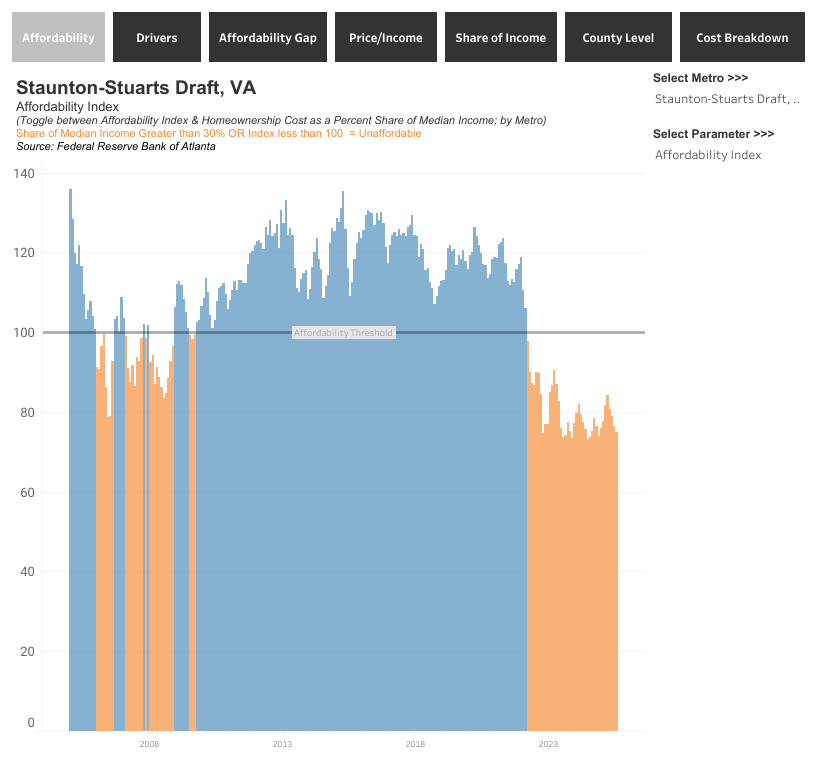
“Affordable” housing, including rent or mortgage plus utilities, is typically defined as housing that doesn’t exceed 30% of one’s income. More than that and other basic needs get strained or unmet, including food, clothing, medical expenses, transportation, child care and so on. The sad part is that we haven’t seen anything close to that 30% ratio since March, 2022, when affordability fell of a cliff (see chart below) to levels not seen since the Great Recession of 2008.

This and other illuminating graphs, compiled by the Federal Reserve Bank of Atlanta, illustrate in several ways how badly we as a society are dealing with our housing issues. For openers, observe that housing today is even more unaffordable than it was in the period leading up to and following a global financial crisis that was triggered by a collapsing U.S. housing market. Although the two crises have differing causes, it’s worth noting that the 2008 collapse resulted in massive government intervention and an all-out effort to stave off another Great Depression. There is nothing comparable today, which means that our housing recession has not only been completely uninterrupted—none of those blue spikes to interrupt a sea of orange—but with no hope that anything’s about to change.

Here’s another way of visualizing the same dynamic, charting the median household income needed to buy a median priced house:

Again, the current lack of affordability exceeds that of the Great Recession. Moreover, the reality is worse than depicted above, since the Atlanta Fed’s statistics include all the components of mortgaged home ownership but do not include utilities. But what is measured is bad enough. The most recent (August, 2025) share of median income going to housing is 39%, the same level reached in July of 2006. By comparison, the lowest share of median income going to housing was in April, 2015, when it dipped to 23%.

With only two statistics going into computing affordability, it’s worth drilling down a bit to see how much each has contributed to our unbalanced ratio. The median household income for our area was $42,819 in mid-2006, $46,661 in April of 2015 and $67,199 a couple of months ago. The median homeownership cost for those same months was $194,033, $164,533 and $308,900. In other words, the cost of homeownership in 2015 was 3.5 times household income, compared to 4.6 times today.

Looked at another way, household income rose 9% over the first near-decade of this comparison, even as homeownership costs dropped 15%. In the decade since? Household income went up 44%, but homeownership costs exploded at twice that rate, by 87.7%. No wonder home ownership has become unaffordable—or that rental rates are likewise skyrocketing, thanks to frustrated homebuyers turning to other shelter options. And just like a rolled-up toothpaste tube, those who can’t keep up get spit out at the other end, ending up couch-surfing or in short-term motel rooms or in their cars or a tent.

Since we’re not about to see a doubling of household income—indeed, given current economic and federal policy trends, we’ll be lucky to see any increase—the only alternative for lowering the affordability threshold is to decrease the cost of homeownership. One way for that to happen is through lower mortgage interest rates, but that’s beyond our meager capabilities, and interest rates are in any case only a secondary factor in housing costs. Even more on the margin are property taxes and home insurance, both of which have climbed over the years but still remain relatively minor components of a monthly mortgage payment. That leaves just one thing we might influence to promote affordable housing: the cost of home building itself. That’s where the conversation should be focused, and it’s also where the conversation has been most lacking.

Home construction is a numbers game that is most profitable when it enjoys economies of scale. As with interest rates, many of the costs that go into that equation—labor, materials, weather—are beyond our control except at the margins. But the one variable over which municipalities have a say is land use. The more housing units that can be built on a particular lot, the lower the per-unit cost of the finished homes. Build a $500,000 house on a half-acre because a lower-cost house won’t pencil out, or build a four-plex with each unit priced at $200,000 and make the same return on investment—and create four times as much housing, each at an affordable price.

That latter option, however, requires a wholesale reexamination of zoning codes and maps, and that’s something Staunton has avoided. The city’s 11-point housing “strategy,” conceived by a working group of housing advocates that not once discussed the role of zoning in driving up housing costs, nibbles around the edges of land-use policies by exploring the possibility of allowing accessory dwelling units. The bulk of the proposed housing strategies, however, merely advocate lots of talking and not so much action: legal services for renters, for instance, or landlord “education.” The nitty-gritty task of grappling with outdated notions of urban planning, meanwhile, apparently proved a step too far.

And so we have moments like Monday’s forum, offered under the hopeful tag line, “I am homeless and still I dream.” Those of us who aren’t homeless are also dreaming—dreaming if we think we’re actually moving the needle on affordable housing, as even a quick look at the charts above should drive home. What’s that phrase, often mis-attributed to Einstein, about the definition of insanity. . . .?

Ambling toward a housing disaster

(Reading time: 9 minutes)

There’s never a good time to be homeless—but there’s bad, and then there’s infernally bad. We’re now well into Dante territory, hurtling past limbo, lust and gluttony to start ricocheting off greed’s boulders.

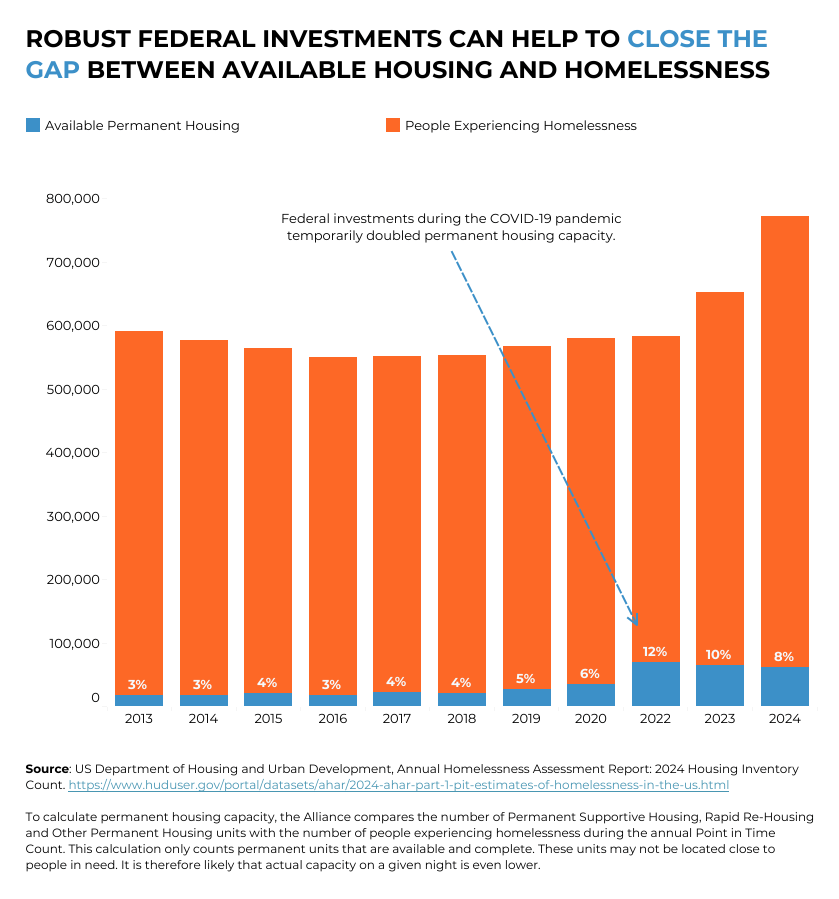
On a federal level, the gap between supply and demand for housing for the homeless was already skyrocketing before the Trump administration took office (graphed above) but exploded in the past year, thanks to a combination of funding rescissions and deep staffing cuts in departments serving the poor and unhoused. That notably includes the departments of Housing and Urban Development (HUD) and of Health and Human Services, which just in the past couple of days have been whacked with further unprecedented layoffs, shredding what little remains of an already tattered social safety net. If there’s any doubt about the local implications of all this, see the Blue Ridge Area Food Bank and its increasingly alarmed appeals for community support.

But there’s also a deeper, more profound shift in housing policy underway that will have the perverse effect of pouring gasoline on the fire. That shift dates back to a July executive order, issued by Donald Trump under the provocative title “Ending Crime and Disorder on America’s Streets,” that ends support for the “Housing First” approach to a growing unsheltered population. While Housing First advocates contend (often with references to Maslow’s hierarchy of needs) that people’s basic needs for food, warmth and shelter must be met before they can effectively address addictions, psychological ills or lack of job training, the executive order claims Housing First policies “deprioritize accountability” and fail to “promote treatment, recovery and self-sufficiency.” The better approach, according to the executive order, is to slash funding for such assistance while instituting sobriety requirements for people living in federally funded housing. Can’t stay straight? It’s back on the street with you, where the physical struggle for survival will take all your energy.

Meanwhile, the current trend toward criminalizing homelessness only adds to the problem. A U.S. Supreme Court decision last year empowered municipal officials to fine, ticket, displace or arrest people sleeping in public spaces, and more than 200 localities around the country have since criminalized homelessness. But other jurisdictions—including Staunton, Waynesboro and Augusta County—already had similar laws on their books. And while our local law enforcement agencies thus far have taken a restrained approach to people camping on public property, acting mostly in response to complaints by directing the offenders to move elsewhere, that could change with any pronounced shift in the political climate.

Homeless people who get jailed for failing to have a sanctioned place to sleep become, ironically, ineligible for certain housing programs. No surprise, then, that once they’ve been incarcerated for not having shelter, many end up in a cycle that perpetuates their homelessness. More than 50,000 people who are released from prison or jail each year go straight into homeless shelters and then into the streets, according to the National Alliance to End Homelessness, which reports that formerly incarcerated people are ten times more likely to become homeless than the general public due to a lack of financial and social support.

What little support for the homeless that still exists is being chopped away almost on a weekly basis. As reported by Politico a couple of weeks ago, the Trump administration is looking to move as much as two-thirds of HUD’s funds designated for permanent housing projects to transitional housing assistance “with some work or service requirements.” Those who can’t meet the requirements—such as a mother with young children, or someone who’s disabled—may end up on the street again, but as explained by a HUD spokesperson, “HUD is no longer in the business of permanently funding homelessness without measuring program success at promoting recovery and self-sufficiency.” That’s consistent with the administration’s overall “suck-it-up-buttercup” approach to social services but does nothing to address root causes, leaving it up to overwhelmed and unfunded local agencies to deal with the fallout.

Some of these issues may be addressed Monday evening at Kate Collins Middle School in Waynesboro, when Building Bridges for the Greater Good will host a forum on teenage homelessness. That’s because homeless teens are supposed to be served by the McKinney-Vento Homeless Assistance Act, which created the Continuum of Care (CoC) program that Politico reports is under attack—indeed, as Politico also noted, Trump’s budget for the next fiscal year proposes cutting all CoC funding. Loss of those funds will mean dozens of students in the SAW region who currently receive emergency housing, transportation and other necessities of life, including food, clothing and personal care supplies, will be at risk of losing their ability to stay in school.

CoC funding also assists 22 households in a program of permanent supportive housing administered by the Valley Community Services Board (VCSB), but their future is equally uncertain. The current funding runs out in December, and while a larger successor grant has been approved, there’s no certainty that money will be released. “If the Politico article is correct, this program would certainly be in jeopardy, but I am not sure what calendar year we will actually feel the impact,” said Lydia Campbell, assistant director of community services at VCSB. “It’s terrible that our community members with the most significant barriers to housing that are finally in their own places could be at risk.”

In the face of this onslaught, local efforts to cope with homelessness and a severe shortage of affordable housing have been lame, at best. That’s partly due to a lack of money, of course, but being cash-poor is insufficient excuse for a city that spends big bucks on a new pool house, golf carts and 50-gallon trash cans for everyone—all welcomed expenditures contributing to Staunton’s quality of life, but at the cost of letting internal sores fester. With only so many tax dollars to go around, expenditures in one area mean belt-tightening in another. In the end, it all comes down to the choices we’re willing to make—or ignore.

Take, for example, the request to city council by Alec Gunn, director of the Waynesboro Area Refuge Ministries (WARM), for financial support for a day center for the homeless at First Presbyterian Church. As initially conceived, this would have been a warm day-refuge in the winter and a cool one in summer for an unsheltered population that otherwise resorts to camping out in the library or in fast food restaurants to escape the weather. Talk of the city providing some modest start-up money for such an effort, perhaps $30,000, has been kicking around since the start of the year, with little to show for it and with ambitions for the day center’s scope of services diminishing with each passing month. More recently, rumblings of resistance from the church’s neighbors have been heard, and Gunn did himself no favors with the skimpy “budget” he presented to city council in early September—but neither has anyone on city council stepped up to press for a resolution. And so. . . still no day center.

As much—or little—can be said of the city’s pursuit of affordable housing, a critical component of any serious effort to eliminate homelessness. A key to this somnolent exercise has been creation of a housing commission that could “provide expertise and guidance regarding the amount and quality of affordable and workforce housing in the City,” an initiative first proposed by Councilor Brad Arrowood in March. That’s March of 2023. This past Thursday the city council finally received a resolution to do just that—but it won’t actually vote on the measure until an unspecified “later date.”

Not that there’s anything to be lost in this slow-walk to another grouping of chin strokers. Six of the proposed nine commission members are to be drawn from the ranks of the housing strategy working group that labored for a whole eight hours spread over 12 months to produce the city’s “housing strategy.” That group served mainly as a sounding board for city planners to present their ideas, and for the most part it resonated in tune; this was not a group brimming with ideas. The new commission will likewise meet only four times a year and, under the influence of its carry-over members, presumably will serve a similar role, with similarly minimal results. If there is to be any hope for the housing commission to provide meaningful input, it will have to come from the three non-working group members, ideally including representatives from the building and development sector and at least one person who has been homeless.

But first, of course, there actually has to be a city council vote to ratify the resolution. Assuming it does so in the next few weeks, and that the housing commission holds its first meeting in January, that will mark nearly three years since Arrowood’s initial proposal.

All this foot-dragging might be tolerable in a slower age, but that’s not where we are today. Instead, we’re hurtling toward a precipice with preternatural speed, the economy teetering toward recession, our political machinery seized up and normal middle-class people growing angry, suspicious and resentful under the weight of a disintegrating social order. How else to explain recent events in Waynesboro, where local residents circulated a letter deploring “the homeless problem” and criticizing St. John’s Episcopal Church for allowing a man to sleep in its bushes and a homeless couple to stay on an empty church lot. The letter expressed concern that mental illness, drug addiction and increased crime rates would put the neighborhood at risk, albeit without linking any of those problems to the three specific people prompting the writers’ angst.

Not all local residents shared that view, and in a couple of meetings pushed back vigorously against such stereotyping. But as the homelessness problem deepens and more people are forced to live in their cars and on the streets, similarly charitable responses may become more strained. We’re in a race against time that community leaders have not yet recognized, for money, effort, planning and initiative, and it would be reassuring to get even a whiff of urgency over what needs to be done.

Why a day center is not a shelter

(Reading time: 4 minutes)

The story in the Augusta Free Press last week was buoyantly misleading. “The City of Staunton will open a day shelter for unhoused persons in the fall,” it announced.

Would that it were so.

Prompting the article’s optimistic declaration was a presentation to city council Sept. 11 by Alec Gunn, director of the Waynesboro Area Refuge Ministry (WARM), who had been invited to outline WARM’s plans for a “day center” for unsheltered homeless people. Gunn’s presence followed a reminder to city council a couple of weeks earlier that that it still had $50,000 in a discretionary fund that needed spending. As I wrote Aug. 24, city manager Leslie Beauregard noted that the council had discussed possibly appropriating $30,000 of that amount for a WARM day shelter for the homeless—perhaps the subject could be revisited? Yes, yes, good idea, council members responded. But first, let’s hear a concrete proposal and budget.

And so Gunn spoke, and from the outset illuminated several problems. Staunton city council’s interest in a day shelter had been triggered most recently by the severe cold we experienced last winter, with homeless people who had been housed overnight by WARM’s network of church-based emergency shelters typically turned out at 7 a.m. the following morning. With nowhere else to go, they resorted to frequenting area libraries, fast-food restaurants, Brite buses and any other accessible public place where they could get out of the wind and cold—frequently to the discomfort of other patrons. Could they not be provided with a refuge of their own?

Yet as Gunn repeatedly stressed—although council members did not obviously pick up on the distinction—WARM was looking to create something different. What he envisioned, Gunn said, specifically was not a “homeless shelter” but rather a place in which people could “work themselves out of” homelessness, through some unspecified combination of classes and workshops. Indeed, “shelter” seemed a word better left unsaid, with all the negative baggage it carries. It was all “center” and “day center” and “welcoming environment.”

Definitions or goals aside, Gunn’s sketchy outline—calling it a “proposal” is too generous—seemingly was aimed more at securing the $30,000 that had been bandied about than at detailing just what the day center would do.  As if by coincidence, $30,000 was exactly the amount WARM envisioned for “support staff,” although how many staff members would be employed or what they would be doing was left unsaid. An additional $18,500 would be needed for utilities, supplies, transportation, insurance and so on, including $1,500 for those undefined classes and workshops. Where would the additional money be found? Unknown.

Meanwhile, although Gunn said this would be a year-round program, he conceded under questioning that at least initially the center would be open only two or three days a week, so definitely not a “shelter” as that term is generally understood. Eventually, he added, WARM hopes to expand operating hours to five days a week—so still not a shelter, which should be accessible every day. And while discussions earlier this year about a day shelter had included proposals for building showers and a laundry facility at the First Presbyterian Church, where all this supposedly is happening, Gunn said last week that he “hopes” Habitat for Humanity will make available a mobile shower system it sometimes uses.

Creating a program to help homeless people get out of their unsheltered circumstances is admirable and necessary, but it’s not at all clear that WARM’s unfocused efforts will accomplish that. Worse yet, there’s a real danger that an uncritical acceptance of WARM’s proposal will convince city council members that if they approve the $30,000 Gunn is seeking they’re actually providing a day shelter that can get homeless people off the streets, just as the Augusta Free Press assumed in its reporting. So far the city council hasn’t done that, but the broadly approving comments from council members after Gunn’s presentation suggest such an appropriation may be in the works.

What the unsheltered homeless population in Staunton, and the SAW region generally, lacks is not complicated: a readily accessible place they can go seven days a week, from 7 a.m. to 5 p.m., in the heat of summer and the freeze of winter. A shelter without preconditions, such as having to participate in a well-intentioned program of one kind or another, and without any expectation that those seeking such shelter will spend their time working themselves into or out of anything. A refuge.

That would be something. Don’t hold your breath.

What if ‘urgent care’ was like this?

(Reading time: 6 minutes)

When it comes to the problem of housing affordability—which is to say, to the insufficient supply of such housing—those without a home at all tend to get the shortest shrift. Most of the public fretting is about people being forced to pay 30% or 40% or more of their already meager incomes for shelter. Or about the shelters themselves, which despite their high price tags too often are poorly maintained, inadequately insulated and ringed by sketchy neighbors. Meanwhile, those who sleep in cars, or in tents tucked into patches of vegetation behind shopping centers or supermarkets, simply drop out of sight and out of mind.

Consider, for example, the Staunton Housing Workgroup, which labored mightily over the past year to produce a list of “strategies” to put the city on the “pathway to affordable housing and housing for working families.” We apparently must gird ourselves for a long and arduous trek. As explained by city planner Rebecca Joyce when she presented the group’s strategic vision to city council a few weeks ago, “This is a plan for a start, not a plan for completion”—and oh, by the way, an additional strategy had been added belatedly to the original ten, to provide services for unhoused persons.

Why the late insertion? Because homelessness had not been discussed by the workgroup, despite such a condition being the natural consequence of unaffordable housing.

Just how sluggish and tone-deaf the city can be on the subject can be seen in the workgroup’s proposed timetable for meeting the needs of the homeless, laid out in a six-step approach divided into neat three-month segments. Step one, to run through the end of September: “Compile current list of resources and organizations that serve unhoused community members in the City.”

That should make for a busy morning.

Meanwhile, step six, scheduled for October through December of 2026, proposes to “conduct assessment of current state of needs of unhoused community members in the City and create an action plan of next steps.”

One might think that talking to the people you want to help would be a first step, not the last, but as the rest of this “strategy” makes clear, the city’s focus is on helping organizations, not individuals. As step two explicitly prescribes, for example, “Survey organizations that serve unhoused community members in the City regarding their most pressing needs [emphasis mine].” Steps three, four and five , which are identical, are all about helping organizations apply for funds.

Another example of kicking the can down the road was exhibited at the city council’s last meeting, when city manager Leslie Beauregard reminded everyone that the last budget had appropriated $50,000 for the council to use “at its discretion.” The council had been so discreet that none of the money had been spent. Perhaps the council should revisit the matter and use the funds in a productive manner? Perhaps, as had been previously discussed, some portion—$30,000 had been mentioned—of that unappropriated fund could go toward a WARM day center for the homeless “as part of a broader housing strategy”?

As summarized in the session’s minutes, “Council members agreed on the urgency in supporting the day center but questioned the need to allocate funds immediately,” which suggests the council has a creatively relaxed definition of “urgency.”  The council instead tabled the proposal and “expressed desire to invite a representative from WARM to present a proposal and budget for the day center at a future council meeting.” One can only hope that “desire” will translate into action.

The underlying problem all this illustrates is a lack of urgency or assertive leadership by city officials and staff in addressing a problem that has festered for years. Staunton’s default position is one of passivity rather than initiative, waiting for someone to bring up an issue rather than proactively intervening in something everyone knows is awry. Somnolent staff can propose an 18-month timetable for the city to reach out to “unhoused community members,” and council members uncritically accept that as reasonable.  Meanwhile, WARM will start operating its emergency overnight shelters in less than three months, but the “urgent” need for a day center will have to wait for the thinly staffed and inadequately resourced agency to get an invitation from the council to appear in its chambers.

Would it be too much for the city, having recognized a problem, to reach out to WARM directly? This week? To sit down with WARM staff and find out what’s needed, how much it will cost and who will be running the show?

Staunton’s laissez-faire approach to social needs is just as pronounced on the supply side as it is on the demand end of things. Lydia Campbell, at the Valley Community Services Board (VCSB), has been peppering the internet with emails pleading with local municipalities and social service agencies to apply for a Homeless Reduction Grant. Such grants, which date back to 2013 as part of Virginia’s Housing Trust Fund, are intended to “ensure homelessness is rare, brief and non-recurring.”   Eligible projects include “rapid rehousing for literally homeless households, innovative projects for unaccompanied homeless youth or older adults experiencing homelessness, and rental assistance and stabilization services for chronically homeless households residing in permanent supportive housing.”

The response has not been encouraging.

True, as such things go this is not a wealthy program, disbursing just $12.9 million across all of Virginia in 2023, the most recent full accounting available. But that amount underwrote 69 projects that year, serving 3,997 people. Among them was (and is) Hope House, a rapid rehousing project in partnership with the Shenandoah LGBTQ Center that serves unaccompanied homeless youth, ages 18-24. On the other hand, over the past five years only one other program application has been filed (albeit not awarded) in our four-county region, according to Campbell.

In other words, when it comes to free money to address homelessness, local governments, non-profit organizations, housing developers (yes, developers, both profit and non-profit alike) and single purpose organizations—all of whom are eligible to file applications—can’t be bothered.

The current application period has a Sept. 12 deadline, but to date Campbell has not received any requests for a letter of support, which the state requires from VCSB to prevent duplication of services. Given the late date, that seems unlikely to change, although it’s always possible that Staunton staffers have been working feverishly but unobtrusively to . . . nah. Just kidding.

Here’s a final irony. Staunton’s 2023 legislative program, an annual exercise in which the city’s governing body communicates its priorities to the Virginia general assembly, urged an increase in funding for permanent supportive housing. “The Governor’s Housing Trust Fund should become a consistent funding stream for these individuals,” council members contended.

“Just don’t make us ask for it,” they could have added.

Winter is coming

(Reading time: 4 minutes)

In another sign that the universe has a dark sense of humor, the Valley Homeless Connection announced last week the results of its annual Point in Time (PIT) survey of the local homeless population. That was on Tuesday. Three days later, the Trumpian chainsaw approach to government slashed funding to an additional half-a-dozen federal agencies, including the U.S. Interagency Council on Homelessness. The council, Trump said, was “unnecessary.”

As government agency budgets go, this won’t save more than pocket change: $3.6 million a year. But as far as meeting a social need, the cut eliminates the only federal agency charged with implementing “the federal strategic plan to prevent and end homelessness.” And yes, there actually is such a plan, adopted Dec. 19, 2022, one that sought to reduce homelessness by 25% by this year. That it has failed to do so is as much a statement about the size of the problem as it is about the government’s effectiveness in addressing systemic issues without adequate funding or political buy-in.

The local PIT count underscores the point. The annual snapshot of how many people are sleeping in homeless shelters and on the streets, in one capacity or another—tents, cars, cardboard boxes—found little change from a year ago, when the 2024 PIT found 157 homeless people in the SAW region of Staunton, Augusta and Waynesboro. This year’s survey, conducted on one of the coldest nights in many years—the temperature in Waynesboro dropped from a high of 22 to just 4 degrees—counted 146 homeless adults in the SAW region (another 10 were counted in Lexington and Rockbridge County). Nine of the adults also had custody of 16 children younger than 18, adding to the total.

The good news is that a greater percentage of the PIT-counted people this year were in emergency shelters, with 82 staying at the Valley Mission, 40 in the overnight shelter operated by WARM, and five staying at the New Directions Center, a shelter for survivors of domestic violence. All the children were sheltered, as well, and two people in the SAW region were put up in motel rooms paid by social agencies. That left just 17 people in the SAW region toughing it out in the cold, compared with last year’s 30 or more. Then again, as observed by Lydia Campbell of the Valley Homeless Connection, the severe weather may have forced any number of homeless people into other alternatives, such as couch-surfing with family or friends. And as always, there’s the question of how many unsheltered people were simply missed in the count, with the extreme cold forcing people to burrow in more tightly wherever they were.

Among the PIT findings that Campbell highlighted was an increase from 51 in 2024 to 71 in 2025 of people who reported they were homeless for the first time. “That is a wild thing,” Campbell said, reflected in such vignettes as the woman who sleeps in a car parked outside her husband’s Verona workplace while he works inside. Indeed, the PIT found “lots” of people sleeping in their cars in the Sheetz and Walmart parking lots, as well as at Cracker Barrel, Martin’s and Lowe’s. Meanwhile, as the number of newly homeless people suggests, the pipeline is filling up faster than it can empty out: the national plan to end homelessness reports that on average, 908,530 people became homeless each year between 2017 and 2020, while 900,895 exited homelessness each of those years.  That’s a remarkable turnaround from the period of 2010-2017, when national homelessness declined 14%.

Meanwhile, meeting the national plan’s goal of a 25% reduction in homelessness would require that this year’s PIT count not exceed 437,000, down from the 582,462 counted in the 2022 PIT census. The trend, alas, has been precisely in the opposite direction, topping out at 770,000 in 2024—and if the local numbers are any indication, the national 2025 PIT results are unlikely to have improved.  But because it takes many months to compile all the national data, just how much worse things have become nationally won’t be known until late this year.

Locally, the outlook is grim. The advent of spring inevitably pushes away concerns about people freezing to death, and the leafing out of the landscape tends to obscure homeless encampments: out of sight, out of mind.  The slash-and-burn practices that are hollowing out—if not completely eliminating—social service budgets and agencies are still to be fully felt locally, but Campbell says Housing and Urban Development funding for permanent housing is already drying up, and an array of services to help people cope with joblessness, substance abuse and poor health is evaporating. Even those who don’t lose sight of the problem can feel hamstrung and helpless to respond in any meaningful way.

Yet as often intoned in Game of Thrones, “Winter is coming.” Even now, on the verge of the spring equinox. What then?

Long-awaited housing study a bust

(Reading time: 12 minutes)

The much-awaited regional housing study was finally released at the end of this past January. It is, to say the least, underwhelming.

Divided into two segments, a “consumer” version marked by larger fonts and a liberal use of photos, plus a so-called “technical” version, the study was marketed as providing “a deep understanding of the housing market dynamics in the Central Shenandoah Planning District,” which encompasses five counties and five cities. The study was originally promised for a June 2024, release, and was eagerly awaited by various local housing groups hoping to use its data as a springboard for further planning. Instead, those expectations were repeatedly put on hold, as first one delay was announced and then another, until in some cases the study became an afterthought.

So why the eight-month delay? It wasn’t because new data was being assimilated, or existing data was being reanalyzed. Indeed, it’s a fair guess that the study itself was barely tweaked at all during this long dry period, as it contains several references to future events that had already occurred by the time it was made public. Instead, the recurring delays were vaguely attributed to foot-dragging by unnamed localities in the planning district that hadn’t “signed off” on the study in a timely fashion.

Which right there should have been a big red flag that the “regional housing study” was actually a political football. In fact, it’s now clear that this is not a “study” as much as it is a “plan”—and plans need buy-in from those charged with implementing them.  Indeed, while a study suggests an effort to gather basic information from which plans can be developed, this study explicitly states that its findings were predetermined. As explained on p.9, study planners “met with staff from each county and city” who “described each jurisdiction’s housing stock, housing challenges and potential opportunities.” The study’s parameters, in other words, were established from the outset. Instead of conclusions flowing from the data, the data followed the conclusions.

Moreover, the “housing” aspects of the plan are only a minor part of its data base, which includes far more information about the region’s demographics than about its housing stock. A more accurate description would be to call this a “householder” study, its glaring gaps in actual housing information acknowledged by the study’s own repeated recommendations for still more study, such as its call for Staunton to “conduct a detailed housing demand analysis,” or that it “conduct a detailed survey and inventory of vacant/underutilized properties in the city.”

“Plans” are recommended courses of action, and there’s nothing wrong with that. But plans need legs, which is to say, they need to be built on a solid, factual base if they’re to have merit. Anyone reading their recommendations should be able to see how those proposals were derived from the available evidence. Yet in this case the cart precedes the horse, with the technical report dedicating just 79 pages to facts and numbers, compared to the 218 pages of proposals for how that information should be applied. Nor are those 79 pages weighed down with dense data dumps and spreadsheets: much of what’s there consists of generalized observations and broad conclusions, unburdened by the kind of detail that would allow readers to develop alternative understandings.

Take, for example, a section in the technical report headlined “Age and Condition of Housing Stock” that opens as follows: “Stakeholders across the Central Shenandoah footprint mentioned concerns about housing conditions. Focus group participants discussed dilapidated single-family homes that need to be demolished; for-sale inventory that needs updates and in some cases, substantial repair; housing that need [sic] rehabilitation and modifications for current residents; multi-family rental housing that has been neglected by landlords; and mobile homes that need replacement, among other conditions-related challenges.”

That reads like a précis for the section that should follow, a quick summary of compelling issues that can then be explored in more satisfying detail. But it’s all a tease. How many dilapidated homes are ripe for demolition? Where are they located? How extensive are the repairs needed by the for-sale inventory, and how quickly should they be undertaken before these homes fall into the “ripe for demolition” category? What would be the estimated cost of such intervention? Which multi-family housing units need remedial attention, and how many families are affected? Good and reasonable questions all, and all of which go unanswered here or anywhere else in the study.

But even on its own meager terms, the study’s scant data is only part of the problem. This is not just an issue of quantity, but of quality: what’s offered is so far past its “sell by” date that it might as well be tossed into the trash.

While many of the study’s conclusions are based on unidentified focus groups and interviews with anonymous “experts”—their identities cloaked, for inexplicably dark reasons, to “protect the anonymity” of participants—its main statistical underpinnings are drawn from U.S. Census Bureau and HUD surveys that largely or completely predate the Covid epidemic. This choice presumably was one of convenience, since such federal data are widely available and require far less effort—or expense—to obtain than more region-specific information. But because these are federal sources, which encompass the whole country and therefore have to distill enormous data quantities, what’s available is neither granular enough or timely enough to be especially useful at a local level.

 As a result, most of the regional housing study’s findings are based on American Community Survey estimates, which are five-year averages spanning the years 2017-2021 (and in some instances 2018-2022). Others are drawn from more dated 2019 Comprehensive Housing Affordability Strategy data, another five-year averaging of surveys spanning the even earlier 2015-2019 period. In other words, the study’s assertions about current housing cost burdens, as just one example, describe a world in which there has been no pandemic, no dislocation of job markets and spike in unemployment, no subsequent inflation and jump in mortgage rates, no moratorium on evictions and no billions of dollars of government assistance pumped into the economy to avert economic collapse. All, it goes without saying, producing massive distortions in housing markets.

Even when the study does (rarely) cite alternative data sources, what it provides lags current information by at least a couple of years. For example, it references the 2022 Point in Time survey to discuss the extent of local homelessness, even though 2024 data—collected in January of that year—was available long before the report was issued. Similarly, although the study turns to sales data from Virginia Realtors to explore time-on-market and related issues, it uses information that is drawn from 2015-2022. By contrast, a realtor who participates in one of the SAW housing groups does a comprehensive sales analysis of local markets every month and has years of more timely information and analysis at his fingertips, some as recent as a month ago.

Just how much difference a couple of years can make is evidenced by the study’s assertion, based on 2022 Realtor sales data, that the median home sales price in Staunton is $250,000. That claim should fail the straight-face test, following the 43.85% run-up in the city’s real estate property tax assessments for the period 2021-2025. Indeed, the local realtor mentioned in the previous paragraph observed that the average home sales price in the SAW region was $324,403 at the start of 2024, following an approximately 9% per year average appreciation over 17 years.

Relying on data that is many years old to describe the present in such a dynamic context means losing nuance, at best, and completely mischaracterizing current developments at worst. Yet at no point does the housing study acknowledge this limitation, or attempt to assess which of its conclusions are therefore least reliable. Like an AI hallucination, it confidently asserts a reality that doesn’t exist, mapping out future action based on staring fixedly into a rearview mirror. It does so by withholding basic data needed for a critical examination of the study’s assessments and conclusions. Indeed, it goes out of its way to obfuscate outside analysis, as when it acknowledges that it “has not documented the source of each estimate discussed” for “readability” reasons—a claim made in the “technical” report, which presumably should be loaded up with “technical” information but isn’t.

So, for example, all discussion about household income is restricted to comparing wages for different job categories, which can encompass widely ranging job titles and pay levels, rather than examining the more useful baseline of the minimum wage. In Virginia that would be an especially helpful metric because of the state’s significant boosts to the minimum, from $7.25 an hour in 2020—where it had been stuck for many years—to $12 in 2024, a time period squarely within the study’s information black hole. The pitfalls this poses was recently illustrated by Staunton’s Consolidated Plan, which overlooked the increase and thereby completely misstated the affordability of the city’s housing stock.

In its unwillingness to cite specific data, the housing study falls back on generalities that are too sweeping or obvious to be useful. Housing “that is for sale or for rent (aka ‘on the market’) is scarce.”  Staunton “continues to grapple with providing adequate housing infrastructure for its most vulnerable residents.” When it comes to housing, “there is not enough supply to serve renters with extremely low incomes.” And in a surprisingly cautious assessment, “the rental market is approaching a too-tight scenario.” All true—notwithstanding the hedge about “approaching”—and all well-known for quite some time. This study does little to go beyond the obvious.

EVEN ON ITS OWN (limited) terms, the housing study makes some questionable assertions while also raising legitimate issues that it then ignores.

On p.64, the study notes that focus groups “explained that a substantial amount of the region’s housing stock needs critical home repair.” Although “critical” implies a matter of urgency, this observation does not lead to a further analysis or remedial recommendations beyond a suggestion for “enhancements to rental inspection programs in Staunton and Waynesboro.” Both cities have opted to enforce the state’s property maintenance code, giving tenants in substandard housing some recourse, but Augusta County has not. The housing study doesn’t feel a need to point that out.

On p.66, the study acknowledges that the area “continues to grapple with providing adequate housing infrastructure for its most vulnerable residents, including those experiencing chronic housing insecurity [i.e. homelessness], mental health conditions and substance use disorder.” The study then quotes a 2023 report from the Virginia Department of Behavioral Health and Developmental Services calling for the Valley Community Service Board to more than double its existing 120 units of supportive housing—but goes no further in developing the recommendation. The consumer version of the study, meanwhile, does call for development of “a strategic plan” to help “those experiencing homelessness.”

The study elsewhere finds that roughly 3% of SAW housing stock—more than 1,800 housing units—consists of long-term vacancies, which is to say, empty housing that is not being held for seasonal, recreational or occasional use. Some of these vacancies “may represent an opportunity to increase the available housing stock by encouraging owners to rent or sell their units,” the study suggests, without further elaboration. The consumer version of the report, meanwhile, concedes that Staunton has “vacant and abandoned properties that contribute to blight and hinder community growth”—but since the housing study doesn’t know how many such properties exist, or where they’re located, the best it can do is urge the city to find out.

There’s much more of this kind of thing. The point here is not to nit-pick, but to point out that the housing study raises many more questions than it answers—questions not of the “how shall we cope with this” variety, but of what’s actually happening. Questions, in other words, that a regional housing study may reasonably have been expected to answer. Instead, the study’s center of gravity is defined by extensive menus of remedial actions that undoubtedly will keep city planners busy for years to come, calling for additional studies, for development of new taxes, bonds, grants  and other financing vehicles, and for seeking out public and private partnerships—all of which is well and good and even essential, but all of which could have been initiated without this document.

Meanwhile, it’s too easy to lose sight of why the regional housing study—at least as it was widely understood—was so anticipated. One clue is on page 17, which observes that “there are approximately 5,000 households at risk of homelessness in the Central Shenandoah footprint.” Already preceding them are “an estimated 265 people comprising 186 households who are unhoused.” Given the current political onslaught in Washington D.C. on anything that even remotely looks like compassion for one’s neighbors, it’s not fanciful to think that the 5,000 households already at risk may have their ranks diminished—by sliding into the unhoused category.

The regional housing study, in either its consumer or “technical” versions, makes us no better prepared to deal with that.

PIT count: more inconvenient truths

(Reading time: 11 minutes)

Key takeaways:

  • Based on last year’s PIT census, the local homeless population grew almost 29% in one year, outstripping the national increase.
  • The SAW area rate of homelessness as measured by the last PIT was roughly 12.8 for every 10,000 people, exceeding the 11 per 10,000 in Harrisonburg and Rockingham.
  • The SAW region has only one year-round homeless shelter, but because of a severe shortage of affordable housing, its average length of stay has more than doubled over  the past few years and demand for beds greatly exceeds supply.
  • Without adequate support services, most homeless people will cycle in and out of homelessness over many years. Each time they do, their mental and physical health deteriorates more.

LESS THAN A MONTH after the U.S. Dept. of Housing and Urban Development released its 2024 Homelessness Assessment Report, based on information gathered last January, the annual census is about to be repeated for 2025. The Point in Time survey, familiarly and perhaps ironically referred to as the PIT count, is scheduled for Wednesday, Jan. 22—a day forecast to be one of the coldest we’ve had in this area in several years. Can there be a more painful juxtaposition?

Described by HUD as “a snapshot of the number of individuals in shelters, temporary housing and unsheltered settings,” the PIT census is frequently criticized for producing significant undercounts of the homeless population, both because of its methodology and because of the transitory nature of homelessness. The National Law Center on Homelessness and Poverty, for example, cites estimates that the annual number of homeless individuals is 2.5 times to more than 10 times the number counted on any single night, as people cycle in and out of homelessness. Advocates for the homeless also take issue with HUD’s exclusion of otherwise homeless people “residing” in jails, hospital beds or detox centers on the night of the count, of people who are couch surfing with friends or family, and of other coping mechanisms that homeless people use. Still, the PIT is one of the few ongoing measurements we have of an extraordinarily vulnerable population, and so deserves our attention.

But there are other caveats. The fact that it took HUD nearly a year to release the results of a one-night count dilutes the PIT’s usefulness as a planning tool, even as it acts as a smokescreen for public officials reluctant to deal with problems of homelessness. Staunton, for example, defaults to the PIT count whenever it’s called on to provide estimates of homelessness in the city, asserting that separate data for the city itself is not available—a statement absurd on its face, since the data for each PIT count is obtained on a local level. Instead, the city observes in HUD filings that Staunton is a member of the Virginia Balance of State Continuum of Care, which is responsible for overseeing the PIT, and that the Balance of State CofC’s findings are as good an estimate as it can provide of local homelessness.

The Balance of State CofC, it should be noted, consists of 71 counties and cities from one end of Virginia to the other, so not exactly “local.”

Just how bad is the homeless situation? Here are some numbers to mull over. Nationally, the Jan. 20, 2024 PIT count found a 7% increase in unsheltered homelessness compared to the previous year, amid an 18% increase in overall homelessness. That’s grim, but much of the jump was attributed by HUD to a rising number of asylum seekers—with waves of border crossers being dumped in Denver, New York and other northern cities—and of several natural disasters, notably the Maui fire in Hawaii. Since neither of those causes had a significant effect on Virginia, it therefore may come as a surprise to learn that the Balance of State CofC clocked an even higher gain in homelessness, of 22% year-over-year.

If there’s one bright note in the 2024 Balance of State CofC PIT, it’s that the increase in unsheltered homelessness was a bit lower than the national increase, at 5.3%. This suggests that even though a greater percentage of Virginians became homeless last year than was true nationally, at least the counties and municipalities in the Balance of State CofC were able to shelter more of their increased homeless populations. But there’s another possibility: that the Balance of State CofC was simply less efficient at locating unsheltered homeless people, who can pitch a tent or park a car in many more nooks and crannies than a handful of volunteers can find. And with national and state land within the bounds of Augusta County, not to mention a largely rural and agricultural landscape, finding a homeless person here can be far more difficult than poking around the alleys of a big city.

HOW DO THOSE percentages translate into actual numbers, and what do we know about the extent of homelessness locally, Staunton’s obfuscation notwithstanding??

The Balance of State CofC that’s already been mentioned is actually divided into 12 planning groups, including our local Valley Homeless Connection, which consists of four counties and four cities: Augusta, Rockbridge, Highland and Bath counties, and the cities of Staunton, Waynesboro, Lexington and Buena Vista.  This week’s PIT count, as was true in the past, ostensibly will cover this entire region, but in practice—either because of limited manpower, or because homeless people gravitate toward urban centers for the support services they provide—past PITs reported only a handful of homeless people in Rockbridge and Lexington, and none at all in Bath, Highland or Buena Vista.

The great preponderance of homeless people, therefore, is in the SAW region—and those numbers jumped even more sharply from 2023 to 2024 than in either the Balance of State CofC or nationally. Specifically, the area of Staunton, Augusta and Waynesboro saw a 28.7% jump in the homeless population, from 122 in 2023 to 157 in 2024. The unsheltered population, meanwhile, registered a 46.6% increase, from 30 to 44. To put that into some kind of perspective, the SAW homeless rate went from approximately 10 per 10,000 population in 2023 (based on a SAW population of 122,770) to roughly 12.8 per 10,000 in 2024; by comparison, the Rockbridge/Harrisonburg area, which recently opened a $5 million dollar emergency shelter for the homeless, has a rate of 11 per 10,000.

That the unsheltered numbers in SAW weren’t even higher is due almost entirely to WARM, a consortium of local churches that offers emergency overnight shelter on a rotating basis, and which on the PIT night last year had 48 clients, compared with just 26 the previous year. How many it will accommodate this Wednesday is anybody’s guess, but in any case WARM has a maximum capacity of 50. Meanwhile, the only other homeless shelter in the region, Valley Mission, had 62 people in its beds during the PIT count in 2023, and increased that only slightly to 65 last year. Although it has a theoretical capacity of 90 single adults, that number is divided between 60 men and 30 women, so if there are fewer than 30 women needing shelter, some beds will go unused. In addition, since half of the beds are top bunks, homeless people with mobility issues—which is not unusual—may be unable to access empty bunks that require climbing a ladder.

Homeless people unable to find shelter with WARM or the Valley Mission, or with a friend or family member, in past years have ended up sleeping in a tent or car or, in at least one case, an RV camper. The dozen or so PIT census-takers last year reported people seeking shelter behind Martin’s Supermarket and Roses Discount Store in Waynesboro, behind the Walmarts in Waynesboro and Staunton, at a laundromat and the county library and along Coal Road in Stuarts Draft. But the survey made no mention, for example, of the homeless people camping behind the Food Lion on West Beverley, and there’s no telling how many other tent camps get missed.

(Also worth noting: because WARM operates only December through March, a PIT survey at other times of the year would result in even higher numbers of unsheltered homeless people.)

The Valley Mission was for many years regarded as the area’s safety valve for this sort of problem, providing short-term shelter and supportive services for homeless people while they transitioned to permanent housing—and, by providing an alternative to the streets, removing a civic discomfort. But the Mission’s capacity has long been outstripped by demand. Executive director Sue Richardson says that when she took her position, in 2012, the publicized expectation for Mission residents was a stay of three months—but as she quickly learned, the reality was closer to five. A lack of affordable housing, even then, made short stays difficult. And three months of support services, helping clients deal with substance abuse issues, psychological problems, unemployment and undeveloped life skills, was in many cases simply insufficient.

But the real hammer blow, Richardson adds, came with the pandemic and a sudden flood of tax dollars, designed to get homeless people out of congregant shelters—because of their heightened risk of COVID contagion—and into motel rooms and other single accommodations. Although such isolation may have made epidemiological sense, it also took the legs out from under the support services most homeless people need to become truly self-sufficient. The result was that a substantial number of Mission clients with various disorders got worse. Counseling and teaching that once may have resulted in sufficient improvement over five or six months was now, in the years after pandemic relief dried up, taking 10 months or a year—or longer. And meanwhile, housing availability only grew tighter.

Today, according to Richardson, the average length of stay at the Mission stretches from 12 to 18 months; in one extreme example, a woman sheltered at the Mission for more than four years. What was once a relatively smooth-flowing pipeline for the homeless, emptying out almost as quickly as it filled up, has now become an overflowing funnel. A growing number of homeless people are piling up at the intake, while only a trickle empty out the other end. And in the SAW area, that overflow increasingly is spilling into the streets because of not having anywhere else to go.

The severity of the problems faced by this population is reflected in the PIT results, which include a questionnaire that provides some crucial insights into who is homeless, why, and how often.  Of the 168 people surveyed across the four-county Valley Homeless Connection area last year, for example, 101 said this was not the first time they’d been homeless. Nor is homelessness a short-term speed bump in the road of life, as 82 had been homeless for more than seven months at the time of the PIT count, the great majority for more than a year.  

How did they end up on the street? Asked for the biggest reason they believed they were homeless, 24 said it was because they didn’t have a job and 18 said they had a disability that presumably kept them from working.  Fifteen had been evicted, six cited high rents and eight said they were underemployed, suggesting they weren’t paid enough to afford rent. An additional 18 were fleeing domestic violence or sexual assault, 17 said they suffered from serious mental illness or had substance use issues, and four cited general health problems. Ten had been released from prison or jail, while family issues, a robbery, and divorce pretty much rounded out the list.

In short, the homeless population spans a wide range of needs and disorders, requiring an equally wide range of support services for meaningful rehabilitation. It also is a population that is expanding at a faster rate locally than it is nationally, while the resources to meet its needs have increased far more slowly, if at all. This Wednesday’s PIT count may add some details, and it most likely will document a continued worsening of overall homelessness. But it almost certainly won’t tell us anything we don’t know already.

We all live on a knife’s edge

(Reading time: 14 minutes)

Most of us, whether we realize it or not, live on a knife’s edge of possibilities. On one side, a comfortable if not extravagant life of warm shelter, nourishing food, the fellowship of loved ones, an adequate supply of pleasurable distractions; on the other, bleak ruination. It doesn’t take much to tip us into disaster. The sudden loss of a job, an illness, the death of a spouse, a car accident or house fire . . . and just like that, a predictably familiar existence can be upended and life becomes a struggle for survival.

Many of us are lucky enough to have a personal safety net of family or close friends who can help when disaster strikes. But for those who don’t, a public safety net is essential—and increasingly more so in recent years, as pandemic-catalyzed stresses sapped an economy already weakened by years of growing income disparity and a shortage of affordable housing. Unfortunately, the same economic forces that create such problems also undermine an effective social response.

There are, after all, only two ways to fund a public answer to extreme privation: public tax dollars, or private charity. As this paper suggests, however, neither has been up to the task. Charitable giving, after a temporary boost resulting from pandemic-induced compassion, has resumed a years-long decline. Taxpayer dollars, swollen by federal programs intended to stimulate the economy, likewise have dwindled as the pandemic recedes into the past. Worse yet, there still is only the most tentative political acceptance locally of the role government should play in such circumstances.

Now, as the holidays are celebrated by those on the fortunate side of the knife edge, an increasing number of people find themselves on the opposite side, homeless or nearly so during the darkest days of the year. How will we ensure that they, our neighbors, are adequately sheltered from winter’s onslaught of ice, sub-freezing temperatures and cutting winds?

FOR AN UNDERSTANDING of how much of a political vacuum exists on this issue, consider that in Staunton there is no public spending on emergency shelters for the homeless, and only a minuscule amount funneled to a handful of non-profit agencies that provide temporary or affordable housing. This is as much a failure of political will as it is a lack of funds.  For example, of the nearly $13 million that Staunton received from the American Rescue Plan Act, none at all went to housing of any kind, or for the needs of the city’s homeless or the agencies trying to help them.

This oversight was entirely in keeping with how the city has expended other federal funds, even those specifically meant to provide decent housing for low- and very low-income people. In its recent accounting of how it wrapped up spending a $1.7 million federal Community Development Block Grant, Staunton conceded it had failed to meet “its goal for housing development”—failed so spectacularly, in fact, that more than $700,000 remained unspent after five years. The city’s biggest outlay over that five-year span? $334,894 for “general administration and planning,” otherwise known as overhead.

Despite this spending shortfall, Staunton nevertheless minimizes its housing problems by asserting in the same document that homelessness in the city “is not widespread, likely because services and shelters are located in neighboring Augusta County.” This claim is both unsupported and speculative, since the city has made no effort to comply with a funding requirement for “reaching out to homeless persons (especially unsheltered persons) and assessing their individual needs.” Indeed, the city has only a vague idea of how many homeless persons live within its boundaries, much less what their needs are.

Moreover, the assertion that services and shelters for the homeless are in Augusta County is risible, given that the same document—in response to a question about the help Staunton has given to individuals and families on the verge of homelessness—cites the city’s contributions to Valley Mission, which provides short-term housing for people who otherwise would be living on the streets. It is also located in Staunton, not Augusta County, and is only a short walk from the Salvation Army, which likewise provides at least some services to the homeless. But despite the fact that it is oversubscribed and has a waiting list, the Mission received no more than $5,000 to $8,000 a year from the city’s federal block grant.

While tax dollars are in short supply, public charity is subject to the same economic constraints that put a significant segment of the population at risk. People can’t give what they don’t have. Extremely wealthy people garner headlines with massive donations to their favored causes, but as a recent New York Times article on “effective altruism” observed, some 20 million households stopped making charitable donations between 2010 and 2016.  The organizations that suffered the most from this drought are community-based groups whose existence depends on small-dollar donors, rather than on mega-philanthropists.

Similarly, the Chronicle of Philanthropy reported earlier this year that fewer than half of U.S. households now make charitable contributions, and overall charitable giving dipped 3% in 2023. Yet even as small-dollar donors have been dropping away, the Forbes top 100 charities saw a 4% increase in their donations last year, leaving smaller local non-profits in a struggle “to raise money from a fatigued, overstretched base of support.”

These aren’t abstract numbers. Although tax filings for local non-profits aren’t always as current as we might wish, those that are available reinforce the notion that things are getting tight right here in our backyards. Valley Mission, already mentioned, peaked in gifts, grants and contributions received in 2020—the first year of the pandemic—at $1.8 million, which then fell off just a bit in 2021, to $1.7 million, and has since seen donations decline sharply, to $1 million in 2022 and $1.1 million last year. Valley Supportive Housing, which provides affordable housing and supportive services for those with mental illness, intellectual disabilities or substance use issues, saw its grants and contributions jump from $139,240 in 2020 to $598,165 the following year—before declining to $432,990 in 2022. How it did in 2023 or this past year remains to be reported.

Then there’s the Waynesboro Area Relief Ministry, or WARM, the only agency within the Staunton-Augusta-Waynesboro area that provides emergency overnight shelter from December through March for people who otherwise are sleeping in tents or cars.  This effort, cobbled together by a score of churches who volunteer their facilities for a week at a time on a rotating basis, is like the Mission in that it is oversubscribed, with more people seeking refuge than can be accommodated. And like the Mission, WARM also has seen a decline in contributions over the past couple of years, from a high of $652,186 in 2022 to a mere $382,352 last year. Just $28,130 of last year’s revenue was from government grants—none from Staunton—with the balance chipped in by churches, foundations and individuals.

There are—or were—a couple of intermediaries in the charitable contributions arena that historically helped plug some of the holes. The local United Way, for example—which pulled in $1.2 million in 2020, or more than double its 2019 haul—contributed $15,000 to Valley Supportive Housing a couple of years ago. Unfortunately, it also burned up twice as much money for overhead expenses as it provided in overall charitable assistance, saw its receipts plunge to just $406,845 in 2021, and closed its doors a few months ago amid charges of fiscal impropriety and possible embezzlement.

That leaves the field to the Community Action Partnership for Staunton, Augusta and Waynesboro (CAPSAW) and to the Community Foundation of the Central Blue Ridge (CFCBR), with the former distributing state and federal funds and the latter dispersing mostly private contributions.  CAPSAW in particular targets low-income individuals and families, “distributing public funds and providing guidance to programs that effectively address the challenges of poverty.”  Last year it awarded grants totaling $431,456, marking at least four years of steady increases—although one of its grant recipients, ironically, was the United Way of Staunton, Augusta and Waynesboro. Meanwhile, only three of its 17 other grant recipients directly address housing issues, including Renewing Homes Greater Augusta, Valley Mission and Valley Supportive Housing.

Among CAPSAW’s signal achievements has been helping renters avoid eviction, starting with 110 renters assisted in fiscal year 2022, 291 in 2023 and 322 in 2024, attesting to the rising demand for such intervention. But in most other respects, CAPSAW’s attempts to assist those most in need of housing assistance have fallen short of its own goals. For example, the partnership had hoped to provide 400 homeless individuals with safe temporary shelter in 2022, but managed to reach only 165. It did much better in 2023, when it reached 296—but the need had grown so much that CAPSAW’s target also had been increased, to 520. And this past year, despite lowering its target to 480, the partnership actually saw a decline in the number helped, to 271.

Similar shortfalls were recorded by CAPSAW in its efforts to help people obtain safe and affordable housing, as differentiated from temporary shelter. Moreover, the number of deficient homes that got needed structural repairs through its funding declined sharply, from 70 in 2022 to 55 in 2023 to 14 last year. The non-profit addressing those needs, Renewing Homes, blamed the slump on a lack of volunteers and the increased cost of building supplies, among other factors.

Meanwhile, the Community Foundation of the Central Blue Ridge is in some ways the 800-pound gorilla in the local charitable funding scene, but it also has a more diffused focus. In 2022 it donated nearly $2 million to a wide-ranging assortment of 91 different organizations that each received $5,000 or more—often much more. Yet because of CFCBR’s broad mandate to “strengthen civil society by enhancing local assets,” in addition to some donors restricting how their money can be spent, a good deal of the money it distributed ended up at tax-supported or user-funded institutions, such as the $265,052 that went to Augusta County Public Schools, or the $32,270 awarded to the Staunton YMCA. Even the City of Staunton came in for a share, at $25,144, for two beautification projects.

That’s not to say that CFCBR hasn’t provided critical funding to some of the housing-assistance agencies already mentioned above: that same year, $51,000 went to Valley Supportive Housing, $11,000 to Valley Mission and $15,025 to Renewing Homes of Greater Augusta. But with its largesse broadcast widely among arts programs, animal shelters, community centers, volunteer fire departments, crisis intervention programs, athletic teams, food assistance programs and so on, CFCBR clearly is spread thin; the amount of assistance it can provide to the most at-risk segment of our population is much less than its overall size might suggest, and much, much less than is actually needed.

BLEAK THOUGH this recitation is, the outlook for the next several years doesn’t allow much room for optimism.

There are bright spots, to be sure. Over the past year or two, Staunton’s political leadership has appeared increasingly receptive to the notion that it has to play a more active role in responding to the city’s housing crisis. November’s municipal election seated several councilors who have shown a willingness to engage with housing issues, and the city is lurching toward eventual creation of a housing commission that could champion housing initiatives at budget time (a process that is just now starting for the 2025 fiscal year). And Virginia Housing last month unveiled a five-year, $75 million investment program to build workforce housing throughout the state, potentially creating as many as 5,000 new affordable housing units—although whether Staunton will qualify for some of that funding, and whether it will move quickly enough to claim a piece of it, remains to be seen.

But the larger picture is more foreboding. Much depends on how completely the new Trump administration descends into chaos, with its announced tariffs, disembowelment of regulatory agencies and overall kleptocratic approach to governance threatening massive economic convulsions. In such circumstances, those with the least to lose inevitably get hurt the most. Consider, for example, that during his first term Donald Trump repeatedly sought deep budget cuts at HUD, source not only of Community Development Block Grants but of countless other programs that altogether provide housing for more than 4.3 million people. Those efforts were stymied by a politically divided Congress, but that balance will shift in Trump’s favor in 2025, and with Elon Musk and Vivek Ramaswamy salivating at the thought of amputating huge chunks of the federal budget, HUD’s future is tenuous, at best.

If all of Trump’s budget proposals are enacted—a big if, to be sure— “you should expect large increases both in the scope of poverty and in the depth of poverty,” Bob Greenstein, a visiting fellow at the Brookings Institution, told National Public Radio in a November report on what lies ahead. Among the possible casualties, based on past defeated efforts, is a new federal fund designed to boost the supply of affordable housing, which proponents argue distorts “the market” by raising demand. Also on the conservative wish list is an end to the homelessness policy known as “housing first,” which contends that people need safe and affordable shelter before they can begin to deal with drug addictions or mental health issues.

The bottom line, if all the promised cuts are delivered, will be a meaner, more Dickensian society that will hit communities that lack social services in depth—like Staunton—especially hard. The future already has been foreshadowed in the wake of the U.S. Supreme Court decision last June that empowered cities to criminalize homelessness, permitting evictions from homeless encampments and confiscation of the last shreds of private property that their inhabitants still possess, including sleeping bags and personal papers. At least 120 cities have passed “anti-camping” laws in the decision’s wake, with another 50 considering as much, according to the National Homelessness Law Center. Alas, that won’t be necessary here: Staunton, Augusta County and Waynesboro already have such laws on their books. It’s only goodwill that has kept them from being fully enforced.

But goodwill is a slender reed. How quickly it can snap is on display in Georgia, where the U.S. Department of Justice filed a lawsuit a few days before Christmas against the City of Brunswick over its efforts to close The Well. Operated since 2014 as an offshoot of the United Methodist Church, The Well offers showers, laundry facilities, meals and other services, including an emergency overnight shelter in cold weather, to the city’s homeless population. Why would the city want to end such a program? Apparently because it attracts the “wrong element”—which is to say, people who have fallen on the wrong side of that knife’s edge.

To avoid going down that path, Staunton and its neighbors can no longer ignore the harsh, cascading reality about to roll over us. Our civic leaders can no longer pretend they don’t have to wade into the housing crisis because churches, foundations and non-profits are taking care of the problem—not when the reality is that such responses are increasingly strained. That will require tax dollars, to be sure. But it also will require political leadership, with both elected officials and social service organizational leaders speaking out publicly and loudly on behalf of those who are largely voiceless. It will require energetic attempts to rally community support, through public forums, neighborhood meetings, media outreach and pulpit oratory. It will mean directly engaging those same voiceless people, whether in shelters, food pantries or on the street, to learn more about how they ended up in such circumstances and what they need to get back on their feet.

It will require putting a human face on destitution, so that people who are homeless, voiceless and powerless can’t simply be dismissed as the “wrong element.” With a little bit of misfortune, any of us could be similarly cast out. Let’s try to keep that from happening.

On winter and a city spending spree

(Reading time: 9 minutes)

This past week’s snowfall, slight and unexpected though it was, signaled not just the start of winter but of the resumption of an annual human pinball game.

This is the season in which our area’s homeless population bounces around from one sleeping facility after another, only to be turned out at 7 a.m. each day to cope with whatever the weather throws at them. There are 19 churches participating in the WARM shelter program this year, scattered across Waynesboro, Staunton and Augusta County, each providing at least a week of nightly refuge starting this Monday and running though the end of March.  Heartwarming, isn’t it?

But there are two ways to frame this helpfulness. One is to commend the generosity of spirit that moves so many disparate congregations to share their facilities with those less fortunate; the other is to sigh over such a Rube Goldberg approach to a community-wide problem that has yet to get the kind of concerted attention it deserves. From the point of view of most of those being helped, sleeping on a cot in a church basement is better than huddling in a nylon tent while the outside temperature dips below freezing; on the other hand, there’s something cold—in every sense of the word—about having to haul off your scant belongings each day before sunrise and not knowing, from one week to another, where you’ll sleep next. Or how or where you’ll spend the intervening 11 hours in an ongoing effort to stay warm and dry.

At least two observations seem pertinent. First, there’s the logistical problem of collecting and delivering several dozen people each day from wherever they’ve spent the day to that night’s designated shelter, as well as the related problem of then dispersing the overnight population the following morning. WARM’s program is a low-barrier approach to sheltering, which means it doesn’t screen for sex offenders or people with criminal histories or other issues that churches might find problematic when they open their facilities to day care centers or worship services or other activities. So: 7 a.m., and everyone must be gone.

The WARM solution is a shuttle bus that can move up to 15 people at a time (at this writing, 28 have already signed on), depending on how many personal possessions—which can include walkers—they’re carrying; what it doesn’t have is sufficient drivers. Two prospective hires have backed out even before the season begins, presumably because they decided that $13 an hour for split shifts spanning a 12-hour day just wasn’t worth it. That leaves one unpaid volunteer and the program’s coordinator to cover 14 driving shifts a week, which seems unsustainable over a four-month period. Raising pay might attract more drivers, but of course that takes money, and WARM simply is not getting enough: its income last year, from gifts, grants and contributions, was just 58% of what it received in 2022 and was the lowest it’s been in four years, according to its tax filings. Its annual fundraising effort this year, as seen on the WARM website, has reached just $30,000, or less than half of its $70,000 goal.

Second, there’s the free ride that Staunton gets out of this. WARM, after all, is an acronym for Waynesboro Area Refuge Ministry, and while the “area” in that acronym is broadly construed to include Augusta County and Staunton, neither of those governing bodies shows up on the program’s list of community partners. Seven of the WARM participating churches are in Staunton, and a considerable number of its homeless clientele also are from Staunton, but the city itself is AWOL from the effort even as it provides no shelter alternatives of its own.

How shameful is that?

WHAT BRINGS ALL this to mind is a story in the Augusta Press on Nov. 20 that detailed how local governments have been spending their American Rescue Plan Act (ARPA) funds. The local governments in this accounting include Harrisonburg, Staunton, Waynesboro and Augusta County, which received nearly $60.5 million in the aggregate. Harrisonburg got the largest share, but Staunton didn’t do too badly, at just under $13 million. But just what has Staunton done with this windfall?

Pretty much what you might expect from a kid turned loose in a toy store with a bunch of money and apparently few if any constraints. Although a chunk of the approved expenditures is going to significant capital improvements, including $3.8 million for the new courthouse and $2 million each for a regional radio system and two new fire trucks, much of the itemization reads like a bucket list of unrelated and scattered purchases, from new fire house doors to the recycling center, from a Staunton Crossing marketing plan to wifi hardware. And then there’s the mysterious “Thermal Application Control system upgrade,” priced at $350,000 with nary a word of explanation of what it means or does.

Nowhere on that list is there an allocation for housing of any kind, or of responding to the needs of the city’s homeless or of the private sector agencies trying to help them. Harrisonburg—which, to be fair, received significantly larger ARPA funding of $23.8 million—nevertheless set aside nearly a third of its windfall to “expand accessible, affordable housing,” including $5 million for a Homeless Services Center and $2 million for a housing development fund. Staunton, on the other hand, apparently forgot the many, many times it has lamented its lack of affordable housing and how this has become a priority issue for the city

Indeed, as I wrote in September, the city has a long-standing history of ignoring housing needs. I pointed out at the time that one recurring reason for this is that housing needs in general, and the problems of our homeless population in particular, don’t have a seat at the table when budgeting requests are made and funding priorities are established. No doubt there are strong arguments to be marshalled for most, if not all, of the projects for which ARPA funds will be dispensed, but there is no sense from that list of how—or if—those projects were prioritized, or even how they were selected other than someone thinking they’d be nice to have.

Meanwhile, as I wrote when I critiqued the West End revitalization plan, there is a certain smug attitude among at least some city staff, when pressed for a program to help homeowners “improve their properties’ sustainability, health and affordability,” that “several programs already exist” and therefore additional city help is unwarranted. Similarly, when the Staunton housing strategy group was recently presented with a list of 60 possible programs to improve housing, not one addressed the issue of “housing and supportive services for persons without housing or temporary housing,” despite that being among the six housing strategies the group supposedly is addressing. Then again, that same blind spot could be found in the West End revitalization plan, which likewise never acknowledged the area’s homeless encampment.

The airy belief that non-profit agencies are filling the gap left by Staunton’s repeated absence from critical housing issues can prevail only as long as the city doesn’t take a close look at what’s actually happening. The WARM shelter program’s struggles are just one example of the tenuous reality many non-profit agencies already face, even before a harsh new governing “philosophy” sweeps Washington, D.C. and gives new meaning to trickle-down economics by closing off any number of funding streams. United Way’s decision to close up shop in the SAW area speaks to a similar drying up of funds, this time from the private sector. Staunton really can’t afford to fiddle while Rome burns.

THE GOOD NEWS, such as it is, is that it’s not too late to change course—at least somewhat.

The City Council, at its November 14 meeting, had a preliminary discussion about reapportioning ARPA funds; moreover, it should be noted that more than half of its ARPA funding has not been spent yet, since the second tranche of $6,477,913 was received less than two months ago, and therefore presumably more of that money could be reapportioned as well. Meanwhile, the money that already has been cleared for reapportionment, amounting to more than $600,000, is to be discussed at a public hearing December 12, with a possible council vote January 9.

In other words, it’s not too late to question how ARPA funding has been allocated, nor is it too late to change those decisions. It’s not too late, or unreasonable, to ask the city council to explain how it solicited spending proposals or how it prioritized the requests it received. Nor is it unreasonable to ask the council to put its money where its mouth is by addressing issues of homelessness and inadequate affordable housing, the possibilities of which are demonstrated by Harrisonburg, if not quite on the same scale.

Yes, WARM can use financial help and should get some, but that’s not the only option.  As described earlier, the whole emergency shelter response in the SAW area is a rickety construct that could use shoring up—but there also is absolutely no program of any kind to provide daytime shelter for the homeless, pushing them into fast-food restaurants, public libraries or interminable rides on a Brite bus in search of warmth.  When will Staunton have a serious discussion about building a drop-in warming shelter for those with nowhere else to go? If not now, when?

However the ARPA funds are allocated, they must be spent by the end of 2026. That’s a two-year window in which the city has an unmatched opportunity to address a problem it thus far has repeatedly ignored—and yes, winter is coming, as if to drive the point home.

West End plan a half-baked dish

(Reading time: 17 minutes)

It’s been four years since Staunton residents first met to discuss a revitalization plan for the West End. Many such meetings, an online survey and input from approximately 300 residents and stakeholders later, a 115-page document that describes itself as “the first holistic plan for Staunton’s western neighborhoods” was presented to the city council this past August, which voted in September to accept it provisionally. Final acceptance is scheduled for a Dec. 12 council meeting, following one final public hearing.

And then?

Quite possibly, not nearly enough. This critique argues that the West End Revitalization Plan is a half-baked dish that isn’t what the customer ordered, notwithstanding its claims to be a community product, and should be sent back to the kitchen. Suffused with a hearty stew of information and suggestions for economic revitalization, improvements to streets and sidewalks and more development of green spaces, it nevertheless serves up only a thin gruel of recommendations for upgrading the area’s residential stock. Housing issues, cited repeatedly by area residents as a major concern, are all but ignored in a document that fundamentally “assumes” reinvestment in the commercial corridor “will lead to reinvestment throughout the rest of the West End,” including private properties and residences.

Not that this is a new attitude. As I wrote earlier, in a white paper released in early September, Staunton has long given lip service to issues of sustainable and affordable housing, as exemplified by its 2018 Comprehensive Plan. There, it contends that “[h]ousing is primarily a private system that is influenced by factors beyond those controlled by local government,” in effect washing its hands of any problems. That sentiment was echoed in the city council’s contemporaneous “Vision for 2030,” wherein the only mention of housing is the claim that Staunton “has housing affordable to a full range of households”—a statement presumably absolving the city of any need to take a closer look at what housing is available, what condition it’s in and whether there’s enough of it to go around.

This myopic perspective has been a recurring theme in several city studies, with the West End Revitalization Plan only the latest link in a chain of housing denial. Planning for the city’s marquee economic development project, for example, started with a consideration of housing as a possible component of Staunton Crossing, only for the idea to be dropped midway through the conceptualization process. There appears to be no written record of the thinking that went into the decision to pivot away.

So when it came to formulating the West End Revitalization Plan, the city’s consultants weren’t starting with a blank slate: they were building on a foundation of other, prior studies with an unacknowledged blind spot. The Cole Avenue stream restoration plan, the intersection improvement study, the long-range transportation plan, the brownfields assessment, the greenway plan, the Gypsy Hill stream restoration plan, the bicycle and pedestrian plan, a city flood analysis—all are cited in the plan as resources that shaped its outcome. None deals with housing. The one marginal exception is the Comprehensive Plan, which despite its repudiation of housing as a city concern, at least provides a city-wide inventory of housing stock, sorted by age and market value.

Nor were the planners concerned about enlisting expert housing assistance. While the plan relates how “transportation planners explored ways to improve the multimodal transportation network” and “economic experts studied the types of business that can be successful in the West End,” there is no mention of input from urban planning and renewal professionals—planners with expertise in addressing urban blight and deteriorating residential neighborhoods.

No wonder, then, that the Revitalization Plan’s attention to housing is fleeting and superficial. Past is indeed prologue.

BUT AS ALREADY MENTIONED, four years of research included several efforts to solicit comments and suggestions from the people closest to the issues. Surely the West End’s residents had something to say about paying attention to housing as part of any meaningful revitalization plan?

Indeed they did, and the Revitalization Plan occasionally acknowledges such concerns, even as it sidelines virtually all such input to its appendices—which, inexplicably, are not attached to the plan itself. The main narrative instead summarizes the many comments planners received in bloodless statements such as, “Throughout the engagement process, community members expressed concern about vacant or unmaintained properties and believed they were reducing the West End’s appeal”—a marked contrast to the more vivid language the plan uses for its own vision, which it describes as  “a vibrant, diverse and multimodal community, where residents can safely and conveniently access their thriving commercial corridor.” Would that its description of the housing situation were as compelling.

Yet as those seeking out the plan’s appendices will learn, the lack of adequate housing in the West End was a dominant theme throughout the planning process. An early stakeholder meeting, for example, concluded that “the West End neighborhoods are aging. Coupled with limited incomes, concerns about property upkeep and affordable housing” were among the area’s most notable “challenges.” Asked to list those challenges, respondents used adjectives like “dreary” and “lackluster,” and roughly a quarter of their comments were housing-related, including complaints about absentee owners and landlords, homeless tent camps, deteriorating Section 8 housing and roadside parking in residential areas. Asked what they would like to see more of in the West End, participants listed “affordable housing, multifamily housing, incentives to rehabilitate vacant or unlivable homes, initiatives to help those who cannot financially maintain their homes, and a renter’s Bill of Rights.”

An online survey late last year provided a graphic ordering of local priorities, with respondents asked to rank, on a scale of 1-5, eight possible elements of a revitalization plan. Leading the list was “adding new shops, stores and services,” with 194 respondents feeling that this was either “important” or “very important”—but running a close second was “improving upkeep of existing housing,” which got 190 votes as “important” or “very important.”  The third biggest response to that question, meanwhile, was “adding new jobs and employment opportunities”—a choice one might have expected to get significantly more than the 179 “important” or “very important” votes it actually received, given a median household income in the West End that’s 28% lower than in the city overall.

The big emphasis on “improved upkeep of existing housing” is rooted in a bleak reality that the plan scarcely acknowledges and never researches in any detail. Yes, the plan gives a brief nod to the area’s demographics: older, poorer, and with a higher proportion of non-white residents than is true of the rest of Staunton. And there’s an equally succinct summary of the homes the West End’s residents inhabit—homes that the plan claims are on average valued at $139,850, or less than two-thirds of the city’s overall median. But within those broad strokes are even more extreme variations, not mentioned by the plan, such as the three census blocks (of seven West End blocks altogether) in which the median house value was just $115,000 in one, $111,600 in another, and $111,100 in a third.

(Those figures, found in the Comprehensive Plan, must be kept in perspective, as they—and virtually all housing statistics currently floating around—are seriously outdated. The Comprehensive Plan’s numbers are from the 2010 U.S. census, which means they’re not only quite old but predate the significant explosion in real estate valuations of the past three years. The Revitalization Plan, on the other hand, doesn’t cite specific sources but almost certainly uses statistics derived from pre-pandemic data.  Despite this ambiguity, however, it’s clear that seven years ago, approximately 1,300 homes in the West End had a median valuation less than half the city average, and it’s highly unlikely that the ratio has narrowed since—indeed, just the opposite may be expected, due to the ongoing deterioration of the West End’s older housing stock because of its older population and lower income levels.)

Given all of the above, it’s reasonable to think the completed revitalization plan would have a substantial and detailed set of recommendations addressing the West End’s housing stock. It does not. Not even close.

AFTER YEARS of casting their fact-finding net across the West End, the city’s consultants settled on a four-pronged set of goals for the area’s revitalization. The first three entail creating more opportunities for West Enders to go shopping, to more safely navigate local streets and sidewalks, and to enjoy enhanced green spaces. The fourth, meanwhile, labeled “reinvestment and affordability,” describes a need to “foster reinvestment in the West End’s neighborhoods and homes while maintaining affordable living and homeownership opportunities.”

One might question why a concern repeatedly cited by local residents as one of their top two issues got bumped to fourth place on a list of goals, but at least it didn’t get completely ignored—although the devil, as they say, is in the details.

For each of the four goals, the revitalization plan lists strategies, actions, and a secondary set of “other actions.” Combined, the four goals prescribe10 strategies, 17 proposed actions and a dozen “other actions.” Only one of those strategies, “support home renovations,” specifically targets housing. And only one of the 17 proposed actions is listed under that housing strategy: “connect residents to existing resources.” In other words, the plan sees no need to come up with any housing initiatives, and certainly no need to spend money other than on staff time—unlike its other goals and their strategies, which call for such investments and incentives as possible tax increment financing, repairing sidewalks and building bus shelters, planting trees, creating a public square, and so on. When it comes to housing, revitalization is in the bargain bin.

To be fair, the home renovations strategy also proposes one “other action” item, recommending that the city develop a home conditions program to help “homeowners and landowners improve their properties’ sustainability, health and affordability.” Such a program, the plan notes, would be best served by a non-profit organization taking a lead role, leaving it up to the city to promote dialogue and coordinate targeted efforts. The suggestion is not nothing. It also requires almost nothing from the city.

That lack of city skin in the game also is reflected in the plan’s other two strategies for the reinvestment goal, to wit, “reinvest in community centers and resources,” and “support neighborhood advocacy”—strategies that call for “reimagining” the former Booker T. Washington high school as a community center (which it already is), and for providing renter education programming. Again, not nothing. And, again, requiring little more from the city than staff time, which is an impoverished definition of “reinvestment.”

In letting the city off the hook for doing anything meaningful about West End housing, the revitalization plan’s authors are simply taking their cue from their paymasters, as reflected in one particular comment. In response to community requests for “additional housing rehabilitation resources,” the plan reports, “City staff noted several programs already exist.”  Which is to say, “We’ve already got everything we need, no need to reinvent the wheel, let’s move on.” Are those programs up to the task? Unknown, since the revitalization plan makes no effort to establish the extent of the problem they are being expected to address. Do those programs have adequate finances, manpower and management skills to meet the need, whatever it might be? No way to answer that, either, since the programs themselves were never examined—all that the plan provides is a recitation of program names.

Paradoxically, the plan does assert elsewhere that “[t]he city currently does not have a program that helps homeowners and landowners improve their properties’ sustainability, health and affordability.” And the city’s assertion that “several programs already exist” is at best a passive-aggressive assertion that puts the onus of unmet needs on those who need help, rather than on those who have the resources they need. The city’s website, for example, lists a score of local, state, federal and non-profit programs and services that are housing related and possibly useful resources for city residents—if they have wi-fi and computer access, if they know where to look, and if they can figure out which of that smorgasbord of entries is relevant to their needs.

Meanwhile, you would never know from the revitalization study that one reason why the West End feels “run-down” is the small but readily visible number of homeless people on its streets. You would never know, from the study, that there is a homeless encampment behind the Food Lion. You would never know that the area has several social agencies targeting the homeless and the near-homeless, including the Valley Mission and the Salvation Army. You wouldn’t know that the West End is where much of the city’s subsidized and public housing is located.

The homeless and those who need subsidized housing also have needs, but those needs won’t be met without acknowledging their existence. Yet despite repeated community input about unsheltered people living in the West End, the plan simply doesn’t see them. They don’t exist. The revitalization plan proposes a neighborhood arts program as “a cost-effective way to beautify public spaces and local neighborhoods,” even as it completely ignores how those public spaces and neighborhoods are made less beautiful by people wandering the streets in obvious need of showers, warm food and a safe place to lay their heads each night.

IN GLOSSING OVER the many housing concerns raised by West End residents, the revitalization plan must be seen as an incomplete and flawed document. The planners behind this effort created a four-legged table, but one leg is so much shorter than the other three that the whole structure is too wobbly to be more than marginally useful.

 Worse yet, by seeking community input and then ignoring much of what it received, the city and its planners have provided yet another reason for public skepticism about government responsiveness. It’s insulting to be asked for one’s thoughts, only to have them disregarded without an explanation, and it’s disrespectful to expect people to contribute their time and energy to an exercise that treats their contributions in such cavalier fashion. This is how civic responsibility and involvement are eroded, replaced by cynicism and resignation.

A comprehensive—or “holistic,” to use its own terminology—revitalization plan would provide as much granular detail about housing stock as it does in its description of sidewalks, or of the potential for business development in the West End. It would explore possible funding sources for underwriting housing repairs, as it does when recommending tax increment financing for economic development, or public-private partnerships, such as land banks and land trusts, to deal with abandoned or blighted dwellings. It would examine current zoning requirements to see if they are impeding private sector investments, and it would analyze the city’s fee structure for new housing for the same reason. It would consider whether the city has a role to play in regulating absentee owners who buy housing for investment purposes, rather than as personal dwellings. It would explore a possible renter’s bill of rights, as urged by several area residents.  

None of this is beyond Staunton’s scope. City leaders sometimes deflect such proposals by claiming their hands are tied by the Dillon Rule, a principle of American municipal law that limits the powers of local governments to those explicitly granted by the state, and to a certain extent they’re correct. But that doesn’t mean the city is entirely without options. Virginia Housing, a self-supporting organization created by the state specifically to help Virginians attain quality affordable housing, released a detailed study last November, titled “Housing as an Economic Development Strategy for Virginia,” that lays out these and other strategies that Virginia cities can use to address housing needs—strategies, in other words, that are available to Staunton right now, and without running afoul of Dillon Rule limitations.

Moreover, it’s worth noting that the very title of the Virginia Housing study gets at a basic economic truth that the revitalization plan fails to recognize.  As the study also summarizes, “Changing economic and market conditions have exposed the necessity of aligning housing and economic development efforts strategically,” which in plain English means that housing and economic development are two sides of the same coin. Meaningful improvement of one requires improving the other. By failing to acknowledge that symbiotic relationship, the West End Revitalization Plan undermines the salutary work it has otherwise done.

Then there’s the elephant in the room, which never enters the revitalization plan’s field of vision. By ignoring the problem of area homelessness, the plan unnecessarily weakens its proposals for economic revitalization and green space enhancements. It also ensures that the plight of the city’s unsheltered residents will only get worse, as occurs with any untended building or garden that’s allowed to deteriorate.

For example, there’s an obvious need in the West End for more short-term shelter space, as the Mission not only can’t accommodate everyone who needs its facilities but is being pressed to shelter people longer because of a lack of longer-term housing—there’s just nowhere for people to go. There’s also a need for overnight warm shelters and for “cold shelters,” where homeless people can go during winter days. Without that, they end up congregating anywhere they can find some warmth—riding Brite buses, hanging out in fast-food restaurants, the library, the YMCA or the community center in Verona—undoubtedly discomfiting the “regular” patrons of those establishments or services. Moreover, as summers get hotter, there will be a growing need for cooling shelters, not just for the homeless but for the many poverty-level residents of the West End without air conditioning.

Finally, by failing to adequately inventory the West End’s physical infrastructure, the revitalization study overlooks possible resources that could be tapped to meet some of these needs. For example, how many older churches in the West End are occupied by dwindling congregations that can barely keep up with maintenance and utility costs? The former Allen Chapel AME church on West Beverley provides one example of how such demographic trends can play out: it’s been converted to housing—for transient guests, occupying its two Airbnb accommodations. Are there other large churches whose congregations could be approached with purchase offers, sufficient to allow them to downsize to more appropriately sized buildings while enabling their existing quarters to be repurposed for a different kind of service?

These and numerous other questions can be asked, and various innovative remedies can be explored, only if the West End’s underlying needs are comprehensively identified. There’s no question that the area needs an injection of economic vitality, that it would benefit enormously from repairing and building an adequate bicycle, pedestrian and jitney bus infrastructure, and that enhanced green and public spaces could generate more community interaction and a sense of civic pride. The West End Revitalization Plan addresses all those needs and provides a detailed schematic on how they may be addressed.

On the issue of adequate and affordable housing, however, it falls disastrously short, and thereby places the whole revitalization effort at risk.