West End suffers from city’s ADD

(Reading time: 6 minutes)

Rereading the West End Revitalization Plan, as I did over the past week in preparing my last post, was a stark reminder of how much we suffer an institutional version of attention deficit disorder. Two examples from that document will make my point: the brownfields study, and the tax increment financing district.

The brownfields study has been cited repeatedly in Staunton planning documents as a critical tool for redeveloping the West End. Funded by $300,000 from the EPA, the three-year Brownfields Assessment Grant was intended to “return vacant or underutilized properties to productive reuse” by assessing West End sites for possible environmental hazards. That would be followed by remediation, which, grandly, would “incentivize investment and jumpstart redevelopment and area-wide revitalization.” Study oversight was to be provided by a consortium of nine West End groups and organizations. Monthly and quarterly reports would keep everyone apprised of the progress made.

Or not.

Because as I wrote a year ago, local oversight never occurred because the Brownfields Redevelopment Advisory Group never met, there have been no monthly reports, and the quarterly reports are remarkably repetitive while also being short on detail. The initial three “high priority” sites targeted for assessment became just one, which in fact was developed and now is home to the city’s new court building on West Beverley, but of the other two sites there has been no public accounting.  The good news, if you can call it that, was that at least the grant money was not completely squandered—indeed, so little of it was spent that by the end of the three-year grant period more than half was still available. That led to a requested one-year grant extension—and then to a second.

With the now five-year grant period set of expire this coming Sept. 30, as of the end of April—the most recent available account—the city had yet to spend almost a fourth of the original grant amount. What it might be doing with approximately $70,000 is anyone’s guess. From the skimpy documentation that’s available, city officials in April were still trying to find suitable sites to assess, with four possible candidates lined up—none of which, it bears noting, are actually in the West End, with the possible exception of an old pump station building near the main entrance to Gypsy Hill Park. The others, however, include the former Coca Cola bottling plant on North Augusta Street; a site on Richmond Road [sic]; and the art school at 219 West Beverley Street, adjacent to the Central United Methodist Church.

It’s possible some or all of these sites should be assessed for environmental contamination, although “brownfield” is not the first image that comes to mind when contemplating a park pumphouse or an art school. But whatever the merits of these four candidates as posing environmental hazards, the bottom line is that federal money once touted as a needed economic shot in the arm for the West End is going to be funneled elsewhere, apparently because there are no more environmental hazards to be found in the West End itself.

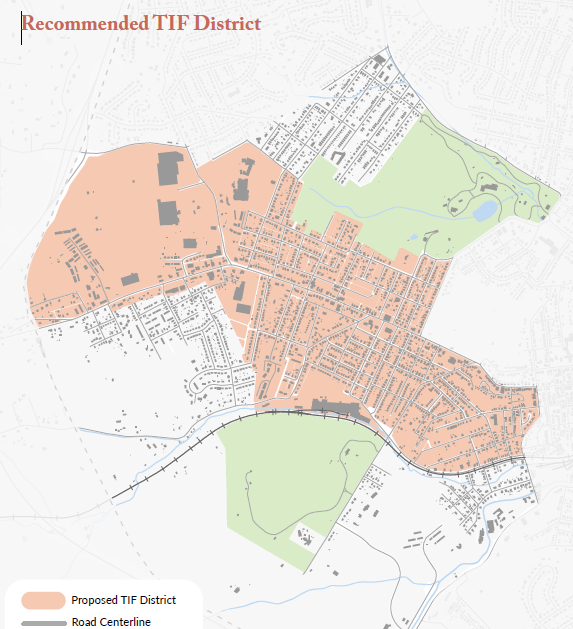
But let me not quibble. Let’s instead take a look at tax increment financing, which one might think would interest a city council that often cites the Dillon Rule as a major reason why we can’t have nice things. (Without getting too much in the weeds, the Dillon Rule is a governing principle that essentially means city and county governments in Virginia don’t have the authority to do anything that hasn’t been explicitly permitted by the state legislature. Which means, among other things, that the city council can’t just levy whatever taxes it wants.) Yet tax increment financing (TIF) is one of the taxing authorities that the state has given the city, and among the West End Revitalization Plan’s key recommendations is for Staunton to “research and establish a TIF district” in the West End to “finance infrastructure needs and improve public amenities.”

From page 35 of the ignored West End Revitalization Plan

As the revitalization plan explains, TIFs have been used throughout Virginia since 1988, typically to “finance infrastructure improvements in blighted and disinvested areas.” Here’s how they work: a “TIF district” is established via a city ordinance, in this case encompassing much of the West End, from which property tax revenue to the city is capped at existing levels for the life of city-issued bonds. Revenue from those bonds pays for eligible projects in the TIF district, including public infrastructure like streets, sidewalks, and sewer and water lines, as well as land acquisition and demolition, structured parking or plazas and, yes, brownfield remediation. As new buildings are constructed and renovations occur, property values in the district rise, as does the amount of property taxes collected—but the difference between the capped tax revenue and the increased revenue due to improvements is used to retire the bonds that funded them. This difference is the “increment,” hence the name.

Such a self-financing mechanism would address one of the biggest obstacles to Staunton’s efforts at revitalization, which is its lack of financial reserves. It’s also, despite being explored at some length in the revitalization plan, a concept quite foreign to city planners and officials. The Staunton Housing Strategy Group, for example, despite reviewing literally dozens of possible funding mechanisms as it laid the groundwork for what is now the city’s Housing Commission, never once considered TIFs. The city’s Economic Development Authority likewise never examined the possibility. It’s not as though city officials considered the pros and cons of such an approach to the West End’s needs and reached a reasoned conclusion—they just ignored the concept altogether.

None of this is to say that TIF is a panacea. While creating such a district in the West End could short-circuit the on-again, off-again piecemeal approach to revitalizing the area that has characterized Staunton’s efforts to date, it would tie up incremental revenue increases to pay off the bonds instead of using that money for other critical public services, some of which would face increased demand precisely because of TIF-enabled growth. Yet it scarcely needs to be pointed out that without the TIF approach that growth is less likely to occur in the first place, and with it a growth in jobs and in the long-term tax base.

More to the point, the lack of discussion about TIF districts raises the question of why efforts like the Revitalization Plan are undertaken in the first place. Staunton hardly needs more dust-catchers, which is the fate that awaits ignored plans and recommendations (take heed, those of you laboring on the Comprehensive Plan update). City councilman Jeff Overholtzer, the council’s liaison to the Economic Development Authority, said in response to my questions that he will “start a conversation” with that body about a possible TIF approach, which is certainly overdue more than 18 months after the city council signed off on the Revitalization Plan. But then again, given the city’s track record with its brownfields grant spending, maybe we shouldn’t expect too much even now.

Warring against willful ignorance

(Reading time: 11 minutes)

Staunton’s census tracts, showing homeownership percentages (in black) and poverty levels (in red), with Census Tract 2 highlighted in pink at left; from Anna Leavitt’s presentation to Staunton City Council on June 25.

For several weeks now—ever since the latest American Community Survey statistics were released—I’ve been thinking about writing something tentatively titled “A Tale of Two Cities.” The piece would have focused on the West End generally, and on Census Tract 2 specifically, and on the various disparities between that area writ small and Staunton overall. And then this past week Anna Leavitt beat me to the punch, at least partly, with a presentation to city council that was an unexpected and bright counterpoint to Staunton’s generally sluggish approach to such matters.

Leavitt, former director of CAPSAW (Community Action Partnership of Staunton, Augusta and Waynesboro), apparently has an affinity for complex acronyms: these days she identifies herself as Staunton’s EMOSA, which stands for Economic Mobility and Opportunity Special Assistant. She’s been in that position only since January, yet already has done more to fill in the terra incognita portions of Staunton’s demographic map than any of the numerous studies and plans generated over the past decade. That’s truly good news. But it’s only a start.

The bottom line in Leavitt’s presentation on Thursday was that it doesn’t matter where you live in Staunton, a median household income is no longer enough to buy you affordable housing. That holds true regardless of whether you’re a lower-income single parent with one child, a two-earner moderate- or middle-income household with two children, or a retired senior living on a fixed income: in each case, expenses outstrip income by several hundred dollars a month. In some parts of the city, however, the deficits are larger than others, and Leavitt’s analysis thus far is only scratching the surface of what that means.

Look at the statistics for Staunton’s seven census tracts, and you’ll be immediately struck by the extremes of Census Tract 2. This is the area south of West Beverley Street often recognized as a major part of the West End, which as defined by the city also includes a hefty chunk of Census Tract 3, on the north side of West Beverley. But Census Tract 2 is considerably more immiserated than its counterpart, as evidenced by median household incomes—$49,470 for tract 2, $80,914 for tract 3—and other indicators of economic well-being. As a result, discussions about the West End generally blur many significant variations; they also obscure the even more stark comparisons between Census Tract 2 and Staunton overall.

For starters (and as Leavitt pointed out), Census Tract 2 has the highest poverty rate of any Staunton census tract, at 19.2%, compared to the city’s overall rate of 12.6%. It also has one of the city’s lowest homeownership rates, at 43%, compared to a citywide average of 61%. That means nearly three of every five homes in Census Tract 2 are owned by someone who lives elsewhere, whether that’s in the house next door or in Virginia Beach, accounting for the large number of complaints from area residents about absentee landlords and neglected properties. It also means the tract’s 4,000 residents have limited financial resources, and therefore limited mobility, to improve their living conditions.

Moreover, the housing that exists, for renters and homeowners alike, ain’t that grand. Of the census tract’s approximately 1,120 rentals, nearly half have what the Census Bureau calls a “condition”: either a lack of complete bathroom facilities, a lack of complete kitchen facilities, an occupancy higher than one person per room, or rent that takes more than 30% of their tenants’ income. Homeowners aren’t faring a whole lot better, with nearly a quarter living in a home with a “condition.” Overall, then, it’s safe to conclude that a huge chunk of Census Tract 2 residents are living in crowded conditions or are paying way more for housing than is financially sustainable for the long term.

 Other Census Tract 2 statistics further underscore the challenges its residents face. Eleven percent of the population was without healthcare coverage in 2024—a percentage sure to have climbed this year because of the federal government’s decision to end Obamacare subsidies—as against 6.4% for Staunton overall. Sixteen percent of Census Tract 2 residents are disabled, which is not that much higher than the city’s rate of 15.2%, but which is more consequential in the context of all the other problems they face. It’s also noteworthy that 45.5% of Census Tract 2 residents have never married, a metric typically associated with household stability and individual health and longevity, compared with a citywide average of 33.9%. And a bit more than 15% of the area’s adults older than 25 don’t have high school diplomas.

The residents of Census Tract 2, in other words, face numerous obstacles that are more limiting than those found elsewhere in the city.  

THE POOR HOUSING SITUATION in the West End generally, and in Census Tract 2 specifically, is no secret. Indeed, having recognized the area’s potential to go into an economic tailspin, the city in 2020 embarked on a four-year exercise to forestall disaster by studying the area and formulating a remediation plan. The result was the 115-page West End Revitalization Plan that the Staunton city council formally adopted at the end of 2024. Woven throughout the plan are the concerns and complaints of area residents about a lack of available and affordable housing, as well as the widespread deterioration of existing housing stock.

But housing, as it turned out, was only a small part of the plan’s remit. And the final plan’s remedial housing recommendations are . . . superficial, to say the least. The leading “action item” regarding housing, for instance, calls for connecting West End homeowners “to existing resources” that would help them address “building and property maintenance code violations.” Only one of the plan’s proposals directly addresses renters, and then by suggesting they should be educated about their rights, presumably so they could hold their landlords accountable for providing decent, safe and sanitary quarters. Indeed, when you parse the handful of housing-related recommendations, it all boils down to a lot of talk but no action or any commitment to provide new city assistance.

It should go without saying that people one step away from being homeless are hardly in a position to insist that their rights be respected. When you’re scraping by at a job that pays less than $20 an hour but still have to fork over more than $1,000 a month for rent because there’s nothing available for less, your airy “rights” take a back seat to more pressing concerns when your landlord won’t get around to fixing the AC. You suck it up. And as I wrote 18 months ago, while the wool-gathering that went into the West End Revitalization Plan encountered repeated complaints of unscrupulous landlords and neglected properties, little of that got more than a passing acknowledgment in the plan itself, apparently because anecdotal stories are easier to ignore than hard numbers.

The lack of hard data should by now be a matter of civic embarrassment. Roughly six years after the revitalization study was started, city planners still do not have an inventory of vacant and developable land in the West End, or an inventory of deteriorating or abandoned dwellings that should be refurbished or condemned. (The city tax assessor presumably has that data, but that speaks to another city problem, of siloed information.) The city has no idea how many rental properties are owned by people who live outside of Staunton. And then there’s the problem of information bias creeping into studies like the Revitalization Plan: of approximately 170 responses to a community survey conducted for the plan, for example, only 78% were from people who actually live in the West End—and of those, nearly 90% were homeowners. In other words, responses from the renters comprising the majority of Census Tract 2 residents were vanishingly few.

Little wonder, then, that the revitalization plan’s proposed remedies regarding housing instability are so toothless. A meaningful recommendation, for example, might have called for adoption of a rental inspection program specifically targeting Census Tract 2, similar to programs operating in Roanoke, Winchester, Hopewell, Colonial Heights, Petersburg—cities throughout the Commonwealth that are both larger and smaller than Staunton. Such programs focus on specific areas in each city where older residences, absentee ownership and low incomes create an environment conducive to property neglect and housing deterioration.

Although the Virginia Landlord and Tenant Act makes landlords largely responsible for the living conditions in their properties, it doesn’t have a mechanism for tenants to enforce its provisions when a landlord ignores complaints. So a tenant’s options when faced with an intolerable living situation are to move—not exactly an alternative in the current market—or to file a lawsuit, which is an even more burdensome proposition. In cities that have rental inspection programs, however, rental units are subject to periodic inspections to ensure they conform with the state’s Maintenance Code, providing some assurance that such problems are less likely to crop up in the first place.

Waynesboro seemed about to adopt such a program three years ago, but then scrapped the effort amid claims that it would be too expensive to implement and that it would raise the already high cost of housing. That sounds remarkably like the fallacious arguments often made against increasing the minimum wage, serving mainly as a rationale for paying people slave wages or, in this instance, keeping them in blighted housing. But it gets repeated uncritically by those who don’t believe government should get involved in housing issues in the first place.

So, for example, asked why Staunton doesn’t have a rental inspection program, John Glover, whose job title is Building Official in the city’s Community Development department, replied that city staff had looked at the possibility in the past and “decided it was not necessary.” Having such a program, he wrote in an email that echoed Waynesboro’s rationale, “can increase the cost of rentals, which is detrimental to affordable housing.” It would require additional staffing, “which can be costly for the city.” A more cost-effective approach, he maintained, is complaint-based enforcement of the state’s Maintenance Code, which can result in the city taking legal action against property owners who don’t remedy violations.

Without providing any specifics about how many complaints have been investigated or how many times a property owner has been taken to court, Glover concludes that “this approach has proven to be very effective for many years.” Perhaps. But as with so many city responses to the West End’s problems, that assertion is made without a factual grounding. It assumes that people living in deficient housing not only know of the city’s complaint-based enforcement of the Maintenance Code—a code that gets only a single, unexplained mention in the Revitalization Plan—but that they have enough courage or desperation to risk calling attention to themselves by filing a complaint. A scarcity of complaints does not necessarily indicate the lack of a problem.   

ALL OF THE ABOVE presupposes that indeed there are unattended housing problems in Census Tract 2. Given the area’s general economic data and the anecdotal feedback received by the Revitalization Plan, that seems like a pretty safe bet. But that very wobbly assertion also attests to the city’s willingness to not look at things too closely.

If you can say with a straight face that you don’t see a problem, then no one can fault you for not fixing it, and that’s pretty much how Staunton has approached its housing problems in the past. That’s true city-wide, but especially so in the West End, and Census Tract 2 more specifically. That’s why the hard data is so spotty. It’s why city staff can so blithely declare that city intervention or oversight “is not necessary.” It’s how residents’  feedback can be superficially acknowledged but ignored when spending and policy-making decisions are made. It’s why planning study after planning study ends up gathering dust on a shelf somewhere.

That changes are afoot, albeit at a glacial pace, is not due to any sudden epiphany, but because at some point being oblivious stopped being an option. Our homeless population is not going away, and indeed—as may be confirmed mid-July in a special Point in Time census—appears to be growing. The state, which historically has left zoning decisions up to localities, is now mandating that Staunton and other cities allow construction of accessory dwelling units—essentially a second home—anywhere they allow single-family homes, an option over which Staunton has been dithering for at least the past year. Another state initiative, signed into law last month, allows churches and other tax-exempt nonprofits to build affordable multifamily housing on their property without prior city approval. And meanwhile the gap between what people are paid and what they have to pay to keep body and soul together is widening.

Staunton’s new EMOSA seems intent on plugging some of those data holes, which will make a deliberate ignoring of the problem much, much harder to sustain. Good luck, Anna!

West End: nothing to BRAG about

(Reading time: 7 minutes)

For anyone looking to understand why civic improvements in Staunton move at a snail’s pace, a good place to start one’s education is with the West End.

Long recognized as the city’s neglected quarter, its vitality sapped by construction of the Woodrow Wilson Parkway decades ago, the West End was targeted by the city council in 2020 as a “high priority zone” for revitalization. That same year, the city applied to the EPA for a three-year, $300,000 Brownfields Assessment Grant.  The purpose of the grant, as explained by city staff, was “to return vacant or underutilized properties to productive reuse” by assessing for possible environmental hazards, often from industrial waste but also from asbestos, underground gas tanks, lead paint or other contamination.  Site remediation would then “incentivize investment and jumpstart redevelopment and area-wide revitalization.”

Initial progress was promising. The EPA signed off on the grant the following spring, with the study scheduled for completion by September 30, 2024. Draper Aden Associates, a Virginia-based consulting engineer, was retained for the heavy lifting. And in keeping with an announced emphasis on “community engagement,” the city and its consultants planned a series of public meetings over a six-month period “to position the impacted community at the forefront as champions for these revitalization initiatives.”

Study oversight and community engagement was to be provided by the Brownfields Redevelopment Advisory Group (BRAG), a consortium of nine “partners” that would “take an active role in leading the City’s Brownfields Program.” Several BRAG members—including the Valley Mission, the Salvation Army and the Staunton Redevelopment/Housing Authority—dealt with housing issues, holding out the promise that this would not be a neglected focus in a process that could easily favor commercial interests. The West End Business Association and Staunton’s West End Alliance, meanwhile, were singled out as being “strongly committed to the preservation and revitalization of West End and will take an active role in leading the City’s Brownfields Program.”

Indeed, BRAG was to play a crucial role in ensuring that the West End wouldn’t simply become a colonial outpost for a bunch of remote planners parachuting in. It would “meet quarterly to assist City staff in site selection and cleanup/reuse planning,” according to the grant application, which added that BRAG and the city would involve representatives “of neighborhoods most directly impacted by proposed redevelopment projects.” Moreover, “partner organizations like the Salvation Army and Valley Mission will represent disadvantaged communities to communicate their needs and disseminate information, which will be beneficial for constituents with limited internet and/or phone access.”

But of course, man plans and God laughs.

Four years on, the brownfields study is still incomplete. Draper Aden Associates has been gobbled up by a larger firm which, if city staff are to be believed, is extremely slow in responding to information requests about its activities. The planned series of public hearings was severely whittled down over Covid concerns. And BRAG? Never happened. The West End Alliance apparently no longer exists as a separate entity. The other BRAG “partners” never met as a group, had nothing to do with selecting brownfield sites for study, and indeed seem largely ignorant of their supposed role.

The disadvantaged communities presumably remain just that.

THERE IS ONE SILVER LINING to this $300,000 brown cloud, and that’s the redevelopment of the former Chestnut Hill Shopping Center. As it happens, this was one of three “priority” sites identified by the grant application because of “their potential to catalyze additional investment and revitalization of West End, as well as to extend redevelopment opportunities.”  That the vacant shopping center happened to meet the city’s need for some place to build a new courthouse was a fortuitous accident, not the result of careful planning, but you take your wins where you can. Will a courthouse turn out to be the best use of that property in the interests of West End revitalization?  Maybe, maybe not, but in any case a moot point now.

But what of the other two “priority” sites that were identified by the grant application, carefully picked from among more than 25 candidates chosen for their “potential to change the blighted landscape and revitalize the stagnant economy in the target area”?  The first is a one-acre site of a salvage yard that closed in 2011, apparently targeted because of its high potential for contaminating Lewis Creek with heavy metals, PCBs and volatile organic compounds. In other words, not much redevelopment potential but a possible environmental disaster if not attended.

The third of the three sites, however, amounts to an enormous blank slate that could accommodate the most ambitious of developments. Bounded by Morris Mill Road on the north and east, the former Unifi Manufacturing site spans approximately 50 acres and has been vacant since 2008. Immediately to its south is a vacant, wooded tract of an additional 27 acres, which backs onto a Food Lion supermarket, while a connecting vacant lot on the east side of the Food Lion could give direct access to West Beverley Street. Ware Elementary and Shelburne Middle schools are within easy walking distance.

All of which is to say, the West End has a void that screams for development. City maps of the West End core study area and of a proposed enterprise zone look like an upside-down saucepan, with the handle running from downtown along West Beverley, then flaring out along Morris Mill Road to the city boundary. The West End Revitalization Plan has a map on page 28 that includes a large green area, matching exactly the description provided in the preceding paragraph, labeled “redevelopable parcels.”  As the grant application summarized, “the site’s proximity to schools and residences make it a high priority for investigation and redevelopment.”

Indeed—but no. The UniFi site is history. Just don’t try to figure out why.

Consider the grant application’s effusive embrace of community engagement: “To maintain progress throughout the grant period, the QEP [Qualified Environmental Professional] will prepare monthly reports to the City and BRAG in compliance with the approved EPA Cooperative Agreement Work Plan, which will summarize activities, e.g. milestones achieved, issues encountered, and budget/schedule updates. These will be used to gauge progress, communicate with constituents and prepare quarterly performance reports.”

Those quarterly reports, however, are too sketchy to be of use to anyone. For example, the decision to extend the initial three-year grant by an additional year is described thus: “An Extension Amendment Request was submitted to EPA as well as updated contact sheet siting a new Grant Recipient Representative.” No reason given why more time was needed—but at least the change was noted. Not so for the UniFi site, which after more than a year of investigation, abruptly dropped off the radar at the end of 2023. The quarterly reports don’t even acknowledge the deep-sixing of its largest “high priority” site, much less a reason for the radical change. On the other hand, the quarterly reports do make sporadic mention of other possible brownfields sites, such as Don’s Auto Repair and Gypsy Hill Park, but again without any explanation.

Does anyone living or working in the West End have the slightest idea that the brownfield study is still chugging along? Highly unlikely. But just as much in the dark are city leaders and planners, all of whom—from council members to the city manager to the head of the planning department—are new to their positions since the grant application was submitted and unable to answer even basic questions, such as why Gypsy Hill Park belatedly became part of a West End brownfield study. This is a ship that has been set adrift, and one can only hope it will eventually touch shore undamaged.

The good news, if one can call it that, is that as of the end of March the study had eaten up only 54% of the original grant money. Of course, that does raise the question of how the city will reasonably spend the remaining $138,000 before Sept. 30—or whether it will seek yet another extension. Maybe it should turn to the West End’s residents for answers. Just don’t look to BRAG for help.

Seeking your thoughts—kinda

(Reading time: 7 minutes)

It’s a fair guess that most Stauntonians have never heard of the city’s comprehensive plan, much less seen it, and that’s not really surprising. The 450-page document states quite explicitly on its cover page that it was prepared for the Staunton Planning Commission, which makes it sound more arcane than it is. The current version is five years old, so a whole lot of water has gone under the bridge—quite literally, in the case of downtown—since it was drafted. And all the people who you might expect would be most involved in its implementation are no longer there: every city council member, the city manager and the city’s director of community development have moved on since the plan was completed.

Then again, much of Staunton’s Comprehensive Plan actually doesn’t, well . . . plan anything, so it’s easy to ignore. While the Commonwealth of Virginia requires every municipality to prepare such plans “with the purpose of guiding and accomplishing a coordinated, adjusted and harmonious development of the territory,” the Commonwealth Code also states that that the plan should be a survey of that municipality’s assets and challenges—and that’s the basket in which Staunton placed most of its eggs. The result is more descriptive than prescriptive, an inventory of the Staunton that existed in 2018 but with few attempts at guidance for the near future, never mind to the plan’s supposed end date of 2040.

But now we have a chance for a do-over. Starting last year, city staff, consultants and a small group of Staunton residents have been revising the plan to make it more up-to-date and, we can hope, make it more of a planning tool than it has been. That process has included seeking input from Stauntonians as to what they think should be in the plan, through online surveys and a series of public meetings, and the next such meeting—an open house at Staunton High School—is less than a month off. Anyone concerned about the city’s future should make an effort to be there: Wednesday, June 25, between 5:30 and 7 p.m.

That said, I wouldn’t be my usual curmudgeonly self if I didn’t add a cautionary note. Despite the city’s apparently diligent attempts to solicit public opinion about various plans, these efforts often have an unfortunately performative aspect to them. The ritual involves lots of easels covered with large white sheets of paper, lots of small stick-on dots in various colors, and an abundance of post-its of obviously limited size on which to scribble fresh ideas. Those in attendance are asked to respond to various questions about whatever the city thinks should be of greatest concern to them, and the answers are subsequently collated, summarized, mentioned in final plan documents—and, generally, thereafter ignored.

Does that sound harsh? Consider, then, the West End Revitalization Plan, completed last summer and subsequently adopted by the city council. That plan also went through a pro forma attempt to get input from West End residents, including public meetings and an online survey. The meetings made it abundantly clear that public “concerns about property upkeep and affordable housing” were among the area’s most notable “challenges.” The online survey disclosed that of eight possible concerns, West End respondents thought that “improved upkeep of existing housing” was the second most “important” or “very important,” just four votes behind the 194 cast for “adding new shops, stores and services.”

How seriously were those views taken? The final, adopted plan is big on retail improvements but scarcely gives a nod to housing concerns. Indeed, only one of 17 proposed actions in the plan directly addresses housing rehabilitation, and does so in the most dismissive way possible by suggesting simply that the city “connect residents to existing resources.” Which is to say, the West End doesn’t have a problem with property upkeep and affordable housing, it has a communication problem.

It therefore will be interesting to see to what extent public input registers in this far broader, city-wide planning document. One possible marker was provided by the Jan. 22 open house, the first of three, when 106 local residents registered their attendance (although city officials believe the actual number attending was higher) and repeatedly voiced support for mixed-use development. Attendees emphasized “the need for mixed-use areas that integrate homes, shops, and parks to create vibrant neighborhoods,” according to a summary of comments under “land use.”  Similarly, in a summary under “economic resources & development,” attendees “highlighted the need for increased mixed-use development and support for small businesses in less densely populated areas.”

The summarized comments about housing, meanwhile, illustrate an increasingly sophisticated understanding of what it takes to create a truly dynamic community. Attendees “highlighted the need for affordable housing for their workforce, concerns about rising prices, the lack of options for low-income and middle-income households, and . . . a pressing need for better connectivity between residential areas [and] increased density of housing.”

The emphasis on mixed-use developments and increased housing density, in a city largely mired in a century-old land-use philosophy known as Euclidean zoning, is in some ways revolutionary. Euclidean zoning (the name comes from a village in Ohio, not the Greek mathematician) separates land uses by type—residential, commercial, retail, industrial, etc.—each into their own zones or areas. That may be desirable in preventing a factory or a slaughterhouse from being plopped down next to a church or apartment complex, but it also creates the largely fragmented land-use pattern we have today, with the notable exception of downtown. Add to that a residential zoning preference for detached single-family homes, with broad swaths of the city’s 20 square miles zoned R-1 (maximum of three homes per acre) and R-2 (maximum of five), and the result is a pleasantly bland, dispersed suburban landscape on which builders can’t afford to build homes for low- and middle-income families.

One possible work-around for developers is to seek special use permits so they can build the mixed-use and denser housing that city residents attending these sessions say we need—but for several presumably obvious reasons, that’s not an attractive option. Nor is it happening in any meaningful way. The alternative, therefore, is for those working on the comprehensive plan update to rework the city’s zoning code—to revise the rules and maps that keep things the way they are—so that standards for higher density and mixed-use developments are written into the code, creating “by right” options for developers. No more having to say “Mother, may I please?”

Whether that in fact will happen is . . . let’s just say not likely. One problem with these sounding-board sessions with the public is that they come at a time when the plan revisions are already well underway, so there’s a natural resistance to taking on big new projects—and rewriting zoning ordinances is just about as big as they come. Then there’s the problem of public backlash. Although the Stauntonians attending these open houses may be largely in favor of such changes, they also tend to be more actively engaged in civic affairs than the majority of the population—and a lot of those folks would be aghast at the idea that there could be a wholesale reordering of the land-use landscape ( just one of the problems facing developers seeking special use permits). Winning them over, or at least muting their resistance, would take time, public education and reassurance.

So I’m not optimistic that these open houses and other attempts to solicit public input will make any meaningful difference. The ship’s course is fairly well set, and any comments that might adjust its bearings are no more likely to change the outcome than occurred with the West End Revitalization Plan. But still. The arguments are worth making, if only to lay one more brick against the day when they finally will make a difference.

West End plan a half-baked dish

(Reading time: 17 minutes)

It’s been four years since Staunton residents first met to discuss a revitalization plan for the West End. Many such meetings, an online survey and input from approximately 300 residents and stakeholders later, a 115-page document that describes itself as “the first holistic plan for Staunton’s western neighborhoods” was presented to the city council this past August, which voted in September to accept it provisionally. Final acceptance is scheduled for a Dec. 12 council meeting, following one final public hearing.

And then?

Quite possibly, not nearly enough. This critique argues that the West End Revitalization Plan is a half-baked dish that isn’t what the customer ordered, notwithstanding its claims to be a community product, and should be sent back to the kitchen. Suffused with a hearty stew of information and suggestions for economic revitalization, improvements to streets and sidewalks and more development of green spaces, it nevertheless serves up only a thin gruel of recommendations for upgrading the area’s residential stock. Housing issues, cited repeatedly by area residents as a major concern, are all but ignored in a document that fundamentally “assumes” reinvestment in the commercial corridor “will lead to reinvestment throughout the rest of the West End,” including private properties and residences.

Not that this is a new attitude. As I wrote earlier, in a white paper released in early September, Staunton has long given lip service to issues of sustainable and affordable housing, as exemplified by its 2018 Comprehensive Plan. There, it contends that “[h]ousing is primarily a private system that is influenced by factors beyond those controlled by local government,” in effect washing its hands of any problems. That sentiment was echoed in the city council’s contemporaneous “Vision for 2030,” wherein the only mention of housing is the claim that Staunton “has housing affordable to a full range of households”—a statement presumably absolving the city of any need to take a closer look at what housing is available, what condition it’s in and whether there’s enough of it to go around.

This myopic perspective has been a recurring theme in several city studies, with the West End Revitalization Plan only the latest link in a chain of housing denial. Planning for the city’s marquee economic development project, for example, started with a consideration of housing as a possible component of Staunton Crossing, only for the idea to be dropped midway through the conceptualization process. There appears to be no written record of the thinking that went into the decision to pivot away.

So when it came to formulating the West End Revitalization Plan, the city’s consultants weren’t starting with a blank slate: they were building on a foundation of other, prior studies with an unacknowledged blind spot. The Cole Avenue stream restoration plan, the intersection improvement study, the long-range transportation plan, the brownfields assessment, the greenway plan, the Gypsy Hill stream restoration plan, the bicycle and pedestrian plan, a city flood analysis—all are cited in the plan as resources that shaped its outcome. None deals with housing. The one marginal exception is the Comprehensive Plan, which despite its repudiation of housing as a city concern, at least provides a city-wide inventory of housing stock, sorted by age and market value.

Nor were the planners concerned about enlisting expert housing assistance. While the plan relates how “transportation planners explored ways to improve the multimodal transportation network” and “economic experts studied the types of business that can be successful in the West End,” there is no mention of input from urban planning and renewal professionals—planners with expertise in addressing urban blight and deteriorating residential neighborhoods.

No wonder, then, that the Revitalization Plan’s attention to housing is fleeting and superficial. Past is indeed prologue.

BUT AS ALREADY MENTIONED, four years of research included several efforts to solicit comments and suggestions from the people closest to the issues. Surely the West End’s residents had something to say about paying attention to housing as part of any meaningful revitalization plan?

Indeed they did, and the Revitalization Plan occasionally acknowledges such concerns, even as it sidelines virtually all such input to its appendices—which, inexplicably, are not attached to the plan itself. The main narrative instead summarizes the many comments planners received in bloodless statements such as, “Throughout the engagement process, community members expressed concern about vacant or unmaintained properties and believed they were reducing the West End’s appeal”—a marked contrast to the more vivid language the plan uses for its own vision, which it describes as  “a vibrant, diverse and multimodal community, where residents can safely and conveniently access their thriving commercial corridor.” Would that its description of the housing situation were as compelling.

Yet as those seeking out the plan’s appendices will learn, the lack of adequate housing in the West End was a dominant theme throughout the planning process. An early stakeholder meeting, for example, concluded that “the West End neighborhoods are aging. Coupled with limited incomes, concerns about property upkeep and affordable housing” were among the area’s most notable “challenges.” Asked to list those challenges, respondents used adjectives like “dreary” and “lackluster,” and roughly a quarter of their comments were housing-related, including complaints about absentee owners and landlords, homeless tent camps, deteriorating Section 8 housing and roadside parking in residential areas. Asked what they would like to see more of in the West End, participants listed “affordable housing, multifamily housing, incentives to rehabilitate vacant or unlivable homes, initiatives to help those who cannot financially maintain their homes, and a renter’s Bill of Rights.”

An online survey late last year provided a graphic ordering of local priorities, with respondents asked to rank, on a scale of 1-5, eight possible elements of a revitalization plan. Leading the list was “adding new shops, stores and services,” with 194 respondents feeling that this was either “important” or “very important”—but running a close second was “improving upkeep of existing housing,” which got 190 votes as “important” or “very important.”  The third biggest response to that question, meanwhile, was “adding new jobs and employment opportunities”—a choice one might have expected to get significantly more than the 179 “important” or “very important” votes it actually received, given a median household income in the West End that’s 28% lower than in the city overall.

The big emphasis on “improved upkeep of existing housing” is rooted in a bleak reality that the plan scarcely acknowledges and never researches in any detail. Yes, the plan gives a brief nod to the area’s demographics: older, poorer, and with a higher proportion of non-white residents than is true of the rest of Staunton. And there’s an equally succinct summary of the homes the West End’s residents inhabit—homes that the plan claims are on average valued at $139,850, or less than two-thirds of the city’s overall median. But within those broad strokes are even more extreme variations, not mentioned by the plan, such as the three census blocks (of seven West End blocks altogether) in which the median house value was just $115,000 in one, $111,600 in another, and $111,100 in a third.

(Those figures, found in the Comprehensive Plan, must be kept in perspective, as they—and virtually all housing statistics currently floating around—are seriously outdated. The Comprehensive Plan’s numbers are from the 2010 U.S. census, which means they’re not only quite old but predate the significant explosion in real estate valuations of the past three years. The Revitalization Plan, on the other hand, doesn’t cite specific sources but almost certainly uses statistics derived from pre-pandemic data.  Despite this ambiguity, however, it’s clear that seven years ago, approximately 1,300 homes in the West End had a median valuation less than half the city average, and it’s highly unlikely that the ratio has narrowed since—indeed, just the opposite may be expected, due to the ongoing deterioration of the West End’s older housing stock because of its older population and lower income levels.)

Given all of the above, it’s reasonable to think the completed revitalization plan would have a substantial and detailed set of recommendations addressing the West End’s housing stock. It does not. Not even close.

AFTER YEARS of casting their fact-finding net across the West End, the city’s consultants settled on a four-pronged set of goals for the area’s revitalization. The first three entail creating more opportunities for West Enders to go shopping, to more safely navigate local streets and sidewalks, and to enjoy enhanced green spaces. The fourth, meanwhile, labeled “reinvestment and affordability,” describes a need to “foster reinvestment in the West End’s neighborhoods and homes while maintaining affordable living and homeownership opportunities.”

One might question why a concern repeatedly cited by local residents as one of their top two issues got bumped to fourth place on a list of goals, but at least it didn’t get completely ignored—although the devil, as they say, is in the details.

For each of the four goals, the revitalization plan lists strategies, actions, and a secondary set of “other actions.” Combined, the four goals prescribe 10 strategies, 17 proposed actions and a dozen “other actions.” Only one of those strategies, “support home renovations,” specifically targets housing. And only one of the 17 proposed actions is listed under that housing strategy: “connect residents to existing resources.” In other words, the plan sees no need to come up with any housing initiatives, and certainly no need to spend money other than on staff time—unlike its other goals and their strategies, which call for such investments and incentives as possible tax increment financing, repairing sidewalks and building bus shelters, planting trees, creating a public square, and so on. When it comes to housing, revitalization is in the bargain bin.

To be fair, the home renovations strategy also proposes one “other action” item, recommending that the city develop a home conditions program to help “homeowners and landowners improve their properties’ sustainability, health and affordability.” Such a program, the plan notes, would be best served by a non-profit organization taking a lead role, leaving it up to the city to promote dialogue and coordinate targeted efforts. The suggestion is not nothing. It also requires almost nothing from the city.

That lack of city skin in the game also is reflected in the plan’s other two strategies for the reinvestment goal, to wit, “reinvest in community centers and resources,” and “support neighborhood advocacy”—strategies that call for “reimagining” the former Booker T. Washington high school as a community center (which it already is), and for providing renter education programming. Again, not nothing. And, again, requiring little more from the city than staff time, which is an impoverished definition of “reinvestment.”

In letting the city off the hook for doing anything meaningful about West End housing, the revitalization plan’s authors are simply taking their cue from their paymasters, as reflected in one particular comment. In response to community requests for “additional housing rehabilitation resources,” the plan reports, “City staff noted several programs already exist.”  Which is to say, “We’ve already got everything we need, no need to reinvent the wheel, let’s move on.” Are those programs up to the task? Unknown, since the revitalization plan makes no effort to establish the extent of the problem they are being expected to address. Do those programs have adequate finances, manpower and management skills to meet the need, whatever it might be? No way to answer that, either, since the programs themselves were never examined—all that the plan provides is a recitation of program names.

Paradoxically, the plan does assert elsewhere that “[t]he city currently does not have a program that helps homeowners and landowners improve their properties’ sustainability, health and affordability.” And the city’s assertion that “several programs already exist” is at best a passive-aggressive assertion that puts the onus of unmet needs on those who need help, rather than on those who have the resources they need. The city’s website, for example, lists a score of local, state, federal and non-profit programs and services that are housing related and possibly useful resources for city residents—if they have wi-fi and computer access, if they know where to look, and if they can figure out which of that smorgasbord of entries is relevant to their needs.

Meanwhile, you would never know from the revitalization study that one reason why the West End feels “run-down” is the small but readily visible number of homeless people on its streets. You would never know, from the study, that there is a homeless encampment behind the Food Lion. You would never know that the area has several social agencies targeting the homeless and the near-homeless, including the Valley Mission and the Salvation Army. You wouldn’t know that the West End is where much of the city’s subsidized and public housing is located.

The homeless and those who need subsidized housing also have needs, but those needs won’t be met without acknowledging their existence. Yet despite repeated community input about unsheltered people living in the West End, the plan simply doesn’t see them. They don’t exist. The revitalization plan proposes a neighborhood arts program as “a cost-effective way to beautify public spaces and local neighborhoods,” even as it completely ignores how those public spaces and neighborhoods are made less beautiful by people wandering the streets in obvious need of showers, warm food and a safe place to lay their heads each night.

IN GLOSSING OVER the many housing concerns raised by West End residents, the revitalization plan must be seen as an incomplete and flawed document. The planners behind this effort created a four-legged table, but one leg is so much shorter than the other three that the whole structure is too wobbly to be more than marginally useful.

 Worse yet, by seeking community input and then ignoring much of what it received, the city and its planners have provided yet another reason for public skepticism about government responsiveness. It’s insulting to be asked for one’s thoughts, only to have them disregarded without an explanation, and it’s disrespectful to expect people to contribute their time and energy to an exercise that treats their contributions in such cavalier fashion. This is how civic responsibility and involvement are eroded, replaced by cynicism and resignation.

A comprehensive—or “holistic,” to use its own terminology—revitalization plan would provide as much granular detail about housing stock as it does in its description of sidewalks, or of the potential for business development in the West End. It would explore possible funding sources for underwriting housing repairs, as it does when recommending tax increment financing for economic development, or public-private partnerships, such as land banks and land trusts, to deal with abandoned or blighted dwellings. It would examine current zoning requirements to see if they are impeding private sector investments, and it would analyze the city’s fee structure for new housing for the same reason. It would consider whether the city has a role to play in regulating absentee owners who buy housing for investment purposes, rather than as personal dwellings. It would explore a possible renter’s bill of rights, as urged by several area residents.  

None of this is beyond Staunton’s scope. City leaders sometimes deflect such proposals by claiming their hands are tied by the Dillon Rule, a principle of American municipal law that limits the powers of local governments to those explicitly granted by the state, and to a certain extent they’re correct. But that doesn’t mean the city is entirely without options. Virginia Housing, a self-supporting organization created by the state specifically to help Virginians attain quality affordable housing, released a detailed study last November, titled “Housing as an Economic Development Strategy for Virginia,” that lays out these and other strategies that Virginia cities can use to address housing needs—strategies, in other words, that are available to Staunton right now, and without running afoul of Dillon Rule limitations.

Moreover, it’s worth noting that the very title of the Virginia Housing study gets at a basic economic truth that the revitalization plan fails to recognize.  As the study also summarizes, “Changing economic and market conditions have exposed the necessity of aligning housing and economic development efforts strategically,” which in plain English means that housing and economic development are two sides of the same coin. Meaningful improvement of one requires improving the other. By failing to acknowledge that symbiotic relationship, the West End Revitalization Plan undermines the salutary work it has otherwise done.

Then there’s the elephant in the room, which never enters the revitalization plan’s field of vision. By ignoring the problem of area homelessness, the plan unnecessarily weakens its proposals for economic revitalization and green space enhancements. It also ensures that the plight of the city’s unsheltered residents will only get worse, as occurs with any untended building or garden that’s allowed to deteriorate.

For example, there’s an obvious need in the West End for more short-term shelter space, as the Mission not only can’t accommodate everyone who needs its facilities but is being pressed to shelter people longer because of a lack of longer-term housing—there’s just nowhere for people to go. There’s also a need for overnight warm shelters and for “cold shelters,” where homeless people can go during winter days. Without that, they end up congregating anywhere they can find some warmth—riding Brite buses, hanging out in fast-food restaurants, the library, the YMCA or the community center in Verona—undoubtedly discomfiting the “regular” patrons of those establishments or services. Moreover, as summers get hotter, there will be a growing need for cooling shelters, not just for the homeless but for the many poverty-level residents of the West End without air conditioning.

Finally, by failing to adequately inventory the West End’s physical infrastructure, the revitalization study overlooks possible resources that could be tapped to meet some of these needs. For example, how many older churches in the West End are occupied by dwindling congregations that can barely keep up with maintenance and utility costs? The former Allen Chapel AME church on West Beverley provides one example of how such demographic trends can play out: it’s been converted to housing—for transient guests, occupying its two Airbnb accommodations. Are there other large churches whose congregations could be approached with purchase offers, sufficient to allow them to downsize to more appropriately sized buildings while enabling their existing quarters to be repurposed for a different kind of service?

These and numerous other questions can be asked, and various innovative remedies can be explored, only if the West End’s underlying needs are comprehensively identified. There’s no question that the area needs an injection of economic vitality, that it would benefit enormously from repairing and building an adequate bicycle, pedestrian and jitney bus infrastructure, and that enhanced green and public spaces could generate more community interaction and a sense of civic pride. The West End Revitalization Plan addresses all those needs and provides a detailed schematic on how they may be addressed.

On the issue of adequate and affordable housing, however, it falls disastrously short, and thereby places the whole revitalization effort at risk.

Throw a party but ignore the guests?

(Reading time: 9 minutes. Written to the city council.)

Imagine you’re planning a lavish themed gala. You obsess over every detail. The driveway, decorated with torches and flower stands, valets dressed in period attire. The dining hall, with its linens, centerpieces and place settings specified to the smallest escargot fork. A small dance orchestra inside, complemented by a string quartet on the outdoor patio.  An elaborate menu of multiple servings of hot and cold entrees and side dishes, preceded by consommé and followed by flambéed desserts.

Everything neatly planned—everything, that is, except for the actual guest list.

That’s pretty much what you’ll be considering at tomorrow’s city council meeting, when you’ll be asked to lay the groundwork for amending the city’s Comprehensive Plan 2018-2040 by incorporating the West End Revitalization Strategies Plan as an addendum. A favorable vote will allow scheduling of a public hearing, to be followed by a council vote Dec. 12 to make it all official.

I have two thoughts about this that I hope you’ll consider.

First, the process of updating the Comprehensive Plan has just started. Assuming this is a goodwill effort to rework a flawed document, as briefly outlined in the white paper I submitted to you last week, it would seem that the comprehensive plan’s committee should get first crack at this revitalization plan as part of its overall mandate. As it is, the council is building an addition to a dwelling even as it’s being renovated, which is putting the cart before the horse (pardon the mixed metaphor).

 But the greater concern I have is more substantive than procedural. The West End Revitalization Strategies Plan, while more comprehensive and detailed than most city planning efforts, falls woefully short in addressing the needs of those whose most pressing needs made the plan necessary in the first place: the people who live in the West End. It’s as though the consultants who prepared the plan, EPR, had planned a banquet down to the smallest detail but had inexplicably forgotten to devise a guest list. Who’s coming? What food preferences or allergies do they have? Who shouldn’t be seated next to whom? Will any of the guests have disabilities that must be accommodated?

Yes, there is a brief nod to the area’s demographics: older, poorer, with a higher proportion of non-white residents than is true in the rest of Staunton. And there’s an equally succinct summary of the homes these residents inhabit—homes that on average are valued at less than two-thirds the overall median for the city overall. (A median, statistics buffs will note, that would be even higher were it not dragged down by this millstone.) But throughout the document, the implications of this soft (to use a kind word) housing stock are ignored. At best, the West End is glibly dismissed as having “more affordable housing than the city,” implying that there’s lemonade to be made from these lemons but without any attempt to ascertain how many of those lemons are long past their sell-by day.

Sometimes “affordable” just means crap.

But how could it have been otherwise? The West End Revitalization Strategies plan, like most such efforts, built on what came before. And as I’ve already established, housing historically has not been viewed by Staunton and its planners as a proper city concern. Consider the many plans that EPR consulted in formulating its conclusions: the Cole Avenue stream restoration plan, the intersection improvement study, the long-range transportation plan, a brownfields assessment, the greenway plan, the Gypsy Hill stream restoration plan, the bicycle and pedestrian plan, a city flood analysis, the Comprehensive Plan itself—what’s the common thread here? Not one of these plans or studies examined the condition and distribution of the city’s housing stock, or where it might benefit from timely city intervention.

Small wonder, then, that the revitalization study’s “vision” is as blind to housing issues as those other documents, the statement focusing almost exclusively on multimodal transportation needs, local shops and commercial corridors, and the condition of streets and sidewalks. These concerns are propelled by a “local narrative that the West End feels ‘run down,’” a theme that “was persistent during the engagement process” and therefore a driver of “this planning effort to revitalize the area.”

It’s not that the feedback EPR solicited didn’t include housing concerns. Time and again the plan refers to the “persistent” demand for help with housing. “Throughout the engagement process, community members expressed concern about vacant or unmaintained properties and believed they were reducing the West End’s appeal,” the report summarizes at one point, adding, “those participating in the meetings expressed concern for absentee landlords and renters’ rights violation.” Similarly, the study elsewhere notes community “concerns about the expense of renovating their homes and the appearance of homes in their neighborhoods.”

Yet when the study states that the community “requested additional housing rehabilitation resources,” city staff “noted several programs already exist.” Nothing to see here!

Ironically, that last quote is followed a page later by this observation: “The city currently does not have a program that helps homeowners and landowners improve their properties’ sustainability, health and affordability.” That apparent contradiction presumably may be attributed to the plethora of non-profit and charitable groups—some of which, to be fair, receive some funding from the city—that form the basis of the plan’s only “action” item under “Support Home Renovations”: “Connect Residents to Existing Resources.”  (Having a heart attack? Here’s a list of local health providers, but you’ll have to figure out which ones may actually be able to help you. Podiatrists? Not so much.)

Are those existing resources adequate for the job of improving housing “sustainability, health and affordability?”  The plan doesn’t say, because it doesn’t evaluate either the size of the job or the finances, manpower and management skills needed by those numerous agencies. Nor does it suggest how best to coordinate those disparate efforts, to minimize duplication and leverage what resources are available in the most efficient manner, beyond speculating that the Booker T. Washington Community Center “could” help local residents “access various local, state and federal programs and services for housing needs.” But however and whenever that might work out, the strategy plan makes it clear that the city sees no reason to get more involved than it already is.

This kind of “you got into this mess, now you figure out how to get out of it” approach is not, of course, what EPR outlines in the rest of the plan. The section on creating a “vibrant commercial center” prescribes three action plans, all involving the city’s direct involvement, while its advice to “raise awareness of existing programs”—the only “action” item under home renovations—is in this more favored subject area relegated to a secondary, “other action” mention. Meanwhile, the section on health and safety connections has five action items, four which require city funding; and the section on green neighborhoods likewise has five action items, at least three of which require city funding. One has to assume that the creativity well had run dry by the time EPR reached the end of its problem categories.

It should go without saying that if the driving force behind this study is “a local narrative that the West End feels ‘run down,’” then that perception must apply just as readily to housing as to commercial and public properties. Fixing up storefronts and painting some murals won’t be sufficient to turn the eye away from overgrown vacant lots, houses with peeling roofs and crumbling porches or rusted-out vehicles sitting in unkempt front yards. (The phrase “lipstick on a pig” would come to mind, were it not so overused.) As long as the revitalization study overlooks this significant area of concern, its job is only half-done and the study should be returned to EPR to finish its work. The gala banquet has been fully prepped, but where, oh where, are the guests?

Which brings me to my final point. You would never know, from reading this revitalization study, that part of the reason why the West End may feel run-down is the small but readily visible number of homeless people on its streets. You would never know, from the study, that there is a homeless encampment behind the Food Lion. You would never know that the area has several social agencies targeting the homeless and the near-homeless, including the Valley Mission and the Salvation Army. You wouldn’t know that the West End is where much of the city’s subsidized and public housing is located. You have, right there, a reverse description of the slippery slope on which people living in homes they can no longer afford may find themselves, sliding through Section 8 rental units (if they’re lucky) to a homeless shelter and then onto the streets. All within a “revitalized” West End.

The homeless also have needs, and meeting those needs would go some way toward shedding some of the area’s “run-down” appearance. For example, the need for more shelter space similar to the Mission’s temporary housing is obvious, but there’s also a need for overnight warm shelters and for “cold shelters,” where homeless people can go during winter days. Without that, they end up congregating anywhere they can find some warmth—riding Brite buses, hanging out in fast-food restaurants, the library, the YMCA or the community center in Verona—undoubtedly discomfiting the “regular” patrons of those establishments or services. Moreover, as summers get hotter, there will be a growing need for cooling shelters, not just for the homeless but for the many poverty-level residents of the West End without air conditioning.

The West End Revitalization Strategies Plan has many admirable and even exciting proposals, but it suffers from the same blind spots that afflict other city planning documents. Central to all of them has been Staunton’s distorted embrace of government’s role in the private sector, in which it is all for providing tax incentives, zoning concessions, planning services, and recruitment and outreach to commercial interests, but becomes myopic when turning its gaze on the working poor and the impoverished, who together make up a majority of the West End population.

Quite simply, more is needed. This plan should be returned as incomplete, and while it’s being reworked, maybe updating of the Comprehensive Plan can proceed in relative peace.