
It’s time to take off the blindfolds

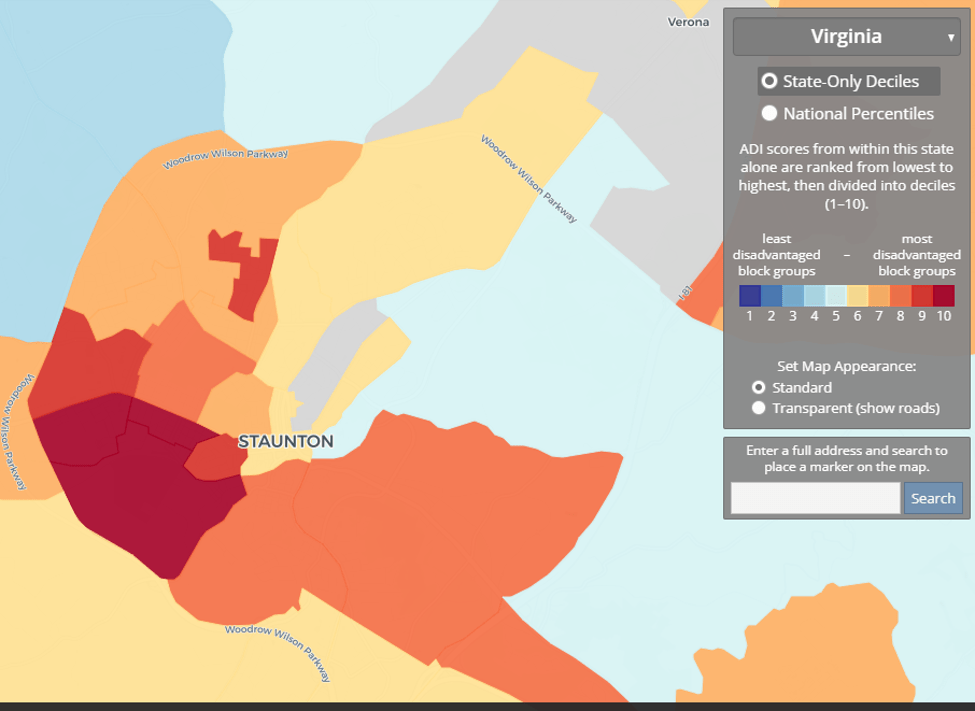
A map of Staunton’s Area Deprivation Index shows the city’s most disadvantaged neighborhoods, where residents are most vulnerable to disasters.

(Reading time: 14 minutes)

The timing could not have been tighter. On Jan. 22, the Staunton City Council adopted an update to its Emergency Operations Plan (EOP). On Jan. 23, City Manager Leslie Beauregard activated that very plan as a major winter storm battered the region with heavy ice and snow. The emergency declaration, Beauregard explained, “removes any barriers to our response efforts and allows us to mobilize additional resources, if necessary”—a prescient call, as it turned out, when the city had to call on additional contractors with beefier equipment to clear ice-bound streets.

How did it all work out? So-so. An after-action review of the city’s response detailed what worked well, what did not work so well and what “action steps” the city should take in response. Staff dedication, contractor response and communications all got high marks. On the other hand, the sheer enormity and unpredictability of the storm, as well as staffing shortages and equipment limitations, all hindered an adequate mobilization. Notably, despite its rating of communications as one of the things that worked well, the review conceded that a lack of radios in the field left the city with no way to track plow locations or coverage history.

There were other problems as well, followed by a list of 15 suggested corrective actions, from upgrading training and equipment to improving overall coordination and communication. Those action items include development of a winter storm public-facing webpage to show which streets have been cleared (as well as, inexplicably, an instructional video on how to shovel out a driveway), in response to perceived “unrealistic public expectations for immediate street clearance.” Most of the recommended actions seem worthwhile, suggesting that lessons were learned, yet taken in its entirety, the list falls short.

More on that in a bit.

STAUNTON’S EMERGENCY OPERATIONS PLAN is only one side of a coin, the “what do we do when we have a problem” face. The other side of that coin is the question, “what can we do ahead of time to minimize the consequences of a disaster?” 

The attempted answer is a 275-page document prepared by the Central Shenandoah Planning District, first drafted in 2005 and updated several times since, most recently this past spring. The Central Shenandoah Hazard Mitigation Plan covers five counties and the cities they encompass, with a general overview of the region followed by city- and county-specific recommendations. The plan identifies 12 hazards—severe winter weather among them—and prescribes a series of mitigation actions for each of the 21 jurisdictions it covers, including more than two-dozen for Staunton.

“To mitigate” means to reduce the extent, severity or painfulness of something. So, for example, among the mitigation plan’s recommendations for Staunton are stream restoration projects and creek daylighting to reduce flooding, or a program of vegetation management around buildings to create defensible spaces against wildfires. The mitigation plan, in other words, is preventative, whereas the emergency operations plan is reactive. But as with the EOP, the Hazard Mitigation Plan concentrates most heavily on the physical environment and on the city resources needed to manage it. Both plans give only passing mention to the beneficiaries of all this planning, making the mistake of treating city residents as customers or victims and not as collaborators.

In that respect, the mitigation plan overlooks one of its potentially biggest resources—which brings me back to the EOP.

IT’S ONLY NATURAL that an after-action analysis concentrates on the emergency just passed, and on the actions taken by those responding to it—natural, but myopic. That’s how armies end up fighting the last war, building defenses against historic attacks, only to be overrun by newer technology or an evolution in tactics. What’s needed is a bigger picture overview.

In that bigger picture, the January winter storm could have been much, much worse. The most obvious missed calamity would have been a widespread power outage, due to falling trees or a heavy truck sliding on ice-slicked pavement into power poles or transformers. Had that happened, restoring power would have taken hours and possibly days, given how thoroughly everything was locked down by implacable ice, trapping residents in their unheated homes in freezing temperatures. A rigorous after-action evaluation therefore should have looked not only at what did happen, but at what could have happened just as readily under the same circumstances, and whether the city would have been able to respond adequately.

Just because we missed a bullet once doesn’t mean we’ll miss it the next time.

Ironically, the Hazard Mitigation Plan recognizes there’s a high probability of power outages in our region, noting that Virginia ranks 42nd out of 50 states for electric grid reliability, with 50 being the worst. It also notes that the Central Shenandoah region had at least four major power outages in the six years through 2024, demonstrating “a clear pattern of recurring vulnerability.” Yet despite that assessment, there is next to nothing in the mitigation plan addressing power outages per se, other than to coordinate with Dominion Energy to “remove dead or hazardous trees near power lines.” Instead, the plan addresses a dozen threats by hazard type—flooding, wildfire, severe winter weather, drought, high winds, etc.—rather than by hazard impact, such as impassable roads, downed power lines or broken water mains.

Against that backdrop, it’s sobering to realize that 21.5% of Staunton’s population is 65 or older, many living alone and many relying on electrically powered medical equipment, such as oxygen concentrators and CPAP machines, as well as on refrigerated (not frozen) medications.

Moreover, old age is but one marker of vulnerability. More than 15% of the city’s residents have a disability, and 12.4% live below the poverty threshold. Much of the city’s housing stock is decades old and in various stages of weather resilience, so that even as city real estate prices have been shooting up the welfare of its residents has been declining: the incidence of unhealthy or unsafe living conditions in the Staunton-Augusta-Waynesboro region jumped from 9.9% to 14% between 2019 and 2025, according to the 2025 Community Health Needs Assessment prepared by Augusta Health.

These and other factors that exacerbate the impact of public emergencies have been combined nationwide by the Centers for Disease Control and Prevention (CDC) into something called the Social Vulnerability Index (SVI), a comparative measure that identifies communities most in need of support before, during and after disasters.  The SVI is intended to “help public health officials and local planners better prepare for and respond to emergency events,” according to the CDC—and residents of Staunton, as illustrated by the map at the top of this post, are in the front ranks of Virginians needing such help.

That rather alarming map ranks census block groups by averaging 16 variables, including income, education, employment, mobility and housing quality. Most of the city is ranked at the sixth decile or higher, which means those neighborhoods have a higher level of disadvantage—are more vulnerable—than half of Virginia’s population. Unsurprisingly, the most vulnerable of them all is the West End south of West Beverley, which is at the very highest decile, but large expanses of the city are at the ninth and eighth decile and may be expected to suffer disproportionately when disaster strikes. But with one generalized exception (about which more in a moment) you’d never know that from either the EOP or the Hazard Mitigation Plan.

The CDC, in promoting the vulnerability index, says it’s designed to be a tool for better emergency preparedness planning, but there’s little evidence that Staunton planners have paid it much heed. For example, these are the steps the CDC believes should be taken to formulate an effective plan: estimate the type and quantity of needed supplies, such as food, water, medicine and bedding; decide on the number of emergency personnel required to assist people; identify areas in need of emergency shelters; create a plan to evacuate people, accounting for those who have special needs, such as those without vehicles, the elderly or those with limited English comprehension.

Little of that is in the EOP, and especially not the part about an evacuation plan. Nor, despite being acknowledged by the Hazard Mitigation Plan, is there any indication that the SVI analysis factors into Staunton’s proposed mitigation actions, which largely treat the city as a monolithic entity instead of a patchwork of vulnerabilities. Had there been a widespread and prolonged outage during the January storm, for example, there would have been no evacuation plan for immobilized residents left without heat or power. And while the EOP designates the city’s public schools as emergency shelters for those who can get there, the schools are not stocked with bedding or other needed supplies, which the EOP expects the Red Cross to provide—which assumes, of course, that the Red Cross can reach the shelters.

Moreover, while the plan optimistically asserts that the schools have sufficient food stocks on hand—“optimistically” because each school is assessed as having adequate shelter for at least a thousand people—it also notes that there will be no food at the schools from about June 5 until after Labor Day, and that it will take about 48 hours to get refrigeration units back to operating temperatures.

The biggest information void, of course, will be knowing who needs help and how to match those people with the hoped-for volunteers who are expected to show up in their four-wheel drives. Nor does the EOP acknowledge the psychological and emotional resistance those volunteers may face when reaching out to the elderly and infirm, who historically have been the most resistant to leaving their homes and who account for a disproportionate number of deaths when disaster strikes.

There are other hurdles as well. The shelters are not supposed to admit pets, which will dissuade some people from going to them. The schools must be brought up to “operating temperatures” before they can accept evacuees, and although most are equipped with generators (Shelburne and Dixon apparently are not), ramping up heat in the winter and air conditioning in the summer could delay their opening.

In short, as bad as the January storm was, it could easily have been much worse. Had that occurred, the after-action review would have been considerably more bleak.

WITH THEIR UNDERSTANDABLE FOCUS on city manpower, resources and command structure, both the EOP and the Mitigation Plan tend to treat the people they’re intended to help largely as afterthoughts. That oversight is evident not just in the lack of an evacuation plan or of the absence of any provision for mental health resources, but also in the lack of a granular understanding of which residents are most vulnerable, where they’re located and what kind of assistance would be most needed. In that sense, the plans are one-size-fits-all schematics.

But both plans have another, equally critical oversight, rooted in an assumption that members of the public are victims and plan responders are their rescuers. Instead of exploring how city residents could become collaborators, the plans create a binary rather than a continuous spectrum of helpers and the helped. Yet the stark reality is that in any true disaster, defined as an overwhelmingly large and complex emergency that could include mass casualties, the city’s personnel and physical resources simply won’t be up to the task. Staunton will need members of the public to help its public works employees, firefighters and cops, but it isn’t prepared for that eventuality.

Such a manpower shortage was already evident in the January storm response, a decidedly mid-level emergency as it actually played out but which, as the after-action review acknowledged, suffered from a lack of sufficient staffing in the streets. Only eight crew members were available, according to the review, presumably accounting  for an unexplained halt in plowing on Saturday night, “when snowfall was at its heaviest” and “when conditions demanded continuous operations.” That pause played a significant role in exacerbating an already difficult operation, allowing not only more snow accumulation but a compression and freezing of what had fallen to create an almost impenetrable ice shield.

But while a major disaster would require a robust community response, the Mitigation Plan gives only two brief nods in that direction, one that is largely pro forma and one that isn’t happening at all.

The pro forma nod is the plan’s recommendation “to coordinate with the Staunton-Augusta-Waynesboro Community Emergency Response Team” to “encourage and improve the disaster readiness of volunteers and the citizenry.” That’s misleading, to the extent that referring to a “team” implies there is some kind of trained and organized entity that can assist first-responders in an emergency. Although in fact there are CERT teams of that sort elsewhere in the U.S., the local CERT program is basically advanced first aid training offered by Augusta Health, together with tips for stocking up on emergency supplies. It’s useful information, and it may ultimately benefit a CERT participant’s immediate neighbors. It is not, however, a way to bolster direct city action in response to a disaster.

The second nod calls for creation of “an educational campaign on individual household preparedness and mitigation measures, particularly for affordable housing or Low-to-Moderate Income neighborhoods”—in other words, precisely those neighborhoods shaded the deepest red in the vulnerabilities map above. Unlike the CERT training, which apparently is offered only once a year to a limited number of people who have to make their way to Fishersville for seven weeks, such an educational campaign would go to the people where they are and offer them the information they need to better ride out a crisis. Things like how much food and water to stock. Alternative but safe sources of heat. How to stay up-to-date on disaster response. Creating neighborhood support groups.

Unfortunately, nothing like that is happening. Although the city notes that its Fire and Rescue personnel do extensive outreach to vulnerable communities, most recently installing fire alarms in people’s homes, there is no educational campaign on household disaster preparedness. And while every home benefits from having fire alarms, installing such alarms must be seen as providing a service, not as enlisting community partners against the day when Fire and Rescue will need a trained citizenry covering its back.

The thing about a major disaster is that it quickly drives home the point that we’re all in this together—think Venezuelans digging through rubble with their bare hands to rescue earthquake victims, or New Orleans residents paddling from house to house in canoes and rowboats after Hurricane Katrina to pluck their neighbors from the rooftops. People will respond that way naturally when circumstances become extreme enough, but their ad hoc efforts will be much more effective—and much safer for everyone—if they are trained and supplied in advance of calamity.

What can be done locally? Disaster planners should hold regular tabletop exercises to game out various scenarios, in some cases including local community members who can point out oversights or missed efficiencies. The city could maintain a contact list of residents with four-wheel drive vehicles who are willing to transport people and supplies in an emergency, and there could be inventories of other personally owned resources—chain saws, generators, freezers, tarps—that city residents would be willing to share. There should be an inventory of homes whose residents have voluntarily consented to get wellness checks in extreme circumstances.

And on and on, sometimes at absurdly mundane levels. During the winter storm, for instance, I wrote about the problem of buried fire hydrants—surely an obvious concern, but one that I think remains ignored. Other “doh” examples surely abound, and presumably would become evident during the tabletop exercises already mentioned.

The thing is, things are only going to get worse. The top three hazards addressed in the Emergency Operations Plan are all weather-related—flooding, wildfire and severe winter weather—as are four of the remaining nine, and all are trending in the wrong direction because of an increasingly extreme climate due to global warming. Other threats also are growing, such as the increased likelihood of a catastrophic failure in the city’s water supply because of its corroding, century-old delivery mains. Meeting those challenges is going to take all of us, and it’s way past time that we started.
Of drunken crows and pesky trees

(Reading time: 4 minutes)

When I was in my early 20s, Robin Hughes and I set out with passports, vaccinations and very little cash to explore the world. We got as far as Vancouver on our thumbs, at which point the romance of the road had worn thin. Robin wired her parents for money and flew back to the East Coast. I didn’t have that kind of backing, so I hitched my way south to look for work in Seattle—little realizing that I was walking into a Puget Sound economy The Seattle Times was describing as “the longest and deepest recession since the Great Depression.”

I lucked out, though. Although jobs were scarce, I got hired as a gravedigger and all-around helper at a small Jewish cemetery on top of Queen Anne Hill. I was the only employee working under the head groundskeeper, a grizzled old guy with a permanent dab of tobacco under his upper lip and a habit of regaling me with stories about growing up in rural Oregon, spitting and talking while I was digging six-foot holes. We had no power equipment, so it was all shovel work and only enough room for one man at a time, which meant I shoveled and he talked. One story that stuck with me concerned his dad, who had a habit of soaking corn in alcohol and then throwing it out in front of the house for the crows to eat. Dad would sit in a rocker on the porch, shotgun across his lap, watching the crows have their fill, and once they’d gotten good and drunk he’d get to his feet and fill them with buckshot.

That pretty much summarized my boss’s approach to groundskeeping, too.

The older parts of the cemetery had traditional headstones, but at some point a decision had been made to allow only flat markers that laid level with the ground. Making that change meant greatly enhanced productivity, since chain mowers could now ride straight across the lawns instead of zigging and zagging while someone else worked around the tombstones with a hand mower or weed whacker. Not everyone took to the idea, however. Bereaved relatives would plant flowers on the graves, and in some cases would plant little bushes around the perimeter of the plot or stick in the occasional small tree. What should have been a wide-open expanse was getting broken up into an obstacle course, and a crusty old guy brought up on a practice of shooting inebriated birds certainly wouldn’t sit still for that sort of interference.

So for the six or seven months that I worked at the cemetery, there was a lot more death than could be accounted for by the occasional fresh grave. My supervisor hunted weeds relentlessly from a tractor-mounted sprayer, pouring untold quantities of herbicide on weeds—and to him, everything looked like a weed. Leaves wilted, flowers drooped, a brown tinge infected and overcame anything that wasn’t grass. But that grass! Vibrant green, thick, boosted by Seattle’s near-daily afternoon showers, standing in stunning contrast to the vegetative carnage all around it. And so easy to cut!

Decades later, and the spirit of that scorched-earth approach to managing the environment lives on in Staunton. Faced with the inevitable encroachment of plants of all sizes on its power lines and transformers, Dominion Power has again retained the services of Asplundh Arbor Assassins to beat back the jungle and ensure that no storm-driven branch will sever its connections to our homes. It’s a ruthlessly efficient business, limbs amputated without regard for what gets chopped off, what stumps are left behind, or how disfigured or lopsided the offending tree will be rendered. Indeed, some may not survive at all.

Crawling down our streets with their boom trucks and chain saws and chippers, the Asplundh horde is in some cases laying waste to trees that were here long before Dominion erected its poles and strung its wires overhead. There are alternatives, of course. Just a couple of years ago, for example, Dominion took a chunk of its service area in the Baldwin Acres area and converted its overhead lines to underground ones, boring laterally through the soil so it didn’t have to trench. But the real estate is more expensive over there, and the trees are thicker and bigger. Elsewhere, it’s faster and a helluva lot cheaper just to slice right through the landscape.

It could be worse. It can always be worse. In some rural areas, such as along railroad tracks, the state of the art is to use helicopters from which dangle long chains of rotating circular saws. Flying buzz saws, swinging against anything in their way. That’s not something you see every day. Or drunken crows.

Zombies in our housing market

(Reading time: 3 minutes)

One of the most puzzling aspects of the local housing market is the number of vacant homes in and around Staunton. Despite an ostensibly tight housing market, anywhere from 2% to 8% of the city’s housing stock sits empty (no one has a good handle on the actual number), in some cases for years on end. Some of that stock consists of second homes, owned by affluent city dwellers elsewhere who have the money to maintain a small-town retreat. Some is “vacant” only in the sense that the homes are unoccupied more often than not, owned by investors who use them as short-term rentals.

But some of those homes, it turns out, are simply waiting for someone to die.

That insight comes from an April story in The New York Times, which quoted an estimate from Flock Homes, a real estate investment service, that there are roughly 7.2 million vacant single-family homes nationwide that are deliberately kept off the market. These so-called “zombie homes”—it’s unclear from the article whether that’s the writer’s label, or whether he picked it up from Flock—typically are owned by retirees who have paid off the mortgage but no longer live there. Some may be in nursing homes or assisted living facilities, some may have moved in with their children or to a second, smaller home that better meets their needs.

Whatever the reason, the house sits empty because the tax bill triggered by a sale would far exceed the cost of leaving it vacant. That exit penalty primarily includes capital gains taxes, paid on the increased value of a home that’s sold, but in some cases might include depreciation recapture taxes, which apply to sellers of rental properties. In the biggest markets, the total tax liability can add up to more than $100,000, compared with annual costs of less than $10,000 for insurance, maintenance and real estate taxes on a vacant property.

Real estate that get passed down to heirs, on the other hand, is inherited on a “stepped-up basis” to the current market value, effectively eliminating the tax overhang. Under those circumstances, it makes perfect economic sense to leave a house sitting empty rather than putting it on the market, since even a decade in limbo may mean less of a financial bite than a quick sale. Indeed, Flock’s analysis concludes that in Los Angeles, where 34% of the homeowning population is 65 or older, it would take 19 years before carrying expenses exceed exit taxes.

Locally, our carrying costs and exit taxes presumably are lower, but that doesn’t mean Staunton or the wider SAW region have escaped the zombie problem. Indeed, real estate values have climbed so sharply since the pandemic that the temptation not to sell grows larger with each passing year. “Our market does have ‘zombie’ houses, even though I had not heard of that term,” a local realtor acknowledged for me in an email exchange. “I have my eye on two, and when I say ‘my eye on,’ it’s obituaries, because the families are waiting until their loved one dies in the nursing home they have moved into.” The realtor added that there’s no estimate of how prevalent the phenomenon may be locally, but it’s “probably more than we realize.”

Meanwhile, it’s worth remembering that vacant homes generally don’t fare well, and even less so when family members are trying to minimize maintenance expenses over a period of several years. Indeed, if you Google “zombie homes,” the top definition refers to bank foreclosures that result from properties being abandoned and subsequently becoming dilapidated and run-down. From there, it’s just a few steps to more widespread urban blight, suggesting that city officials and homeowners’ groups should take a livelier interest in identifying the zombies in our midst.

A cold shoulder for the heat-stricken

(Reading time: 5 minutes)

Been hot lately? If you’re a farmer, you know all about that. Ditto for construction workers, city public works employees, high school kids in the marching band all decked out in their uniforms. But perhaps no group of people is more attuned to changing weather and temperature extremes than those who don’t have a home.

For these folks, where to sleep on any particular night is always an issue, of course. But so is figuring out how to shower and wash clothes, how to protect personal possessions from theft or confiscation, how to take care of relatively minor injuries or illness before they blossom into left-threatening maladies. All those efforts are complicated by extreme heat, such as we’ve been experiencing this summer, but also by extreme cold, snow and ice, as when Staunton was hammered this past winter.

So it’s encouraging, at this summer mid-point, to learn that Staunton’s government, the city’s faith-based community and its social service agencies have finally acknowledged that they have a responsibility to help this most vulnerable segment of our local population. Thanks to the outspoken leadership of several key community leaders and a vigorous fund-raising effort, augmented by a generous allocation of city funds and an outpouring of volunteer support, we can now expect . . . ha-ha-ha! Just kidding. None of that actually happened.

What did happen was very little, and the near-term outlook is for even less than that.

Here’s some of the good stuff. The Valley Mission continues to operate the area’s primary homelessness shelter, supplemented by other organizations providing limited shelter space for women. Trinity Episcopal in downtown Staunton is still serving free lunch each weekday (as does the Mission), thanks to a rotating roster of supporting groups of volunteer cooks and servers. After a fumbling effort last year, a cooling shelter has been open for eight hours each weekday since early July in the basement of Faith Lutheran Church, also in downtown Staunton.

Here’s some not-so-good stuff. Valley Mission continues to sit on a multi-million-dollar windfall it amassed, thanks to a surplus of pandemic funding, with no public indication of how it might use that money to expand its operation. The cooling shelter is scheduled to have its last day Sept. 4, long before daytime highs will be reliably moderate, but not before its volunteer staff dwindles to a fraction of its start-up numbers. The director of the Waynesboro Area Refuge Ministry, which provides overnight shelter in church facilities during the winter months, is stepping down for health reasons—even as church participation in the effort has been declining.

And looming over all of that is the federal government’s attack on social services funding of every description, from SNAP (food stamp) benefits to housing vouchers to Medicaid coverage. Perhaps most egregious, however, may be the Trump administration’s efforts to kick people out of permanent supportive housing and back onto the streets by changing the way the Dept. of House and Urban Development (HUD) grants more than $4 billion to homelessness programs. Although those changes have been enmeshed in months of court challenges and reversals, there still is no clear resolution in sight.

“HUD doesn’t know what’s going on,” said Crystal Stuck, chair of the Valley Homeless Connection (VHC), in a recent conference call of local service providers. “For now, things are going to stay the way they are—but we don’t know what’s coming down the pike.”

Meanwhile, the homelessness situation in our region is only getting worse. Because this past winter’s devastating snow/ice storm essentially torpedoed the annual Point in Time (PIT) census, limiting the count exclusively to sheltered populations, VHC for the first time decided to conduct an additional, summer-time census. Although the statistical analysis of the summer PIT isn’t expected until next month, the raw numbers July 15 were 101 people in shelters in the VHC service area of Augusta, Rockbridge and Highland counties and their cities, as well as 73 people living unsheltered, primarily in tent encampments or cars. That contrasts with 259 people that VHC has on its list of coordinated entry applicants for housing, suggesting that fully a third of the area’s homeless people could not be located.

(By comparison, the local PIT census last year turned up only 156 homeless people, of whom a mere 19 were unsheltered. Then again, the day of that count, Jan. 22, had a high of 22 degrees and a low of 4 degrees in Waynesboro, so once again extreme weather undoubtedly distorted the results.)

According to VHC vice chair Jackson Weatherly, the July PIT counters found “a lot of abandoned encampments” in Staunton and Waynesboro, presumably the result of their occupants being forced to move out. Consequently, he added, “there were many people we were unable to find,” with other homeless people attesting to the existence of new encampments that are staying under the radar. Crunching all the numbers, Weatherly concludes that the SAW region has less than 40% of the shelter space needed for its homeless population.   

Moreover, the shortage is more dire for some groups than for others. The Mission, for example, although a local mainstay, does not admit homeless people who are registered sex offenders and cannot accommodate couples or people with pets. Meanwhile, as both local and national statistics  attest, the homeless population is aging—according to the PIT count from this past winter, 29% of the sheltered population was 55 or older—which creates additional mobility challenges; half of the Mission’s beds are top bunks that may be inaccessible for much of that group.

So the squeeze is on—more homeless people living in more extreme circumstances but with dwindling prospects for more help. Indeed, it’s fair to say that after a whole lot of talking and hand-wringing locally about the homeless, the local people and institutions that ostensibly were coming to their aid are faltering, at best, and dropping away altogether at worst.

 Meanwhile, hard though it may be to envision in mid-August, there is another winter coming.

J. Blair, the man behind the curtain

(Reading time: 5 minutes)

At first blush, the City of Staunton demonstrates a remarkable accessibility for residents wanting to learn the ins and outs of their local government. Currently, for example, the city is taking applications for Staunton Citizen University, an annual 10-week course that introduces 25 of its residents to the city’s inner workings. It has numerous boards and commissions led by members of the public who supplement the city’s employees. Its city council and planning commission meetings can be observed remotely and are videotaped for those who can’t make the scheduled times. The city charter, annual budget, zoning code and lots of other documentation are accessible online.

All of which is praiseworthy, even as it also makes the city’s  reticence about its attorney so much more obvious. And inexplicable.

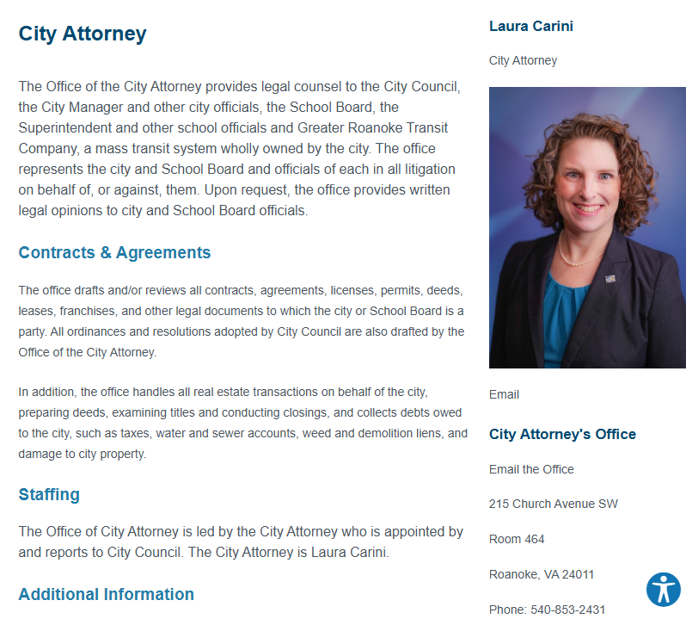
Go to Staunton’s website and click on “Departments,” and you’ll see a heading for “City Attorney.” Click on that link and what you’ll see is . . . nothing concrete. No name. No picture. No phone number or email address or even a physical location. There’s a single sentence of boilerplate explaining (some of) the city attorney’s responsibilities, and a whole lot more saying what the city attorney does not do and please take your questions elsewhere.

Contrast that with the way Roanoke presents its information, below, and it’s clear that there’s nothing in state law requiring such anonymity. So what’s with Staunton?

It’s not like John Blair’s role is a secret. Google a question seeking the name of Staunton’s city attorney and his name will pop right up, including mention of his former employment as city attorney in Charlottesville—whose website, by the way, doesn’t have a picture of its current attorney but does provide the incumbent’s name, plus a mailing address and phone number. Once you get Blair’s name from Google and return to Staunton’s website so you can reach out to him, however, you’ll find that he’s also not listed in the city’s directory. The man doesn’t exist.

Because I had a question about the city’s civil prosecution of property owners who don’t respond to notices of infractions, I asked a city council member why Staunton keeps the city attorney’s contact information out of sight. His brief response was that the position “by statute is an internal-facing resource for the city, advising Council and staff,” and presumably that’s why Blair doesn’t show up in the public directory. Which, when you think about it for even a heartbeat, is simply nuts. Neither the Virginia Code nor the City Charter create categories of positions that are “internal facing” versus their presumed “outward facing” counterparts, with different sets of rules applied to each. And while Blair’s duties do include legal counsel to the city, which is protected, the city attorney also has numerous “outward facing” duties, such as drafting contracts, leases and other documents, defending the city when it’s sued and prosecuting civil cases on its behalf.

All of which should be fair game for information requests and questions. And while presumably such inquiries could be submitted via the city manager’s office, as my city council member suggested, the city’s organizational chart explicitly keeps Blair’s office separate from the city manager and makes it answerable only to the city council. It’s therefore clear that keeping Blair behind a curtain is a de facto city council policy, not a city manager’s decision or a state mandate. Trying to reach Blair via an intermediary is an unnecessary hurdle quite out of step with the city’s otherwise admirable accessibility practices, but if that has to happen, such a gate-keeper role more properly rests with the city council and not with the city manager.

There’s another aspect of Blair’s position worth noting, the result of his taking on additional duties as clerk of council. The cost-saving move occurred earlier this year, following the resignation of former clerk Kiley Kesecker, when the city council decided that such a full-time position was no longer needed and that Blair could also be responsible for keeping all records of council and commission meetings. In making that change, of course, the council moved the clerk of council behind the same curtain that conceals the city attorney. Have a question or dispute about the minutes of last month’s city council meeting? Good luck figuring out how to contact the man responsible for them.

It should go without saying that both the city attorney and clerk of council are taxpayer-funded positions, which all by itself suggests a certain amount of public accountability that is undermined by making the positions unapproachable. The city attorney’s remuneration, set under Staunton’s pay classification system, is grade 25 and ranges between $130,361 and $195,541; the clerk of council is paid at grade 12, ranging between $54,167 and $81,252. It’s not clear whether John Blair is drawing two paychecks or just one, but the city has budgeted the two offices in the current fiscal year for $342,767 and $36,860, respectively—and in each office, Blair is the only employee.

I’d like to learn how all those numbers pencil out, and have some other non-privileged questions to ask as well. Now, if only I had a phone number or email address to send them to . . . .  


Aug. 7 postscript: Earlier this week, Staunton’s public information officer responded to this post with the information that a) John Blair does not draw a paycheck for his work as clerk of council; and b) that his salary as city attorney is $188,967.30 a year. No response or explanation for the lack of other information on the city’s website—and, again, no email address or phone number for John Blair to ask him for an explanation.