
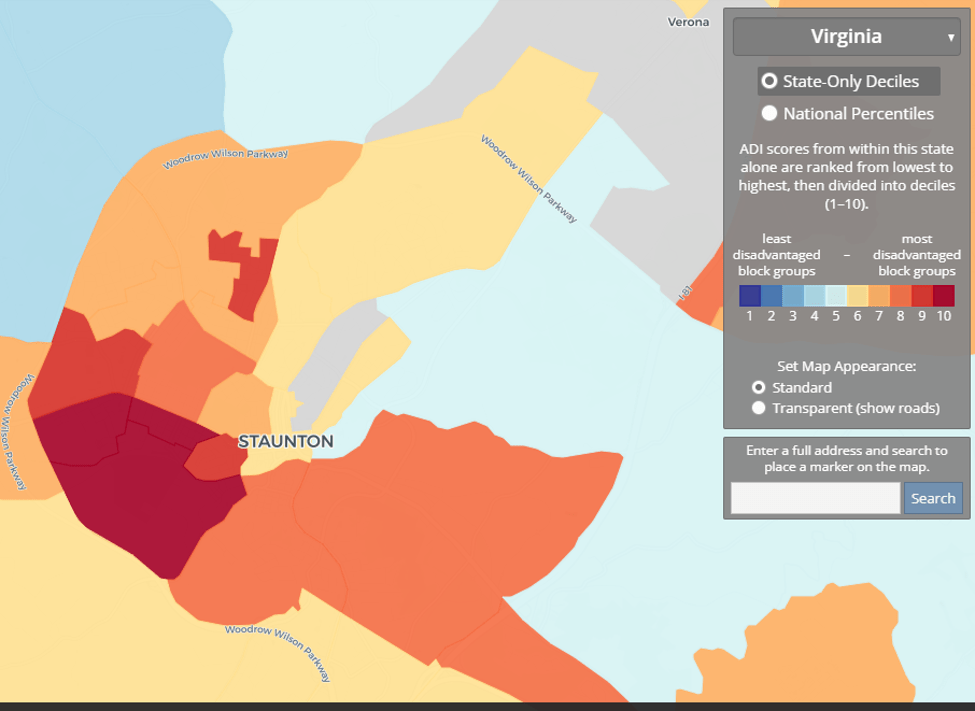
A map of Staunton’s Area Deprivation Index shows the city’s most disadvantaged neighborhoods, where residents are most vulnerable to disasters.
(Reading time: 14 minutes)
The timing could not have been tighter. On Jan. 22, the Staunton City Council adopted an update to its Emergency Operations Plan (EOP). On Jan. 23, City Manager Leslie Beauregard activated that very plan as a major winter storm battered the region with heavy ice and snow. The emergency declaration, Beauregard explained, “removes any barriers to our response efforts and allows us to mobilize additional resources, if necessary”—a prescient call, as it turned out, when the city had to call on additional contractors with beefier equipment to clear ice-bound streets.
How did it all work out? So-so. An after-action review of the city’s response detailed what worked well, what did not work so well and what “action steps” the city should take in response. Staff dedication, contractor response and communications all got high marks. On the other hand, the sheer enormity and unpredictability of the storm, as well as staffing shortages and equipment limitations, all hindered an adequate mobilization. Notably, despite its rating of communications as one of the things that worked well, the review conceded that a lack of radios in the field left the city with no way to track plow locations or coverage history.
There were other problems as well, followed by a list of 15 suggested corrective actions, from upgrading training and equipment to improving overall coordination and communication. Those action items include development of a winter storm public-facing webpage to show which streets have been cleared (as well as, inexplicably, an instructional video on how to shovel out a driveway), in response to perceived “unrealistic public expectations for immediate street clearance.” Most of the recommended actions seem worthwhile, suggesting that lessons were learned, yet taken in its entirety, the list falls short.
More on that in a bit.
STAUNTON’S EMERGENCY OPERATIONS PLAN is only one side of a coin, the “what do we do when we have a problem” face. The other side of that coin is the question, “what can we do ahead of time to minimize the consequences of a disaster?”
The attempted answer is a 275-page document prepared by the Central Shenandoah Planning District, first drafted in 2005 and updated several times since, most recently this past spring. The Central Shenandoah Hazard Mitigation Plan covers five counties and the cities they encompass, with a general overview of the region followed by city- and county-specific recommendations. The plan identifies 12 hazards—severe winter weather among them—and prescribes a series of mitigation actions for each of the 21 jurisdictions it covers, including more than two-dozen for Staunton.
“To mitigate” means to reduce the extent, severity or painfulness of something. So, for example, among the mitigation plan’s recommendations for Staunton are stream restoration projects and creek daylighting to reduce flooding, or a program of vegetation management around buildings to create defensible spaces against wildfires. The mitigation plan, in other words, is preventative, whereas the emergency operations plan is reactive. But as with the EOP, the Hazard Mitigation Plan concentrates most heavily on the physical environment and on the city resources needed to manage it. Both plans give only passing mention to the beneficiaries of all this planning, making the mistake of treating city residents as customers or victims and not as collaborators.
In that respect, the mitigation plan overlooks one of its potentially biggest resources—which brings me back to the EOP.
IT’S ONLY NATURAL that an after-action analysis concentrates on the emergency just passed, and on the actions taken by those responding to it—natural, but myopic. That’s how armies end up fighting the last war, building defenses against historic attacks, only to be overrun by newer technology or an evolution in tactics. What’s needed is a bigger picture overview.
In that bigger picture, the January winter storm could have been much, much worse. The most obvious missed calamity would have been a widespread power outage, due to falling trees or a heavy truck sliding on ice-slicked pavement into power poles or transformers. Had that happened, restoring power would have taken hours and possibly days, given how thoroughly everything was locked down by implacable ice, trapping residents in their unheated homes in freezing temperatures. A rigorous after-action evaluation therefore should have looked not only at what did happen, but at what could have happened just as readily under the same circumstances, and whether the city would have been able to respond adequately.
Just because we missed a bullet once doesn’t mean we’ll miss it the next time.
Ironically, the Hazard Mitigation Plan recognizes there’s a high probability of power outages in our region, noting that Virginia ranks 42nd out of 50 states for electric grid reliability, with 50 being the worst. It also notes that the Central Shenandoah region had at least four major power outages in the six years through 2024, demonstrating “a clear pattern of recurring vulnerability.” Yet despite that assessment, there is next to nothing in the mitigation plan addressing power outages per se, other than to coordinate with Dominion Energy to “remove dead or hazardous trees near power lines.” Instead, the plan addresses a dozen threats by hazard type—flooding, wildfire, severe winter weather, drought, high winds, etc.—rather than by hazard impact, such as impassable roads, downed power lines or broken water mains.
Against that backdrop, it’s sobering to realize that 21.5% of Staunton’s population is 65 or older, many living alone and many relying on electrically powered medical equipment, such as oxygen concentrators and CPAP machines, as well as on refrigerated (not frozen) medications.
Moreover, old age is but one marker of vulnerability. More than 15% of the city’s residents have a disability, and 12.4% live below the poverty threshold. Much of the city’s housing stock is decades old and in various stages of weather resilience, so that even as city real estate prices have been shooting up the welfare of its residents has been declining: the incidence of unhealthy or unsafe living conditions in the Staunton-Augusta-Waynesboro region jumped from 9.9% to 14% between 2019 and 2025, according to the 2025 Community Health Needs Assessment prepared by Augusta Health.
These and other factors that exacerbate the impact of public emergencies have been combined nationwide by the Centers for Disease Control and Prevention (CDC) into something called the Social Vulnerability Index (SVI), a comparative measure that identifies communities most in need of support before, during and after disasters. The SVI is intended to “help public health officials and local planners better prepare for and respond to emergency events,” according to the CDC—and residents of Staunton, as illustrated by the map at the top of this post, are in the front ranks of Virginians needing such help.
That rather alarming map ranks census block groups by averaging 16 variables, including income, education, employment, mobility and housing quality. Most of the city is ranked at the sixth decile or higher, which means those neighborhoods have a higher level of disadvantage—are more vulnerable—than half of Virginia’s population. Unsurprisingly, the most vulnerable of them all is the West End south of West Beverley, which is at the very highest decile, but large expanses of the city are at the ninth and eighth decile and may be expected to suffer disproportionately when disaster strikes. But with one generalized exception (about which more in a moment) you’d never know that from either the EOP or the Hazard Mitigation Plan.
The CDC, in promoting the vulnerability index, says it’s designed to be a tool for better emergency preparedness planning, but there’s little evidence that Staunton planners have paid it much heed. For example, these are the steps the CDC believes should be taken to formulate an effective plan: estimate the type and quantity of needed supplies, such as food, water, medicine and bedding; decide on the number of emergency personnel required to assist people; identify areas in need of emergency shelters; create a plan to evacuate people, accounting for those who have special needs, such as those without vehicles, the elderly or those with limited English comprehension.
Little of that is in the EOP, and especially not the part about an evacuation plan. Nor, despite being acknowledged by the Hazard Mitigation Plan, is there any indication that the SVI analysis factors into Staunton’s proposed mitigation actions, which largely treat the city as a monolithic entity instead of a patchwork of vulnerabilities. Had there been a widespread and prolonged outage during the January storm, for example, there would have been no evacuation plan for immobilized residents left without heat or power. And while the EOP designates the city’s public schools as emergency shelters for those who can get there, the schools are not stocked with bedding or other needed supplies, which the EOP expects the Red Cross to provide—which assumes, of course, that the Red Cross can reach the shelters.
Moreover, while the plan optimistically asserts that the schools have sufficient food stocks on hand—“optimistically” because each school is assessed as having adequate shelter for at least a thousand people—it also notes that there will be no food at the schools from about June 5 until after Labor Day, and that it will take about 48 hours to get refrigeration units back to operating temperatures.
The biggest information void, of course, will be knowing who needs help and how to match those people with the hoped-for volunteers who are expected to show up in their four-wheel drives. Nor does the EOP acknowledge the psychological and emotional resistance those volunteers may face when reaching out to the elderly and infirm, who historically have been the most resistant to leaving their homes and who account for a disproportionate number of deaths when disaster strikes.
There are other hurdles as well. The shelters are not supposed to admit pets, which will dissuade some people from going to them. The schools must be brought up to “operating temperatures” before they can accept evacuees, and although most are equipped with generators (Shelburne and Dixon apparently are not), ramping up heat in the winter and air conditioning in the summer could delay their opening.
In short, as bad as the January storm was, it could easily have been much worse. Had that occurred, the after-action review would have been considerably more bleak.
WITH THEIR UNDERSTANDABLE FOCUS on city manpower, resources and command structure, both the EOP and the Mitigation Plan tend to treat the people they’re intended to help largely as afterthoughts. That oversight is evident not just in the lack of an evacuation plan or of the absence of any provision for mental health resources, but also in the lack of a granular understanding of which residents are most vulnerable, where they’re located and what kind of assistance would be most needed. In that sense, the plans are one-size-fits-all schematics.
But both plans have another, equally critical oversight, rooted in an assumption that members of the public are victims and plan responders are their rescuers. Instead of exploring how city residents could become collaborators, the plans create a binary rather than a continuous spectrum of helpers and the helped. Yet the stark reality is that in any true disaster, defined as an overwhelmingly large and complex emergency that could include mass casualties, the city’s personnel and physical resources simply won’t be up to the task. Staunton will need members of the public to help its public works employees, firefighters and cops, but it isn’t prepared for that eventuality.
Such a manpower shortage was already evident in the January storm response, a decidedly mid-level emergency as it actually played out but which, as the after-action review acknowledged, suffered from a lack of sufficient staffing in the streets. Only eight crew members were available, according to the review, presumably accounting for an unexplained halt in plowing on Saturday night, “when snowfall was at its heaviest” and “when conditions demanded continuous operations.” That pause played a significant role in exacerbating an already difficult operation, allowing not only more snow accumulation but a compression and freezing of what had fallen to create an almost impenetrable ice shield.
But while a major disaster would require a robust community response, the Mitigation Plan gives only two brief nods in that direction, one that is largely pro forma and one that isn’t happening at all.
The pro forma nod is the plan’s recommendation “to coordinate with the Staunton-Augusta-Waynesboro Community Emergency Response Team” to “encourage and improve the disaster readiness of volunteers and the citizenry.” That’s misleading, to the extent that referring to a “team” implies there is some kind of trained and organized entity that can assist first-responders in an emergency. Although in fact there are CERT teams of that sort elsewhere in the U.S., the local CERT program is basically advanced first aid training offered by Augusta Health, together with tips for stocking up on emergency supplies. It’s useful information, and it may ultimately benefit a CERT participant’s immediate neighbors. It is not, however, a way to bolster direct city action in response to a disaster.
The second nod calls for creation of “an educational campaign on individual household preparedness and mitigation measures, particularly for affordable housing or Low-to-Moderate Income neighborhoods”—in other words, precisely those neighborhoods shaded the deepest red in the vulnerabilities map above. Unlike the CERT training, which apparently is offered only once a year to a limited number of people who have to make their way to Fishersville for seven weeks, such an educational campaign would go to the people where they are and offer them the information they need to better ride out a crisis. Things like how much food and water to stock. Alternative but safe sources of heat. How to stay up-to-date on disaster response. Creating neighborhood support groups.
Unfortunately, nothing like that is happening. Although the city notes that its Fire and Rescue personnel do extensive outreach to vulnerable communities, most recently installing fire alarms in people’s homes, there is no educational campaign on household disaster preparedness. And while every home benefits from having fire alarms, installing such alarms must be seen as providing a service, not as enlisting community partners against the day when Fire and Rescue will need a trained citizenry covering its back.
The thing about a major disaster is that it quickly drives home the point that we’re all in this together—think Venezuelans digging through rubble with their bare hands to rescue earthquake victims, or New Orleans residents paddling from house to house in canoes and rowboats after Hurricane Katrina to pluck their neighbors from the rooftops. People will respond that way naturally when circumstances become extreme enough, but their ad hoc efforts will be much more effective—and much safer for everyone—if they are trained and supplied in advance of calamity.
What can be done locally? Disaster planners should hold regular tabletop exercises to game out various scenarios, in some cases including local community members who can point out oversights or missed efficiencies. The city could maintain a contact list of residents with four-wheel drive vehicles who are willing to transport people and supplies in an emergency, and there could be inventories of other personally owned resources—chain saws, generators, freezers, tarps—that city residents would be willing to share. There should be an inventory of homes whose residents have voluntarily consented to get wellness checks in extreme circumstances.
And on and on, sometimes at absurdly mundane levels. During the winter storm, for instance, I wrote about the problem of buried fire hydrants—surely an obvious concern, but one that I think remains ignored. Other “doh” examples surely abound, and presumably would become evident during the tabletop exercises already mentioned.
The thing is, things are only going to get worse. The top three hazards addressed in the Emergency Operations Plan are all weather-related—flooding, wildfire and severe winter weather—as are four of the remaining nine, and all are trending in the wrong direction because of an increasingly extreme climate due to global warming. Other threats also are growing, such as the increased likelihood of a catastrophic failure in the city’s water supply because of its corroding, century-old delivery mains. Meeting those challenges is going to take all of us, and it’s way past time that we started.

