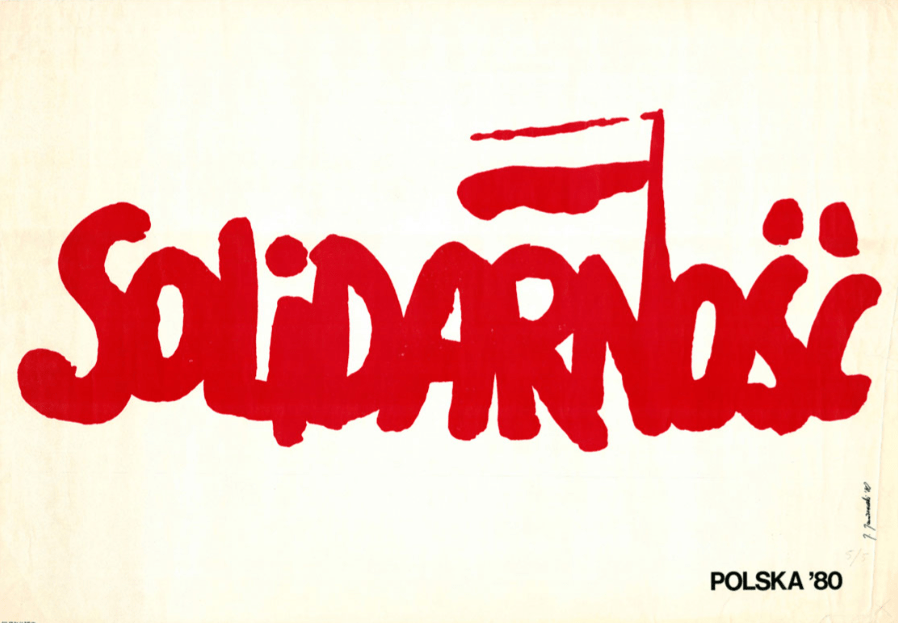
Screen grab of one of the most widely known Polish posters, a giant 37 x 26 inches in size. This particular piece is advertised as an original 1980 print that was buried for seven years during martial law and is one of five copies numbered and signed by artist Jerzy Janiszewski. Price? You gotta ask.
(Reading time: 13 minutes)
When you give a buck to a panhandler, you do so with the understanding that your money may get spent on food or shelter—or on cigarettes or a cheap high. You have no control and no oversight. What is important to you may not be important to the recipient of your small donation, and vice versa, and you shouldn’t expect an explanation for how your buck will get spent.
What you also shouldn’t expect is for non-profit social service agencies to operate in the same way.
Donations made to charitable organizations known as 501(c)3s, for example, are accepted for a stated purpose. In the case of the SAW Habitat for Humanity, that purpose is to “build and restore homes, lives and communities through faith.” Stewardship of such contributions is vested in a board of trustees, drawn from the community, and the money is administered by a director who answers to the board. Public transparency for this process is provided in annual filings with the Internal Revenue Service, known as Form 990s.
Such filings are the quid pro quo accepted by charitable organizations in exchange for being tax exempt—they represent a compact under which an organization accepts the public’s money to perform a public good and in return doesn’t have to pay taxes. Form 990s, in other words, are not merely bothersome red tape. They are a window into an organization that allows for public transparency. By law, they are to be filed by the fifteenth day of the fifth month after the end of an organization’s fiscal year. Late filings can result in daily financial penalties, and missing three consecutive years results in automatic revocation of tax-exempt status.
That’s how it’s supposed to work. But then there’s our local Habitat, which at worst is busy covering up its financial misfeasance and at best is just financially incompetent.
Habitat’s financial stumbling dates back to the spring of 2024, when its executive director, Lance Barton, was given the boot for a variety of reasons too complicated to repeat here but which were amply chronicled in the Augusta Free Press. At that time, the most recent Form 990 that Habitat had filed was for its 2021 fiscal year, which ended on June 30, 2022.
Following Barton’s ouster, temporary control of Habitat was placed in the hands of David Wenger, who came aboard in September of 2024 and stayed as acting director until spring of 2025. On May 13, 2025, in an apparent effort to clean up the organization’s books, Wenger filed a 2023 Form 990 for a changed fiscal year, defined on the form as the calendar year ending Dec. 31, 2023. In doing so, Wenger inexplicably overlooked any financial accounting for the latter half of 2022. Nor did he file a Form 990 for 2024, even though the due date for that filing was just two days after he filed the 2023 return.
Wenger was succeeded by Brad Bryant, who became Habitat’s director effective June 2, 2025. Under Bryant’s leadership, but over the signature of Habitat’s treasurer, Keith Clark, the organization filed a 2024 Form 990 that reverted to its former fiscal year: the 2024 filing is for the period July 1, 2024 through June 30, 2025. In other words, this filing also opened up a six-month gap, from Jan. 1, 2024 to June 30, 2024, for which there is no financial accounting.
Put another way, the 990s posted on Habitat’s website (scroll to the bottom of the page) seemingly show six consecutive years of reports, 2019 to 2024. But the actual years of the reports, as seen in the upper right corner of the front page of each Form 990, skip over 2022.
All this might seem like a lot of whoop-de-doo about nothing, were it not for the fact that the net result is a full year’s worth of money coming in and going out for which there is no acknowledgment or explanation. And just to be clear, this isn’t a matter a few dollars here or there: Habitat routinely pulls in hundreds of thousands of dollars a year in contributions and has total assets in the millions. A missing 12 months of financial accountability is a huge deal.
And that’s only the beginning of it.
ASIDE FROM FAILING to report a year’s worth of income and expenses, the Form 990s that Habitat did file raise several questions. They also, perhaps inadvertently, supply at least one possible reason for the sloppiness: while the forms filed during Barton’s tenure showed a $14,000 expense for accounting, the 990s filed by Wenger and Bryant leave that line item blank. Moreover, the form acknowledges that Habitat’s financial statements were not “compiled or reviewed by an independent accountant,” leading to the conclusion that its financial data was compiled in-house, for better or worse.
That’s not to say that the 990s were entirely without oversight. While an independent accountant was not retained to compile the data, the latest filing asserts that its financial statements were audited by such an accountant—individually, and not on a consolidated basis. Separating them that way presumably avoided any questions about the changing fiscal years and gaps in information. And while the 2024 Form 990 also asserts that Habitat has “a committee that assumes responsibility for oversight of the audit, review, or compilation of its financial statements and selection of an independent accountant,” that committee clearly missed several red flags. Among them: an unexplained $33,942 payment to “former executive director Lance Barton” between July 1, 2024 and June 30, 2025, or months after Barton had been forced to resign.
There undoubtedly are explanations, however weak or unconvincing, for all the obvious questions. The problem is that no one with the answers is willing to give them.
For example, why did David Wenger change Habitat’s fiscal year and in doing so skip over six months of financial reporting? And after filing a Form 990 for calendar year 2023, why did he not also file a Form 990 for calendar year 2024? Only Wenger can explain his reasons, but when I reached out to him via his former employer, the Central Valley Habitat for Humanity, the response—relayed by office manager Ittaty Coto—was that Wenger would not speak to me and that any questions about SAW habitat’s finances should be directed to Brad Bryant.
Bryant, of course, can’t speak to why Wenger made the decisions he did. But Bryant’s explanations for the decisions he’s made in the 13 months since becoming Habitat’s executive director, delivered in a July 8 emailed response to my questions, are no more illuminating than Wenger’s stonewalling:
- Why is there no 2022 Form 990 posted on Habitat’s website? Bryant replied that he didn’t know but that he “physically put my hands on the hard copy this morning” and would get it up on the website soon. As of this writing, that has not happened. My request that he email a PDF directly to me went unanswered.
- Why did Barton get paid months after he was no longer working for Habitat? If that was a severance payment, why was it not reported in the year it was incurred? Bryant wrote that he did not know but was investigating to find out.
- Why was Habitat’s fiscal year changed under Wenger, then changed back under Bryant, enabling the fiscal sleight-of-hand that buried a year’s worth of financial reporting? Bryant denied that Habitat changed its fiscal year, the Wenger-filed Form 990 notwithstanding, and wrote that he “cannot find anything that suggests or shows any voted-on changes from July 1-June 30 as our reporting year.”
Two subsequent emails to Bryant have gone unanswered. The second, sent a week ago, asked for the names of board members serving on the financial oversight committee and for contact information for the committee chair.
UNDERLYING AND WOVEN THROUGH all this confused financial reporting are the Polish posters. No one wants to talk about the posters, but it is the posters that triggered much of the drama of the past couple of years and it is the posters that hang over Habitat’s finances as a huge question mark.

“Police,” by Mieczyslaw Gorowski
That might sound obscure to most Americans. But just as select American comic books might be worth thousands of dollars to a discerning collector, so Polish poster art has a niche following of similar passion and valuations. Formally known as the Polish School of Posters, the art form had its heyday in the ’Fifties and ’Sixties, when its illustrations of movies, plays and daily life were slyly subversive of the Communist regime. Readily recognizable by their painterly quality and use of metaphors, hyperbole, flair and imagination, the Polish posters were a subversive rallying point “even in the darkest moments of Polish history,” as explained by one critic.
There remains to this day a lively market for such art, with contemporary posters selling on-line for $30 or $40 apiece, but rarer or more historically significant pieces can go for many hundreds of dollars apiece and are marketed with certificates of authenticity. And several hundred such posters now belong to SAW Habitat, although just how many and of what quality is unknown. Indeed, even current board members do not all know where the posters are being kept, with Bryant saying only that they’re under lock and key.
How Habitat came to possess the posters is a strange tale, but basically comes down to Lance Barton convincing his board that the art would make a unique and profitable fund-raising investment for the organization. That led to Barton and local artist Cleveland Morris traveling to the source, with Habitat covering Barton’s expenses for his Polish buying excursion. Although the Augusta Free Press, quoting Morris, reported that Barton spent $10,000 on posters, Barton himself claims an expenditure of nearly twice that amount—and that of the $18,000 he spent, a third was his own money. (Morris also declined my interview request.)
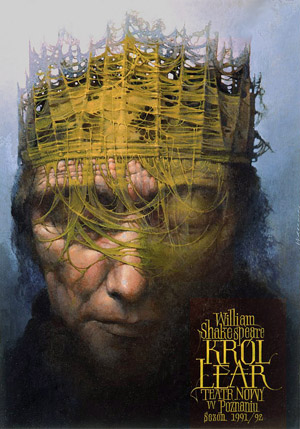
“King Lear,” by Walkuski
Not that Barton is eager to say much of anything. Not long after his return from overseas he was ousted from Habitat, all the posters were locked away, and repeated threats from Habitat of criminal charges have forced him into keeping a low profile. That he said anything at all to me was only the result of my surprising him May 30 at his Staunton home while he was mowing his lawn, an interruption during which he lamented that the only way he’ll be able to claim his third of the art will be to force Habitat into court. Since that brief exchange, however, Barton, like Wenger, has declined to answer my questions.
Barton’s claim to a third of the purchased posters, however, raises ownership issues and explains Bryant’s inability to come to grips with the subject. The only apparent game plan at Habitat is a hope that the whole affair will just go away. After more than a year as executive director, Bryant has yet to find a qualified appraiser for an art collection that conceivably could run into six figures and explains his inaction by saying that “it just does not have a priority in my world with the amount of things we are trying to move forward on.”
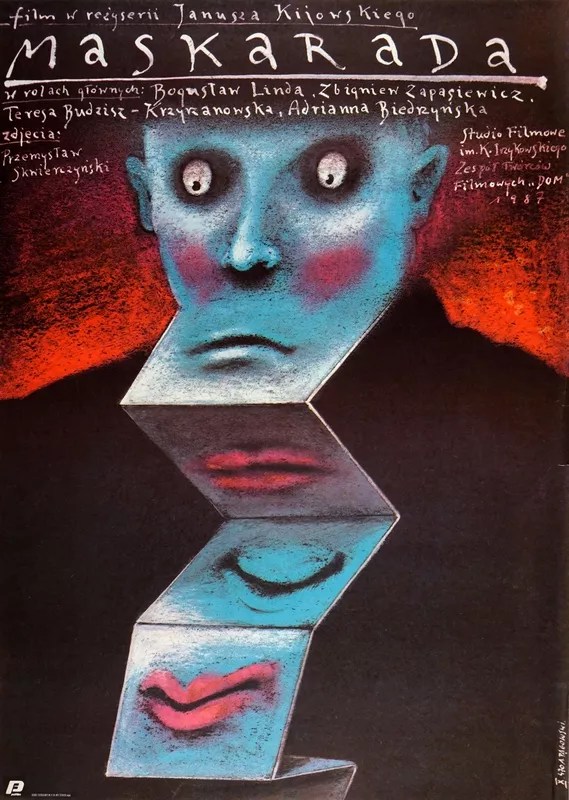
“Masquerade,” by Andrzej Pagowski
Meanwhile, Habitat’s refusal to acknowledge its art stash extends to its erratic Form 990 filings, which among other things ask “did the organization maintain collections of works of art, historical treasures or other similar assets?” Habitat repeatedly has replied no. But as Schedule D to Form 990 helpfully notes, answering “yes” would apply to art held “for financial gain,” which presumably encompasses art acquired for fund-raising purposes.
“I am going to look into that,” Bryant responded when asked about the untruthful response, “but I would guess it to be an oversight.” Easy to do, when everyone is busy ignoring the art elephant in the room.
IT’S HARD TO FIGURE OUT whether the unresolved Polish poster art saga is the result of embarrassment, legal uncertainties or misplaced priorities. Possibly a combination of all three. But the episode almost certainly feeds into the screwed-up filing of federal tax forms that followed and the unresolved question of what happened to 12 months of financial transactions, and it appears that one can’t be resolved without the other.
Much of the responsibility for presiding over this mess has to rest with Bryant, who despite his abilities as a builder seems to be in over his head with this aspect of his job. But at least as much responsibility resides with Habitat’s board of directors, who seemingly have not been asking the tough questions or providing the resources needed to resolve Bryant’s predicament. In that respect, at least, the current board seems to be cut pretty much from the same cloth as the board that green-lit Barton’s Polish expedition—which is to say, inattentive and easily rolled.
The Augusta Free Press, in originally reporting on Habitat’s travails with Barton, provided an extensive list of local organizations that have been hit with financial irregularities and outright embezzlement because of inadequate financial oversight, in some cases over a period of several years. For those that were governed by a board of directors, the failures were the result of a board that didn’t heed its three primary legal duties: the duty of care, the duty of loyalty and the duty of obedience. The latter deserves special attention, as the duty of obedience is not to a specific person but to applicable laws and regulations, the organization’s own bylaws and to its stated mission.
Habitat skated right to the edge of that abyss but pulled back at the last second, largely on the strength of Bryant’s reputation. It’s a shame he’s now reduced to the 501(c)3 equivalent of a panhandler, looking for donations but unable to explain where they’ve gone in the past. Meanwhile, of course, the abyss is still there. You have to wonder what a Polish poster artist would have done with that image.