
(Reading time: 8 minutes)
To better understand why Staunton can’t get a handle on its lack of sufficient affordable housing, consider the June 18 meeting of its Planning Commission. Dominating the 90-minute session was a meandering and inconclusive conversation about a subject the commission has largely ignored, over which it has little control, but about which it is willing to entertain dystopian fantasies. In doing so, it made an inadvertent argument for renaming itself, perhaps as the Reaction Commission. Or the Let’s-First-See-What-Everyone-Else-Is-Doing Commission.
Among Staunton’s most pressing problems is its largely acknowledged if imprecisely documented shortage of housing that local residents making local wages can actually afford. There just isn’t enough of it to go around in the first place, so what’s available is priced out of reach. The obvious solution is to build more housing that is smaller and less expensive, leading to the equally obvious question: why isn’t that happening? And the obvious candidate to answer that question is the provocatively named Planning Commission (there’s also the newly formed Housing Commission, but that bunch is still trying to figure out what it’s doing), which one might think is currently consumed with trying to cut the Gordian knot of failed housing policy. One would be mistaken.
True, there are numerous reasons why Staunton has an insufficient housing supply, reasons that are at work all across the country and most of which are quite out of reach of a mere five Stauntonians meeting once a month, mostly to review rezoning requests. The cost of construction materials has sky-rocketed since the pandemic, the ranks of skilled construction workers have been depleted by Trump’s xenophobic deportation policies, interest rates are high and apparently poised to go higher. Those aren’t things a local planning commission can affect. But there’s also the matter of housing design and density, and that fits squarely within the planning commission’s wheelhouse. It’s also something the commission avoids looking at too closely.
Strange though it might seem, there’s not enough land available for building small homes in Staunton. With an average population density of just over two people per acre, it might appear that Staunton has lots of room for additional housing. But parks and agricultural districts and heavy industry whittle down the amount of land suitable for development. So too with land devoted to roads and parking lots, as well as land that’s too steep or too rocky or subject to flooding. There is land available for sizeable developments, as evidenced by the recently announced 267-home McIntosh Village, but that’s big money chasing market-rate housing that will be too big and too expensive for empty nesters or service worker paychecks.
But then there’s our fondness for zoning that deliberately spaces homes far apart, allowing few homes per acre and dictating setbacks and minimum lot sizes and maximum lot coverage—our self-imposed limitations on what’s possible, in other words. Not geography or geology, but the very sort of thing that a planning commission concerned about an adequate housing supply for its existing population should be examining.
Just how inadequately it is doing so was on display June 18, when the commission was presented with a proposed amendment of the city zoning code that would clear the way for accessory dwelling units (ADUs) to be built pretty much anywhere Staunton allows housing. The proposed revision was not something the Planning Commission had solicited. Nor was it sought by the Housing Commission, which has been slow-walking the ADU idea to some future chin-stroking evaluation. It was instead mandated by the Virginia General Assembly, which to its credit got fed up with all the wheel-spinning in the provinces and adopted this past session a bill that overrides local zoning authority.
Most succinctly, the state is mandating that as of July 1, 2027, ADUs are to be permitted by right—that is, without requiring “May I?” special-use review—in all zoning districts throughout the Commonwealth that allow single family use. ADUs are defined as “an attached or detached dwelling” that provides “complete independent living facilities for one or more individuals.” There are restrictions on size and placement, as well as parking and building code requirements, but basically the new law opens the door for homeowners to double their capacity. It could be with a backyard cottage, a basement apartment, a garage with a second-floor apartment. The additional space could be rented out, or it could house an aging parent or adult child. Best of all, the increase in the city’s housing stock will come without requiring any of the new roads, storm water management, water and sewer lines and other infrastructure that come with a new subdivision.
Planning commission reaction? Mixed but generally aghast. Commission member Dale Hansen, fantasizing about slap-dash cabins with hot plates and composting toilets popping up in backyards, said he wants to see some kind of allowance for ADUs “but not getting too crazy, and I don’t know how to regulate crazy,” eliciting sympathetic chuckles from other commissioners. The way the law is written, Hansen complained, “It’s sort of the Wild West—anyone who wants one can get one.” Well, yeah. That’s the idea.
Commission chair Jessica Robinson summarized the commission’s approach to the idea of getting ahead of an issue by asserting, “I don’t want to be a trailblazer.” No fear there—the state has already taken on that mantle—but because Staunton doesn’t have to amend its zoning code before next July, Robinson clearly is hoping to kick the can down the road. “I don’t think it’s impossible that people will start pushing back on this and that at the next General Assembly session it gets put off further?” she suggested, albeit on a questioning note. “And I think we should wait and see and make sure it survives all that.”
There was talk among the commissioners about seeing what zoning amendments other cities are writing—“Let them fail first, before we fail,” Hansen offered helpfully—and a suggestion that perhaps the Housing Commission could provide helpful insights. There was musing about feeling like “deer in the headlights.” None of it grappled with the fact that Virginia now has an explicit law to which Staunton must conform, without a lot of room for creative embellishments or escape clauses, which means there are only so many ways the city’s zoning code can be amended to be in compliance. The rest is wishful thinking.
Unfortunately, it’s not at all clear that the planning commission comprehends just how much the regulatory landscape is shifting beneath its feet. For the state to wade into a zoning issue—one of the few areas of responsibility reserved for localities—is huge. (See also the new state law that gives churches the by-right power to build affordable housing on their property.) At the same time, the commission’s tone-deaf approach to ADUs suggests its members haven’t been paying attention either to the ADU concept or to the housing needs of their neighbors. ADUs as a relief valve for housing pressures have been around for years—long enough to be a significant part of the conversation at last year’s Virginia Governor’s Housing Conference, as I wrote last fall, and long enough to be discussed by the city’s Housing Strategy Group and in Comprehensive Plan ruminations. The problem locally is that it’s been just that—talk—and little more, as if a bunch of old folks were sitting around discussing the desirability of going to heaven.
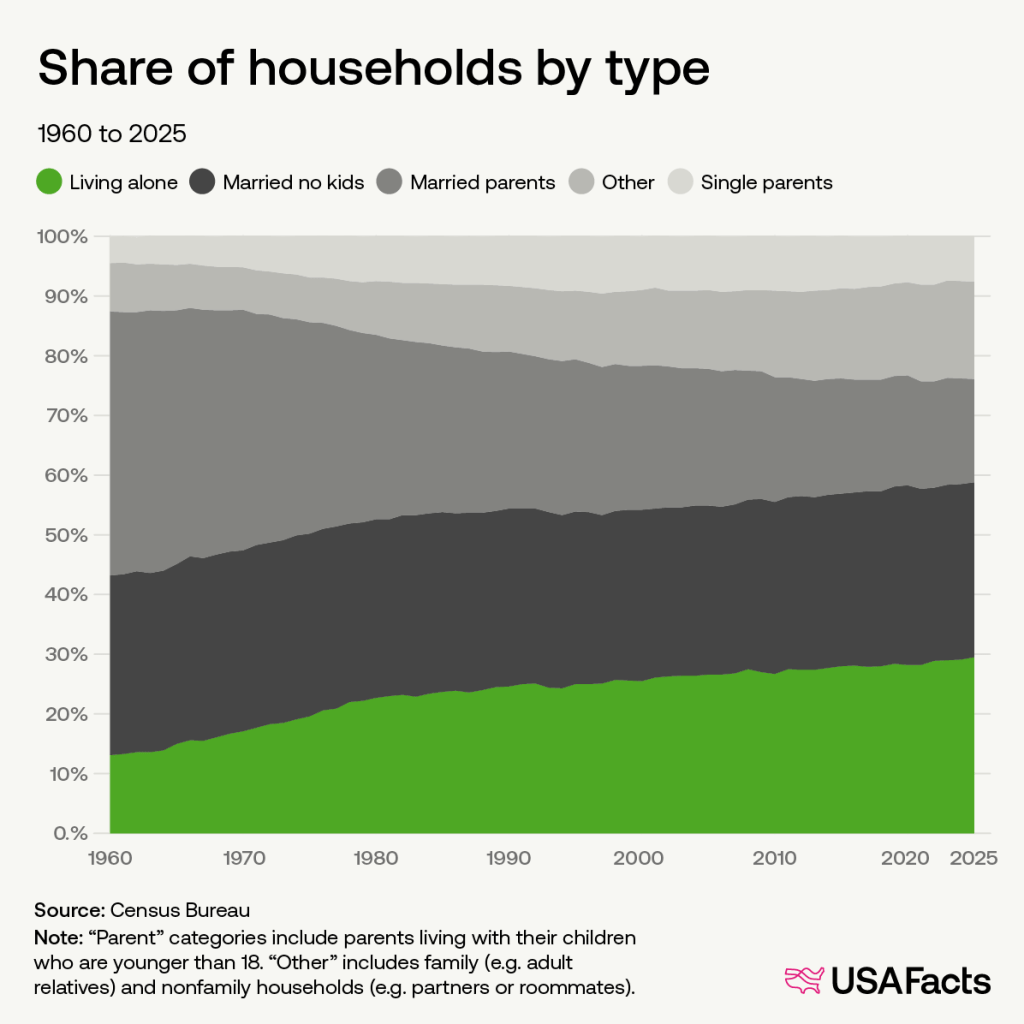
The green and (to a lesser extent) the black area in the graph above are prime sources of potential tenants for ADUs and now comprise substantially more than 50% of all households.
Nor will ADUs be the end of it. In addition to having a high percentage of relatively low-wage workers, Staunton has a higher percentage of elderly residents than the national average. It’s sobering, therefore, to learn that the fastest growing group of people entering homelessness are those 55 and older—people increasingly on fixed incomes, often in poor health, who can no longer afford to live in the city in which they were raised or worked or raised their own families. ADUs are not only more appropriately sized for these populations, which don’t need multiple bedrooms or a backyard, but can be built more cheaply and therefore rented for less than single-family homes. But they’re only one possible approach.
Other housing variations that are excluded from permitted uses within current zoning regulations, such as cottage courts, may be next. Expect pressure to grow for allowing single-family home conversions into duplexes or triplexes by right, or for eliminating lot size minimums in established neighborhoods, or for eliminating all parking mandates for housing, thereby freeing up more land for infill development. None of these are novel concepts in the wider world, although they are locally. All should enter into the planning (and housing) commission’s awareness if it wants to avoid future “deer in the headlights” moments, and if it intends to take seriously the “planning” part of its mandate.
Instead, the commission won’t be meeting again until August, when it’s not clear whether the proposed ADU revisions to the city code it receives will be substantively different from what it’s already seen. The city’s community development planners have been given next to no guidance on what changes to make, beyond a vaguely worded request to “keep refining it.” At some point the commission will have to hold a public hearing on the proposed changes; next April was suggested as a good choice.
No sense in rushing things. Or starting them, for that matter.

