
Housing worries are making us sick

(Reading time: 7 minutes)

Tax season is fully upon us, so it’s only natural for people to grumble about the Internal Revenue Service. But here’s one undeniably good thing for which the taxman can take credit: because of an IRS rule dating back more than a decade, tax-exempt hospitals are required to periodically assess the health needs of the communities they serve. That’s the good news. The bad news, for anyone reading Augusta Health’s report card from last year, is that our health in some key areas has declined steadily since 2016, and a significant reason for that decline is housing affordability issues that weren’t even on the radar a decade ago.

Indeed, the most recent Community Health Needs Assessment (CHNA) provides a sharp contrast to the first in a series dating back to 2013. That freshman effort took a notably upbeat approach by noting that Augusta was the 31st most healthy county in the 20th healthiest state in the country. “Augusta County is living up to its motto ‘Let the ages return to the first golden period,’ referring to a period of simplicity and happiness,” it rhapsodized, in less than scientifically detached fashion. “In general, the Augusta County, Staunton, Waynesboro area outperforms the state averages for health status. Where local results fall at or below those levels, we see an opportunity for combined actions that result in improved community ratings.”

But then, in a prescient turn of phrase, it added: “There are several lifestyle gaps that need to be closed to move Augusta County toward greater overall health.”

Fast forward a dozen years, and last year’s CHNA indicates that those gaps not only were not closed, but that some grew into chasms.  While the 2012-13 assessment ranked chronic disease management, as well as health behaviors (“particularly related to obesity and physical activity”) as its top two health priorities, the 2025 ranking vaults mental health to the top spot. And although physical activity and weight retain their number two ranking, right on their heels as number three is housing, which scarcely registered in the earlier assessment.*  Meanwhile, chronic diseases, led by diabetes, trail behind in importance.

To be sure, the 2013 assessment was significantly more superficial than the reports that started coming out in 2016, when the grunt work was handed over to Professional Research Consultants and a 28-page report metastasized into a document nearly nine times as long. Moreover, the greater detail was complemented by a consistency of format, enabling comparisons across the three-year intervals that followed. The problem is that this consistency also highlights just how much backsliding has occurred.   

AMONG THE ASSESSMENT’S housing-related findings for Staunton (anyone wanting to focus more on Waynesboro or Augusta County can peruse the complete assessment here), nearly a third (32.1%) of residents worried or stressed over their rent or mortgage payments in the previous year—apparently with good reason, as 12.3% reported they had been displaced from their housing within the past two years, and 9.9% said they’d been homeless in that same time period. Another 11.2 % said they were living in unhealthy or unsafe conditions.

For the SAW region as a whole, the incidence of unhealthy or unsafe living conditions jumped significantly from 2019 to 2025, from 9.9% to 14%—but even more sharply for renters, to 19.5%, compared to 10.5% of homeowners. An even wider disparity between renters and homeowners was found in response to the question of housing instability, with 17.8% of renters in the SAW region saying they had to find emergency housing in the previous two years, compared to 4.8% of homeowners. Meanwhile, the overall incidence of housing instability in the SAW region doubled, from 5% in 2016 to 10.2% in 2025.

Homelessness in the SAW region—defined as adults reporting “a time in the past two years when they lived on the street, in a car, or in a temporary shelter”—was zero in 2016, then climbed steadily through each reporting period, to 6.8% in 2025.

The health consequences of being homeless or of living in unsafe housing can be intuited by most people, but less immediately obvious is the toll on mental health taken by persistent anxiety over losing the home one already has. And while there are numerous reasons for depression or suicidal ideation, the parallel growth of deteriorating mental health and of insufficient affordable housing strongly suggests a link. Indeed, as housing stress has grown significantly over the past decade, the area’s mental health has taken a dive:

  • Asked to rate their overall mental health, 21.9% of SAW adults believe it is only “fair” or “poor,” a 150% increase since 2016. Staunton leads the way on that metric, with 27.8% reporting fair or poor mental health.
  • A total of 41.7% of SAW adults (and 50.4% of Stauntonians) say they have had two or more years in their lives when they felt depressed or sad most days. The open-ended nature of that measurement would dilute its significance, were it not for the fact that it is nearly double the 21.8% reading in 2016.
  • More than a third (35.5%) of SAW adults say they have been professionally diagnosed as having a depressive disorder, a 138% increase from the 14.9% reported in 2016. Moreover, that incidence jumps to a whopping 47.1% of Staunton’s adults, which is more than twice the 20.4% incidence for Virginia overall.
  • Local residents aren’t just depressed; 17.2% of SAW adults say they feel that most days are “very” or “extremely” stressful—a percentage also up significantly from the 10.5% recorded in 2016. Staunton leads the pack on this metric as well, with 22.1% reporting they feel stressed out.

Such ailments, alas, afflict some demographic groups far more severely than others, with low income and LGBTQ+ respondents greatly over-represented in all negative ratings—demographic groups that also have less visibility within the larger community, and less political clout with which to address the issues that are making them sick. Nor, once they do get sick, are there adequate mental health and related services to provide the care that’s needed.

The CHNA includes literally scores of comments from local doctors, social services providers, community leaders and others, detailing what they believe are the reasons for this intractable morass. To be blunt, there isn’t much that’s revelatory, although some of the anecdotes—a 35-year-old father, working two jobs to house his family in a motel room, dying from a stress-induced heart attack—get at the human cost of the illness permeating our body politic.  And then there’s the occasional assessment item that further drives the point home, such as the finding that 19.3% of local adults acknowledge they have been “hit, slapped, pushed, kicked or otherwise hurt by an intimate partner.” That rate, too, has doubled since the 9.7% reported in 2016.

The problem with health exams, as all too many physicians know, is that patients will yes them to death—exercise, stop smoking, eat more nutritionally, cut down on the booze, yadda-yadda—and then go blithely on as though no red flags had been raised. So it seems with the 2025 CHNA’s section marked “evaluation of past activities.” Number two on its list of previous strategies was meeting the health care needs of the homeless through a four-pronged approach, all of which were implemented in 2023—and all but one, and then only minimally, going unaddressed in 2024, due to a vacant RN Health Educator position.

Vacant since November 2023, that is, or almost two years prior to the 2025 CHNA’s release.

It’s a near certainty that Augusta Health’s unfilled position is a result of budget constraints, but as with all such cuts, choices reflect priorities. Short-term rewards have a way of biting us in the ass down the road, and a high-salt, high-cholesterol diet almost invariably morphs into diabetes and obesity. But what are you going to do when it’s your doc who’s ignoring sound medical advice?

Meanwhile, it’s clear we have to move beyond discussing the lack of sufficient affordable housing simply in economic terms, or of viewing housing issues through a policy-making lens that bogs down in abstract philosophical differences. The lack of sufficient housing for city residents earning what passes for a living wage locally is a serious health issue every bit as insidious as lead poisoning, seeping into the populace largely unseen and unremarked until it explodes in seemingly inexplicable violence, depression and apathy. The 2025 CHNA waved several red flags. How many more such studies will we need to awaken us to the epidemic that’s underway?


* “Scarcely registered,” indeed. The single mention of housing in the 2013 CHNA was in a graph showing the SAW region’s top three health and community issues, in which “affordable housing” came in at no.21 of 22 issues overall.
On some tests a failing grade is better

(Reading time: 3 minutes)

Sometimes you can stumble across the most alarming news in the most unexpected places.

Case in point: Staunton today put out its February activity report, which includes a regular update on how many articles and stories have mentioned Staunton in the past month, as well as how many eyeballs may have seen them. Fourth on the list this time, with a “reach” of more than 40 million, was a piece on Realtor.com headlined, “Best Mountain Towns Where Homes Deliver the Strongest Airbnb Returns.”

Care to guess which “mountain town” came in tenth on the list? That would be Staunton, of course, where homes have a median listing price of either $370,000 or $418,000 (Realtor.com couldn’t settle on a single figure) and an “average annual revenue potential” of $43,000. “We are seeing investors with proven track records buy strategically in Staunton, where they know they can implement their knowledge of the market with robust design and differentiated amenities,” Realtor.com quotes Sydney Robertson, identified as a real estate agent with Loring Woodriff Real Estate Associates—which, as it happens, is based not in Staunton but in Charlottesville.

Robertson may be good at tossing word salads (“robust design and differentiated amenities”?), but it should be noted—especially since it was ignored by Realtor.com—that she also is chief sales officer for Carriage House STR. Carriage House, as of a couple of years ago, was operating scores of Airbnbs across central Virginia, including more than two-dozen in Staunton proper, to which it gave a thumbs-up for the city’s lack of short-term rental restrictions. So, not exactly a disinterested observer.

The list of mountain towns so conducive to making money for “investors” was created by AirDNA, a firm that compiles and analyzes Vrbo and Airbnb data. What makes cities like Staunton so attractive to people who think in terms of balance sheets, according to AirDNA chief economist Jamie Lane, is that all the really hot mountain destinations have gotten too expensive. That makes second-tier cities like ours look like bargains. “The markets on this list tend to benefit from steady, multiseason demand and more affordable home prices than those in top mountain destinations,” Lane elaborated. “That combination can create a more balanced investment profile, with strong revenue potential relative to acquisition costs.”

Just how much of a bargain Staunton represents is encapsulated by AirDNA’s ranking system, which looks at five variables to generate a score between 40 and 100. A score of 90-100 is an A. Waynesboro merited only a 70, Lexington and Winchester notched a slightly higher 74, but Staunton roared to the head of the class with a list-making 93. Which all sounds terrific for Staunton, until you realize that what’s being assessed is Staunton’s attractiveness for people who view housing as financial assets, not as homes.

The five variables feeding into this grade include investability, rental demand, revenue growth, seasonality and regulation—or, more accurately, the lack of regulation. Or to put it in English, Staunton offers high curb appeal year-round, with under-priced real estate compared to what the short-term rental market will pay. That may come as a surprise to Staunton residents who can’t find a house they can afford to buy, but that’s what happens when our housing supply is being picked over by people who don’t have to live here.

All the handwringing about Staunton’s lack of sufficient affordable housing is pointless as long as there’s essentially no city regulation of short-term rentals. Without it, the transformation of homes into business assets will continue, largely unseen and unchecked, and articles like this one reaching as many as 40 million people will only accelerate the process. That may be something for the new Staunton Housing Commission to ponder as it plots its future course.

Thinking of giving? Think carefully

(Reading time: 9 minutes)

At a time when an increasingly frayed “safety net” is in danger of collapsing altogether, starved of funds and overseen by a vastly hollowed out federal bureaucracy, it’s only to be expected that social service agencies will step up their fund-raising efforts. At our household, for example, we get a plea for donations to the Blue Ridge Area Food Bank at least once a month, to which we respond as we’re able. But the line of those in need cuts across all of life’s essentials, and seems to get only longer, and you have to wonder how it will all end.

One thing about which we should not have to wonder, but which is rarely addressed publicly, is the level of institutional need. Yes, people are hungry, and in need of shelter, and wanting for adequate medical care or school supplies or decent clothing. But are the agencies working to help such people equally needy? How well do they apply the funds they raise, and how accountable and transparent are they with their donors? Do some have more than they need to help their constituents? Or have some squandered the donations they’ve received, as was so blatantly true of the now defunct local United Way a couple of years ago? How many local affiliates of national organizations coast on the latter’s reputations, rather than on their actual accomplishments?

These are tough questions to pose, because they threaten to tarnish institutions seen as local champions of the downtrodden. But the reality is that the pot of community goodwill and financial support is finite, and likely to shrink even as the need keeps growing. Giving money to Agency A means there’s less money to give to Agency B. Yet the few local institutionalized sources of such help—such as Community Development Block Grants, the Community Action Partnership of Staunton, Augusta and Waynesboro (CAPSAW) or the Community Foundation of the Central Blue Ridge—pay scant attention to the financial statements of their grant applicants, showing more concern for how many people their contribution might benefit.  Private contributors, meanwhile, are even less likely to do their homework when responding to the latest tug at their heart strings.

SAW Habitat for Humanity

One prominent example of muddled financial accountability is provided by the SAW Habitat for Humanity, which a couple of years ago was roiled by scandal involving its then-executive director, Lance Barton. Initial accusations of sexual assault by Barton were followed by reporting in the Augusta Free Press of years of Barton’s alleged verbal abuse of staff, temper outbursts, uncomfortable conversations about sex, substance abuse, drunken behavior at work and supposed financial irregularities. By late spring of 2024, Barton was out of a job, Habitat’s board of directors had virtually a complete makeover, and an interim director was brought on to manage the transition until a permanent replacement could be recruited.

That replacement was Brad Bryant, a widely respected local builder, teacher and former Habitat board member who was hired almost ten months ago. To be fair, Bryant inherited a mess—but it’s also fair to question his lack of public progress thus far in setting Habitat’s financial house in order. Although Bryant says the organization recently completed its first financial audit on his watch, its findings have not yet been publicized. Meanwhile, the most recent Form 990 tax return posted on Habitat’s website—the IRS form all non-profit organizations are required to submit to maintain their non-profit status, a form that potential contributors can consult before giving their money—is for the fiscal year that ended June 30, 2022. That was almost four years ago.

More recent Form 990s have been filed with the IRS, but Bryant had not seen them before this week. One was for the fiscal year that ended June 30, 2023. A second, following an apparent decision by the interim executive director to change Habitat’s fiscal year to a calendar year, was filed for the year ending Dec. 31, 2023. Depending on how diligently someone in the public searches for financial accountability, then, there’s been a lack of reporting for more than two years, and possibly quite a bit longer.

Some of that gap may get filled when the recent audit results are published, but even then, the report will be notably deficient in at least one material aspect. Among the financial assets in Habitat’s possession are nearly 300 pieces of poster art that were purchased by the disgraced Barton on a junket to Poland, ostensibly as an investment that could be sold to American collectors at a hefty mark-up. The art was purchased with Habitat funds, on a trip underwritten by Habitat that was rationalized as an unconventional but potentially lucrative fund-raiser. The art now sits in a locked room. It has never been shown to the public, and it has yet to be professionally appraised. Whether it’s a significant if unrealized financial asset, or whether it’s just a lot of worthless paper, the product of Barton’s feverish imagination, remains unknown.

In Bryant’s assessment, any fuss over the Polish art is a tempest in a teapot, much ado about nothing at a time when he’s struggling with more substantive issues to make Habitat “viable again.”  He may be right. He may also be markedly wrong. The point is that a somewhat bizarre aspect of Habitat’s bookkeeping is a black box that the organization doesn’t want anyone looking into. When I asked Habitat’s new chairman of the board, Charles Edmond, for an explanation of the Polish art fiasco, his terse response was to say that “due to ongoing litigation, our attorney has advised us to not talk about this issue at this time.”  Yet as Bryant conceded, there actually isn’t any litigation, just repeated failed attempts at getting the Commonwealth’s Attorney to look at the possibility.

There’s no question that Habitat was left in tatters by its departed executive director, and that restoring its luster—not to mention its effectiveness at actually building affordable housing—is a monumental task. But that task is not made easier in the face of financial inscrutability. Not when organizational viability is dependent on the public’s willingness to open its wallet.

Valley Mission

A diametrically opposite set of circumstances is provided by Valley Mission, which provides long-term shelter and case management for our area’s homeless population. It is perpetually over-subscribed, with a waiting list that can stretch for months, and even though the Mission ostensibly has a six-month window within which its clients are encouraged and worked with to obtain permanent housing, the reality is that a year or more of residency is not unusual. There just isn’t enough affordable housing to meet the need.

It may seem paradoxical, therefore, that the Covid pandemic was very good to the Mission’s financial fortunes. Money poured in from various sources, so even as expenses climbed, revenue far outstripped what was needed, jumping from a more or less normal $1.3 million in 2019 to $2.5 million in 2020 to $3 million in 2021. And although income declined somewhat thereafter, it remained significantly higher than pre-pandemic revenue.

Give the Mission a thumbs-up for showing restraint in the face of this bounty: although expenses have continued to climb every year, they have not outstripped the Mission’s two main sources of regular income, contributions and grants, and the income generated by its thrift stores in Staunton and Waynesboro. The surplus has instead been banked, some in cash and some in investments, where it has been generating an enviable amount of interest income: $103,909 in 2023, for example, and an additional $121,642 in 2024.

All told, then, the Mission ended 2024 (its 2025 financials have not been filed yet) with just a tad less than $3 million in cash, $1.6 million in investments, and a total of $5.4 million in unrestricted assets. To put that in context, the Mission’s total expenses in 2024 were $2.3 million—which is to say, the organization is now sitting on enough liquid assets to operate for two years without a single additional dollar coming in the door. It is, in one sense, functioning like an investment bank, which may not be what potential donors want their contributions to fund.

A possibly bigger problem is that even as it hoards a lot of cash, the Mission continues seeking and receiving funding from the same sources used by other local social service agencies, many of which are also trying to help people meet their housing needs. That includes Waynesboro Area Relief Ministries (WARM), Valley Supportive Housing, New Directions Center, and Renewing Homes of Greater Augusta, all of which operate on a shoestring. Meanwhile, in recent years the Mission has been receiving approximately $7,940 annually from Staunton’s Community Development Block Grant, was awarded $11,500 from the Community Foundation in 2024 and $161,000 in 2023, and in the year ending June 30, 2025, received $36,622 from CAPSAW. That’s all money that would have had a far more meaningful impact elsewhere.

There’s another aspect of the Mission’s growing wealth that is problematic. Not only is the Mission not meeting the full demand for the services it already provides, but there are numerous adjacent needs of the homeless population that remain completely unaddressed.  Among the most prominent, for example, is the lack of a day center in the SAW region to provide shelter and services to people who otherwise are left wandering the streets in search of winter warmth, summer shade and refuge from rain and other extreme weather in all seasons.  There are several reasons why this state of affairs exists, but among the most prominent is a lack of adequate funding.

Providing a day center is not the Mission’s responsibility. On the other hand, it’s not unreasonable to think that perhaps the Mission could expand its efforts to answer an unmet need that is entirely aligned with its core mission.  Perhaps it will.

The Mission’s executive director, Susan Richardson, left open that possibility by asserting that the Mission’s board and leadership “makes financial and strategic decisions based on what we believe is best for Valley Mission and the residents we serve.” So . . . not saying no either to expanding the Mission’s facilities to provide more shelter space, or to filling in other holes in the safety net provided to the same generalized population. But also not saying no to bellying up to the financial water hole frequented by all those other critters in the social services ecosystem, which after all is how the system works.

It’s a jungle out there.

A glimmer of hope for housing

(Reading time: 5 minutes)

The new Staunton Housing Commission, the city’s attempt to address issues of homelessness and an inadequate supply of affordable housing, got off to a rocky start with its first meeting last week. Two of its nine members were not present, and the meeting itself—one of only four scheduled for this year—occurred two months later than initially scheduled. Moreover, much of the meeting was marked by red flags waved by city planner Rebecca Joyce, who asked commission members to trust her efforts over the next year to steer their work.  

“We have to stay in a certain lane,” Joyce cautioned, warning against scattershot thinking on the one hand and thinking there is a magic formula to fix everything on the other. “Guard rails” were mentioned repeatedly.

For all that, the 30 minutes or so of group discussion that took place during the 75-minute session were the liveliest on the subject since the commission’s progenitor, the Staunton Housing Strategy Group, started meeting 18 months ago. This was, in part, due to the addition of new voices and perspectives that were notably absent from the strategy group, including those of Robin Miller, a developer, and Hans B. Kettering, a young man searching for housing he can afford while working for Fisher Auto Parts. So perhaps there’s hope for some innovative thinking.

One hint of a possible clash of ideas and values came, interestingly enough, from city vice mayor Brad Arrowood, who was an early proponent of creating such a commission. Noting that Staunton has more cows than most cities its size because of its more than 2,000 acres (of less than 13,000 total) zoned for agricultural use, Arrowood suggested that this flat and gently rolling land could eventually be developed for housing.  That contrasted with an observation made later in the meeting by Miller, the developer, who noted that building out a road map—that is, building roads, curbs, sidewalks and utilities, including electric, water and sewer lines, plus storm drains—currently costs between $1,700 and $2,000 a linear foot.

Imagine what that means for an entire traditional subdivision. With the exception of Bell’s Lane, a narrow asphalt road, Staunton’s ag-forestal district has none of that infrastructure, so building housing there will be enormously expensive. So expensive, in fact, that there’s only two ways it can happen: either by building very large, very expensive homes, or by building lots and lots of homes within a much smaller footprint. Easier, cheaper and faster, Miller offered, would be to fill in what’s already here, building on vacant lots in the developed parts of Staunton. Indeed, he added, one of the quickest ways Staunton could generate more affordable housing would be to allow greater density overall, and to allow accessory dwelling units (ADUs) in particular.

ADUs have become exactly the kind of quick-fix housing solution that makes Joyce fret, universally offered as a sure-fire way to get more people housed by allowing property owners to build second or even third homes on their existing lots. They invariably come up in these discussions because they’ve become so widespread—elsewhere. Miller mentioned that Richmond just recently adopted an ADU ordinance, despite heavy opposition. A map I published back in November showed the stark contrast locally, with Staunton and Waynesboro as non-ADU islands surrounded by the ADU-receptive sea of Augusta County.

Although the Staunton Housing Strategy Group ostensibly embraced the ADU approach, the formal housing strategy it presented to city council last fall slow-walks the concept—and one possible reason was advanced by Arrowood, who told last week’s commission meeting that it’s fraught with possible unintended consequences. What if, he suggested, homeowners on large lots put up several ADUs, only to position them as short-term rentals, or Airbnbs?  Staunton would be helpless to prevent a transformation of quiet residential neighborhoods into beehives of transient activity, while scarcely increasing the amount of affordable housing for teachers, fire fighters and other essential workers.

The obvious response is not to obstruct ADUs but to regulate Airbnbs, as other Virginia localities already do. Albemarle County, for example, requires short-term rentals to be on a minimum of five acres with a rural zoning.  But a regulatory approach runs into another philosophical roadblock, which Arrowood also articulated and which goes a long way toward explaining why Staunton is in the spot it’s in: houses are private property. They’re not just homes, but financial assets.  Airbnbs are property owners’ entrepreneurial effort to better themselves, comparable to the boarding houses of yore, when widows would let out their spare rooms to working class stiffs who couldn’t afford their own homes. Any attempt to regulate such enterprise would be downright un-American.

Airbnbs, which are rented by the day, week or month to transient guests, are nothing like boarding houses, but the comparison appeals to a certain rosy nostalgia. It also highlights the tension, albeit not one that was further explored at last week’s commission meeting, between two opposing views of how we move from here. On the one hand, an assertive embrace of a higher density and infill strategy that builds on what already exists; on the other, a long-range contemplation of how a blank canvas, otherwise known as the ag-forestal district, might be shaped while avoiding upsetting the status quo.

As with many such tensions, the outcome most probably will lie somewhere between the two. But it will be interesting, in the months ahead, to see how clearly these differences are articulated by commission members and how they’re resolved. That could make for more of the animated conversation that showed briefly last week, before Joyce threw up those guard rails, and just might lead to a more durable and meaningful consensus.

* * *

March 11 postscript/clarification: I’ve misstated Hans Kettering’s interest in local housing issues, as he wrote to let me know that he has decent housing and an amicable relationship with his landlord. As Hans further noted, “I was speaking for friends and people of the community that can’t find anything in Staunton at a reasonable price.” My apologies for my mistake.

Public housing faces multiple attacks

(Reading time: 5 minutes)

As far as the U.S. Department of Housing and Urban Development (HUD) is concerned, March came in like a lion.

Starting in late February and continuing into this week, the federal agency responsible for most public housing fired off a volley of proposals guaranteed to make its tenants miserable. The timing, as the economy teeters on the edge of a downturn, affordable housing remains more mythical than real and the war on immigrants continues unabated, couldn’t be more heartless.

The first assault came Feb. 20, when HUD published a proposal to prohibit immigrants who are ineligible for housing assistance from living with family members who are eligible, as is the current policy. The ineligibility list includes immigrants who are otherwise in the U.S. legally, such as immigrants with student visas or those with Temporary Protected Status. Such mixed-status families currently receive prorated housing assistance that covers only the eligible members, which means the family as a whole pays proportionally higher rent than fully eligible families. If adopted, the proposal would force mixed-status families to separate or to leave their homes altogether.

A second shoe dropped just a week later, when HUD took steps to repeal a requirement that public housing agencies and private homeowners accepting vouchers provide their tenants with a 30-day notice before filing for eviction for non-payment of rent. The Feb. 26 announcement was designated an “Interim Final Rule,” which in a ready-fire-aim twist, means that despite a comment period that runs through April, the repeal will go into effect March 30. Although HUD’s notice acknowledges that the 30-day eviction notice “provided tenants with longer runways to undertake remedial actions to become current with their rent,” the agency contends that too many tenants simply took advantage of the additional time to go deeper into arrears.

Besides, HUD added, dropping the 30-day window will improve housing access by “opening up housing opportunities” for people on waitlists for affordable housing. Which fits right in with the Orwellian phrase, “War Is Peace. Freedom Is Slavery. Ignorance Is Strength.”

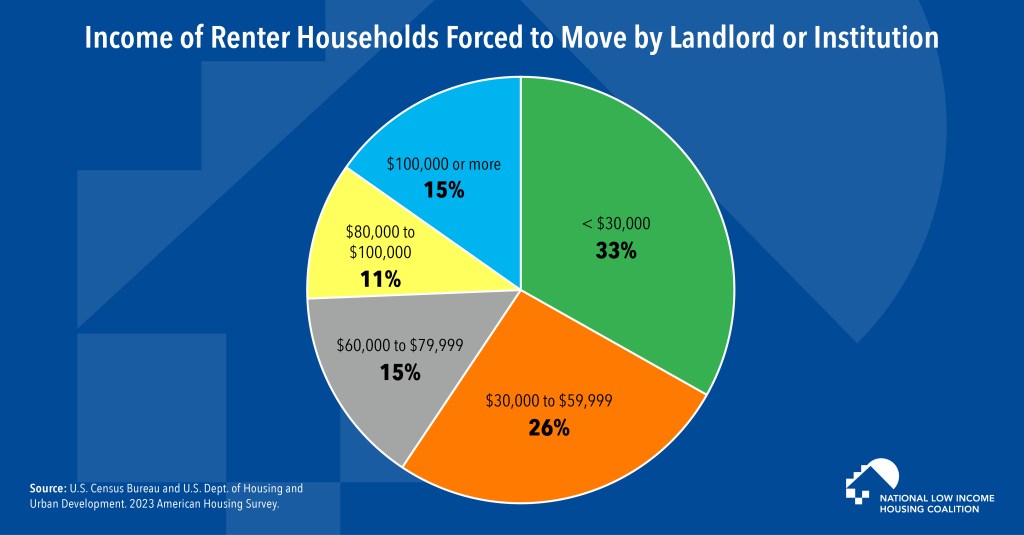
Consider the graph at the top of this page, which shows that a third of all evicted renters have incomes of less than $30,000 a year. Even at the top of that range, monthly rent of more than $750 pushes a tenant into the “rent burdened” category, which leaves little wiggle room for other necessary living expenses or emergencies. Falling behind on rent by even a month creates a nearly insurmountable financial hurdle for catching up.

But that’s not all. While an estimated 80,000 people would lose their housing assistance because of the mixed-status family rule change, and more than 2 million HUD-assisted households will be impacted by the loss of the 30-day eviction notice, an estimated 3.3 million would lose their rental assistance as a result of a March 2 proposal to impose work requirements and time limits on housing assistance. The estimate, based on an analysis by the Center on Budget and Policy Priorities, includes 1.7 million children who could lose their homes.

The proposed work requirement, long embraced by political conservatives who fret about welfare queens, would require “work eligible” adults to put in up to 40 hours a week at programs and projects that “address local needs and goals.” Failure to comply with work requirements would be grounds to terminate housing assistance. But potentially even more onerous is the proposal to allow PHAs and housing owners to establish two-year limits on housing assistance for non-elderly, non-disabled families.

All of these proposals are more nuanced than these brief summaries reflect, but the bottom line is that there are more than 10 million people in the United States who have a roof over their heads primarily because of federal rental assistance programs. Most people in HUD-assisted housing who can work do work: in Virginia, 81% of non-disabled people without young children worked in the past year, according to the National Low Income Housing Coalition. With the minimum wage in the state set at $12.41 an hour, and Virginia’s fair market rent for a two-bedroom home coming in at $1,749, it should be obvious why subsidized housing is the only way many state residents can have a roof over their heads. Now that’s at increased risk.

Nehemias Velez, executive director of the Staunton Redevelopment and Housing Authority, says he knows of no local families that will be threatened by the proposed mixed-status family proposal. The local effects of the other two proposals, however—not to mention other shots HUD might take in the weeks ahead at the people it ostensibly serves—remain to be seen. But it’s already quite clear that the fragile existence of people depending on federal tax dollars to survive is becoming ever more precarious. And as more of them inevitably get pushed out of their homes, it’s going to be up to municipalities like Staunton to pick up the pieces.

That’s not good. We’re not meeting current demand as it is, with long waiting lists at the housing authority, the Valley Mission and Valley Supportive Housing, so where will the new waves of suddenly homeless people go? How many more emergencies like the one we had in late January will it take before we get serious about developing an adequate supply of affordable housing, as well as providing sufficient transitional emergency shelter spaces to tide people over in the short term? Where is the political leadership we need to start beating the drum on these issues?