Follow the colored-dot road . . .

(Reading time: 17 minutes)

A draft of Staunton’s revised and updated Comprehensive Plan is out for review, following 18 months of data collection, meetings and pulse-taking—including hundreds of colored dots on a wall of easels—and presumably is heading for rapid city council adoption in early June. Public comments are being received until May 26. We should hope there are many.

As plans go, this latest iteration is an improvement over the original, which was adopted July 11, 2019—before Covid and before the post-pandemic explosion in real estate prices, an affordable housing crisis, devastating downtown floods and numerous other shifts in the firmament. That initial “plan” was far more descriptive than prescriptive, more a gazeteer than a road map suitable for navigating two decades. Its conservative approach meant the original plan avoided being derailed by the Covid era, but even on those few occasions when it tried to peer into the future it often missed the mark, as when it projected that Staunton’s population in 2040 would be 25,442—a number the current draft revises upward by 10%.

Predicting the future is tricky business, to be sure. But the 2019 plan also was hindered by its blinkered view of what properly falls within the city government’s scope of responsibilities, a perspective shaped at least as much by philosophy as by financial limitations. The plan’s view of housing, as “primarily a private system that is influenced by factors beyond those controlled by local government,” is perhaps the most egregious example of a hands-off attitude that produced a planning document with obvious blind spots. The result was a soulless slab of prose, devoid of vision or inspiration, suffocated by the expectation that the Staunton of 2040 would be just like Staunton in 2020 only more so.

The new draft, by contrast, takes a more expansive view of the city’s role, which is a welcome change. But it also goes to the opposite emotional extreme, so devoted to “vision” that it often reads like a romantic ode, a fulsome psalm to a city that is welcoming, vibrant, empowering, resilient, inclusive, thriving, harmonious, sustainable . . .  and on and on.  Fair enough—who wouldn’t want to live in a place like that?—but at some point it does become a repetitive blur. The new draft also is big on graphics and states forthrightly it intends to “minimize text,” which may be a nod to shortened attention spans but which undermines its credibility as a planning document. We think, analyze and plan more with words than with images, although images do provide a better complement to the whole “vision” thing.

But whether dry or frothy, both the original and the revision fall short of being either “comprehensive” or of being a “plan.” The update is more aspirational than the original, to be sure, but its attention to detail is erratic and uneven, ranging from the highly specific—even providing exact dollar amounts for specific sidewalk expenditures—to the kind of broad-brush statements of intent with which no one can quibble but with little or no guidance regarding how to get there. The lack of sufficient affordable housing, to offer just one example, is acknowledged as being “a foundational theme that touches nearly all chapters” of the plan, yet the housing section has the least number of proposed “tactics” of any of them, and even those few are wan at best.

Does it matter? On the plan’s own terms, it should. The Comprehensive Plan, according to its introduction, “guides Staunton’s efforts to update local ordinances, justifies city programs and initiatives, helps officials set budget priorities, and directs decisions or development applications.” In other words, the plan defines what’s important and what isn’t. If something isn’t in the plan, it doesn’t exist and stands a good chance of being overlooked. Any evaluation of the plan therefore should pay as much attention to what isn’t there as to what is.

Land Use

In the news business, it’s called burying the lede: starting a story with peripheral details, only getting around to the core concept many paragraphs later.  In the section on land use, the lede is buried in a grey table of “tactics” that makes passing but repeated mention of “updates to the Zoning Ordinance” to solve various problems (infill, residential development in commercial districts, cottage courts, accessory dwelling units, etc.) without any prior narrative introduction of the ordinance, its limitations, or whether the whole thing should be overhauled rather than be subjected to a thousand tweaks and cuts. Instead, the explanatory text preceding the “tactics” (recommendations) is replete with mostly generic drawings of various land uses and how they might be improved, seemingly borrowed from the Cincinnati Urban Design and Architecture Studio, together with concepts like “building to street ratios” that it doesn’t explain. It’s all very colorful, but given the lack of a comprehensive review of the zoning code, mostly unhelpful.

How much more useful would this have been if the plan’s drawings were of actual Staunton city blocks, the streets and existing buildings clearly labeled, together with a vigorous discussion of how Staunton currently assigns land use and how it might do so differently? As it is, an ostensibly comprehensive plan casually presents information that should—but doesn’t—elicit sharp questioning, such as its unquestioned endorsement of reserving nearly a quarter of the city’s land for “heritage farmland.” Should it?  Why? How is it sensible to set aside municipal acreage for cattle grazing when we’re surrounded by the state’s second largest agricultural county?

That’s not to say that the misleadingly labeled “ag-forestal” (much more ag than forest) corner of the city should be turned into suburbs, but that there is no sign that the comprehensive plan even considered alternative uses for the land.  It also plays into repeated nonsense like this statement: “Trends analysis indicates that roughly 86% of Staunton’s land is already developed, meaning future housing growth will rely primarily on reinvestment, infill development, and reuse of existing structures.”  That sounds dire, doesn’t it? But given that 22% of Staunton’s land mass is, as just noted, undeveloped agricultural land, it’s also absurd.

A more accurate—and helpful!—statement would be that “roughly 86% of Staunton’s land is already developed under current zoning constraints,” which opens the door to all kinds of fresh possibilities.  Zoning is something we invented. It’s something we could change. And if we did, it’s amazing how much land would abruptly be available for all sorts of urban designs.

Farmland aside, there are numerous examples of ostensibly “developed” but underutilized land in Staunton. Consider, for example, the commercially zoned dog-leg rectangle between N. Central and Augusta that runs from West Frederick to Pump Street. Covering approximately 7.5 acres, this three-block area is immediately adjacent to the much more densely occupied multi-use downtown area that is generally regarded as an example of enlightened land use. But what do we find here? Five financial institutions, two fast-food restaurants and a store-front church—eight buildings altogether, with a combined footprint a tad over 35,000 square feet, covering just 11% of the land they occupy. As for the other 289,000 square feet of that “developed” land? Mostly asphalt parking lots and driveways.

Imagine if, instead of all those borrowed graphics, the plan had mapped out this three-block expanse and showed how it could be redeveloped for maximum use and return on the dollar. Yes, the land is privately owned. But the private sector, more readily than government, recognizes how it benefits economically from greater density and its synergistic effect on business. What the private sector doesn’t have is the overarching vision and resources to assemble such a transformation. That’s where the comprehensive plan could make a difference.

Blind Spots

The unquestioned acceptance of continuing the ag-forestal land-use designation is symptomatic of a bigger problem within the comprehensive plan: that of failing to see or question what’s right in front of our faces.

Decaying churches

Staunton is chock-a-block with churches, many with congregations that are aging out and increasingly unable to support large sanctuaries. Some are relatively modest, others may include spacious grounds and additional buildings. But like aging parents with a house stuffed full of belongings that no one will know what to do with when they die, too many will pass away without proper dispensation of their assets.  For one example of what that looks like, see the former Bibleway Community Church on West Beverley, vacant for all of this decade and increasingly showing it.

Aging churches can be revitalized or repurposed in various ways, most notably but not solely as affordable housing. But whatever transformation may occur often requires the intervention of an outside agency, such as the city, working from an inventory that assesses which churches can continue to flourish and which ones need hospice care. Most critically, repurposing church properties typically requires someone else to initiate the conversation, since most aging congregations are reluctant to acknowledge they can no longer support their long-established houses of worship. That’s an understandably delicate exchange to have, but it only gets harder the longer it’s postponed.

Even without an inventory of an estimated 76 Staunton churches, there are a couple of obvious places where the comprehensive plan could get the ball rolling. The Marquis Memorial United Methodist Church on West Beverley, for instance, has more than two acres fronting on one of the city’s principal gateways, as well as several vacant and near-vacant buildings. It also has a dwindling congregation and can afford only a part-time pastor. Heating and cooling costs for its large sanctuary are so high that the church frequently holds services in other spaces on the property that have lower ceilings. How much more productively could that property be used?

Or consider Christ United Methodist Church on Churchville Avenue, also a Staunton gateway. A potential candidate for revitalization rather than repurposing, Christ United sits on five acres that present several development possibilities. Some of that land, for example, could be used for housing or a mixed-use development that would generate revenue for the church, thereby creating an income stream that offsets declining financial support from a diminishing congregation. But here, too, it might take creative city outreach to set such a change in motion.

Other iffy assets

Numerous though they are, Staunton’s churches are hardly the only large buildings that are under-utilized or facing obsolescence. Two of the most notable are the vacant and decaying Ingleside Resort, on the north end of town, and the spooky, shuttered sanitarium next to the Frontier Culture Museum. The former apparently is mentioned nowhere in the comprehensive plan. The latter gets a nod in one of the two appendices, in which attendees at an open house suggested the “DeJarnette campus” has development potential. No explanation or context is provided for that description, which would be meaningless for Staunton residents without a good historical grounding, and no attempt is made in the plan to explore the development potential of either property.

An even larger property within the city, widely referenced by the plan as a notable asset while avoiding a direct examination of its precarious outlook, is Mary Baldwin University. The plan does make a brief suggestion that the city should “develop plans for what to do if the worst-case scenarios unfold,” but then fails to describe what those scenarios might be or how the city might respond. That’s unfortunate. The university encompasses 58 acres of prime land and multiple buildings, including dorms that could be repurposed as low-income housing. While closing the campus would be a significant loss to the city, it would open other possibilities to which Staunton should be ready to respond in a timely fashion.

In addition to such major examples, Staunton has numerous vacant buildings whose existence the plan acknowledges but doesn’t address, beyond mentioning that it would be a good idea to inventory them. We’ve known that for years, of course, but for some reason such an inventory has yet to be assembled, which means the city is often flying blind when trying to match unmet needs with unused assets. One example is the city’s recurring failure to find space for a day shelter for the homeless—even though there is, and has been for quite some time, a vacant storefront right next to city hall, as well as several vacant buildings on South Augusta Street, all of which would be more than sufficient for the purpose. And then there’s the former Coca Cola bottling plant at the intersection of Augusta and Churchville streets, which at one point was eyed as a possible brewery but which remains empty year after year.

How is that we have people who need a roof over their heads, and buildings that have roofs but no tenants? And how is it that such an obvious pairing of needs and resources goes unaddressed in the city’s “comprehensive” plan?

Infrastructure

Sewer and stormwater systems are among the infrastructure elements that make it possible for more than 25,000 people to live in close and supportive proximity to each other. But so is the network of water mains and pipes that delivers potable water to every city home and business, and while the comprehensive plan has much to say about storm water it is almost entirely silent about the drinking kind.

That may be the inevitable result of the very visible destruction caused by recent flooding, leading to the plan’s emphasis on storm water management, versus the comparative invisibility of the water that’s being moved underground. On the other hand, last year’s major water-main break came in the middle of the comprehensive plan’s drafting process and should have been top of mind. Instead, the plan says nothing at all about pipes that are now more than a century old, or about a water delivery system that loses more than one in every four gallons that are pumped into it—a rate nearly twice the national average—or about the $40 million to $50 million the city says it will need to fix these problems.

The city shows no sign of knowing where that money will come from. This plan won’t be any help in that regard.

Economic development

To read the comprehensive plan, you might think that the only economic vitality in Staunton is centered on the downtown area, and that the only kind of business the city wants to attract is the kind that plays well with tourists: outdoor recreation, arts and music festivals, restaurants, galleries, theaters, pop-up markets and so on. If the city wants to attract manufacturing of any sort, you wouldn’t know it from this document. Nor would you know what kind of business development the city would like to see along Greenville Avenue or Route 250.

But the plan’s biggest economic oversight is the blind-eye it turns toward Staunton Crossing, which it mentions not at all despite the millions of dollars already poured into that industrial park’s development. That may be because among the park’s targeted industries is a data center, with all the electricity and water consumption issues and controversy that entails—reason enough, perhaps, to just pretend that there’s no “there” there. Unfortunately, that also means there is no consideration in the plan of possible alternatives for the park, such as manufactured housing or solar panels and batteries, which would create many more long-term jobs than a data center and at a far lower social and environmental cost.  

 Ignoring the inevitable

Unlike blind spots, which refer to things the plan simply doesn’t acknowledge, there are several problems or issues the comprehensive plan does see—and then ignores.  

Homelessness

As mentioned above, the new comprehensive plan goes where the old one didn’t by recognizing the centrality of housing to virtually every aspect of the city’s vitality, from economic development to meeting educational needs to community health. And as have other plans that seek community input, the draft plan acknowledges public concern about the consequences of inadequate affordable housing. When plan consultants conducted what they describe as “public intercepts,” housing was the number one concern voiced by the people they encountered, by far. Attendees at an open house highlighted “the lack of focus on vulnerable populations, particularly homelessness, in current plans.”   Vision statements for the city called for “more services for the unhoused.”

So it comes as a surprise that the comprehensive plan presents not even one suggestion for meeting the needs of people who lose their homes, even as it gives pro forma recognition to “the challenges faced by people facing homelessness.” Instead, it deflects. Housing is a “national issue,” the plan explains, presumably as much beyond local control as climate change. “Local efforts are unlikely to ‘solve’ the housing affordability problem.” (Bye-bye, Staunton Housing Commission?)

But failing to “solve” the housing affordability problem, it should go without saying, only guarantees that the number of people who are homeless will continue to grow. Indeed, Alec Gunn, executive director of the Waynesboro Area Relief Ministries, says that demand this past winter for overnight emergency shelter grew 26% over the previous year, even as the number of churches willing to provide such shelter is declining. Efforts to create a day shelter for the homeless have been even more ragged, with a church that was intermittently open for that purpose last summer—a first—declining to do so again this year.

Regarding all this and more having to do with homelessness, the comprehensive plan is silent.

Student population growth

While the plan draft acknowledges that Staunton’s public schools are at or beyond “functional capacity,” its forecast of what that means for the future is tentative at best—even as it cites the possibility of “urgent space management.” “If” current population growth continues, the plan states, “further modular units and long-term facility expansions will be necessary.” But the plan makes no effort to project how much the student population may grow, or in what parts of the city, basically deferring to Staunton City Schools to “assess current conditions and identify future infrastructure, modernization and capacity needs.”

That may be appropriate in jurisdictions where there is greater distance between municipal and pedagogical governance, but the two are intertwined more tightly in Staunton. The city, because of its planning and zoning responsibilities, is in a better position than the school district to assess future growth patterns. At the same time, the city inevitably will be involved in whatever financing is needed for new school buildings, and possibly for expansion or renovation of existing facilities, suggesting that city planning for such developments should be more proactive than the comprehensive plan contemplates.

In closing . . .

To the extent that the revised comprehensive plan is more user-friendly than its predecessor, thanks to more graphics and minimized text, it may pull in more eyeballs and thereby increase public engagement. That’s a good thing. The not-so-good thing is that such overly visual and summarized presentations tend to diminish critical analysis, acting like cotton candy for the brain: long on mouth-feel, but neither filling nor nutritious.

Much of what the comprehensive plan presents is a distillation of the aspirational and critical comments it received from the public in multiple forums—and yes, that’s also a good thing. But most of that feedback was in response to alternatives presented by the plan’s architects (for this feature, do you prefer A or B?), which means public input was largely limited to the subjects and choices it was given. That’s why the plan has so many blind spots, and presumably many more than the few I’ve offered. And when the public was given a more open-ended opportunity to voice concerns, subjects it raised that didn’t fit within the plan’s parameters often would be acknowledged but then ignored.

Making 20-year decisions based on how many colored dots ended up on a series of easels, which was one of the primary methods used to solicit public feedback,  is better than casting a series of animal bones onto a blanket to divine the future. But not that much better.

Thinking of giving? Think carefully

(Reading time: 9 minutes)

At a time when an increasingly frayed “safety net” is in danger of collapsing altogether, starved of funds and overseen by a vastly hollowed out federal bureaucracy, it’s only to be expected that social service agencies will step up their fund-raising efforts. At our household, for example, we get a plea for donations to the Blue Ridge Area Food Bank at least once a month, to which we respond as we’re able. But the line of those in need cuts across all of life’s essentials, and seems to get only longer, and you have to wonder how it will all end.

One thing about which we should not have to wonder, but which is rarely addressed publicly, is the level of institutional need. Yes, people are hungry, and in need of shelter, and wanting for adequate medical care or school supplies or decent clothing. But are the agencies working to help such people equally needy? How well do they apply the funds they raise, and how accountable and transparent are they with their donors? Do some have more than they need to help their constituents? Or have some squandered the donations they’ve received, as was so blatantly true of the now defunct local United Way a couple of years ago? How many local affiliates of national organizations coast on the latter’s reputations, rather than on their actual accomplishments?

These are tough questions to pose, because they threaten to tarnish institutions seen as local champions of the downtrodden. But the reality is that the pot of community goodwill and financial support is finite, and likely to shrink even as the need keeps growing. Giving money to Agency A means there’s less money to give to Agency B. Yet the few local institutionalized sources of such help—such as Community Development Block Grants, the Community Action Partnership of Staunton, Augusta and Waynesboro (CAPSAW) or the Community Foundation of the Central Blue Ridge—pay scant attention to the financial statements of their grant applicants, showing more concern for how many people their contribution might benefit.  Private contributors, meanwhile, are even less likely to do their homework when responding to the latest tug at their heart strings.

SAW Habitat for Humanity

One prominent example of muddled financial accountability is provided by the SAW Habitat for Humanity, which a couple of years ago was roiled by scandal involving its then-executive director, Lance Barton. Initial accusations of sexual assault by Barton were followed by reporting in the Augusta Free Press of years of Barton’s alleged verbal abuse of staff, temper outbursts, uncomfortable conversations about sex, substance abuse, drunken behavior at work and supposed financial irregularities. By late spring of 2024, Barton was out of a job, Habitat’s board of directors had virtually a complete makeover, and an interim director was brought on to manage the transition until a permanent replacement could be recruited.

That replacement was Brad Bryant, a widely respected local builder, teacher and former Habitat board member who was hired almost ten months ago. To be fair, Bryant inherited a mess—but it’s also fair to question his lack of public progress thus far in setting Habitat’s financial house in order. Although Bryant says the organization recently completed its first financial audit on his watch, its findings have not yet been publicized. Meanwhile, the most recent Form 990 tax return posted on Habitat’s website—the IRS form all non-profit organizations are required to submit to maintain their non-profit status, a form that potential contributors can consult before giving their money—is for the fiscal year that ended June 30, 2022. That was almost four years ago.

More recent Form 990s have been filed with the IRS, but Bryant had not seen them before this week. One was for the fiscal year that ended June 30, 2023. A second, following an apparent decision by the interim executive director to change Habitat’s fiscal year to a calendar year, was filed for the year ending Dec. 31, 2023. Depending on how diligently someone in the public searches for financial accountability, then, there’s been a lack of reporting for more than two years, and possibly quite a bit longer.

Some of that gap may get filled when the recent audit results are published, but even then, the report will be notably deficient in at least one material aspect. Among the financial assets in Habitat’s possession are nearly 300 pieces of poster art that were purchased by the disgraced Barton on a junket to Poland, ostensibly as an investment that could be sold to American collectors at a hefty mark-up. The art was purchased with Habitat funds, on a trip underwritten by Habitat that was rationalized as an unconventional but potentially lucrative fund-raiser. The art now sits in a locked room. It has never been shown to the public, and it has yet to be professionally appraised. Whether it’s a significant if unrealized financial asset, or whether it’s just a lot of worthless paper, the product of Barton’s feverish imagination, remains unknown.

In Bryant’s assessment, any fuss over the Polish art is a tempest in a teapot, much ado about nothing at a time when he’s struggling with more substantive issues to make Habitat “viable again.”  He may be right. He may also be markedly wrong. The point is that a somewhat bizarre aspect of Habitat’s bookkeeping is a black box that the organization doesn’t want anyone looking into. When I asked Habitat’s new chairman of the board, Charles Edmond, for an explanation of the Polish art fiasco, his terse response was to say that “due to ongoing litigation, our attorney has advised us to not talk about this issue at this time.”  Yet as Bryant conceded, there actually isn’t any litigation, just repeated failed attempts at getting the Commonwealth’s Attorney to look at the possibility.

There’s no question that Habitat was left in tatters by its departed executive director, and that restoring its luster—not to mention its effectiveness at actually building affordable housing—is a monumental task. But that task is not made easier in the face of financial inscrutability. Not when organizational viability is dependent on the public’s willingness to open its wallet.

Valley Mission

A diametrically opposite set of circumstances is provided by Valley Mission, which provides long-term shelter and case management for our area’s homeless population. It is perpetually over-subscribed, with a waiting list that can stretch for months, and even though the Mission ostensibly has a six-month window within which its clients are encouraged and worked with to obtain permanent housing, the reality is that a year or more of residency is not unusual. There just isn’t enough affordable housing to meet the need.

It may seem paradoxical, therefore, that the Covid pandemic was very good to the Mission’s financial fortunes. Money poured in from various sources, so even as expenses climbed, revenue far outstripped what was needed, jumping from a more or less normal $1.3 million in 2019 to $2.5 million in 2020 to $3 million in 2021. And although income declined somewhat thereafter, it remained significantly higher than pre-pandemic revenue.

Give the Mission a thumbs-up for showing restraint in the face of this bounty: although expenses have continued to climb every year, they have not outstripped the Mission’s two main sources of regular income, contributions and grants, and the income generated by its thrift stores in Staunton and Waynesboro. The surplus has instead been banked, some in cash and some in investments, where it has been generating an enviable amount of interest income: $103,909 in 2023, for example, and an additional $121,642 in 2024.

All told, then, the Mission ended 2024 (its 2025 financials have not been filed yet) with just a tad less than $3 million in cash, $1.6 million in investments, and a total of $5.4 million in unrestricted assets. To put that in context, the Mission’s total expenses in 2024 were $2.3 million—which is to say, the organization is now sitting on enough liquid assets to operate for two years without a single additional dollar coming in the door. It is, in one sense, functioning like an investment bank, which may not be what potential donors want their contributions to fund.

A possibly bigger problem is that even as it hoards a lot of cash, the Mission continues seeking and receiving funding from the same sources used by other local social service agencies, many of which are also trying to help people meet their housing needs. That includes Waynesboro Area Relief Ministries (WARM), Valley Supportive Housing, New Directions Center, and Renewing Homes of Greater Augusta, all of which operate on a shoestring. Meanwhile, in recent years the Mission has been receiving approximately $7,940 annually from Staunton’s Community Development Block Grant, was awarded $11,500 from the Community Foundation in 2024 and $161,000 in 2023, and in the year ending June 30, 2025, received $36,622 from CAPSAW. That’s all money that would have had a far more meaningful impact elsewhere.

There’s another aspect of the Mission’s growing wealth that is problematic. Not only is the Mission not meeting the full demand for the services it already provides, but there are numerous adjacent needs of the homeless population that remain completely unaddressed.  Among the most prominent, for example, is the lack of a day center in the SAW region to provide shelter and services to people who otherwise are left wandering the streets in search of winter warmth, summer shade and refuge from rain and other extreme weather in all seasons.  There are several reasons why this state of affairs exists, but among the most prominent is a lack of adequate funding.

Providing a day center is not the Mission’s responsibility. On the other hand, it’s not unreasonable to think that perhaps the Mission could expand its efforts to answer an unmet need that is entirely aligned with its core mission.  Perhaps it will.

The Mission’s executive director, Susan Richardson, left open that possibility by asserting that the Mission’s board and leadership “makes financial and strategic decisions based on what we believe is best for Valley Mission and the residents we serve.” So . . . not saying no either to expanding the Mission’s facilities to provide more shelter space, or to filling in other holes in the safety net provided to the same generalized population. But also not saying no to bellying up to the financial water hole frequented by all those other critters in the social services ecosystem, which after all is how the system works.

It’s a jungle out there.

The homeless population is graying

(Reading time: 7 minutes)

As the number of people pushed into homelessness keeps growing, a worrisome subset of that population is expanding at an even faster pace. Locally, we’re not paying nearly enough attention.

Nationwide, there are more than 16 million people 65 or older living by themselves. That represents 28% of our oldest age group, and the older you are, the higher the likelihood you’re living alone: more than half of households with someone 75 and older consist of only one person.

Being old and alone doesn’t necessarily result in homelessness, of course, but it does increase the odds considerably. Living alone is riskiest for the elderly, who tend to have more accidents, are more prone to neglect their health and are frequent targets of financial scams, all of which can result in the loss of a home. And while many Baby Boomers are living in comfortable retirement, 5 million people over 65 live below the poverty line and an additional 2.6 million were classified in 2020 as “near poor,” meaning their incomes were less than 25% above the poverty line—and far below the amount needed to rent an apartment.

Put it all together, and the number of elderly people becoming homeless for the first time is swelling. Add that to the number of chronically homeless people who are “graduating” into the older population, and the ranks of elderly homeless people are growing to levels not seen in decades. The 2024 national Point in Time (PIT) census, the most recently available, found more than 146,000 homeless people who were 55 or over, or 18.9% of the 771,480 total. And here’s the kicker: more than half of those elderly homeless people were unsheltered, compared with just 36% of the overall homeless population.

Locally, the percentages are even more skewed, in keeping with a population that on average is older than at either national or state levels. (In Staunton, we have more people over the age of 65 than we have under 18.) That same 2024 PIT count, conducted by the Valley Homeless Connection, found 47 people ages 55 and older who were homeless, or roughly 26% of the total. Eight were unsheltered, sleeping in cars, a church vestibule and other make-shift accommodations.

Why do elderly homeless people sleep on the street rather than in a shelter? One obvious reason is that there aren’t enough shelters to go around. In recent weeks, for example, the emergency shelter space offered by the Waynesboro Area Relief Ministry (WARM) has been fully subscribed, with 60 or more people filling both primary and overflow churches.  But even when shelters are available, they often aren’t a good match for a population with mobility and other health issues. Getting in and out of bunks, such as those used at Valley Mission; managing medications, like insulin, that might need refrigerating; or making it to a shared bathroom in time for those with incontinence issues, are just some of the major challenges facing older people.

Conversely, older people are more wary of entering shelters because they recognize how vulnerable they are, and because of their generally lower tolerance for conditions that a younger, more resilient population can handle more readily. The National Alliance to End Homelessness, for example, cites the biggest reasons given by people for avoiding homeless shelters as overcrowding (37%) and the related issues of bugs (30%) and germs (22%).

But recognition of the special needs of an elderly homeless cohort has been slow in coming. The national PIT count, for example, only recently started breaking out the age demographics of those it surveys, after years of lumping everyone older than 24 into one giant category. USAging, a national organization that issues periodic assessments of services for the elderly, as recently as 2020 limited its housing focus primarily to home modifications and repairs that help older adults stay in their homes, thereby preventing homelessness. Last year’s report, on the other hand, finally acknowledged a deeper problem, observing that “more older adults are experiencing housing instability or even homelessness,” the insertion of “even” suggesting a previously unimagined condition.

USAging’s findings are based on a national survey of what are known as Area Agencies on Aging, or AAAs, which were established throughout the country by Congress in 1973 to respond to the needs of Americans age 60 and older. Its 2025 Chartbook includes a new “spotlight” on housing issues that charts “the top housing-related challenges facing older adults.” Number one on the list, submitted by 94% of the AAAs, is a lack of affordable housing, while more than a third (35%) cited “increasing homelessness” as among their top dozen concerns.

That concern, however, has yet to filter down to this part of Virginia in any meaningful way. Our local AAA is the Valley Program for Aging Services (VPAS), which serves a five-county area and its cities, including Augusta, Staunton and Waynesboro. Among its better-known programs are Meals on Wheels, but VPAS also helps the elderly with case management services, Medicare counseling, respite and transportation services, and health and wellness programs. When it comes to housing, however, VPAS comes up blank. Its strategic plan for 2025-2027 doesn’t even mention the word.

VPAS executive director Beth Bland said last week that her agency is “certainly aware” of the housing issue, but contended that the problem is “bigger than any one organization can tackle” and added that VPAS doesn’t have the financial or staffing resources to make a difference. Asked why VPAS doesn’t at least provide leadership in bringing community attention to the problem, Bland demurred. “We are not prepared to be, nor would it be appropriate for us, to take the lead on this issue,” she replied, suggesting that the Community Fund is already doing this. The Community Fund, alas, while it has tried to put a spotlight on the overall lack of affordable housing, has had little to do with homelessness.

Putting aside Bland’s unwillingness to have VPAS take the lead on an issue that clearly falls within the AAA mandate, it’s only fair to acknowledge that the local agency is squarely within the national mainstream. As documented in the 2025 Chartbook, only 8% of the nation’s AAAs have a formal partnership with homelessness or emergency shelters, 7% with coordinated entry systems for the homeless and 6% with an affordable housing coalition. The problem of old people living on the streets apparently will have to become much more egregious before we start paying attention.

There is one slim ray of hope locally, although it’s still many, many months from fruition. The Staunton city council last week approved a rezoning request for a property on West Beverley that has been vacant for at least the past 40 years, changing it from an R-4 to a B-5 zoning category. The R-4 category had frustrated multiple development proposals over the years because of its parking requirements—requirements that are much looser in a B-5 zone, so poof! a bureaucratic hurdle was vanquished just like that. Sometimes all it takes is someone with vision to make things happen.

The rezoning clears the way for the former Dunsmore Business College to be redeveloped as 15 one-bedroom apartments for “extremely low-income” senior citizens. The project is being led by Stu Armstrong, a former Staunton resident who owns the brick building and has a history of renovating other residential properties in the Newtown area. Although he estimates the renovation will cost at least $3 million, Armstrong says he can raise sufficient capital through multiple layers of grants, federal housing programs and private equity funding—and a good thing, too, because if he had to cover his costs through rent income, the apartments would have to list for approximately $2,000 a month.

To be sure, were those apartments available today, they would make only the slightest dent in demand. The Staunton Redevelopment Housing Authority, which is lending its support to Armstrong’s efforts, has a waiting list for its subsidized apartments that includes 137 elderly people with annual incomes, on average, of slightly under $14,000. That’s not enough to rent anything in today’s market. But even if Armstrong’s project reduces the housing authority’s waiting list by just 10%, that’s 15 people who otherwise could very well end up on the street.

And maybe, just maybe, Armstrong’s success could point the way for others to follow suit. Let’s wish him well, because the need he’s addressing is only going to keep growing as all of us keep aging.

We’re not moving the needle

(Reading time: 5 minutes)

Maybe it’s just the cold that’s slowing everything down, with much of Staunton still sheathed in so much ice it could be the setting for “Dr. Zhivago.” Nearly two weeks after a devastating winter storm hit the region, we’re still digging out and only weakly reestablishing life’s normal routines. A lot of important things have been put on hold.

But attention fatigue and disengagement with issues of affordable housing and homelessness, of such prominent concern in 2023 and 2024, had already set in before the storm.  Where once scores of people attended the two housing summits hosted by the Community Foundation of Central Blue Ridge and the Community Action Partnership of Staunton, Augusta and Waynesboro, only a few dozen soldiered on in two working groups that were spun off to address issues of housing stability and housing stock. Monthly workgroup meetings soon bogged down into every-other-month events, attendance dwindled, the focus blurred.

Most recently, when the oncoming storm threatened a housing stock working group meeting scheduled for last week, the meeting was scrubbed altogether. Not postponed for a week or two, which one might expect if weather were the only problem, but canceled outright. That created a four-month gap between meetings, but it’s doubtful anyone views that as a problem—not when there’s so little to show for the past two years.

Then there’s the much-heralded Staunton Housing Commission, which after a similarly lengthy gestation, was scheduled to meet for the first time in early January. Instead, supposedly because just six of its nine members have been appointed to date, the commission’s inaugural meeting will occur later this month. Or maybe in March. With only four meetings per year, there’s really no rush—although it’s fair to ask how this leisurely pace fits in with the city’s “housing strategy,” for which an 18-month clock started ticking last July 1, and for which the housing commission was to be the lead advisory board.

And here’s an ironic twist: the Point in Time (PIT) count, which attempts to enumerate all the homeless people who can be found on one specific night per year, was scheduled for last Wednesday. But because of the extreme cold and generally impassable roads, any homeless people who might have been stuck in their cars, tents or other improvised shelters were given a pass—the only ones who (were) counted were those who reached homeless shelters, like Valley Mission or that week’s WARM emergency facility, which was in Waynesboro. So the “good news” in this year’s PIT count will be that 100% of those who are homeless were sheltered—no unsheltered people were found!

We may hope there will be an asterisk after those numbers.

One good thing that did come out of the storm was a last-minute, hastily assembled temporary emergency shelter thrown together by Staunton Mayor Michele Edwards—although she did so, she struggled to explain, as a private citizen and not as a city official. At least I think that’s the distinction she was trying to draw. Housed in the basement of the Central United Methodist Church, the emergency shelter was full to its limited capacity right up until it closed this past Monday morning, when presumably the emergency was over and the “temporary” aspect of its existence kicked in.

Anyone looking at a landscape torn from Boris Pasternak’s novel might have been puzzled—local schools wouldn’t reopen for another couple of days, after all—where the people who had stayed at the Central United shelter would go that day, or even that night, but that’s how the icicle crumbled. As Edwards emphasized, “temporary means temporary.”

The thing that’s clearly not temporary is Staunton’s ongoing lack of sufficient affordable housing, which persists despite the two years of chin-wagging mentioned above. Also not temporary is the lack of additional resources to cope with the inevitable consequences of that housing shortage. The emergency shelter program operated by WARM has an increasingly shaky roster of local churches willing to have their facilities used for a week at a time. The Mission continues to be backed up, as its supposedly short-term residents are unable to find permanent housing. And despite months of shambolic efforts at creating a day shelter for the homeless, we’re no closer to having one today than we were a year ago.

All that talking and meeting and feel-good assertions of what we’re going to do have made not one bit of progress in either stemming the tide of homelessness or of providing for the most basic needs of the unsheltered. We’ve just been treading water.

The online meeting that came up with an eleventh-hour plan to create an emergency shelter for the homeless took place two weeks ago today. There was much agreement, among the dozen or so participants, that this stop-gap measure should serve as a teaching moment—that the lessons learned from this intervention should result in better planning for the next emergency. Doing so, it was remarked both at the meeting and in subsequent emails, would be best served by sharing insights and observations as soon as possible after the fact, while memories were still fresh.

Two weeks later, and a week after the emergency shelter was closed, that conversation has yet to take place. The temperature tomorrow night is predicted to drop back into single-digits, and the ice and snow won’t melt significantly until mid-week, when the climate rollercoaster we’re riding may push us into the 50s. It is not outside the realm of possibility that when the melt occurs it will uncover someone who did not make it to a shelter, who was not found by a non-existent PIT count, who believed with good reason that there really was no refuge to be had.

That would be depressing, if, we may hope, unlikely. What’s more depressing, precisely because it is more likely, is the thought that a year from now essentially nothing will have changed.

What we should be learning

(Reading time: 9 minutes)

Four degrees this morning, according to my outside thermometer, which with a mild breeze of six miles per hour pushes us into sub-zero wind chill territory. That white stuff on the ground stopped being snow—if it ever was that—several days ago, compressing into an ice cap you can walk across without breaking through the crust. The city finally realized that this is not your normal snowstorm and brought in massive farming and road-building machinery to break up the ice still coating most roads, impervious to workaday snowplows mounted on pickups and garbage trucks. The deep freeze will extend into next week.

And yet, this could have been far worse. Had we had a widespread power outage, caused by storm-toppled transmission poles or a fried substation, many hundreds of city residents would have faced a life-threatening situation. No heat, no light, and often no way to get out of the house to seek help—if any help could be found. In many cases, the extreme cold would have resulted in burst pipes, which not only would have meant no water now but too much water later, when a thaw eventually arrives. And those in greatest danger, as always, would have been the most vulnerable: the elderly and disabled, those relying on medical devices, families with small children.

What would they have done? Who could they have called, and what help would have been provided?

A day before the storm hit, the city put out a press release announcing that it had declared a state of emergency. This apparently was intended to provide some kind of assurance that matters were well in hand, with references to the activation of an Emergency Operations Plan and a claim that it “removes any barriers to our response efforts and allows us to mobilize additional resources, if necessary.” Just what that was supposed to mean for the average Staunton resident was never explained, however, and aside from advising people to call 911 in an emergency, the only direct communication to the public was a stern reminder about shoveling out the sidewalks. As if!

Meanwhile, the city’s lack of foresight and advance emergency planning was captured in microcosm by its response to the unsheltered residents who live on our streets—which is to say, no municipal response at all. Whatever resources are unleashed by the Emergency Operations Plan, apparently none are extended to people sleeping in their cars or huddled in a tent somewhere. If a declared state of emergency is in any way meaningful, that umbrella doesn’t cover those who need it most.

That’s not to say nothing was done. To her enormous if paradoxical credit, Michele Edwards spearheaded a mobilization effort last week to find, transport and shelter the homeless before they froze to death—but she did so as a private citizen, not as the city’s mayor. Edwards’ initial outreach was an email, written “with urgency and with hope,” to approximately 40 local religious leaders, homeless advocates and social service agencies, seeking their help “in an 11th-hour effort to protect life and dignity.” But as Edwards also made clear, “I am writing as a local government leader, and I’m not representing the City of Staunton. So, I am not writing with local government solutions.”

Why this official hands-off policy was necessary was not explained. Equally inexplicable was the distinction Edwards drew between acting as a local government leader and as a representative of the City of Staunton: is not the local government she leads that of Staunton?

That confusion aside, Edwards’ outreach resulted in roughly a dozen participants meeting online Friday night to brainstorm a last-minute response to a humanitarian crisis. Thanks to their efforts, an emergency shelter was thrown together at Central United Methodist Church (CUMC), under the direction of the Rev. Won Un. Food donations were received, as were 17 cots on loan from the Boy Scouts at Camp Shenandoah. The YMCA made a large donation of bedding, sleeping bags and pillows, and others also donated blankets. Volunteers to staff the shelter were recruited from Mary Baldwin University (MBU), and Edwards recruited a friend, Bill Woodruff, to supervise them for the first three nights.

All good, right? Five homeless people were housed by the shelter Saturday night, including one who was transported from the current WARM shelter in Waynesboro because it’s at full capacity. (Another three people were provided emergency shelter at the Valley Mission, a high-barrier shelter that serves people working toward permanent housing and does not normally offer transient services.) The headcount Sunday night increased to nine, including one woman and a Vietnam vet that Staunton’s own Spiderman—who was walking home after volunteering at the shelter the first night—found in the snow and escorted back to the church. Two-dozen or so volunteers, many from MBU, signed up for eight-hour shifts at CUMC.

But as with most such reflexive volunteer mobilizations, interest and commitment wane with time. People eager to help at the outset of an emergency become distracted by other, more pressing needs on the home front—driveways to shovel out, children who must be tended because schools remain closed—or believe the situation is well in hand and they’re no longer needed. Communications begin to break down, with group chats suddenly funneled through a single person—supposedly in the interests of efficiency—but with daily updates becoming first scarce, and then non-existent. Energy dissipates, and the few people still working at the center of it all become over-stretched and frazzled.

The danger here is not that the current effort will crumble, although that’s certainly a possibility, but that nothing changes going forward—that the next time we’re in a similar situation, the people who stepped forward this time will be a little less eager to do so again. For that not to happen, we have to learn that extreme conditions must be met with advance planning and an organized response, and that’s really a government function. No church or nonprofit social agency has either the resources or the authority to marshal what’s needed when the general population is fragmented and isolated by extreme weather or other disasters.

What should we have learned from current events? At the very least, the following:

  • Meaningful communication with the public is crucial. General, nonspecific assurances about disaster declarations and emergency operations plans don’t convey any useful information. Nor does hectoring people about shoveling their sidewalks demonstrate any understanding of how much outside the norm a situation has become.
  • Any city emergency plan should include a centralized relief center that is opened to the public when a disaster is declared. In Staunton’s case that could be the gym at Gypsy Hill Park, or it could be the National Guard Armory—but wherever it is, that information should be widely communicated to the public, and ideally it should be widely known before there’s a disaster.
  • A centralized relief shelter should be stocked with, or have ready access to, cots, bedding, food and water. Of less critical importance, but still desirable, would be showers, cooking facilities, accommodation for pets, and games, books and other activities, especially for children.
  • Both paid and volunteer staffing are needed at a relief shelter. Paid staffing is needed to assure reliable oversight and accountability, and could consist of cross-trained city employees who are not front-line responders and are recruited ahead of time. Volunteers are needed to fill the many roles that would stretch paid staff too thin, but also should be recruited ahead of an emergency (more on that below) and contacted via a master list maintained by the city.
  • Transportation, of both volunteers and people in need of emergency shelter, is a critical but overlooked necessity when people are trapped in their homes. The city should have an emergency list of residents with four-wheel-drive vehicles they are willing to operate in such circumstances, to ferry volunteers, refugees, food and other supplies as needed. This may extend to National Guard equipment as well.

I don’t think it’s hyperbolic to observe that in a different time, extreme situations like the one we’re confronting—and inevitably will be confronting again—resulted in the creation of civil defense organizations of various sorts. Although often associated with wartime conditions, civil defense forces were designed to supplement the military and civilian first-responders by fielding volunteers to do the more mundane tasks of shepherding people to shelter, cooking and serving meals, driving and delivering people and goods where needed, checking in with refugees to ensure their needs are being met, and so on.

The irony is that an organization like this is on tap in many communities around the country—and until a few years ago was available locally, as well. Known as Community Emergency Response Teams (CERT), the FEMA-sponsored program at its most ambitious trained and organized groups of community volunteers into emergency teams, with an internal command structure and in a subordinate position to first responder agencies. A watered-down version of the concept was taught locally by Rebecca Joyce, currently the city’s housing planner but at that time an employee of the Central Shenandoah Planning District, which apparently terminated CERT training without public explanation. A shadow of the group lingers on, primarily to recruit volunteer victims for local disaster drills but without any presence when the real thing strikes.

Whether reviving CERT is either feasible or desirable is open to discussion, but it’s clear that something of the sort would have been an enormous help in recent days. But that’s not a program that can spontaneously combust: it, or something similar, requires advance government initiative and government resources, as do the other elements of a meaningful disaster plan sketchily outlined above.  

This won’t be our last rodeo (and indeed, this one isn’t even over yet), so the question that must be answered is, what have we learned from it? And how will that education inform our actions going forward? Failure to respond is not an option.

Jan. 29 postscript, 4 p.m.: the CUMC emergency shelter reports it is full.

Homeless folks get short shrift again

(Reading time: 5 minutes)

Here’s poetic timing for you: the next nationwide Point in Time (PIT) count of homeless people is scheduled for Wednesday, following on the heels of local forecasts of ice and snow, abundant advice on stocking up with food, water and batteries, and schadenfreude-laden commiseration from the lucky few for those who haven’t already installed back-up generators. But really, the only thing we know for sure is that it’s going to be cold. Really, really cold.

Most of us will get along just fine. The notable exception will be people who no longer have a home and make do by staying at homeless shelters or by sleeping in their cars, tents or church vestibules. The PIT count is an annual attempt to take a snapshot of just how many such people there are, but the irony is that the worse the weather when the census is taken, the less reliable its results: those without access to a homeless shelter burrow deeper into whatever hole they find, prevail on friends or acquaintances to let them couch-surf, or scrape together enough money for a short motel stay. Not only are the homeless harder to find when the weather is most extreme, but it’s only human nature in the face of such adversity for the census takers to be less diligent than they might otherwise be.

So we’ll get some numbers, of questionable usefulness—eventually. The unfortunate reality is that while a “snapshot” connotes immediacy, these annual exercises are taking ever longer to collate. The National Alliance to End Homelessness, for example, which you might expect to be as up to date as anyone, has a dashboard that ostensibly serves up 2025 homelessness data but the numbers it reports are from the 2024 PIT count. That means the statistics are two years old and increasingly irrelevant. Mary Frances Kenion, Chief Equity Officer for the alliance, says this is because the U.S. Department of Housing and Urban Development has not released last year’s data, which sounds par for the course these days but probably should be spelled out on the alliance website.

Locally, here’s what we can expect next week: that the PIT census will find 80 to 90 people staying at the Valley Mission, another 30 to 40 in a WARM overnight shelter (more on that in a minute) and up to a dozen others in emergency accommodations, including the New Directions Center for survivors of domestic violence and motel rooms paid for by social service agencies. Only an additional score or so will be identified in the usual gathering spots. including several tent encampments in Staunton and Waynesboro, as well as the parking lots of Sheetz, Walmart, Cracker Barrel, Martin’s, Lowe’s and similar commercial outlets.

All told, the final count for the SAW area of Staunton, Augusta County and Waynesboro will come in between 140 and 160, and to the extent that anyone makes an effort to publicize this finding, much will be made of what a high percentage of that number were sheltered for the night. The implication will be that the circumstances aren’t too dire, even though the actual number of unsheltered people most assuredly will be higher than reported—perhaps much higher. WARM executive director Alec Gunn, for example, as close to local homelessness reality as anyone, contends that “there’s easily at least a hundred” unsheltered people in the SAW region.

A misleadingly low count next week will, however, dull any sense of urgency to do something about a problem still firmly on the backburner of civic or social concern. Last year’s bitter January weather prompted some hesitant steps toward creating a day shelter, as a suitable alternative for people otherwise forced to find refuge in the library, YMCA, fast-food restaurants and other public spaces. Alec Gunn ostensibly was point-man on that effort, but says it went nowhere because the Staunton city council wouldn’t offer more than a year’s funding—and a miserly amount at that, of just $30,000—and he didn’t want to start something that would have to shut down a year later. Moreover, he added, the day center’s proposed site, the First Presbyterian Church, turned out to be inappropriate for a low-barrier facility because its premises are used for two children’s schools.

So. No day shelter. But also fragile provision of an emergency night shelter, since the roster of churches willing to work with WARM to provide week-long accommodations is noticeably shorter than last year. The season began with two unclaimed slots for host churches, forcing at least one to extend its commitment by a week, and even today the schedule has multiple openings for overflow sites, which are needed when the primary host has insufficient room to meet demand, usually around 30 people. And this next week, when the weather will be at its most unforgiving, the host church will be not in Staunton or Fishersville or Waynesboro, as is the norm, but in Mt. Sidney, creating additional transportation headaches. Nor is there an overflow site on next week’s schedule.

Bottom line: be appropriately grateful if you have a warm, weather-tight and amply stocked refuge in which to ride out the storm, and even more so if you don’t get pushed into the cold to fend for yourself for 10 hours until you can return. But remember also that there are dozens among us who don’t have those bare necessities, after yet another year of handwringing but not a bit of increased help—if you’re on the street, all you’ve received is blah, blah, blah. Thin gruel indeed.

Jan. 23 postscript: According to a note from a WARM board member, the sheltered count now approaches 50. First Baptist Waynesboro, the host church this week, has been staying open some days, depending on the weather, but thus far there’s no word on whether Salem Lutheran in Mt. Sidney will follow suit next week.

Homelessness as a kick in the pants

(Reading time: 13 minutes)

The calendar may insist that winter won’t arrive for another six weeks or so, but anyone who ventured outside Tuesday morning knew otherwise—not when the temperature hit a bone-chilling 24 degrees Fahrenheit.  Tuesday was a good day, in other words, to be bundled up in a cozy bed or snuggled with a good book under a comforter in an easy chair. If you were that lucky.

It’s ironic, then, that just 12 hours earlier the city had held the third of three public workshops addressing proposed revisions to its comprehensive plan. Dozens of goals and draft strategies were outlined on multiple easels for Staunton residents to ponder and evaluate, spanning everything from land use, housing and economic development to transportation, public infrastructure and education. A section on health and human services stressed “active living, healthy food access and a clean environment.” Public safety, environmental resources, art and recreation all received due consideration.

But nowhere in all this planning and verbiage was there any mention of Staunton’s homeless population, or its needs and how those needs might be met. True, the section on housing gave a vague nod to promoting “affordable housing options for people of all incomes, needs and abilities,” but it remained silent regarding those unable to take advantage of such promotions. Nor did the draft comprehensive plan set a goal of eliminating homelessness by any particular date, and at no point did it acknowledge, much less prescribe, the kinds of services a homeless population requires. As far as the comprehensive plan is concerned, Staunton residents without permanent shelter simply don’t exist.

Winter’s advent will make that fiction harder to maintain.

Let’s take stock. A long-promised day shelter, offering homeless people refuge from extreme weather, remains as elusive as ever, in part because of a crumbling commitment by First Presbyterian Church to allow the use of its premises, but also because of a lack of financial and leadership backing from city council. Meanwhile, the Waynesboro Area Refuge Ministry (WARM), which was to operate the day shelter and which already provides emergency overnight shelters from late November through March, just published its schedule of participating churches for the upcoming season. Two of the week-long slots remain unfilled, at an exceptionally late date in the planning cycle, and there are reports that a third also may fall vacant because one of the congregations got cold feet and is backing out. Meanwhile, eight of the 18 overflow slots, for when the primary host churches receive more than 40 people, likewise remain unclaimed.

The Valley Mission, the area’s transitional shelter for homeless people working on reentry into the workforce and established housing, has 89 residents and is at full capacity—as it has been for several years—and is as far as ever from meeting its goal of a six-month turnover. “Yes, the average length of stay has been much longer than a year,” concedes director Sue Richardson. “In fact, we had two different women who were here four years each,” which puts a whole new meaning on “transitional.”

Then there’s Valley Supportive Housing, which provides affordable housing for clients diagnosed with mental illness, intellectual disabilities or addiction—people, in other words, who otherwise would be prime candidates for living on the streets. It also is at capacity, with 68 tenants, and has a waiting list of 43—the biggest it has been in at least a decade. “Two years ago it would have been half of that,” says director Lou Siegel, who says some of those on the waiting list are at Valley Mission, some are in temporary accommodations with family members, and some are living in their cars.

Both Valley Mission and Valley Supportive Housing are in a perpetual scramble for adequate financial backing, which comes in bits and drabs from local sources such as the city’s Community Development Block Grant (CDBG), the Community Fund and the Community Action Partnership of Staunton, Augusta and Waynesboro (CAPSAW). CDBG is all federal money, while CAPSAW receives nearly half of its funding from the federal government—which means both revenue streams are threatened by the current political climate.

Meanwhile, the area’s homeless population, while always difficult to assess accurately, is almost certainly not diminishing. WARM director Alec Gunn estimated this summer that the SAW region has 250 homeless people.  And while this year’s Point in Time (PIT) count—a one-night snapshot—found fewer unsheltered homeless people than last year, bitterly cold weather the night of the census may have driven them deeper underground. Moreover, as a surprised Lydia Campbell of the Valley Homeless Connection observed, of the 157 sheltered and unsheltered people who were counted by the 2025 PIT census, 71 reported they were homeless for the first time, up from 51 in 2024.

All of which is to say, the Staunton Comprehensive Plan as it’s currently coming together has a gaping hole big enough to push a shopping cart through.

FAILING TO SEE THE CITY’S HOMELESS population means the comprehensive planners also fail to ask why the homeless exist in the first place. If you don’t see a problem, you can’t solve it.

Homelessness, with some rare exceptions, is a signal that the system itself is failing. At its most basic doh! level, homelessness results from an inadequate supply of housing that people can afford. With rental vacancies at or around 2% and housing costs far outstripping the affordability provided by median incomes, the inevitable outcome has been compared to a game of musical chairs, in which the number of available chairs is always less than the number of people circling them. When the music stops, someone always ends up on the floor.

The obvious question: why is that? Why, in a market economy, isn’t more affordable housing being built? The law of supply and demand suggests that when demand exceeds supply, market forces will step up production until the imbalance is corrected. You want to end homelessness? Simple: build more housing at a price that people can afford. So . . . why isn’t that happening in Staunton?

The Staunton Housing Strategy Group spent a year purportedly wrestling with this very issue, ultimately producing this past summer what it optimistically called “Staunton’s Pathway to Affordable Housing and Housing for Working Families.”  Yet it’s notable that of the 19 members of the workgroup, only one, Stu Armstrong, could be categorized as a builder or developer—that is, as someone from the supply side of the supply-demand equation. And Armstrong, as it turned out, didn’t attend a single one of the group’s four meetings.

What that left was an assortment of political leaders, planners and heads of non-profit social agencies holding a one-sided conversation about how best to plug the city’s housing deficits. The result was a set of 11 strategies that, while not entirely without merit, only tangentially address the critical question of how to increase the city’s stock of affordable housing, and do so on a less than urgent timetable. For example, completion of a “strategy” to allow accessory dwelling units (ADUs) in the city is expected to take 18 months, a process that won’t add any new homes but will create the possibility of some down the road.

Foot-dragging over ADUs, which have been given the go-ahead in many municipalities in Virginia and other states, is emblematic of a more fundamental problem that the housing strategy group didn’t address: the city’s zoning code. The main reason Staunton doesn’t have tiny homes or converted garages that can provide additional housing on established home lots is that its rules don’t allow it. Allowing ADUs therefore requires yet another amendment to the zoning code—the default response to every fresh demand for land use, such as creating exceptions to minimum lot size in Uniontown. And just like computer operating systems that over many years become an unwieldy morass of work-arounds, patches and buggy over-writes, zoning codes tend toward increased complexity with every change. What the city’s “pathway to affordable housing” proposes is more tinkering with the underlying code. What the city needs is a new operating system.

It’s not just ADUs that are at issue. Ask developers—as the housing strategy group did not—why they’re not building more affordable homes in Staunton, and the answer you’ll get is a) that the permitting process is too onerous, and b) that they can’t afford to do so. Answer b) to some extent is a consequence of a), because it costs money and time (which is money) to comply with zoning and permitting regulations. But the bigger reason is the zoning itself, which not only limits how a specific piece of land can be used, but which arbitrarily dictates so many other construction variables that the only homes that pencil-out for a builder are expensive ones.

Zoning codes, as the name suggests, create “zones”—a zone for housing, a zone for shopping, a zone for manufacturing, and so on. That made sense when used to keep foundries or slaughterhouses away from residential areas, but it also created artificial divides that segregated functions—stores, homes, offices, apartment buildings, schools, cultural centers—that were all mixed together before zoning codes were created. That mixture, still found and now treasured in downtown Staunton, created a lively, walkable and rich urban environment. The imposition of zones, on the other hand, created land-use monocultures—predominantly large areas of all homes, but also of all mercantile and other activities, as in shopping centers and office parks—that then necessitated a car culture for most people to get to work, do their shopping and go to church or school.

It should be noted that there is nothing intuitively logical about a zoning code’s specific requirements. Staunton’s R-1 residential zoning, for example, is distinguished from R-2 zoning primarily by its minimum lot size, of 15,000 square feet versus 8,750 square feet. But the R-1 lot also must have a minimum lot width of 75 feet at the front and any home built on it must have a minimum 30-foot front set-back, a rear yard at least 35 feet deep and maximum lot coverage of 30%. The same requirements for R-2 homes, meanwhile, are a 70-foot minimum lot width, a 25-foot front setback, a rear yard at least 30 feet deep and maximum lot coverage of, yes, 30%. Why? Why a 25-foot setback for one but a 30-foot setback for the other, or a lot width of at least 70 feet for R-2 but an extra five feet for R-1? What compelling urban mathematics produced these arbitrary requirements?

For builders and developers looking at a lot of 45,000 square feet (just a bit over an acre) zoned R-1, the maximum they can build is three homes. They can’t build cottage courts, fourplexes, townhomes or any number of other configurations increasingly known as “missing middle” housing—housing more dense than single-family homes but smaller than apartment buildings. Instead of 10 or 12 homes they can build just three, so those three are going to be built at a level where they can fetch top dollar, not at a density that would allow at least some affordable homes to be part of the mix.  And in Staunton, the great majority of land is zoned R-1 or R-2, leaving scant room for more modest dwellings.

Zoning’s arbitrary guidelines do preserve a uniformity of appearance that appeals to some people, but which others find stultifying—or as summarized by city planning critic Jane Jacobs, more like taxidermy. Yet their very persistence creates an aura of inevitability, as if the only (unthinkable) alternative is anarchy. And so, even as local feedback to Staunton’s comprehensive plan repeatedly stresses walkability, community, and an integration of work, play and housing, the main obstacle to realizing that vision has gone largely untouched. Despite a proposal to reduce the total number of zoning sub-categories, the comprehensive plan promises to preserve the overall zoning approach. The builders’ dilemma will go unaddressed.

WITHOUT A SERIOUS EVALUATION of how zoning got us into the housing crunch we’re now struggling to overcome, there seems little hope for improvement.

Defenders of the status quo will point to the equivalent of a techie’s work-arounds and system upgrades, including district overlays, special use permits and other ways to game the system while leaving the underlying code untouched. But there’s a reason DOS-based systems have been left behind, not least because they became too expensive to maintain in terms of talent and manpower.

Nor does junking zoning codes mean descending into anarchy. Just as DOS-based systems were replaced by GUI ones—the graphical user interfaces we use without a second thought because they’re so intuitive and user-friendly—so traditional zoning codes are giving way elsewhere to form-based zoning. Traditional zoning codes are a top-down approach that segregates land uses. Form-based zoning is less concerned with regulating land use and instead prioritizes the physical form, scale and character of buildings and public spaces.  Because form-based zoning is a bottom-up approach that regulates how buildings interact with the street and with each other but not what use they’re put to, they tend to encourage infill and the development of walkable, mixed-use neighborhoods and high-quality public spaces.

That doesn’t mean truly disruptive or dangerous industries or businesses can’t be relegated to specific buffered areas, but the landscape is otherwise opened up to a free market constrained primarily by the same kind of rules that apply to coloring books: use whatever color you want but stay within the lines. Observe the regulations we’ve adopted about building height, scale, massing and relationship to the street, but otherwise put your land to the most productive use you can envision.

That may sound radical at first blush, but it is in fact what occurred in what are now the most treasured parts of Staunton—before the zoning code was adopted. It’s also what a growing number of municipalities around the country are adopting, from Mesa, Arizona to Cincinnati, Ohio to parts of Gaithersburg, Maryland. Form-based zoning deserves, at the very least, a serious examination and consideration by those who are revising a comprehensive plan for Staunton that has a 20-year outlook.

Here’s the bottom line: developers aren’t building affordable housing because our zoning code makes it prohibitively expensive to do so. The real-world consequences of sticking with that creaky form of land-use regulation are, quite predictably, more people without homes. And because as a society we apparently have neither the money nor the political will to minister to those people’s most basic needs, every homeless person we see on the streets, huddled in doorways, or sleeping in uninsulated tents or cars, should be a reminder that we’re not addressing root causes of a social disease.

The Staunton Housing Strategy Group failed to do so. The comprehensive plan’s designers are likewise missing the mark. Who’s left?

Ambling toward a housing disaster

(Reading time: 9 minutes)

There’s never a good time to be homeless—but there’s bad, and then there’s infernally bad. We’re now well into Dante territory, hurtling past limbo, lust and gluttony to start ricocheting off greed’s boulders.

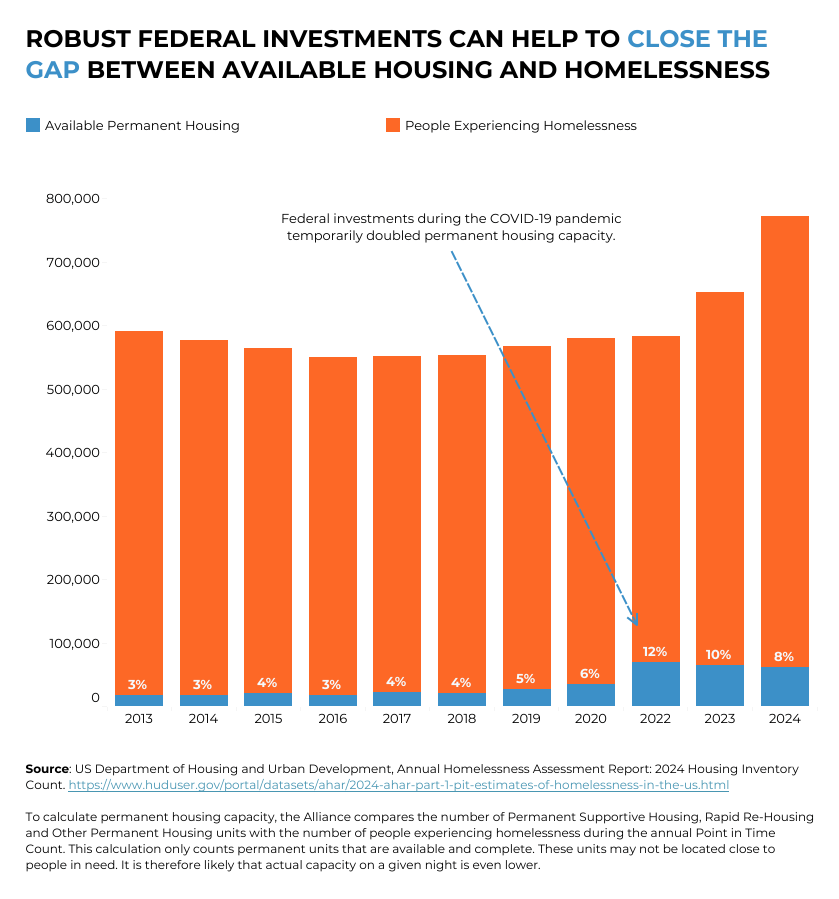
On a federal level, the gap between supply and demand for housing for the homeless was already skyrocketing before the Trump administration took office (graphed above) but exploded in the past year, thanks to a combination of funding rescissions and deep staffing cuts in departments serving the poor and unhoused. That notably includes the departments of Housing and Urban Development (HUD) and of Health and Human Services, which just in the past couple of days have been whacked with further unprecedented layoffs, shredding what little remains of an already tattered social safety net. If there’s any doubt about the local implications of all this, see the Blue Ridge Area Food Bank and its increasingly alarmed appeals for community support.

But there’s also a deeper, more profound shift in housing policy underway that will have the perverse effect of pouring gasoline on the fire. That shift dates back to a July executive order, issued by Donald Trump under the provocative title “Ending Crime and Disorder on America’s Streets,” that ends support for the “Housing First” approach to a growing unsheltered population. While Housing First advocates contend (often with references to Maslow’s hierarchy of needs) that people’s basic needs for food, warmth and shelter must be met before they can effectively address addictions, psychological ills or lack of job training, the executive order claims Housing First policies “deprioritize accountability” and fail to “promote treatment, recovery and self-sufficiency.” The better approach, according to the executive order, is to slash funding for such assistance while instituting sobriety requirements for people living in federally funded housing. Can’t stay straight? It’s back on the street with you, where the physical struggle for survival will take all your energy.

Meanwhile, the current trend toward criminalizing homelessness only adds to the problem. A U.S. Supreme Court decision last year empowered municipal officials to fine, ticket, displace or arrest people sleeping in public spaces, and more than 200 localities around the country have since criminalized homelessness. But other jurisdictions—including Staunton, Waynesboro and Augusta County—already had similar laws on their books. And while our local law enforcement agencies thus far have taken a restrained approach to people camping on public property, acting mostly in response to complaints by directing the offenders to move elsewhere, that could change with any pronounced shift in the political climate.

Homeless people who get jailed for failing to have a sanctioned place to sleep become, ironically, ineligible for certain housing programs. No surprise, then, that once they’ve been incarcerated for not having shelter, many end up in a cycle that perpetuates their homelessness. More than 50,000 people who are released from prison or jail each year go straight into homeless shelters and then into the streets, according to the National Alliance to End Homelessness, which reports that formerly incarcerated people are ten times more likely to become homeless than the general public due to a lack of financial and social support.

What little support for the homeless that still exists is being chopped away almost on a weekly basis. As reported by Politico a couple of weeks ago, the Trump administration is looking to move as much as two-thirds of HUD’s funds designated for permanent housing projects to transitional housing assistance “with some work or service requirements.” Those who can’t meet the requirements—such as a mother with young children, or someone who’s disabled—may end up on the street again, but as explained by a HUD spokesperson, “HUD is no longer in the business of permanently funding homelessness without measuring program success at promoting recovery and self-sufficiency.” That’s consistent with the administration’s overall “suck-it-up-buttercup” approach to social services but does nothing to address root causes, leaving it up to overwhelmed and unfunded local agencies to deal with the fallout.

Some of these issues may be addressed Monday evening at Kate Collins Middle School in Waynesboro, when Building Bridges for the Greater Good will host a forum on teenage homelessness. That’s because homeless teens are supposed to be served by the McKinney-Vento Homeless Assistance Act, which created the Continuum of Care (CoC) program that Politico reports is under attack—indeed, as Politico also noted, Trump’s budget for the next fiscal year proposes cutting all CoC funding. Loss of those funds will mean dozens of students in the SAW region who currently receive emergency housing, transportation and other necessities of life, including food, clothing and personal care supplies, will be at risk of losing their ability to stay in school.

CoC funding also assists 22 households in a program of permanent supportive housing administered by the Valley Community Services Board (VCSB), but their future is equally uncertain. The current funding runs out in December, and while a larger successor grant has been approved, there’s no certainty that money will be released. “If the Politico article is correct, this program would certainly be in jeopardy, but I am not sure what calendar year we will actually feel the impact,” said Lydia Campbell, assistant director of community services at VCSB. “It’s terrible that our community members with the most significant barriers to housing that are finally in their own places could be at risk.”

In the face of this onslaught, local efforts to cope with homelessness and a severe shortage of affordable housing have been lame, at best. That’s partly due to a lack of money, of course, but being cash-poor is insufficient excuse for a city that spends big bucks on a new pool house, golf carts and 50-gallon trash cans for everyone—all welcomed expenditures contributing to Staunton’s quality of life, but at the cost of letting internal sores fester. With only so many tax dollars to go around, expenditures in one area mean belt-tightening in another. In the end, it all comes down to the choices we’re willing to make—or ignore.

Take, for example, the request to city council by Alec Gunn, director of the Waynesboro Area Refuge Ministries (WARM), for financial support for a day center for the homeless at First Presbyterian Church. As initially conceived, this would have been a warm day-refuge in the winter and a cool one in summer for an unsheltered population that otherwise resorts to camping out in the library or in fast food restaurants to escape the weather. Talk of the city providing some modest start-up money for such an effort, perhaps $30,000, has been kicking around since the start of the year, with little to show for it and with ambitions for the day center’s scope of services diminishing with each passing month. More recently, rumblings of resistance from the church’s neighbors have been heard, and Gunn did himself no favors with the skimpy “budget” he presented to city council in early September—but neither has anyone on city council stepped up to press for a resolution. And so. . . still no day center.

As much—or little—can be said of the city’s pursuit of affordable housing, a critical component of any serious effort to eliminate homelessness. A key to this somnolent exercise has been creation of a housing commission that could “provide expertise and guidance regarding the amount and quality of affordable and workforce housing in the City,” an initiative first proposed by Councilor Brad Arrowood in March. That’s March of 2023. This past Thursday the city council finally received a resolution to do just that—but it won’t actually vote on the measure until an unspecified “later date.”

Not that there’s anything to be lost in this slow-walk to another grouping of chin strokers. Six of the proposed nine commission members are to be drawn from the ranks of the housing strategy working group that labored for a whole eight hours spread over 12 months to produce the city’s “housing strategy.” That group served mainly as a sounding board for city planners to present their ideas, and for the most part it resonated in tune; this was not a group brimming with ideas. The new commission will likewise meet only four times a year and, under the influence of its carry-over members, presumably will serve a similar role, with similarly minimal results. If there is to be any hope for the housing commission to provide meaningful input, it will have to come from the three non-working group members, ideally including representatives from the building and development sector and at least one person who has been homeless.

But first, of course, there actually has to be a city council vote to ratify the resolution. Assuming it does so in the next few weeks, and that the housing commission holds its first meeting in January, that will mark nearly three years since Arrowood’s initial proposal.

All this foot-dragging might be tolerable in a slower age, but that’s not where we are today. Instead, we’re hurtling toward a precipice with preternatural speed, the economy teetering toward recession, our political machinery seized up and normal middle-class people growing angry, suspicious and resentful under the weight of a disintegrating social order. How else to explain recent events in Waynesboro, where local residents circulated a letter deploring “the homeless problem” and criticizing St. John’s Episcopal Church for allowing a man to sleep in its bushes and a homeless couple to stay on an empty church lot. The letter expressed concern that mental illness, drug addiction and increased crime rates would put the neighborhood at risk, albeit without linking any of those problems to the three specific people prompting the writers’ angst.

Not all local residents shared that view, and in a couple of meetings pushed back vigorously against such stereotyping. But as the homelessness problem deepens and more people are forced to live in their cars and on the streets, similarly charitable responses may become more strained. We’re in a race against time that community leaders have not yet recognized, for money, effort, planning and initiative, and it would be reassuring to get even a whiff of urgency over what needs to be done.

Why a day center is not a shelter

(Reading time: 4 minutes)

The story in the Augusta Free Press last week was buoyantly misleading. “The City of Staunton will open a day shelter for unhoused persons in the fall,” it announced.

Would that it were so.

Prompting the article’s optimistic declaration was a presentation to city council Sept. 11 by Alec Gunn, director of the Waynesboro Area Refuge Ministry (WARM), who had been invited to outline WARM’s plans for a “day center” for unsheltered homeless people. Gunn’s presence followed a reminder to city council a couple of weeks earlier that that it still had $50,000 in a discretionary fund that needed spending. As I wrote Aug. 24, city manager Leslie Beauregard noted that the council had discussed possibly appropriating $30,000 of that amount for a WARM day shelter for the homeless—perhaps the subject could be revisited? Yes, yes, good idea, council members responded. But first, let’s hear a concrete proposal and budget.

And so Gunn spoke, and from the outset illuminated several problems. Staunton city council’s interest in a day shelter had been triggered most recently by the severe cold we experienced last winter, with homeless people who had been housed overnight by WARM’s network of church-based emergency shelters typically turned out at 7 a.m. the following morning. With nowhere else to go, they resorted to frequenting area libraries, fast-food restaurants, Brite buses and any other accessible public place where they could get out of the wind and cold—frequently to the discomfort of other patrons. Could they not be provided with a refuge of their own?

Yet as Gunn repeatedly stressed—although council members did not obviously pick up on the distinction—WARM was looking to create something different. What he envisioned, Gunn said, specifically was not a “homeless shelter” but rather a place in which people could “work themselves out of” homelessness, through some unspecified combination of classes and workshops. Indeed, “shelter” seemed a word better left unsaid, with all the negative baggage it carries. It was all “center” and “day center” and “welcoming environment.”

Definitions or goals aside, Gunn’s sketchy outline—calling it a “proposal” is too generous—seemingly was aimed more at securing the $30,000 that had been bandied about than at detailing just what the day center would do.  As if by coincidence, $30,000 was exactly the amount WARM envisioned for “support staff,” although how many staff members would be employed or what they would be doing was left unsaid. An additional $18,500 would be needed for utilities, supplies, transportation, insurance and so on, including $1,500 for those undefined classes and workshops. Where would the additional money be found? Unknown.

Meanwhile, although Gunn said this would be a year-round program, he conceded under questioning that at least initially the center would be open only two or three days a week, so definitely not a “shelter” as that term is generally understood. Eventually, he added, WARM hopes to expand operating hours to five days a week—so still not a shelter, which should be accessible every day. And while discussions earlier this year about a day shelter had included proposals for building showers and a laundry facility at the First Presbyterian Church, where all this supposedly is happening, Gunn said last week that he “hopes” Habitat for Humanity will make available a mobile shower system it sometimes uses.

Creating a program to help homeless people get out of their unsheltered circumstances is admirable and necessary, but it’s not at all clear that WARM’s unfocused efforts will accomplish that. Worse yet, there’s a real danger that an uncritical acceptance of WARM’s proposal will convince city council members that if they approve the $30,000 Gunn is seeking they’re actually providing a day shelter that can get homeless people off the streets, just as the Augusta Free Press assumed in its reporting. So far the city council hasn’t done that, but the broadly approving comments from council members after Gunn’s presentation suggest such an appropriation may be in the works.

What the unsheltered homeless population in Staunton, and the SAW region generally, lacks is not complicated: a readily accessible place they can go seven days a week, from 7 a.m. to 5 p.m., in the heat of summer and the freeze of winter. A shelter without preconditions, such as having to participate in a well-intentioned program of one kind or another, and without any expectation that those seeking such shelter will spend their time working themselves into or out of anything. A refuge.

That would be something. Don’t hold your breath.

What if ‘urgent care’ was like this?

(Reading time: 6 minutes)

When it comes to the problem of housing affordability—which is to say, to the insufficient supply of such housing—those without a home at all tend to get the shortest shrift. Most of the public fretting is about people being forced to pay 30% or 40% or more of their already meager incomes for shelter. Or about the shelters themselves, which despite their high price tags too often are poorly maintained, inadequately insulated and ringed by sketchy neighbors. Meanwhile, those who sleep in cars, or in tents tucked into patches of vegetation behind shopping centers or supermarkets, simply drop out of sight and out of mind.

Consider, for example, the Staunton Housing Workgroup, which labored mightily over the past year to produce a list of “strategies” to put the city on the “pathway to affordable housing and housing for working families.” We apparently must gird ourselves for a long and arduous trek. As explained by city planner Rebecca Joyce when she presented the group’s strategic vision to city council a few weeks ago, “This is a plan for a start, not a plan for completion”—and oh, by the way, an additional strategy had been added belatedly to the original ten, to provide services for unhoused persons.

Why the late insertion? Because homelessness had not been discussed by the workgroup, despite such a condition being the natural consequence of unaffordable housing.

Just how sluggish and tone-deaf the city can be on the subject can be seen in the workgroup’s proposed timetable for meeting the needs of the homeless, laid out in a six-step approach divided into neat three-month segments. Step one, to run through the end of September: “Compile current list of resources and organizations that serve unhoused community members in the City.”

That should make for a busy morning.

Meanwhile, step six, scheduled for October through December of 2026, proposes to “conduct assessment of current state of needs of unhoused community members in the City and create an action plan of next steps.”

One might think that talking to the people you want to help would be a first step, not the last, but as the rest of this “strategy” makes clear, the city’s focus is on helping organizations, not individuals. As step two explicitly prescribes, for example, “Survey organizations that serve unhoused community members in the City regarding their most pressing needs [emphasis mine].” Steps three, four and five , which are identical, are all about helping organizations apply for funds.

Another example of kicking the can down the road was exhibited at the city council’s last meeting, when city manager Leslie Beauregard reminded everyone that the last budget had appropriated $50,000 for the council to use “at its discretion.” The council had been so discreet that none of the money had been spent. Perhaps the council should revisit the matter and use the funds in a productive manner? Perhaps, as had been previously discussed, some portion—$30,000 had been mentioned—of that unappropriated fund could go toward a WARM day center for the homeless “as part of a broader housing strategy”?

As summarized in the session’s minutes, “Council members agreed on the urgency in supporting the day center but questioned the need to allocate funds immediately,” which suggests the council has a creatively relaxed definition of “urgency.”  The council instead tabled the proposal and “expressed desire to invite a representative from WARM to present a proposal and budget for the day center at a future council meeting.” One can only hope that “desire” will translate into action.

The underlying problem all this illustrates is a lack of urgency or assertive leadership by city officials and staff in addressing a problem that has festered for years. Staunton’s default position is one of passivity rather than initiative, waiting for someone to bring up an issue rather than proactively intervening in something everyone knows is awry. Somnolent staff can propose an 18-month timetable for the city to reach out to “unhoused community members,” and council members uncritically accept that as reasonable.  Meanwhile, WARM will start operating its emergency overnight shelters in less than three months, but the “urgent” need for a day center will have to wait for the thinly staffed and inadequately resourced agency to get an invitation from the council to appear in its chambers.

Would it be too much for the city, having recognized a problem, to reach out to WARM directly? This week? To sit down with WARM staff and find out what’s needed, how much it will cost and who will be running the show?

Staunton’s laissez-faire approach to social needs is just as pronounced on the supply side as it is on the demand end of things. Lydia Campbell, at the Valley Community Services Board (VCSB), has been peppering the internet with emails pleading with local municipalities and social service agencies to apply for a Homeless Reduction Grant. Such grants, which date back to 2013 as part of Virginia’s Housing Trust Fund, are intended to “ensure homelessness is rare, brief and non-recurring.”   Eligible projects include “rapid rehousing for literally homeless households, innovative projects for unaccompanied homeless youth or older adults experiencing homelessness, and rental assistance and stabilization services for chronically homeless households residing in permanent supportive housing.”

The response has not been encouraging.

True, as such things go this is not a wealthy program, disbursing just $12.9 million across all of Virginia in 2023, the most recent full accounting available. But that amount underwrote 69 projects that year, serving 3,997 people. Among them was (and is) Hope House, a rapid rehousing project in partnership with the Shenandoah LGBTQ Center that serves unaccompanied homeless youth, ages 18-24. On the other hand, over the past five years only one other program application has been filed (albeit not awarded) in our four-county region, according to Campbell.

In other words, when it comes to free money to address homelessness, local governments, non-profit organizations, housing developers (yes, developers, both profit and non-profit alike) and single purpose organizations—all of whom are eligible to file applications—can’t be bothered.

The current application period has a Sept. 12 deadline, but to date Campbell has not received any requests for a letter of support, which the state requires from VCSB to prevent duplication of services. Given the late date, that seems unlikely to change, although it’s always possible that Staunton staffers have been working feverishly but unobtrusively to . . . nah. Just kidding.

Here’s a final irony. Staunton’s 2023 legislative program, an annual exercise in which the city’s governing body communicates its priorities to the Virginia general assembly, urged an increase in funding for permanent supportive housing. “The Governor’s Housing Trust Fund should become a consistent funding stream for these individuals,” council members contended.

“Just don’t make us ask for it,” they could have added.