
(Reading time: 5 minutes)
At first blush, the City of Staunton demonstrates a remarkable accessibility for residents wanting to learn the ins and outs of their local government. Currently, for example, the city is taking applications for Staunton Citizen University, an annual 10-week course that introduces 25 of its residents to the city’s inner workings. It has numerous boards and commissions led by members of the public who supplement the city’s employees. Its city council and planning commission meetings can be observed remotely and are videotaped for those who can’t make the scheduled times. The city charter, annual budget, zoning code and lots of other documentation are accessible online.
All of which is praiseworthy, even as it also makes the city’s reticence about its attorney so much more obvious. And inexplicable.
Go to Staunton’s website and click on “Departments,” and you’ll see a heading for “City Attorney.” Click on that link and what you’ll see is . . . nothing concrete. No name. No picture. No phone number or email address or even a physical location. There’s a single sentence of boilerplate explaining (some of) the city attorney’s responsibilities, and a whole lot more saying what the city attorney does not do and please take your questions elsewhere.
Contrast that with the way Roanoke presents its information, below, and it’s clear that there’s nothing in state law requiring such anonymity. So what’s with Staunton?
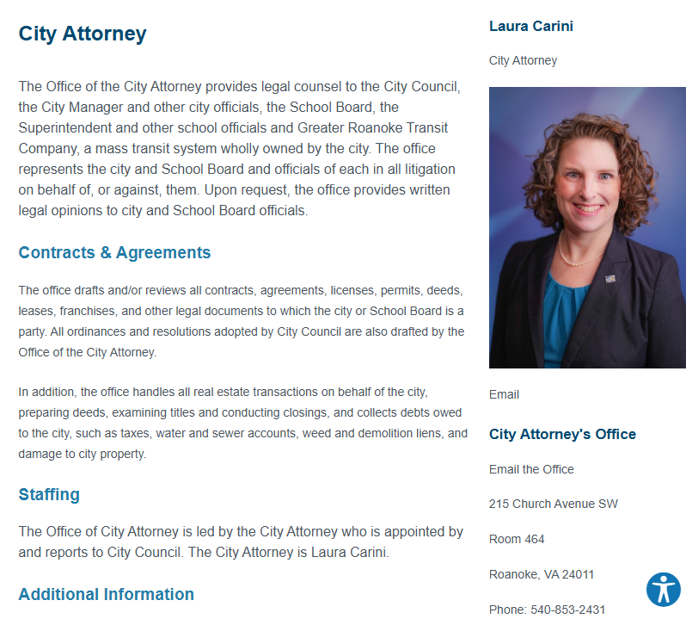
It’s not like John Blair’s role is a secret. Google a question seeking the name of Staunton’s city attorney and his name will pop right up, including mention of his former employment as city attorney in Charlottesville—whose website, by the way, doesn’t have a picture of its current attorney but does provide the incumbent’s name, plus a mailing address and phone number. Once you get Blair’s name from Google and return to Staunton’s website so you can reach out to him, however, you’ll find that he’s also not listed in the city’s directory. The man doesn’t exist.
Because I had a question about the city’s civil prosecution of property owners who don’t respond to notices of infractions, I asked a city council member why Staunton keeps the city attorney’s contact information out of sight. His brief response was that the position “by statute is an internal-facing resource for the city, advising Council and staff,” and presumably that’s why Blair doesn’t show up in the public directory. Which, when you think about it for even a heartbeat, is simply nuts. Neither the Virginia Code nor the City Charter create categories of positions that are “internal facing” versus their presumed “outward facing” counterparts, with different sets of rules applied to each. And while Blair’s duties do include legal counsel to the city, which is protected, the city attorney also has numerous “outward facing” duties, such as drafting contracts, leases and other documents, defending the city when it’s sued and prosecuting civil cases on its behalf.
All of which should be fair game for information requests and questions. And while presumably such inquiries could be submitted via the city manager’s office, as my city council member suggested, the city’s organizational chart explicitly keeps Blair’s office separate from the city manager and makes it answerable only to the city council. It’s therefore clear that keeping Blair behind a curtain is a de facto city council policy, not a city manager’s decision or a state mandate. Trying to reach Blair via an intermediary is an unnecessary hurdle quite out of step with the city’s otherwise admirable accessibility practices, but if that has to happen, such a gate-keeper role more properly rests with the city council and not with the city manager.
There’s another aspect of Blair’s position worth noting, the result of his taking on additional duties as clerk of council. The cost-saving move occurred earlier this year, following the resignation of former clerk Kiley Kesecker, when the city council decided that such a full-time position was no longer needed and that Blair could also be responsible for keeping all records of council and commission meetings. In making that change, of course, the council moved the clerk of council behind the same curtain that conceals the city attorney. Have a question or dispute about the minutes of last month’s city council meeting? Good luck figuring out how to contact the man responsible for them.
It should go without saying that both the city attorney and clerk of council are taxpayer-funded positions, which all by itself suggests a certain amount of public accountability that is undermined by making the positions unapproachable. The city attorney’s remuneration, set under Staunton’s pay classification system, is grade 25 and ranges between $130,361 and $195,541; the clerk of council is paid at grade 12, ranging between $54,167 and $81,252. It’s not clear whether John Blair is drawing two paychecks or just one, but the city has budgeted the two offices in the current fiscal year for $342,767 and $36,860, respectively—and in each office, Blair is the only employee.
I’d like to learn how all those numbers pencil out, and have some other non-privileged questions to ask as well. Now, if only I had a phone number or email address to send them to . . . .
Aug. 7 postscript: Earlier this week, Staunton’s public information officer responded to this post with the information that a) John Blair does not draw a paycheck for his work as clerk of council; and b) that his salary as city attorney is $188,967.30 a year. No response or explanation for the lack of other information on the city’s website—and, again, no email address or phone number for John Blair to ask him for an explanation.


