(Reading time: 17 minutes)
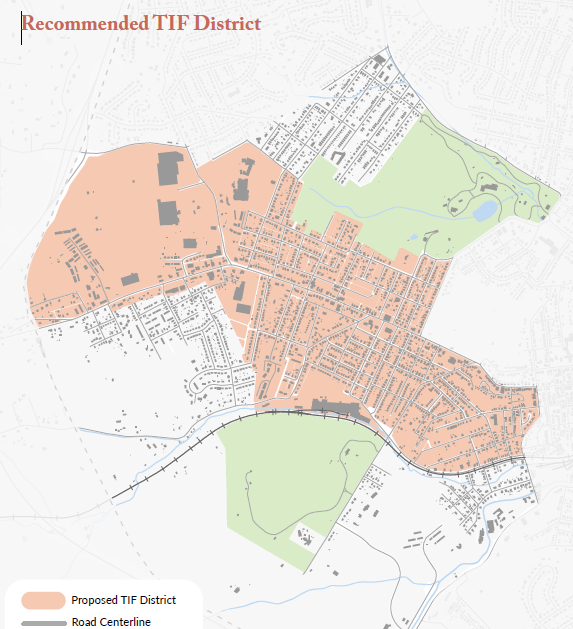
It’s been four years since Staunton residents first met to discuss a revitalization plan for the West End. Many such meetings, an online survey and input from approximately 300 residents and stakeholders later, a 115-page document that describes itself as “the first holistic plan for Staunton’s western neighborhoods” was presented to the city council this past August, which voted in September to accept it provisionally. Final acceptance is scheduled for a Dec. 12 council meeting, following one final public hearing.
And then?
Quite possibly, not nearly enough. This critique argues that the West End Revitalization Plan is a half-baked dish that isn’t what the customer ordered, notwithstanding its claims to be a community product, and should be sent back to the kitchen. Suffused with a hearty stew of information and suggestions for economic revitalization, improvements to streets and sidewalks and more development of green spaces, it nevertheless serves up only a thin gruel of recommendations for upgrading the area’s residential stock. Housing issues, cited repeatedly by area residents as a major concern, are all but ignored in a document that fundamentally “assumes” reinvestment in the commercial corridor “will lead to reinvestment throughout the rest of the West End,” including private properties and residences.
Not that this is a new attitude. As I wrote earlier, in a white paper released in early September, Staunton has long given lip service to issues of sustainable and affordable housing, as exemplified by its 2018 Comprehensive Plan. There, it contends that “[h]ousing is primarily a private system that is influenced by factors beyond those controlled by local government,” in effect washing its hands of any problems. That sentiment was echoed in the city council’s contemporaneous “Vision for 2030,” wherein the only mention of housing is the claim that Staunton “has housing affordable to a full range of households”—a statement presumably absolving the city of any need to take a closer look at what housing is available, what condition it’s in and whether there’s enough of it to go around.
This myopic perspective has been a recurring theme in several city studies, with the West End Revitalization Plan only the latest link in a chain of housing denial. Planning for the city’s marquee economic development project, for example, started with a consideration of housing as a possible component of Staunton Crossing, only for the idea to be dropped midway through the conceptualization process. There appears to be no written record of the thinking that went into the decision to pivot away.
So when it came to formulating the West End Revitalization Plan, the city’s consultants weren’t starting with a blank slate: they were building on a foundation of other, prior studies with an unacknowledged blind spot. The Cole Avenue stream restoration plan, the intersection improvement study, the long-range transportation plan, the brownfields assessment, the greenway plan, the Gypsy Hill stream restoration plan, the bicycle and pedestrian plan, a city flood analysis—all are cited in the plan as resources that shaped its outcome. None deals with housing. The one marginal exception is the Comprehensive Plan, which despite its repudiation of housing as a city concern, at least provides a city-wide inventory of housing stock, sorted by age and market value.
Nor were the planners concerned about enlisting expert housing assistance. While the plan relates how “transportation planners explored ways to improve the multimodal transportation network” and “economic experts studied the types of business that can be successful in the West End,” there is no mention of input from urban planning and renewal professionals—planners with expertise in addressing urban blight and deteriorating residential neighborhoods.
No wonder, then, that the Revitalization Plan’s attention to housing is fleeting and superficial. Past is indeed prologue.
BUT AS ALREADY MENTIONED, four years of research included several efforts to solicit comments and suggestions from the people closest to the issues. Surely the West End’s residents had something to say about paying attention to housing as part of any meaningful revitalization plan?
Indeed they did, and the Revitalization Plan occasionally acknowledges such concerns, even as it sidelines virtually all such input to its appendices—which, inexplicably, are not attached to the plan itself. The main narrative instead summarizes the many comments planners received in bloodless statements such as, “Throughout the engagement process, community members expressed concern about vacant or unmaintained properties and believed they were reducing the West End’s appeal”—a marked contrast to the more vivid language the plan uses for its own vision, which it describes as “a vibrant, diverse and multimodal community, where residents can safely and conveniently access their thriving commercial corridor.” Would that its description of the housing situation were as compelling.
Yet as those seeking out the plan’s appendices will learn, the lack of adequate housing in the West End was a dominant theme throughout the planning process. An early stakeholder meeting, for example, concluded that “the West End neighborhoods are aging. Coupled with limited incomes, concerns about property upkeep and affordable housing” were among the area’s most notable “challenges.” Asked to list those challenges, respondents used adjectives like “dreary” and “lackluster,” and roughly a quarter of their comments were housing-related, including complaints about absentee owners and landlords, homeless tent camps, deteriorating Section 8 housing and roadside parking in residential areas. Asked what they would like to see more of in the West End, participants listed “affordable housing, multifamily housing, incentives to rehabilitate vacant or unlivable homes, initiatives to help those who cannot financially maintain their homes, and a renter’s Bill of Rights.”
An online survey late last year provided a graphic ordering of local priorities, with respondents asked to rank, on a scale of 1-5, eight possible elements of a revitalization plan. Leading the list was “adding new shops, stores and services,” with 194 respondents feeling that this was either “important” or “very important”—but running a close second was “improving upkeep of existing housing,” which got 190 votes as “important” or “very important.” The third biggest response to that question, meanwhile, was “adding new jobs and employment opportunities”—a choice one might have expected to get significantly more than the 179 “important” or “very important” votes it actually received, given a median household income in the West End that’s 28% lower than in the city overall.
The big emphasis on “improved upkeep of existing housing” is rooted in a bleak reality that the plan scarcely acknowledges and never researches in any detail. Yes, the plan gives a brief nod to the area’s demographics: older, poorer, and with a higher proportion of non-white residents than is true of the rest of Staunton. And there’s an equally succinct summary of the homes the West End’s residents inhabit—homes that the plan claims are on average valued at $139,850, or less than two-thirds of the city’s overall median. But within those broad strokes are even more extreme variations, not mentioned by the plan, such as the three census blocks (of seven West End blocks altogether) in which the median house value was just $115,000 in one, $111,600 in another, and $111,100 in a third.
(Those figures, found in the Comprehensive Plan, must be kept in perspective, as they—and virtually all housing statistics currently floating around—are seriously outdated. The Comprehensive Plan’s numbers are from the 2010 U.S. census, which means they’re not only quite old but predate the significant explosion in real estate valuations of the past three years. The Revitalization Plan, on the other hand, doesn’t cite specific sources but almost certainly uses statistics derived from pre-pandemic data. Despite this ambiguity, however, it’s clear that seven years ago, approximately 1,300 homes in the West End had a median valuation less than half the city average, and it’s highly unlikely that the ratio has narrowed since—indeed, just the opposite may be expected, due to the ongoing deterioration of the West End’s older housing stock because of its older population and lower income levels.)
Given all of the above, it’s reasonable to think the completed revitalization plan would have a substantial and detailed set of recommendations addressing the West End’s housing stock. It does not. Not even close.
AFTER YEARS of casting their fact-finding net across the West End, the city’s consultants settled on a four-pronged set of goals for the area’s revitalization. The first three entail creating more opportunities for West Enders to go shopping, to more safely navigate local streets and sidewalks, and to enjoy enhanced green spaces. The fourth, meanwhile, labeled “reinvestment and affordability,” describes a need to “foster reinvestment in the West End’s neighborhoods and homes while maintaining affordable living and homeownership opportunities.”
One might question why a concern repeatedly cited by local residents as one of their top two issues got bumped to fourth place on a list of goals, but at least it didn’t get completely ignored—although the devil, as they say, is in the details.
For each of the four goals, the revitalization plan lists strategies, actions, and a secondary set of “other actions.” Combined, the four goals prescribe 10 strategies, 17 proposed actions and a dozen “other actions.” Only one of those strategies, “support home renovations,” specifically targets housing. And only one of the 17 proposed actions is listed under that housing strategy: “connect residents to existing resources.” In other words, the plan sees no need to come up with any housing initiatives, and certainly no need to spend money other than on staff time—unlike its other goals and their strategies, which call for such investments and incentives as possible tax increment financing, repairing sidewalks and building bus shelters, planting trees, creating a public square, and so on. When it comes to housing, revitalization is in the bargain bin.
To be fair, the home renovations strategy also proposes one “other action” item, recommending that the city develop a home conditions program to help “homeowners and landowners improve their properties’ sustainability, health and affordability.” Such a program, the plan notes, would be best served by a non-profit organization taking a lead role, leaving it up to the city to promote dialogue and coordinate targeted efforts. The suggestion is not nothing. It also requires almost nothing from the city.
That lack of city skin in the game also is reflected in the plan’s other two strategies for the reinvestment goal, to wit, “reinvest in community centers and resources,” and “support neighborhood advocacy”—strategies that call for “reimagining” the former Booker T. Washington high school as a community center (which it already is), and for providing renter education programming. Again, not nothing. And, again, requiring little more from the city than staff time, which is an impoverished definition of “reinvestment.”
In letting the city off the hook for doing anything meaningful about West End housing, the revitalization plan’s authors are simply taking their cue from their paymasters, as reflected in one particular comment. In response to community requests for “additional housing rehabilitation resources,” the plan reports, “City staff noted several programs already exist.” Which is to say, “We’ve already got everything we need, no need to reinvent the wheel, let’s move on.” Are those programs up to the task? Unknown, since the revitalization plan makes no effort to establish the extent of the problem they are being expected to address. Do those programs have adequate finances, manpower and management skills to meet the need, whatever it might be? No way to answer that, either, since the programs themselves were never examined—all that the plan provides is a recitation of program names.
Paradoxically, the plan does assert elsewhere that “[t]he city currently does not have a program that helps homeowners and landowners improve their properties’ sustainability, health and affordability.” And the city’s assertion that “several programs already exist” is at best a passive-aggressive assertion that puts the onus of unmet needs on those who need help, rather than on those who have the resources they need. The city’s website, for example, lists a score of local, state, federal and non-profit programs and services that are housing related and possibly useful resources for city residents—if they have wi-fi and computer access, if they know where to look, and if they can figure out which of that smorgasbord of entries is relevant to their needs.
Meanwhile, you would never know from the revitalization study that one reason why the West End feels “run-down” is the small but readily visible number of homeless people on its streets. You would never know, from the study, that there is a homeless encampment behind the Food Lion. You would never know that the area has several social agencies targeting the homeless and the near-homeless, including the Valley Mission and the Salvation Army. You wouldn’t know that the West End is where much of the city’s subsidized and public housing is located.
The homeless and those who need subsidized housing also have needs, but those needs won’t be met without acknowledging their existence. Yet despite repeated community input about unsheltered people living in the West End, the plan simply doesn’t see them. They don’t exist. The revitalization plan proposes a neighborhood arts program as “a cost-effective way to beautify public spaces and local neighborhoods,” even as it completely ignores how those public spaces and neighborhoods are made less beautiful by people wandering the streets in obvious need of showers, warm food and a safe place to lay their heads each night.
IN GLOSSING OVER the many housing concerns raised by West End residents, the revitalization plan must be seen as an incomplete and flawed document. The planners behind this effort created a four-legged table, but one leg is so much shorter than the other three that the whole structure is too wobbly to be more than marginally useful.
Worse yet, by seeking community input and then ignoring much of what it received, the city and its planners have provided yet another reason for public skepticism about government responsiveness. It’s insulting to be asked for one’s thoughts, only to have them disregarded without an explanation, and it’s disrespectful to expect people to contribute their time and energy to an exercise that treats their contributions in such cavalier fashion. This is how civic responsibility and involvement are eroded, replaced by cynicism and resignation.
A comprehensive—or “holistic,” to use its own terminology—revitalization plan would provide as much granular detail about housing stock as it does in its description of sidewalks, or of the potential for business development in the West End. It would explore possible funding sources for underwriting housing repairs, as it does when recommending tax increment financing for economic development, or public-private partnerships, such as land banks and land trusts, to deal with abandoned or blighted dwellings. It would examine current zoning requirements to see if they are impeding private sector investments, and it would analyze the city’s fee structure for new housing for the same reason. It would consider whether the city has a role to play in regulating absentee owners who buy housing for investment purposes, rather than as personal dwellings. It would explore a possible renter’s bill of rights, as urged by several area residents.
None of this is beyond Staunton’s scope. City leaders sometimes deflect such proposals by claiming their hands are tied by the Dillon Rule, a principle of American municipal law that limits the powers of local governments to those explicitly granted by the state, and to a certain extent they’re correct. But that doesn’t mean the city is entirely without options. Virginia Housing, a self-supporting organization created by the state specifically to help Virginians attain quality affordable housing, released a detailed study last November, titled “Housing as an Economic Development Strategy for Virginia,” that lays out these and other strategies that Virginia cities can use to address housing needs—strategies, in other words, that are available to Staunton right now, and without running afoul of Dillon Rule limitations.
Moreover, it’s worth noting that the very title of the Virginia Housing study gets at a basic economic truth that the revitalization plan fails to recognize. As the study also summarizes, “Changing economic and market conditions have exposed the necessity of aligning housing and economic development efforts strategically,” which in plain English means that housing and economic development are two sides of the same coin. Meaningful improvement of one requires improving the other. By failing to acknowledge that symbiotic relationship, the West End Revitalization Plan undermines the salutary work it has otherwise done.
Then there’s the elephant in the room, which never enters the revitalization plan’s field of vision. By ignoring the problem of area homelessness, the plan unnecessarily weakens its proposals for economic revitalization and green space enhancements. It also ensures that the plight of the city’s unsheltered residents will only get worse, as occurs with any untended building or garden that’s allowed to deteriorate.
For example, there’s an obvious need in the West End for more short-term shelter space, as the Mission not only can’t accommodate everyone who needs its facilities but is being pressed to shelter people longer because of a lack of longer-term housing—there’s just nowhere for people to go. There’s also a need for overnight warm shelters and for “cold shelters,” where homeless people can go during winter days. Without that, they end up congregating anywhere they can find some warmth—riding Brite buses, hanging out in fast-food restaurants, the library, the YMCA or the community center in Verona—undoubtedly discomfiting the “regular” patrons of those establishments or services. Moreover, as summers get hotter, there will be a growing need for cooling shelters, not just for the homeless but for the many poverty-level residents of the West End without air conditioning.
Finally, by failing to adequately inventory the West End’s physical infrastructure, the revitalization study overlooks possible resources that could be tapped to meet some of these needs. For example, how many older churches in the West End are occupied by dwindling congregations that can barely keep up with maintenance and utility costs? The former Allen Chapel AME church on West Beverley provides one example of how such demographic trends can play out: it’s been converted to housing—for transient guests, occupying its two Airbnb accommodations. Are there other large churches whose congregations could be approached with purchase offers, sufficient to allow them to downsize to more appropriately sized buildings while enabling their existing quarters to be repurposed for a different kind of service?
These and numerous other questions can be asked, and various innovative remedies can be explored, only if the West End’s underlying needs are comprehensively identified. There’s no question that the area needs an injection of economic vitality, that it would benefit enormously from repairing and building an adequate bicycle, pedestrian and jitney bus infrastructure, and that enhanced green and public spaces could generate more community interaction and a sense of civic pride. The West End Revitalization Plan addresses all those needs and provides a detailed schematic on how they may be addressed.
On the issue of adequate and affordable housing, however, it falls disastrously short, and thereby places the whole revitalization effort at risk.

 Looking askance