
(Reading time: 6 minutes)
Rereading the West End Revitalization Plan, as I did over the past week in preparing my last post, was a stark reminder of how much we suffer an institutional version of attention deficit disorder. Two examples from that document will make my point: the brownfields study, and the tax increment financing district.
The brownfields study has been cited repeatedly in Staunton planning documents as a critical tool for redeveloping the West End. Funded by $300,000 from the EPA, the three-year Brownfields Assessment Grant was intended to “return vacant or underutilized properties to productive reuse” by assessing West End sites for possible environmental hazards. That would be followed by remediation, which, grandly, would “incentivize investment and jumpstart redevelopment and area-wide revitalization.” Study oversight was to be provided by a consortium of nine West End groups and organizations. Monthly and quarterly reports would keep everyone apprised of the progress made.
Or not.
Because as I wrote a year ago, local oversight never occurred because the Brownfields Redevelopment Advisory Group never met, there have been no monthly reports, and the quarterly reports are remarkably repetitive while also being short on detail. The initial three “high priority” sites targeted for assessment became just one, which in fact was developed and now is home to the city’s new court building on West Beverley, but of the other two sites there has been no public accounting. The good news, if you can call it that, was that at least the grant money was not completely squandered—indeed, so little of it was spent that by the end of the three-year grant period more than half was still available. That led to a requested one-year grant extension—and then to a second.
With the now five-year grant period set of expire this coming Sept. 30, as of the end of April—the most recent available account—the city had yet to spend almost a fourth of the original grant amount. What it might be doing with approximately $70,000 is anyone’s guess. From the skimpy documentation that’s available, city officials in April were still trying to find suitable sites to assess, with four possible candidates lined up—none of which, it bears noting, are actually in the West End, with the possible exception of an old pump station building near the main entrance to Gypsy Hill Park. The others, however, include the former Coca Cola bottling plant on North Augusta Street; a site on Richmond Road [sic]; and the art school at 219 West Beverley Street, adjacent to the Central United Methodist Church.
It’s possible some or all of these sites should be assessed for environmental contamination, although “brownfield” is not the first image that comes to mind when contemplating a park pumphouse or an art school. But whatever the merits of these four candidates as posing environmental hazards, the bottom line is that federal money once touted as a needed economic shot in the arm for the West End is going to be funneled elsewhere, apparently because there are no more environmental hazards to be found in the West End itself.
But let me not quibble. Let’s instead take a look at tax increment financing, which one might think would interest a city council that often cites the Dillon Rule as a major reason why we can’t have nice things. (Without getting too much in the weeds, the Dillon Rule is a governing principle that essentially means city and county governments in Virginia don’t have the authority to do anything that hasn’t been explicitly permitted by the state legislature. Which means, among other things, that the city council can’t just levy whatever taxes it wants.) Yet tax increment financing (TIF) is one of the taxing authorities that the state has given the city, and among the West End Revitalization Plan’s key recommendations is for Staunton to “research and establish a TIF district” in the West End to “finance infrastructure needs and improve public amenities.”
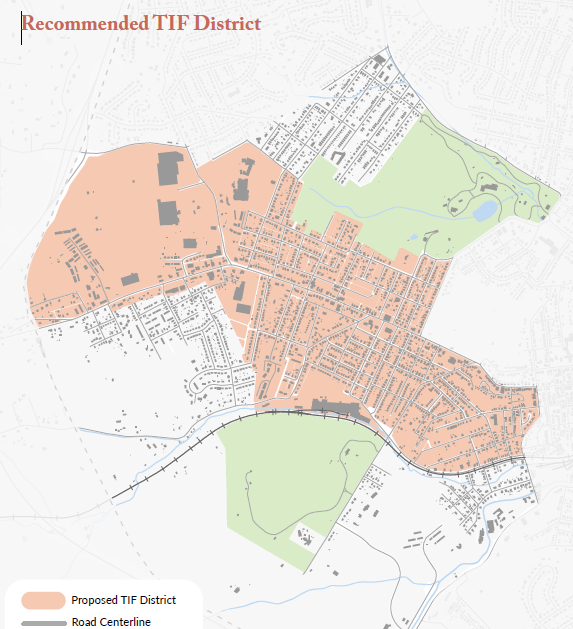
From page 35 of the ignored West End Revitalization Plan
As the revitalization plan explains, TIFs have been used throughout Virginia since 1988, typically to “finance infrastructure improvements in blighted and disinvested areas.” Here’s how they work: a “TIF district” is established via a city ordinance, in this case encompassing much of the West End, from which property tax revenue to the city is capped at existing levels for the life of city-issued bonds. Revenue from those bonds pays for eligible projects in the TIF district, including public infrastructure like streets, sidewalks, and sewer and water lines, as well as land acquisition and demolition, structured parking or plazas and, yes, brownfield remediation. As new buildings are constructed and renovations occur, property values in the district rise, as does the amount of property taxes collected—but the difference between the capped tax revenue and the increased revenue due to improvements is used to retire the bonds that funded them. This difference is the “increment,” hence the name.
Such a self-financing mechanism would address one of the biggest obstacles to Staunton’s efforts at revitalization, which is its lack of financial reserves. It’s also, despite being explored at some length in the revitalization plan, a concept quite foreign to city planners and officials. The Staunton Housing Strategy Group, for example, despite reviewing literally dozens of possible funding mechanisms as it laid the groundwork for what is now the city’s Housing Commission, never once considered TIFs. The city’s Economic Development Authority likewise never examined the possibility. It’s not as though city officials considered the pros and cons of such an approach to the West End’s needs and reached a reasoned conclusion—they just ignored the concept altogether.
None of this is to say that TIF is a panacea. While creating such a district in the West End could short-circuit the on-again, off-again piecemeal approach to revitalizing the area that has characterized Staunton’s efforts to date, it would tie up incremental revenue increases to pay off the bonds instead of using that money for other critical public services, some of which would face increased demand precisely because of TIF-enabled growth. Yet it scarcely needs to be pointed out that without the TIF approach that growth is less likely to occur in the first place, and with it a growth in jobs and in the long-term tax base.
More to the point, the lack of discussion about TIF districts raises the question of why efforts like the Revitalization Plan are undertaken in the first place. Staunton hardly needs more dust-catchers, which is the fate that awaits ignored plans and recommendations (take heed, those of you laboring on the Comprehensive Plan update). City councilman Jeff Overholtzer, the council’s liaison to the Economic Development Authority, said in response to my questions that he will “start a conversation” with that body about a possible TIF approach, which is certainly overdue more than 18 months after the city council signed off on the Revitalization Plan. But then again, given the city’s track record with its brownfields grant spending, maybe we shouldn’t expect too much even now.

