
(Reading time: 7 minutes)
To the casual observer, it must seem that we’re in the middle of one heckuva residential building boom—and indeed we are. In Staunton, several dozen apartments have been carved out of what were once commercial buildings, 130 apartments have been built off Middlebrook Avenue, and the planning commission is reviewing an application to build 267 single-family homes in a planned residential development at the end of Richie Boulevard. All that pales when compared to what’s going on in Waynesboro, however, where more than 1,200 new apartments, town homes and single-family homes are being built or have been recently completed, and several hundred more are being discussed.
So what’s with all the local angst about a lack of affordable housing? Aren’t we being swamped by new homes and apartments?
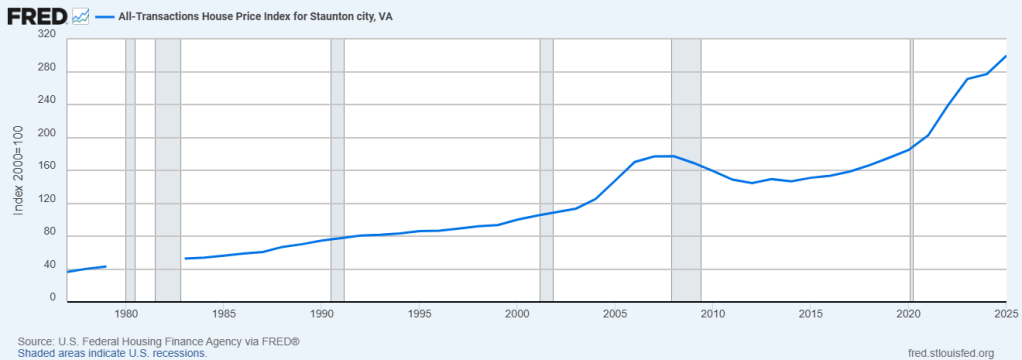
The answer to that lies in the word “affordable.” Yes, there’s a lot of ongoing construction, but all of the examples mentioned above are of homes that will be sold or rented at market rates—and the market is a beast. The house price index in Staunton, for example, rose from 100 in the year 2000 to 185 in 2020, which is to say, home prices rose 85% in that period, or an average of just over 4% a year. But by 2025 the index had jumped to 299.48, zipping along at a brisk 23% average annual increase. Translated into dollars, that boosted the February median home sales price in the Staunton-Augusta-Waynesboro (SAW) area to $330,000, according to local realtor Rick Kane, who’s been tracking these stats for a couple of decades.
Nor is renting a bargain. According to the city’s most recent consolidated plan, prepared as a requirement for receiving federal community development block grants, the fair market rent for a two-bedroom apartment—appropriate for a family with at least one child—in 2024 was $1,149 a month. Apartments.com, meanwhile, currently shows Staunton rents as averaging $$1,151 for a one-bedroom and $1,264 for two bedrooms. (Parenthetically, it’s noteworthy that 45% of all Staunton households with children have only one parent present, according to latest U.S. Census Bureau statistics.)
To put those numbers in perspective, consider that the federal standard for housing affordability is less than 30% of household income. Spending more than that puts you in the “cost-burdened” category, while spending more than 50% pushes you into “severely burdened” territory. To reasonably afford that market-rate two-bedroom apartment, a household would have to be earning $46,000 a year. Homeownership, no surprise, is even pricier: the $330,000 median home sales price will require a six-figure annual income unless the buyer comes in with a downpayment upwards of $66,000—and even then he or she will need an annual income of roughly $80,000.
Now consider this. The median annual wage income for Staunton’s full-time, year-round workforce, according to the most recent U.S. Census report, is $55,023. See the problem?
Unless a household has two wage earners, local homeownership is out of reasonable reach for most. So are rentals for the 1,651 full-time workers in Staunton that the U.S. Census says make less than $35,000 a year. A look at the city’s job openings illustrates how new employees almost invariably will be forced into the rental market: elementary school teachers, for example, start at $53,000, police officers at less than $51,000. The starting wage for a water treatment plant operator is $20 an hour, which works out to affordable rent of just $1,000 a month. Good luck finding such a place.
Many households, of course, have more than one wage-earner, which is why Staunton’s household median income is $11,000 higher than the median for wage-earners. And, of course, there is nothing ironclad about the 30% rule. People routinely pay more than 30% of their income to put a roof over their heads—but that’s the problem. The more someone spends on housing, the less there is for all of life’s other essentials, including food, transportation, health care, clothing and childcare. Small wonder, then, that the 2025 Community Needs Health Assessment prepared by Augusta Health reported that 25.8% of Staunton residents don’t have enough cash on hand to cover a $400 emergency expense.
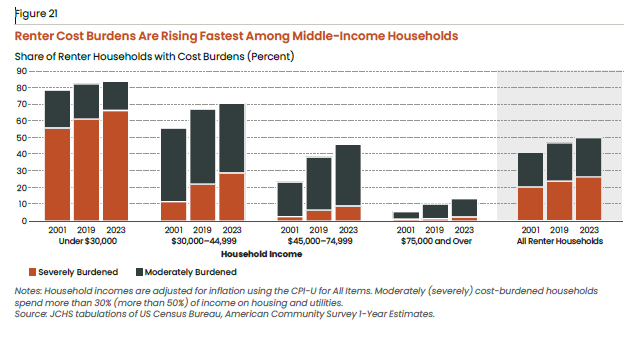
One of the problems with such statistics is that they paint with a broad brush, glossing over the glaring disparities among various subgroups. This is especially true in any discussion of housing affordability, as illustrated by the graph above. Relatively few people making more than $75,000 a year will have trouble finding affordable housing, not only because they make more money but also because the housing market will have more choices for them. Conversely, those who make less than $30,000 are overwhelmingly cost-burdened, not only because they can’t afford much of a home but because they’ll be lucky to find anything in their price range. As a result, two-thirds of them get pushed into the “severely burdened” category, putting them one misstep away from being homeless.*
(While these bar charts are for the U.S. as a whole, they track the local situation pretty closely. For example, a statistically dated Central Shenandoah Planning District housing study released last year reported that more than 42% of Staunton and Waynesboro renters were cost-burdened, or roughly the percentage for 2019 shown above for “all renter households.”)
All of which raises the question: who’s going to be buying or renting all those new homes that are popping up in our two cities? And the obvious answer is: for the most part, not people who are already here. They can’t afford it.
Some of the new housing in Waynesboro undoubtedly will be snapped up by employees of Northrup-Grumman, which has a new plant that is filling more than 300 new jobs paying an average of $94,000 a year—but an estimated 80% of those jobs require four-year college degrees or more, suggesting many if not most will be filled by employees from elsewhere. But Waynesboro also has become increasingly attractive to a better-paid Charlottesville workforce searching for housing that’s more affordable on this side of Afton Mountain—and once you’ve crossed the Blue Ridge, Staunton is just an additional 20 minutes down the road. So presumably the developers behind all the new construction have looked at all that and concluded there’s a market demand they can meet.
The unmet market—the housing market for median wage earners already here—is another story. As the above analysis should illustrate, there are two sides of the affordable housing equation that can be addressed to make things equal: pay people more money, or build cheaper housing. Neither is about to magically happen, but there is a workaround: subsidize housing builders so they can sell or rent at below-market prices.
Unfortunately, that strikes some people as being, um . . . too much like socialism?
*The statement about homelessness is not hyperbolic. The usefulness of this year’s Point in Time (PIT) count of homeless people in the SAW region was limited because it coincided with the extreme ice storm that paralyzed the region, preventing census takers from seeking out those who were unsheltered. But even surveying just those who were in shelters underscored some troubling trends: 39% of the 157 respondents were homeless for the first time, and 29% were 55 or older. Unemployment and eviction were the two most common reasons they provided to explain their homelessness.
Next up: The housing squeeze, part two. Waynesboro leads the way toward a socialist utopia. Can trouble be far behind?


