
(Reading time: 12 minutes)
There aren’t a lot of U.S. tax dollars coming into Staunton these days, and less all the time, thanks to—well, you know. So the little bit that does trickle in should be scrupulously measured and dispensed where it can do the most good, and that includes the approximately $323,000 that comes our way each year via the federal Community Development Block Grant (CDBG) program. That’s the program whose No. 1 “overarching objective” is to “provide decent affordable housing.”
It’s therefore perplexing to read, in Staunton’s annual CBDG action plan for 2026, that the Valley Program for Aging Services (VPAS) was one of eight local social service agencies that were consulted by the city when it assessed how that money should be spread around. Specifically, VPAS was sought out because of its presumed understanding of “non-homeless special needs” of the elderly, which, fair enough. But according to the action plan, VPAS also was consulted for a “housing needs assessment,” which is nonsense.
VPAS does many good things for local residents who are getting on in years, including Meals on Wheels to deliver food and a transportation program enabling non-driving seniors to keep medical and other appointments. (Each of those programs stands to get a modest CDBG grant.) But VPAS has absolutely nothing to do with either assessing or meeting anyone’s housing needs. As I wrote in February, the organization’s strategic plan for 2025-2027—optimistically headlined “Charting a New Course”—never once mentions housing, and executive director Beth Bland, citing limited resources, said that isn’t about to change. Indeed, she added, “We are not prepared to be, nor would it be appropriate for us, to take the lead on this issue.”
City planners clearly don’t understand that, with their misrepresentation of VPAS’s expertise attesting to the compartmentalization of critical information that can occur even in as small a community as Staunton. Not that the assumption was unreasonable. VPAS is one of more than 600 Area Agencies on Aging across the country that were established decades ago by Congress under the Older Americans Act, and given its broad mandate to serve the needs of older Americans, it’s not far-fetched to think that those needs would include housing.
That it doesn’t, says something about the Older Americans Act. That city planners don’t know that says something about Staunton.
WHILE MOST PEOPLE are aware of, if not knowledgeable about, Medicaid and Medicare, which were passed at the same time as the Older Americans Act, the latter has had a much lower profile. To some extent that may be indicative of a general American attitude toward old people, perhaps the most easily overlooked demographic segment of our society. Much is made (appropriately) of the high cost of day care and the burden it places on working families. Public schools claim a significant chunk of every locality’s taxes and of its electoral attention. Affordable housing for the working class is a hot topic, as are labor force participation, unemployment rates and other issues that affect people well into middle age.
But old people tend to fade into the background. They ask less of society, and society expects less from them. Historically, most have owned their homes after decades of paying off their mortgages. Others live in housing complexes designed specifically for the elderly, with varying degrees of supportive care. Either way, all those people tend to disappear from view, and the kinds of services that the Older Americans Act underwrites have similarly limited visibility in the wider community. In some ways, therefore, the more successful the Older Americans Act and its programs have been, the more invisible its target population has become.
Yet times change. The Older Americans Act is supposed to be reauthorized by Congress every four years but was last reupped in 2020, so it’s already two years overdue. Although the Senate got around to passing a reauthorization bill this past July, the House of Representatives went home without following suit, leaving a zombie in its wake: a service organization sustained by annual appropriations (at least so far), but unable to update its programs in response to changing needs.
And that’s the other half of the equation: those needs are not only changing, but changing at a growing clip as the U.S. population ages. Back in 1965, and for most of the decades since, the act’s focus has been on helping older Americans age in place, through case management services, Medicare counseling, respite and transportation services, and health and wellness programs. Housing was hardly on anyone’s radar. But between 2013 and 2023 the number of people 65 or older renting their homes grew nearly 30%, making them increasingly vulnerable to market forces. Some of that increase is due simply to more people getting older, but some of it is due to people selling their homes as they age.
Today, one in five older adults is a renter, and of that number half are cost-burdened, meaning they spend more than 30% of their income on rent. But whether they’re renting or living in their own home, elderly people face several challenges that make their continued independence problematic. Trips and falls, more likely if a home hasn’t had the elder equivalent of toddler-proofing, are the leading cause of injuries among those 65 and older, sometimes—as with a fractured hip—with devastating consequences. Failing memories can make management of personal finances, including payment of rent or mortgage and utility bills, a game of Russian roulette. And married couples inevitably become widows or widowers, which further isolates the survivors even as they themselves grow more vulnerable.
No surprise, then, that old people can be just a physical or financial stumble away from becoming homeless. Adults 55 and older now comprise 20% of the homeless population, with two of every five older adults experiencing their first episode of homelessness after the age of 50. This is a population, in other words, of people who for most of their adult lives were mostly self-sufficient contributing members of society but suddenly found themselves unable to care for their basic needs. Add their numbers to the cohort of long-term homeless people who are aging into senior citizen status and you have what Ann Oliva, chief executive of the National Alliance to End Homelessness, describes as “the fastest growing and least visible trend in homelessness.”
A piece of federal legislation that was crafted to help senior citizens “age in place” is ill-equipped to help them when that place is gone. But if the Older Americans Act is frozen by Congressional inaction, rendered incapable of adapting to changing circumstances, what—or who—will pick up the slack?
FAILURE TO RECOGNIZE the growing mismatch between the housing needs of its oldest residents and the resources available to them through VPAS means, in some respects, that Staunton is off the hook. From a cynic’s perspective, the existence of a federally- and state-funded organization to take care of the needs of the elderly means one less worry for budget-constrained municipal leaders. And if VPAS doesn’t accept a role of housing advocate for the elderly, as Beth Bland’s comment underscores, city leaders can’t be held accountable for their oversight.
But the grim reality is that whatever the national trends may be, they are more pronounced here in the Queen City. Not only does Staunton have a higher percentage of old people than is true nationally, but it also has a slightly higher poverty rate, a higher proportion of rental housing and a higher percentage of old people living alone. One obvious inference is that the city has a higher than national average of elderly people who either already are or are in danger of becoming homeless, a problem made more acute by the city’s lack of social services specifically targeting that population.
Yet one of the biggest obstacles to Staunton successfully addressing the problem of elderly homelessness is its lack of hard data—you can’t fix something you can’t document as broken. The evidence of Staunton’s housing needs is often similar to the evidence for planets circling stars many light years away, deduced from slight spectral shifts but always portrayed in an artist’s rendering because no one’s actually seen such a thing.
Local efforts to enumerate the homeless have been halting and piecemeal. The usual measuring stick nationally, as well as locally, is a one-night census in January known as the Point in Time (PIT) count, which is widely criticized for its limited scope—made even more so this year by an extreme winter storm that limited the count to people already in shelters. Even with that limitation, however, this year’s PIT count identified 45 homeless people 55 and older, or 31% of the local tally and up from 39 in 2025. There’s no telling how many people sleeping in their cars, in a tent or on a Good Samaritan’s couch went uncounted. Meanwhile, a separate but suggestive finding was that 39% of those identified by the PIT count reported they were homeless for the first time.
Nevertheless, the implication of both such limited data and of broader national trends is that we face a growing storm, one made more threatening by the federal government’s retreat from the promises it made decades ago. That doesn’t mean there’s nothing we can do, however—as long as we face up to the situation, and provided also that we acknowledge that doing anything will require spending local dollars. The federal cavalry simply is not coming, and state support is questionable, at best.
Consider San Diego County, for example, which created a shallow rental subsidy program in 2023 to provide rental assistance to low-income adults 55 and older who were at risk of eviction. Initially set up as a pilot program, the approach is now entering its third cycle and is being replicated elsewhere. “Our biggest aha! moment was, for those who are experiencing housing insecurity, a simple $300 to $500 a month of rental assistance would have kept them housed,” Melinda Forstey, president and CEO of Serving Seniors, told a Shelterforce reporter. “If you compare that to some estimates where it can be $50,000 a year for one individual experiencing homelessness, it’s not only the ethical thing to do, it’s clearly the more economic thing to do as well.”
Assuming something similar were undertaken in Staunton, that would mean an outlay of $7,200 could keep someone in his or her home for 18 months instead of living on the street, hopefully long enough to get back on their feet. In any rational universe, that’s a no-brainer.
If homelessness is not prevented, swift intervention to help the elderly becomes more critical than for any group other than the very young. Living on the street exacerbates every aspect of aging. People stop getting older on a human schedule, their life spans instead whittled away in giant gulps—a process that anyone working with local homeless people has observed. Federal estimates are that a 50-year-old homeless person has the health profile of a 70- to 80-year-old; 70% of that population has visited an emergency room within the last year, compared to 19% of all older adults nationally.
Those kinds of statistics underscore the urgency of providing shelter space that can quickly meet the more specialized needs of old people, such as Denver’s push to create emergency shelters that are age restricted to those 55 or older. Locally, however, the only homeless shelter is the Mission, which has a waiting list but which in any case is incompatible with the needs of people too old to clamber into bunk beds, who have special dietary needs because of their age, or who feel threatened by a younger, sometimes predatory population. And while there are limited—and much needed—shelter spaces elsewhere in our area for abused women, there has been no comparable recognition of the emergency shelter needs of this equally vulnerable group.
Where would the money come from to provide such a shelter? That’s a fair question, but one without an answer until the social agencies closest to the problem start ringing the alarm bell. That could include the Mission itself, which is sitting on a nest egg that could make a significant dent in creating a new facility. It definitely should include VPAS, which Staunton has already declared is responsible for assessing the housing needs of the elderly. It also could include the Valley Homeless Connection and its parent organization, the Valley Community Services Board, the local lead in the federally subsidized Continuum of Care system that is designed to end homelessness by coordinating services across multiple sectors.
Above all, it requires someone to sit up and take notice. And for city planners to get out of their information silos.
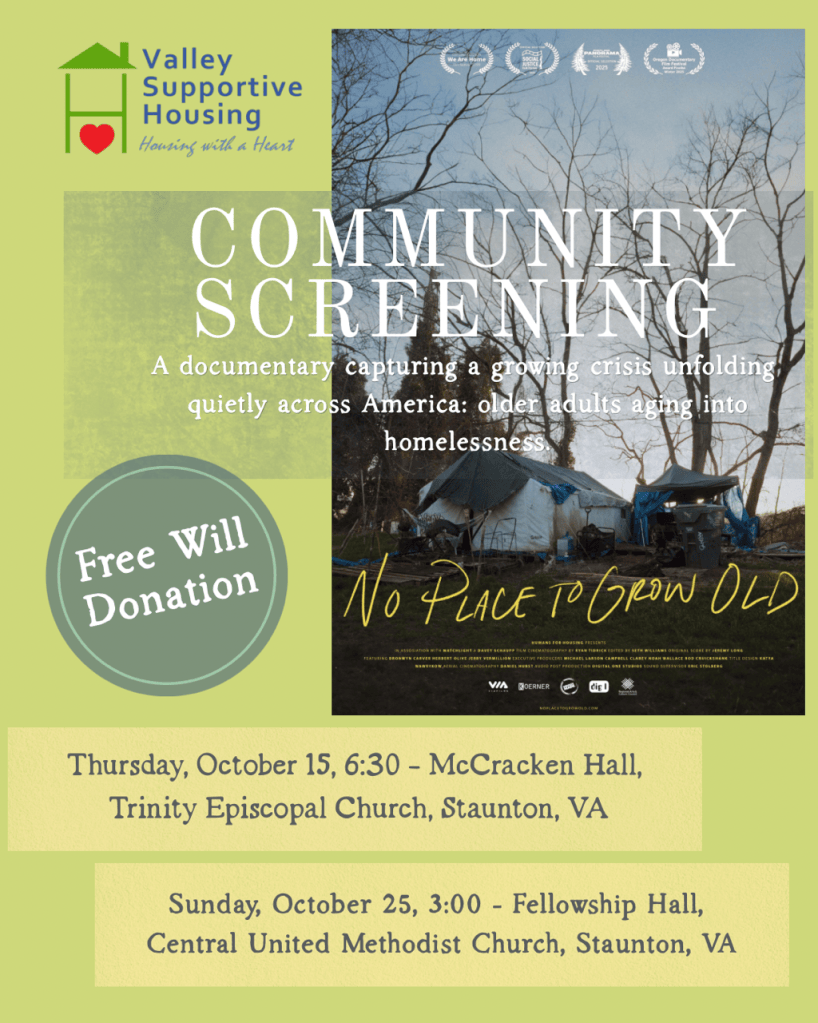
Data is important, but even more important are the stories that put a human face on an otherwise abstract problem. In that regard, I urge everyone reading this to see a free local screening of a tremendously evocative 50-minute documentary on the subject of older adults aging into homelessness, ‘No Place to Grow Old.’ You can see the trailer here.
Sponsored by Valley Supportive Housing, ‘No Place to Grow Old’ will be shown Thursday, Oct. 15 at 6:30 p.m. at McCracken Hall, Trinity Episcopal Church in downtown Staunton; and again on Sunday, October 25 at 3 p.m. in the fellowship hall of Central United Methodist Church, also in downtown Staunton.

