Seeking Dominion with a $25 bribe

(Reading time: 3 minutes)

To the many reasons we already had to be wary of the siren call of data centers, we now can add this week’ s announcement of a proposed $67 billion merger of Dominion Energy with NextEra Energy. The combination would create the world’s largest regulated utility, on a par with the world’s largest oil companies, which right there should give us pause. When the elephants in the room start their mating rituals, it’s time for the rest of us to rush for the exits to avoid getting trampled.

NextEra, already this country’s largest utility,is known as its biggest developer of renewable energy even as it assiduously contributes to the rapid build-out of natural gas-fired power stations. That apparent contradiction is a result of its partnership with Google Cloud to provide electricity to its data centers, a partnership with gas turbine maker GE Vernova to develop power plants to serve data centers, and its early efforts to develop 10 gigawatts of natural gas capacity in Pennsylvania and Texas to fire up the turbines that power those data centers. So, not exactly a “green” power company.

Dominion, meanwhile, supplies electricity to the world’s largest concentration of data centers, right here in Virginia. What could be a better fit? Unless, of course, you’re one of the 3.6 million homes and businesses currently served by Dominion, which bumped up residential rates $11.24 a month this past January. Or as summarized by state assemblyman Suhas Subramanyam, whose district includes the data center megaplex in northern Virginia, “A company that specializes in building energy infrastructure just bought a company that likes to increase rates for new infrastructure.”

The merger is so clearly not in the best interests of Virginia ratepayers that the utilities are proposing to sweeten the pot with $2.25 billion in bill credits to ratepayers over two years—a seemingly impressive number that works out to just $25 a month per customer. After that, of course, it’s back to business as usual, albeit with an even more imposing multi-state behemoth than we have now flexing its lobbying and campaign contributions muscles to get its way.

Industry consultant Arif Gasilov, who sees data center electricity demand as fundamentally restructuring utility ownership, told POWER Magazine this week that mergers like the one now on the table threaten to overturn public restraint on critical utility monopolies. “Virginia’s SB 253, signed into law this spring, was specifically designed to shift more of those infrastructure costs onto data centers and away from residential customers,” he said. “The question now is how NextEra [a company whose growth thesis is built on serving large-load customers] implements a law that was designed to make those same customers pay more and more. That inequality between the new owner’s business model and the state’s cost allocation policy is what stakeholders should be watching.”

The merger won’t be a done deal for at least another year, as it must be approved by shareholders of both corporations and pass muster with a bevy of regulatory agencies, including the Nuclear Regulatory Commission, the Federal Energy Regulatory Commission and the U.S. Dept. of Justice, as well as state regulators in Virginia—notably the State Corporation Commission—and both Carolinas. But as imposing as that sounds, it comes in the context of a White House that is more than receptive to corporate mergers and whose favorite adjective is “big.”

It also comes at a time when the massive data center build-out is driving electricity bills steadily higher, with Americans paying an average of 8.5% more for electricity in December than a year earlier, and 28% more over the past five years.  The National Energy Assistance Directors Association is projecting that U.S. households will pay an estimated $778 to cool their homes this summer, also an 8.5% increase over last year.

Roof-top solar has never looked more attractive. The proposed data center at Staunton Crossing has never looked uglier.

When data centers pull the plug

(Reading time: 2 minutes)

Although my biggest concern about a data center possibly setting up shop in Staunton has been the enormous amount of water such centers consume, their voracious consumption of electricity also is top of mind. It’s notable, therefore, that the North American Electric Reliability Corp. yesterday issued its highest level of warning about the risks that data centers pose to the electric grid. The rare Level 3 alert followed several incidents over the last two years in which more than a gigawatt of data center load simultaneously and unexpectedly disconnected, destabilizing the grid and creating a potential blackout.

The North American Electric Reliability Corp. (NERC), often described as the continent’s “grid watchdog,” issued its alert after analyzing disruptions of electric service in Virginia and Texas caused by data centers abruptly pulling the plug in 2024 and 2025. Such disconnects may occur when data centers respond to relatively minor grid disturbances, such as a local lightning strike or line fault, by switching to backup power supplies so they can maintain consistent voltage flow to sensitive computing equipment—but the sudden load loss stresses grid infrastructure, like transformers, that consequently may shut down as well, triggering a cascade of system failures.

Currently, data centers don’t have to follow the rules that require power plants to inform grid monitors when they are going on- and off-line, even though some centers can add or subtract as much or more power than a power plant. And while the data center contemplated for Staunton is hardly on that scale—measured in megawatts rather than gigawatts—it could be part of a wider network of such centers triggered by a common disruption. An analysis by dozens of scientists from the largest AI companies warned last year that their industry’s power swings could physically damage the grid.

Yesterday’s Level 3 alert was only the third in NERC’s history. It was followed by the corporation’s call for transmission planners to develop a detailed list of “modeling data, settings and parameters needed from computational loads” and to study the grid stability “margin” at least annually in areas with large AI infrastructure, such as Virginia.

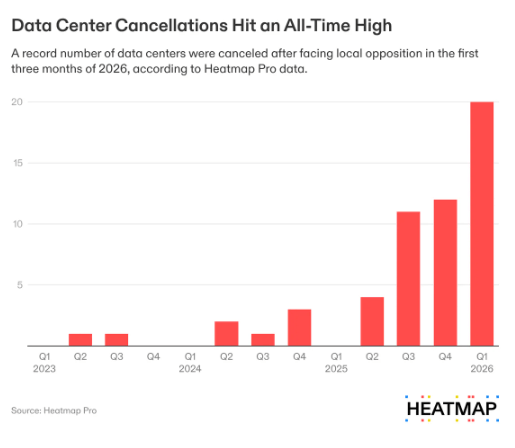
Such developments don’t happen in a vacuum. As evidence of the outsized negative impact of data centers on communities, electricity rates, water supplies and the electric grid become unavoidably in your face, resistance to new centers is snowballing. At least 20 proposed new centers were canceled the first three months of this year due to local pushback, as tracked by Heatmap, with more than a hundred new fights added within the same time frame. Recruiting a data center for Staunton, in other words, means inviting a whole lot of problems the city can do without.

Staunton’s cross(ing) is hard to bear

(Reading time: 6 minutes)

We’re now more than three weeks into the 90-day timetable Tim Davey gave Staunton City Council for updating the Staunton Crossing master plan, and so far there’s been no word on how or when this process will begin, or how the city’s residents will be included. That’s a problem, and more so if the city is seriously thinking of trying to land a data center.

For those who missed my earlier write-up on the subject, Davey, director of economic development for the Timmons Group, addressed the city council April 9 to acknowledge that “a long time” had passed since Timmons designed Staunton Crossing. Despite that lengthy hiatus, during which data centers have exploded in number, size and recognized adverse environmental impacts, Davey argued they should remain in the recruiting mix, if only because of the tax revenue one or more such centers would generate for the city.

Along the way, Davey also mentioned, almost parenthetically, that a data center might need its own on-site electrical plant, which these days is the industry response to widespread uproar over the higher electricity rates such centers cause. That would be a new and seemingly significant change to the Crossing’s master plan, especially since the industry’s default option in such cases has been gas-fired generators, which add to local noise and air pollution. Then again, Davey did mention the possibility of a “small” nuclear reactor. Either way, it seems that Staunton’s residents might have some thoughts on the subject.

Davey was equally blithe—and seemingly misleading—in his response to concerns about how much of the city’s water supply would be consumed by a data center. Those concerns have at least two sources. One is the city’s fragile, century-old system of feeder mains that increasingly is prone to catastrophic breaks and which already can’t account for 28% of the water pumped into it. The second is an increasingly erratic climate of precipitation extremes that includes periods of severe drought. The city doesn’t have the $50 million or so needed to beef up its water system, and it has no idea or plan for how to obtain it. And despite some recent showers, all of Virginia has been in a drought since last fall described as the most extreme in two decades.

But not to worry, Davey counseled—there’s always the possibility of recruiting a data center that uses a closed-loop cooling system, thereby limiting water demand. Note the tenuous nature of that “possibility.” Although closed-loop systems are indeed possible, most data centers don’t use them because they’re more complicated, involve higher upfront costs and typically require up to 40% more electricity to operate their additional pumps and heat exchangers, effectively swapping water and electricity burdens.

More to the point, it’s questionable just how much water is conserved by closed-loop systems. A closed-loop system simply means that the water used to cool the processors that comprise the bulk of all data centers—and which, incidentally, run at average temperatures of more than 188 degrees Fahrenheit—runs through a closed loop that passes through a heat exchanger. The other half of the heat exchanger is not a closed loop. The water in this outer loop absorbs the heat from the closed loop before passing through a water-cooling tower, in which it evaporates and thereby releases its heat into the atmosphere.  Cooling towers require a constant water flow to work, each day releasing hundreds of thousands of gallons into thin air.

That’s obviously a concern when long-term water availability is a question mark. But a similar  concern can be raised by pharmaceuticals, which Davey threw out as a new, possible recruitment target for the industrial park. To be fair, it was just a passing mention, so seemingly off-the-cuff that it provoked little follow-up from council members. It’s worth noting, however, that pharmaceutical manufacturing also is a thirsty business—so much so that the industry acknowledges it faces “major challenges in terms of water consumption with potential impacts on the environment and sustainability.”

That’s not to say that the possibility of a pharmaceutical manufacturer setting up shop in Staunton Crossing should be discarded. It is, however, a reminder that there are no silver bullets and that any industry will bring drawbacks as well as advantages. The trick is to publicly and honestly identify assets and liabilities alike, without minimizing costs or overstating benefits, so that everyone is given an opportunity to weigh trade-offs and draw his or her own conclusions about what is or isn’t acceptable. Thus far, at least, that seems not to have happened with Staunton Crossing—or not in nearly a decade, at any rate.

It’s also worth noting that the past decade has seen the development and even explosion of industries that scarcely existed when the Staunton Crossing masterplan was being drawn up—industries that Davey did not mention and that council members didn’t raise, but which should at least be in the mix of any “update” review. One obvious industry group sure to gain momentum in the years ahead, for example, is anything to do with renewable energy: photovoltaic panels, storage batteries, even electric vehicles of various sizes and applications if Staunton Crossing is large enough for their assembly plant. This sector includes newly developed perovskite-silicon cells that achieve 34% efficiency, solar paint, solar windows and thin-film solar panels—all technologies still in their early days, with lots of development potential ahead, unlike the data center boom that even Davey says is nearing an end.

Another industry group that has been ignored—and one that could have additional benefits for our affordable housing-starved area—is manufactured housing, with a particular focus on factory-built or prefab housing. Unlike data centers, which move electrons rather than physical products, a manufactured housing plant could take advantage of Staunton Crossing’s accessibility to rail and highway transportation networks, one of the industrial park’s presumed selling points. Moreover, off-site modular housing construction, like renewable energy products, is an industry of the future, with the U.S. playing catch-up to countries like Sweden, where prefabrication accounts for 84% of the residential market. The Netherlands (20%) and Japan (15%) likewise have a significant share of their homes built this way, compared to just 5% in the U.S.

There may be, on closer examination, convincing reasons why neither renewable energy nor factory-built housing (nor an unknown number of other industries one might think of) is a suitable match for Staunton Crossing. It may also be that they are desirable industries to recruit, but that finding and wooing them will take more work than simply opening the doors to the data centers that are sprouting up everywhere in Virginia like mushrooms after an (increasingly rare) soaking rain. But that’s why a three-month “refresh” of the Staunton Crossing master plan, off to a slow start at that, doesn’t seem like a sincere effort as much as a rush job toward a foregone conclusion.

Data center FOMO with a side of nuke

(Reading time: 7 minutes)

What’s going on with Staunton Crossing?  

Fifteen years and tens of millions of dollars after it was first conceived, the 300-acre industrial park at the corner of I-80 and U.S. 250 has finally achieved Tier 4 status, which signifies it is ready to do business. Which raises the question: what now?

What kinds of businesses should be recruited for Staunton Crossing, and how will the city measure the project’s overall success? Should Staunton put more emphasis on job creation—or on increasing its tax base? How much disruption to its infrastructure and social fabric can the city tolerate, and what’s a fair trade-off for the jobs and tax dollars that result?

These and other issues were raised last week at a regular city council meeting in a rapid-fire presentation by Tim Davey, a professional engineer and director of economic development for the Timmons Group, which had created Staunton Crossing’s master plan by late 2018. “In the marketing world, six years is a long time,” he conceded Thursday, explaining why the plan should be updated. Seven-plus years is an even longer time, but Davey was not one to get bogged down in details, rushing through his remarks as if by doing so he could somehow turn back the clock. Along the way, he managed to toss a couple of hand grenades.

The most obvious casualty of time’s passage has been the master plan’s inclusion of a data center, an industry that was all the rage last decade but which has since lost much of its luster, and which dominated much of last week’s discussion. Just how much of a data center was being contemplated in 2018 is hard to tell from the documents produced at the time. Maps of the site allocated 831,250 square feet to a data center that Timmons projected would be built in the fifth year—which is to say, before now. Elsewhere, however, in a chart that includes water and sewer consumption, the data center was inexplicably reduced to 375,000 square feet, shrinking its hefty water needs below those of a light manufacturing plant. And water, as the master plan noted, is key: “Nothing else matters more than water.”

The intervening years have had other implications for the master plan, which includes a modest level of retail but a significant amount of office space among its target end-users—two categories, as pointed out by Mayor Michele Edwards, that have seen significant post-Covid shifts in demand. Such changes, in turn, affect bottom-line calculations about how many jobs and how many tax dollars Staunton Crossing might generate. Office space, for example, requires relatively little taxable capital investment but generates a lot of jobs when compared with light manufacturing, which requires more taxable spending on equipment and facilities but hires fewer people. Back when the master plan was first assembled, the outlook was for “3,000 quality jobs,” apparently considered a sufficiently high return on the many millions of state tax dollars lavished on the site in the name of job creation. But whether that’s still in the cards remains to be seen.

Data centers completely flip the calculus. Once such a center is built, typically by a transient workforce, its employee headcount is measured in dozens rather than hundreds. A data center’s potential boost to the city’s tax base, on the other hand, is enormous, thanks to its capital-intensive nature. In one sense, then, Staunton’s financial interests are at cross-purposes with Virginia’s, since state-funded land development allocated to a data center essentially transfers state capital to the city’s coffers—a nice offset for Staunton taxpayers, if not so great for the Staunton workforce.

A questionable transfer of tax dollars aside, data centers over the past decade have evolved in public perception from a relatively benign, low-impact and “clean” form of industry into power-guzzling, water-sucking vampires that can be noisy neighbors and a threat to local air quality, thanks to their reliance on diesel- and gas-fired emergency generators. With residential electricity rates climbing and water scarcity exacerbated by such developments, progressive Democrats are pushing a national moratorium on the construction of data centers nationally. A growing number of municipalities are following suit on a local level.

Despite all that, however, Tim Davey clearly believes that data centers should stay in the mix for Staunton Crossing—and not just a data center, but possibly an on-site electric plant to supply its energy needs, up to and including a “small” nuclear reactor.* Data centers and their associated energy sources are “things that people are asking about, and I’m not advocating for it, I’m just telling you that it’s just one of those things that people are asking about and you need to have an answer for that,” he counseled.

City councillor Corrie Park pushed back on such assertions, citing all the drawbacks associated with data centers and the resistance she has encountered from city residents on the subject. It would be “inefficient of us” to pursue a data center at this time because Staunton residents “won’t go for it,” she contended, a waste of time better spent going after more acceptable land uses. Davey, on the other hand, wasn’t having any of it, suggesting various work-arounds for some of the objections, offering for example that some data centers are using closed-loop cooling systems to reduce water consumption. And, of course, there was that whole nuke thing to avoid distorting local energy costs.

But the bottom line for Davey seemed to be . . . the bottom line. The Virginia boom in data centers will have run its course in another five years, he predicted, so it would be in Staunton’s best interests not to miss the gravy train. “I pose the question to my clients, do you want to be the only jurisdiction in Virginia without one, and the tax revenue that could come from it?” he asked the city council, leaning into fear-of-missing-out anxieties. “If the answer is yes, then that’s great—but the tax revenue is pretty impressive.”

What happens next is not clear. Davey’s presentation ended with several recommendations, starting with development of “a diverse, internal marketing team” and creation of “a target marketing portfolio,” which presumably would revisit the kinds of industries the city would try to recruit for Staunton Crossing. Yet the overall package smacks of a rush job staffed by insiders. There is no suggestion that public input would be sought—even for so weighty a subject as the desirability of having a “small nuke” within city limits—and the whole business plan refresh could be done within just 90 days, Davey assured the council.

Doubts about data centers aside, other questions about Staunton Crossing abound. For example, a key question raised by Davey on behalf of Staunton Crossing prospects is, “Where will my employees live?” To that, Davey replied, “I believe you guys are in a very good, healthy position to answer that,” which may come as news to the recently created Staunton Housing Commission and various local groups grappling with the inadequate supply of affordable housing—and all the more so if Staunton Crossing delivers on its promise of 3,000 new jobs. That’s a lot of fresh housing demand!

It’s also worth noting that whatever goes into Staunton Crossing, whether light manufacturing plants or a data center or both, will put additional demands on a water and sewer infrastructure that is already under stress. It’s ironic, therefore, that Davey’s presentation was immediately followed by a request to increase utility rates by 5% to 7% to pay for long overdue water and sewer improvements and maintenance. The increased amount, everyone agreed, will raise only a fraction of what’s actually needed.  

There were no comments made at the public hearing on the rate increase, which was then approved.

*Once you’ve picked your jaw up off the floor and want to get the full context of the casual reference to nuclear reactors, you can find Davey’s comments here, starting at around the 54-minute mark. It should go without saying that any onsite power plant, nuclear or otherwise, would need additional coolant water.