
(Reading time: 9 minutes)
Halloween is not only about goblins and ghouls. It’s also the starting gun in the sprint to Thanksgiving and Christmas, when charities and social welfare agencies lean into the charitable impulses such holidays inspire. But this also is the season when shorter days and colder nights bring human needs more to the forefront, so there’s a push as well as a pull to the seasonal tugging at heartstrings and wallets.
There are several trusted strategies deployed to support such imploring. One is to tell stories of people in need, suffering because of fate’s fickle finger rather than as a result of personal failings. Another is to highlight the ever-greater cruelty of the grasping Orange Man, laying waste to Medicaid, food stamps and housing subsidies. A third is to cite reams of statistics to summarize not just how bad things have become, but to show how rapidly they’re deteriorating.
And that’s a problem. Most people don’t do numbers so good.
The Blue Ridge Area Food Bank (BRAFB) inadvertently provided proof of this innumeracy a couple of weeks ago, jumping the gun on the charitable-giving season with a Zoom presentation on hunger in Virginia. The Oct.14 session, which drew 77 participants, proceeded with the observation that most people in the food bank industry expected demand to peak in the years immediately after the 2020 Covid pandemic. Instead, food demand has kept growing, year after year, and “we’re very concerned about the wave we see coming,” explained BRAFB chief executive Kari Diener.
To buttress that concern, lots and lots of numbers got tossed around, from poverty stats to SNAP enrollment figures to financial pressure points forcing people to skimp on life’s other essentials to keep from starving to death. The bottom line, however, could be summarized in just one statistic: that 42% of Virginia households face food insecurity, meaning they don’t have enough food to eat or don’t know where their next meal will come from. Forty-two percent is a lot; 3.7 million people.
Well, maybe.
THE PROBLEM WITH NUMBERS, as I’ve written before, is that they seem so damn authoritative. People’s emotions are squishy and changeable, but we all have them and so tend to think we’re experts when it comes to examining or questioning feelings.
Numbers are different: angular, sharp-edged, resistant to interpretation. Or so they seem, never mind the confusion of Boolean algebra allowing 1+1=0 or the profound (and profoundly disturbing) complexities of quantum physics that enable things to simultaneously exist and not exist. Throw a lot of numbers at most people and their critical faculties seize up, unable to question even the most obvious incongruities, either for fear of seeming stupid or simply because they don’t actually see what’s being shown. Numbers are taken at face value in a way that people rarely are.
That’s pretty much what happened with the food bank presentation on hunger, based on a statewide survey conducted this past May by NORC (formerly the National Opinion Research Center) at the University of Chicago. To be fair to the Zoom call’s participants, neither the survey itself nor its methodology were shared on the call, just its interpreted results. To see the actual data one had to visit the website of the Federation of Virginia Food Banks, headquartered in Richmond, which apparently commissioned the survey on behalf of the seven food banks that serve the state. (BRAFB, for example, covers 25 counties in the western end of Virginia.) Yet even that wasn’t very rewarding in terms of getting basic information.
Despite the federation’s website claim that its survey “offers a new level of precision that captures the extent of food insecurity across the state,” a link purporting to explain the survey’s methodology does no such thing. It simply provides a summary of conclusions. The survey’s supposed precision, meanwhile, is encapsulated in a one-page data sheet that in mid-October waved a very noticeable red flag by claiming to have interviewed the same number (560) of respondents in the BRAFB area as in the much more heavily populated Capital Area Food Bank region. Moreover, while the study states that it surveyed a total of 5,621 Virginians, the individual totals for the seven food bank areas at that time added up to just 3,975.
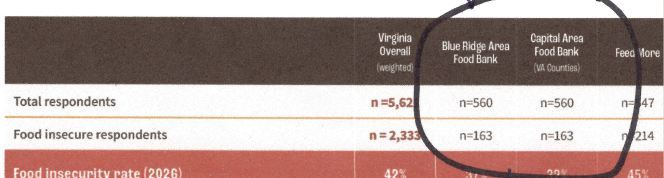
Oct. 14: An unbelievable—literally unbelievable—duplication of numbers.
The identical number of respondents for two greatly disparate food bank areas should have caught the eye of anyone at BRAFB preparing for the Zoom call, but apparently no one looked. Worse yet, a second data row, reporting how many respondents were food insecure, had the same problems: identical numbers of the food insecure (163) in both the BRAFB and Capital Area Food Bank. Meanwhile, the food-insecure total for all seven food banks, 1,474, fell far short of the 2,333 claimed for the state as a whole—yet that’s the number from which 42% food insecurity was computed.
My questions to BRAFB about these inconsistencies resulted in several email exchanges and three different versions of the data. The duplicated numbers were attributed in Richmond to an “administrative error” that, when corrected, increased the number of Capital Area respondents to 2,206 and the number of the Capital Area food-insecure to 535. With that change, the state total for all respondents matched the sum of the seven food bank areas—but even with the Capital Area increase in the number of food-insecure respondents, the total for the seven food banks in that category was still 486 less than the 2,333 claimed statewide.
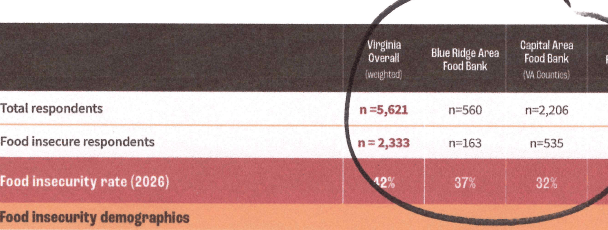
Oct. 22: An unheralded number change, but without modifying state totals.
Was that a problem? Apparently not in Richmond, which in response to my further questions to BRAFB simply changed the statewide number of food insecure respondents to 1,846. No explanation was provided for the change, which now matched the total of the seven food banks. And no reason—“administrative error” or otherwise—was provided for why this error had occurred in the first place.
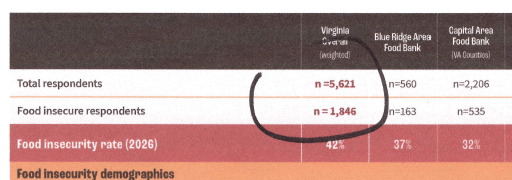
Currently: Fudging the numbers, but without changing the calculations that follow.
Here’s the thing, though: these changes have only dug a deeper pit of uncertainty for the food bank’s statistical claims. When the survey initially asserted that 2,333 of its respondents were food insecure, that worked out to 41.5% of its sample pool. Lowering that number to 1,846 drops the percentage of food insecure respondents to a tad less than 33%, yet the data sheet that’s still online clings stubbornly to its claim of 42%. That’s a big discrepancy. Huge, even.
DOES ANY OF THIS MATTER? These are just numbers, after all, and mistakes happen, and . . . and.
It matters for the same reason that it would matter if BRAFB were to present a heart-tugging story of a single unemployed mother suffering from a debilitating illness for whom a local food pantry had meant she could feed her three children, only to find out that the single mother was as healthy as a horse or that she had a cushy job or that the three kids were her neighbor’s, provided as photo-op props. The story’s coloration changes. A third of all respondents is still a lot of people facing food insecurity, but it’s not as dramatic as 42%, so why not go with the better story? Meanwhile, the data sheet that offers “a new level of precision” about hunger in Virginia has 30 more rows of percentages about hunger, both statewide and for each of the seven food bank areas, all of which should now be questioned.
None of this is to suggest there’s anything nefarious going on, or that BRAFB is guilty of deliberate deception. If anything, BRAFB is the unwitting victim of sloppy data manipulation by others, compounded by its own lack of attention to detail. But BRAFB also is a participant in a game of pass-the-buck, serving as a go-between to the Federation of Virginia Food Banks but deflecting questions about data manipulation to NORC, which responded to my inquiries about who prepared the original data sheet by suggesting I contact . . . the Federation of Virginia Food Banks. Which, to date, has not responded to several inquiries that started more than two weeks ago.
The problem is not only that a potentially powerful message about hunger in Virginia has been undercut by an unexplained butchering of fundamental facts. The wider problem is that local social service agencies keep shooting themselves in the foot with an essentially cavalier approach to numbers generally and to numbers that keep them financially accountable specifically. I’ve written about this before, excoriating SAW Habitat for Humanity for fudging its tax reports in such a way as to obscure a lack of accounting for 12 months of receipts and expenses. And I returned to this problem more recently by questioning the apparent disappearance of more than a million dollars over several years at the Verona Community Food Pantry.
In those cases, too, the response has been to admit to nothing and to stonewall any inquiries. And while BRAFB can sidestep questions about the data it presented mid-October by asserting that it was simply a conduit for others, it has been just as quick to take a hands-off approach to the Verona food pantry’s accounting problems by noting that the food bank and the food pantry are separate legal entities. That’s true as far as it goes, but it obscures the legal relationship between the two organizations that defines financial terms, operational responsibilities and compliance requirements.
At a most fundamental level, all these agencies are part of a social welfare ecosystem that is highly dependent on public support and public trust. Trust is built on transparency and accountability, which in turn depend on accurately presenting facts and figures so that the public understands what’s going on. Lose that trust in one area, whether because of guile, heedlessness or just telling a story too well, and you weaken the entire structure.

