
Zoning: new wine in old wineskins

(Reading time: 5 minutes)

It’s only human to think that the way things are is the way they’ve always been—until they’re not. That may seem like an incongruous statement, given the extraordinarily dynamic world we’re living in. Constant social and political upheaval, as well as ever-changing rules about appropriate behavior and how we maintain relationships, can seduce us into thinking we’ve mastered this change thing—that we’ve learned how to be light on our feet as we bob and weave through everything that’s being thrown at us.

Which is true enough, as far as it goes. But learning how to respond to shifting expectations and responsibilities is not the same as learning how to effect change. Adaptation is all about reaction, not about proactively creating the world we want to see—to being able to think outside of the box, changing our circumstances to better serve our needs rather than merely responding to the world’s demands on us.

What brings all this to mind is a subject I’ve touched on in the past, albeit briefly, which is the realization that our zoning code is a decades-old strait jacket that almost invisibly shapes our built environment. Decisions that were made in the 1960s about how Staunton should be laid out, and its various land uses apportioned, have become so engrained that we rarely think about how they constrain our efforts to meet modern challenges. As a result, discussions and studies about how best to create more affordable housing, or how to make Staunton more walkable and bicycle friendly, or how to better integrate small businesses, homes and professional offices, invariably overlook root causes.

Because of this blind spot, city planners can make absurd statements about Staunton’s lack of available land for further development. The Staunton housing strategy group can meet for a year with only short mention of the zoning code, and then only to acknowledge its restrictions, without any discussion of whether those restrictions still make sense or how they can be changed to meet contemporary needs. The city’s recently adopted 11-point housing strategy mentions zoning only once, as part of an “exploration” of what might be needed to encourage additional housing options on existing properties. And it remains to be seen whether Staunton’s revision of its Comprehensive Plan will address this most fundamental issue.

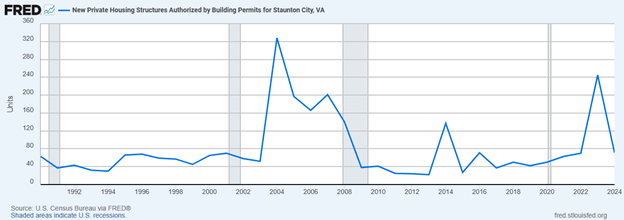
That the city’s demographics and housing needs have undergone significant changes since 1969, when the current zoning code was adopted, should go without saying. Households are significantly smaller and the population overall skews significantly older. The city itself has more than doubled in geographic size, following the 1986 annexation of 11 square miles from Augusta County—yet while both Augusta County (+76%) and Waynesboro (+35%) have seen not insignificant population increases over the past half-century, Staunton’s has inched up just 5%, and all of that over just the past decade. The amount of new housing permitted in a city with 12,352 housing units is measured most years in mere dozens (see graph above or here).

 One way to describe all this is “stagnation.” Indeed, at the most recent Virginia Governor’s Housing Conference, one of the supposedly most cautionary statistics—because of its implications for future housing needs—served up by a keynote speaker was the projection that by 2050, 22% of all Americans will be senior citizens. Staunton has all but reached that mark already, at 21%—more than two decades ahead of schedule.

Older people neither want (in most cases) nor need as much house as they did when they were raising families. Smaller households—the result of more adults of all ages living alone, or with just one other person—likewise need smaller homes. And Stauntonians of all ages have emphasized repeatedly their desire to have homes within walking distance of essential shopping, as well as of cultural and recreational amenities. But none of that is possible in more than half of the city, where zoning allows only bigger homes than needed on lots that are spaced more widely apart than is conducive to walking. Moreover, that limitation means rents and home prices in the other, more desired half of the city are at more of a premium than they otherwise would be.

All this suggests that a comprehensive review of Staunton’s zoning code should be a fundamental prerequisite for any serious attempt to tackle the city’s shortage of affordable housing, but the city’s blind spot in this regard has left it spinning its wheels. Although it’s been more than five years since the state’s Joint Legislative Audit and Review Commission (JLARC) directed its staff to analyze Virginia’s affordable housing needs, its conclusions have gone largely ignored locally—including the observation that “local zoning ordinances can be a substantial barrier” to “construction of new affordable housing.”

As the JLARC report also observed, “Very few localities zone more than 50 percent of their land for multifamily housing, which is the housing that is most needed in Virginia.” Although that finding is aimed primarily at the state’s more urban northern crescent, it’s worth noting that less than a fifth of Staunton’s zoned land fits that description.

Our zoning ordinances are much to blame for the fix we’re in today, but they also can ease the way out—once we recognize just how much they’re hobbling our housing market. What man has made, man can change.

Zoned out over affordable housing

What a difference a line makes: in the purple areas of this map from the Virginia Zoning Atlas, ADUs good. In the white areas, which have the greatest need for more housing, ADUs bad.

(Reading time: 6 minutes)

If there was one dominant theme at the Virginia Governor’s Housing Conference, held this past week in Roanoke, it was zoning—zoning and how it gets in the way of creating sufficient affordable housing. Two plenary sessions were devoted to the subject, one featuring a self-styled “zoning whisperer,” the other debuting a zoning atlas for the entire state. Zoning issues were integral to several break-out panels. Housing Forward Virginia, a non-profit research and policy organization, announced it will be doing a road-show next year throughout the state to educate civic leaders, planners and the general public about this antiquated approach to land use and why it needs to be revisited.

That’s a lot of attention to a subject that is as esoteric for most people as debentures or polychlorides. Yet as I coincidentally wrote less than a week before the conference, “developers aren’t building affordable housing because our zoning code makes it prohibitively expensive to do so,” making this the elephant in any room where the lack of affordable housing is being lamented. Because zoning codes that were written two and three generations ago (Staunton’s dates back to 1969) dictate what we can build on land today, the result has been what Eric Kronberg, an Atlanta-based developer featured in the opening plenary, succinctly summarized as “legally mandated scarcity.”

Rattling through a fast-paced presentation that drenched his audience with numbers and statistics, Kronberg’s analysis hinged on two basic observations. First, that today’s zoning maps and codes were drafted largely in the 1950s, when 43% of households comprised nuclear families and only 9% were singles living alone, compared with 20% nuclear families and 28% singles today (the balance in each case is attributed to couples without kids or single-parent families). A 1950 household averaged 3.8 people, compared with 2.5 people in 2017, indicating a need for half again as many homes for a static population—which, of course, it has not been.  Yet in 2022, 70% of all housing starts were of single-family homes, as if builders were oblivious to such changing demographics.

Second, Kronberg laid out the greatly higher municipal costs of single-family zoning. Two or three homes on an acre have the same infrastructure requirements—sidewalks, curbs, utility poles, streetlights, water and sewer lines, storm drains, paved roads—as an acre zoned for high density, but an acre with 18 housing units provides a far more robust tax base to fund all those improvements. Moreover, denser multi-use zoning creates more walkable neighborhoods than drive-only suburban-style housing, resulting in a real estate premium that fattens tax receipts. So in addition to stifling construction of the housing that’s actually needed, current zoning codes are a bad economic deal for the cities that have them.

Just how skewed land use has been could be seen most vividly in Sara Bronin’s presentation of the National Zoning Atlas, a multi-year work in progress whose Virginia component was completed just days earlier. As summarized by Bronin, a law professor at George Washington University who’s been overseeing the project, the state is short 165,000 homes but its developers are building only half as many homes annually as they were 20 years ago. One consequence of this imbalance: housing now costs too much, with nearly half of all renters paying more than 30% of their incomes for shelter, up from 34% of the renting population in 2000.

The atlas is worth a leisurely perusal, especially its filters that map selected variables, such as “show me where people can build” apartments, or accessory dwelling units (ADUs), or various forms of single-family housing. Meanwhile, atlas statistics indicate that of Staunton’s 10,988 zoned acres, 64% are reserved for single-family homes “by right,” meaning you can build a house on that land without needing special permits or discretionary approvals. Nearly three-quarters of the residentially zoned land allows only single-family housing. That leaves 2,005 acres where duplex and three-unit housing is allowed “by right,” but according to the atlas there is no zoning provision for larger “missing middle” housing of four or more units, or for apartment buildings, ADUs, planned residential developments or other denser housing. Nor are there any areas permitting housing by right without a parking mandate, which further constrains urban development.

As was made clear by both plenary speakers, as well as numerous break-out panelists, there won’t be any progress toward creating sufficient housing for working families and people with below median incomes until this zoning stranglehold is loosened. That will require reducing lot minimums and setback requirements, expanding multifamily options, streamlining approval processes, encouraging multi-use developments, allowing ADUs by right and reducing or eliminating parking mandates altogether, as has occurred in Charlottesville. It also will mean responding to the inevitable backlash from established homeowners who want to maintain existing levels of city services and low taxes and low housing density—something entirely unattainable in the real world, according to Kronberg, who said you can have any two of those but never all three.

Staunton has made tentative steps in some of these areas, such as modifying—although not eliminating—parking requirements for new housing. And it does have ADUs on its radar, although the city’s newly formed Housing Commission doesn’t plan on proposing a zoning code amendment on the subject to city council until the end of next year. But as long as Staunton avoids dealing with root causes, this merely amounts to tinkering at the edges.  If the city is going to get serious about opening the door to developers willing to build housing at prices that Staunton residents can afford, it will have to question why it’s handicapping itself by relying on your grandparents’ zoning code.

*              *              *              *              *

In addition to the Virginia Zoning Atlas, another useful online resource that came out of the conference is the Virginia Rural Opportunity Dashboard. Its name notwithstanding, the “rural” dashboard maps the entire commonwealth and provides a handy, centralized data bank of demographic, health, economic and other data by county and city. Like many mercantile sites that permit comparisons across possible purchases, it also enables side-by-side comparisons of municipalities, such as all three SAW (Staunton, Augusta and Waynesboro) components, which can provide some surprising insights.

For example, although Staunton is often perceived as being better off than Waynesboro, 12.6% of Staunton residents fall below the federal poverty level, compared to 11.7% of residents in Waynesboro—who also have a higher employment rate, at 64.1%, compared with Staunton’s 60.2%. More revealing statistics await the curious.

How not to read the (housing) room

(Reading time: 4 minutes)

The Virginia Governor’s Housing Conference just wrapped up its 2025 get-together, with 800 or so housing advocates from all parts of Virginia descending on Roanoke to grapple with the key question of the day: how do we make housing more affordable?  The answer, at least according to two plenary speakers, requires revamping zoning codes that are so prohibitively restrictive they result in “legally-mandated scarcity,” as one of them put it.

All that and more is deserving of more detailed analysis, which I’ll get into in a separate post. But whatever the merits of zoning reform, a different answer to the question of how we can get more affordable housing was provided by a breakout panel with the promising title, “Designing for Dignity: Scaling Permanent Supportive Housing in the Suburbs.” Spoiler alert: the answer is “we won’t,” because we’re losing all sense of perspective.

The panel seemed promising. Its two key speakers were Tara Ruszkowski, executive director of the Lamb Center, which among its other good deeds operates a day shelter for the homeless in Fairfax County; and Taylor Stout, senior project manager for Wesley Housing, a long-time non-profit developer of affordable housing in Virginia and Washington, D.C.  Together, they had collaborated on creating a housing project, Beacon Landing, that had its ground-breaking just a couple of weeks ago, and they were at the conference to explain how they overcame various obstacles and assembled 13 different funding sources to reach that point.

As with the panel, Beacon Landing seems like a great idea. Replacing an old motel in a commercial and industrial area with a new five-story building, it will have 54 units of 400 square feet apiece for long-term residents referred by the county’s coordinated entry system, which is to say, people who already are or are at high risk of becoming homeless. In addition to furnished apartments, Beacon Landing will have a large community room, an outside terrace for socializing, a demonstration kitchen for cooking lessons, and case manager offices for staff to provide wrap-around services and oversight.

That something of the sort—and much more—is needed is unquestionable. The county’s Point in Time (PIT) count of the homeless this year was 1,322, a 3% increase from 2024 and up 27% from 2020. Providing supportive housing for 54 of that number may seem like barely scratching the surface, but it’s a start. And as people going into Beacon Landing gain their footing and move on to a bigger and better life, others will come in behind them, making the project’s overall impact far larger than its overall size suggests.

But here’s a wake-up call: the capital expenditure for this project is $33.1 million (no wonder it required 13 funding sources!). That’s just the up-front costs of creating the facility and doesn’t include operating costs, including a payroll of six to seven full-time employees that the Lamb Center says will be needed. The math is insane. The median sales price of a single-family home in Fairfax County is currently around $715,000, or approximately $351 per square foot. Beacon Landing’s per-unit cost comes in at $613,000, or around $1,500 a square foot. True, it can be argued that the cost of the additional common and program areas within the building should be subtracted from the total before making comparisons, but it’s inconceivable that doing so would reduce the per-unit cost to anything approaching $351 a square foot.

There undoubtedly are many arguments the Lamb Center and Wesley Housing can make to justify a seemingly over-the-top acquisition and construction budget, but the bottom line remains that Beacon Landing will be spending enough money to buy 46 single-family homes so it can house 54 people in a fraction of the space. For people already struggling to maintain mortgage payments or to meet their rent, that can seem . . . profligate?

The mystery is that this panel was presented as “scaling” permanent supportive housing, leaving unanswered the question of scaling for what? or where? How many projects of this sort can any locality afford? How many, looking for ways to help their most vulnerable unhoused residents, would look at Beacon Landing and throw up their hands at the sheer impossibility of such a model working for them? What is the message Beacon Landing is sending to anyone concerned about the growing number of homeless people in our communities?

Valley Supportive Housing, which provides supportive housing in Staunton for 68 tenants, does so in a dozen modest structures acquired over the years through conventional loans and grants of various sorts.  I’m betting its director, Lou Siegel, would have choked on his coffee had he attended the housing conference and sat in on the “Designing for Dignity” panel. It’s a good thing for his health that he stayed home.