Zoning: new wine in old wineskins

(Reading time: 5 minutes)

It’s only human to think that the way things are is the way they’ve always been—until they’re not. That may seem like an incongruous statement, given the extraordinarily dynamic world we’re living in. Constant social and political upheaval, as well as ever-changing rules about appropriate behavior and how we maintain relationships, can seduce us into thinking we’ve mastered this change thing—that we’ve learned how to be light on our feet as we bob and weave through everything that’s being thrown at us.

Which is true enough, as far as it goes. But learning how to respond to shifting expectations and responsibilities is not the same as learning how to effect change. Adaptation is all about reaction, not about proactively creating the world we want to see—to being able to think outside of the box, changing our circumstances to better serve our needs rather than merely responding to the world’s demands on us.

What brings all this to mind is a subject I’ve touched on in the past, albeit briefly, which is the realization that our zoning code is a decades-old strait jacket that almost invisibly shapes our built environment. Decisions that were made in the 1960s about how Staunton should be laid out, and its various land uses apportioned, have become so engrained that we rarely think about how they constrain our efforts to meet modern challenges. As a result, discussions and studies about how best to create more affordable housing, or how to make Staunton more walkable and bicycle friendly, or how to better integrate small businesses, homes and professional offices, invariably overlook root causes.

Because of this blind spot, city planners can make absurd statements about Staunton’s lack of available land for further development. The Staunton housing strategy group can meet for a year with only short mention of the zoning code, and then only to acknowledge its restrictions, without any discussion of whether those restrictions still make sense or how they can be changed to meet contemporary needs. The city’s recently adopted 11-point housing strategy mentions zoning only once, as part of an “exploration” of what might be needed to encourage additional housing options on existing properties. And it remains to be seen whether Staunton’s revision of its Comprehensive Plan will address this most fundamental issue.

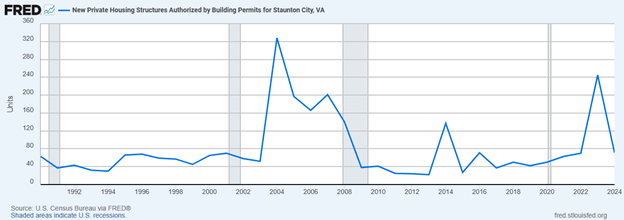
That the city’s demographics and housing needs have undergone significant changes since 1969, when the current zoning code was adopted, should go without saying. Households are significantly smaller and the population overall skews significantly older. The city itself has more than doubled in geographic size, following the 1986 annexation of 11 square miles from Augusta County—yet while both Augusta County (+76%) and Waynesboro (+35%) have seen not insignificant population increases over the past half-century, Staunton’s has inched up just 5%, and all of that over just the past decade. The amount of new housing permitted in a city with 12,352 housing units is measured most years in mere dozens (see graph above or here).

 One way to describe all this is “stagnation.” Indeed, at the most recent Virginia Governor’s Housing Conference, one of the supposedly most cautionary statistics—because of its implications for future housing needs—served up by a keynote speaker was the projection that by 2050, 22% of all Americans will be senior citizens. Staunton has all but reached that mark already, at 21%—more than two decades ahead of schedule.

Older people neither want (in most cases) nor need as much house as they did when they were raising families. Smaller households—the result of more adults of all ages living alone, or with just one other person—likewise need smaller homes. And Stauntonians of all ages have emphasized repeatedly their desire to have homes within walking distance of essential shopping, as well as of cultural and recreational amenities. But none of that is possible in more than half of the city, where zoning allows only bigger homes than needed on lots that are spaced more widely apart than is conducive to walking. Moreover, that limitation means rents and home prices in the other, more desired half of the city are at more of a premium than they otherwise would be.

All this suggests that a comprehensive review of Staunton’s zoning code should be a fundamental prerequisite for any serious attempt to tackle the city’s shortage of affordable housing, but the city’s blind spot in this regard has left it spinning its wheels. Although it’s been more than five years since the state’s Joint Legislative Audit and Review Commission (JLARC) directed its staff to analyze Virginia’s affordable housing needs, its conclusions have gone largely ignored locally—including the observation that “local zoning ordinances can be a substantial barrier” to “construction of new affordable housing.”

As the JLARC report also observed, “Very few localities zone more than 50 percent of their land for multifamily housing, which is the housing that is most needed in Virginia.” Although that finding is aimed primarily at the state’s more urban northern crescent, it’s worth noting that less than a fifth of Staunton’s zoned land fits that description.

Our zoning ordinances are much to blame for the fix we’re in today, but they also can ease the way out—once we recognize just how much they’re hobbling our housing market. What man has made, man can change.

Macy’s ‘tough crowd’ was just rude

(Reading time: 4 minutes)

Crystal Graham’s article in the Augusta Free Press today, about the curtain-raiser on the most promising effort to date to depose Rep. Ben Cline, ran under a curious headline: “Beth Macy faces tough crowd in Waynesboro, first stop on listening tour.” I didn’t think so—and have to hope Macy didn’t, either.

A Roanoke resident, former reporter for the Roanoke Times & World News and author of several books on contemporary social issues, Macy last week became the third Democrat to announce a bid to challenge Cline in next year’s mid-terms. This is her first foray into politics, so give Macy credit for skipping the easy stuff and plunging right into the belly of the beast: the Congressional Sixth District, despite embracing a handful of Democratic cities, is as reliably red-meat MAGA country as you can find, and the oleaginous Cline has oozed into every one of its Republican crevices. Since winning his seat in 2018 by thumping a hapless Jennifer Lewis, 59.7% to 40.2%, Cline has not had a lower margin in three subsequent elections.

So Macy’s appearance Monday night at the Faded Poppy, on East Main Street, can be fairly characterized as only the most tentative testing of the waters. A “tough crowd” it was not. While Waynesboro has been a reliably red city, it broke blue in this year’s election for the first time, even as it recorded the state’s highest percentage increase in new voter registrations. Perhaps the color switch was thanks to all those new voters, especially as Waynesboro increasingly becomes a bedroom community for notably progressive—and expensive—Albemarle County’s employees. Perhaps it was because of Trump fatigue. Or both. In any case, Macy’s day of reckoning with a salivating MAGA crowd still lies ahead.

But with Graham conceding that “the 40 or so people in attendance were a friendly audience and mostly fellow Democrats,” what prompted the headline assertion about a “tough crowd”? She didn’t explicitly say, but presumably that was a nod to the two audience members who demanded to know why they should expect Macy not to become yet another Washington insider, more intent on satisfying industry lobbyists than on serving her constituents—just another version of Cline, in other words. Macy’s response, which essentially amounted to “trust me,” drew disbelieving sneers. “I’m old enough to have heard that one too many times in my life,” one responded.

Indeed, there is no conceivable answer Macy or any other candidate can provide to such a hypothetical that would satisfy a determined skeptic, given how debased all political discourse has become. No one can predict the future. All we can do is assess a candidate’s character by what he or she has done and hope it’s rooted deeply enough to stand up to future challenges and temptations, and in that regard Macy seems to tick all the boxes. She’s wicked smart, articulate and poised. Her published work is a testament to deeply held concerns and compassion for those who are poor, downtrodden and exploited, affirming a fixed moral compass that is so notably lacking in her putative Republican opponent.

At the end of the day, all any of us can do can do is look at a candidate and trust our ability to take that person’s measure—to trust ourselves, in other words, more than we trust someone else. Without that trust, no assurances of the other person’s merit or integrity will ever fully satisfy.

How well Macy will conduct herself when venturing deeper into the MAGA waters remains to be seen, of course, but her courage in deciding to do so requires at least the benefit of the doubt, if not full-throated endorsement. That can come later. At this point, however, Macy has done or said nothing to merit the skepticism she encountered yesterday—although I don’t think as much can be said of her second interrogator. Holding a cell phone in front of her face throughout the entire “exchange,” apparently so she could record her insightful analysis, the second skeptic speechified for several minutes and was noticeably more interested in how she sounded than in recording the little bit of Macy’s response she grudgingly allowed.

That’s not a tough crowd. It’s an immature, rude crowd of one.

Zoned out over affordable housing

What a difference a line makes: in the purple areas of this map from the Virginia Zoning Atlas, ADUs good. In the white areas, which have the greatest need for more housing, ADUs bad.

(Reading time: 6 minutes)

If there was one dominant theme at the Virginia Governor’s Housing Conference, held this past week in Roanoke, it was zoning—zoning and how it gets in the way of creating sufficient affordable housing. Two plenary sessions were devoted to the subject, one featuring a self-styled “zoning whisperer,” the other debuting a zoning atlas for the entire state. Zoning issues were integral to several break-out panels. Housing Forward Virginia, a non-profit research and policy organization, announced it will be doing a road-show next year throughout the state to educate civic leaders, planners and the general public about this antiquated approach to land use and why it needs to be revisited.

That’s a lot of attention to a subject that is as esoteric for most people as debentures or polychlorides. Yet as I coincidentally wrote less than a week before the conference, “developers aren’t building affordable housing because our zoning code makes it prohibitively expensive to do so,” making this the elephant in any room where the lack of affordable housing is being lamented. Because zoning codes that were written two and three generations ago (Staunton’s dates back to 1969) dictate what we can build on land today, the result has been what Eric Kronberg, an Atlanta-based developer featured in the opening plenary, succinctly summarized as “legally mandated scarcity.”

Rattling through a fast-paced presentation that drenched his audience with numbers and statistics, Kronberg’s analysis hinged on two basic observations. First, that today’s zoning maps and codes were drafted largely in the 1950s, when 43% of households comprised nuclear families and only 9% were singles living alone, compared with 20% nuclear families and 28% singles today (the balance in each case is attributed to couples without kids or single-parent families). A 1950 household averaged 3.8 people, compared with 2.5 people in 2017, indicating a need for half again as many homes for a static population—which, of course, it has not been.  Yet in 2022, 70% of all housing starts were of single-family homes, as if builders were oblivious to such changing demographics.

Second, Kronberg laid out the greatly higher municipal costs of single-family zoning. Two or three homes on an acre have the same infrastructure requirements—sidewalks, curbs, utility poles, streetlights, water and sewer lines, storm drains, paved roads—as an acre zoned for high density, but an acre with 18 housing units provides a far more robust tax base to fund all those improvements. Moreover, denser multi-use zoning creates more walkable neighborhoods than drive-only suburban-style housing, resulting in a real estate premium that fattens tax receipts. So in addition to stifling construction of the housing that’s actually needed, current zoning codes are a bad economic deal for the cities that have them.

Just how skewed land use has been could be seen most vividly in Sara Bronin’s presentation of the National Zoning Atlas, a multi-year work in progress whose Virginia component was completed just days earlier. As summarized by Bronin, a law professor at George Washington University who’s been overseeing the project, the state is short 165,000 homes but its developers are building only half as many homes annually as they were 20 years ago. One consequence of this imbalance: housing now costs too much, with nearly half of all renters paying more than 30% of their incomes for shelter, up from 34% of the renting population in 2000.

The atlas is worth a leisurely perusal, especially its filters that map selected variables, such as “show me where people can build” apartments, or accessory dwelling units (ADUs), or various forms of single-family housing. Meanwhile, atlas statistics indicate that of Staunton’s 10,988 zoned acres, 64% are reserved for single-family homes “by right,” meaning you can build a house on that land without needing special permits or discretionary approvals. Nearly three-quarters of the residentially zoned land allows only single-family housing. That leaves 2,005 acres where duplex and three-unit housing is allowed “by right,” but according to the atlas there is no zoning provision for larger “missing middle” housing of four or more units, or for apartment buildings, ADUs, planned residential developments or other denser housing. Nor are there any areas permitting housing by right without a parking mandate, which further constrains urban development.

As was made clear by both plenary speakers, as well as numerous break-out panelists, there won’t be any progress toward creating sufficient housing for working families and people with below median incomes until this zoning stranglehold is loosened. That will require reducing lot minimums and setback requirements, expanding multifamily options, streamlining approval processes, encouraging multi-use developments, allowing ADUs by right and reducing or eliminating parking mandates altogether, as has occurred in Charlottesville. It also will mean responding to the inevitable backlash from established homeowners who want to maintain existing levels of city services and low taxes and low housing density—something entirely unattainable in the real world, according to Kronberg, who said you can have any two of those but never all three.

Staunton has made tentative steps in some of these areas, such as modifying—although not eliminating—parking requirements for new housing. And it does have ADUs on its radar, although the city’s newly formed Housing Commission doesn’t plan on proposing a zoning code amendment on the subject to city council until the end of next year. But as long as Staunton avoids dealing with root causes, this merely amounts to tinkering at the edges.  If the city is going to get serious about opening the door to developers willing to build housing at prices that Staunton residents can afford, it will have to question why it’s handicapping itself by relying on your grandparents’ zoning code.

*              *              *              *              *

In addition to the Virginia Zoning Atlas, another useful online resource that came out of the conference is the Virginia Rural Opportunity Dashboard. Its name notwithstanding, the “rural” dashboard maps the entire commonwealth and provides a handy, centralized data bank of demographic, health, economic and other data by county and city. Like many mercantile sites that permit comparisons across possible purchases, it also enables side-by-side comparisons of municipalities, such as all three SAW (Staunton, Augusta and Waynesboro) components, which can provide some surprising insights.

For example, although Staunton is often perceived as being better off than Waynesboro, 12.6% of Staunton residents fall below the federal poverty level, compared to 11.7% of residents in Waynesboro—who also have a higher employment rate, at 64.1%, compared with Staunton’s 60.2%. More revealing statistics await the curious.

How not to read the (housing) room

(Reading time: 4 minutes)

The Virginia Governor’s Housing Conference just wrapped up its 2025 get-together, with 800 or so housing advocates from all parts of Virginia descending on Roanoke to grapple with the key question of the day: how do we make housing more affordable?  The answer, at least according to two plenary speakers, requires revamping zoning codes that are so prohibitively restrictive they result in “legally-mandated scarcity,” as one of them put it.

All that and more is deserving of more detailed analysis, which I’ll get into in a separate post. But whatever the merits of zoning reform, a different answer to the question of how we can get more affordable housing was provided by a breakout panel with the promising title, “Designing for Dignity: Scaling Permanent Supportive Housing in the Suburbs.” Spoiler alert: the answer is “we won’t,” because we’re losing all sense of perspective.

The panel seemed promising. Its two key speakers were Tara Ruszkowski, executive director of the Lamb Center, which among its other good deeds operates a day shelter for the homeless in Fairfax County; and Taylor Stout, senior project manager for Wesley Housing, a long-time non-profit developer of affordable housing in Virginia and Washington, D.C.  Together, they had collaborated on creating a housing project, Beacon Landing, that had its ground-breaking just a couple of weeks ago, and they were at the conference to explain how they overcame various obstacles and assembled 13 different funding sources to reach that point.

As with the panel, Beacon Landing seems like a great idea. Replacing an old motel in a commercial and industrial area with a new five-story building, it will have 54 units of 400 square feet apiece for long-term residents referred by the county’s coordinated entry system, which is to say, people who already are or are at high risk of becoming homeless. In addition to furnished apartments, Beacon Landing will have a large community room, an outside terrace for socializing, a demonstration kitchen for cooking lessons, and case manager offices for staff to provide wrap-around services and oversight.

That something of the sort—and much more—is needed is unquestionable. The county’s Point in Time (PIT) count of the homeless this year was 1,322, a 3% increase from 2024 and up 27% from 2020. Providing supportive housing for 54 of that number may seem like barely scratching the surface, but it’s a start. And as people going into Beacon Landing gain their footing and move on to a bigger and better life, others will come in behind them, making the project’s overall impact far larger than its overall size suggests.

But here’s a wake-up call: the capital expenditure for this project is $33.1 million (no wonder it required 13 funding sources!). That’s just the up-front costs of creating the facility and doesn’t include operating costs, including a payroll of six to seven full-time employees that the Lamb Center says will be needed. The math is insane. The median sales price of a single-family home in Fairfax County is currently around $715,000, or approximately $351 per square foot. Beacon Landing’s per-unit cost comes in at $613,000, or around $1,500 a square foot. True, it can be argued that the cost of the additional common and program areas within the building should be subtracted from the total before making comparisons, but it’s inconceivable that doing so would reduce the per-unit cost to anything approaching $351 a square foot.

There undoubtedly are many arguments the Lamb Center and Wesley Housing can make to justify a seemingly over-the-top acquisition and construction budget, but the bottom line remains that Beacon Landing will be spending enough money to buy 46 single-family homes so it can house 54 people in a fraction of the space. For people already struggling to maintain mortgage payments or to meet their rent, that can seem . . . profligate?

The mystery is that this panel was presented as “scaling” permanent supportive housing, leaving unanswered the question of scaling for what? or where? How many projects of this sort can any locality afford? How many, looking for ways to help their most vulnerable unhoused residents, would look at Beacon Landing and throw up their hands at the sheer impossibility of such a model working for them? What is the message Beacon Landing is sending to anyone concerned about the growing number of homeless people in our communities?

Valley Supportive Housing, which provides supportive housing in Staunton for 68 tenants, does so in a dozen modest structures acquired over the years through conventional loans and grants of various sorts.  I’m betting its director, Lou Siegel, would have choked on his coffee had he attended the housing conference and sat in on the “Designing for Dignity” panel. It’s a good thing for his health that he stayed home.

Homelessness as a kick in the pants

(Reading time: 13 minutes)

The calendar may insist that winter won’t arrive for another six weeks or so, but anyone who ventured outside Tuesday morning knew otherwise—not when the temperature hit a bone-chilling 24 degrees Fahrenheit.  Tuesday was a good day, in other words, to be bundled up in a cozy bed or snuggled with a good book under a comforter in an easy chair. If you were that lucky.

It’s ironic, then, that just 12 hours earlier the city had held the third of three public workshops addressing proposed revisions to its comprehensive plan. Dozens of goals and draft strategies were outlined on multiple easels for Staunton residents to ponder and evaluate, spanning everything from land use, housing and economic development to transportation, public infrastructure and education. A section on health and human services stressed “active living, healthy food access and a clean environment.” Public safety, environmental resources, art and recreation all received due consideration.

But nowhere in all this planning and verbiage was there any mention of Staunton’s homeless population, or its needs and how those needs might be met. True, the section on housing gave a vague nod to promoting “affordable housing options for people of all incomes, needs and abilities,” but it remained silent regarding those unable to take advantage of such promotions. Nor did the draft comprehensive plan set a goal of eliminating homelessness by any particular date, and at no point did it acknowledge, much less prescribe, the kinds of services a homeless population requires. As far as the comprehensive plan is concerned, Staunton residents without permanent shelter simply don’t exist.

Winter’s advent will make that fiction harder to maintain.

Let’s take stock. A long-promised day shelter, offering homeless people refuge from extreme weather, remains as elusive as ever, in part because of a crumbling commitment by First Presbyterian Church to allow the use of its premises, but also because of a lack of financial and leadership backing from city council. Meanwhile, the Waynesboro Area Refuge Ministry (WARM), which was to operate the day shelter and which already provides emergency overnight shelters from late November through March, just published its schedule of participating churches for the upcoming season. Two of the week-long slots remain unfilled, at an exceptionally late date in the planning cycle, and there are reports that a third also may fall vacant because one of the congregations got cold feet and is backing out. Meanwhile, eight of the 18 overflow slots, for when the primary host churches receive more than 40 people, likewise remain unclaimed.

The Valley Mission, the area’s transitional shelter for homeless people working on reentry into the workforce and established housing, has 89 residents and is at full capacity—as it has been for several years—and is as far as ever from meeting its goal of a six-month turnover. “Yes, the average length of stay has been much longer than a year,” concedes director Sue Richardson. “In fact, we had two different women who were here four years each,” which puts a whole new meaning on “transitional.”

Then there’s Valley Supportive Housing, which provides affordable housing for clients diagnosed with mental illness, intellectual disabilities or addiction—people, in other words, who otherwise would be prime candidates for living on the streets. It also is at capacity, with 68 tenants, and has a waiting list of 43—the biggest it has been in at least a decade. “Two years ago it would have been half of that,” says director Lou Siegel, who says some of those on the waiting list are at Valley Mission, some are in temporary accommodations with family members, and some are living in their cars.

Both Valley Mission and Valley Supportive Housing are in a perpetual scramble for adequate financial backing, which comes in bits and drabs from local sources such as the city’s Community Development Block Grant (CDBG), the Community Fund and the Community Action Partnership of Staunton, Augusta and Waynesboro (CAPSAW). CDBG is all federal money, while CAPSAW receives nearly half of its funding from the federal government—which means both revenue streams are threatened by the current political climate.

Meanwhile, the area’s homeless population, while always difficult to assess accurately, is almost certainly not diminishing. WARM director Alec Gunn estimated this summer that the SAW region has 250 homeless people.  And while this year’s Point in Time (PIT) count—a one-night snapshot—found fewer unsheltered homeless people than last year, bitterly cold weather the night of the census may have driven them deeper underground. Moreover, as a surprised Lydia Campbell of the Valley Homeless Connection observed, of the 157 sheltered and unsheltered people who were counted by the 2025 PIT census, 71 reported they were homeless for the first time, up from 51 in 2024.

All of which is to say, the Staunton Comprehensive Plan as it’s currently coming together has a gaping hole big enough to push a shopping cart through.

FAILING TO SEE THE CITY’S HOMELESS population means the comprehensive planners also fail to ask why the homeless exist in the first place. If you don’t see a problem, you can’t solve it.

Homelessness, with some rare exceptions, is a signal that the system itself is failing. At its most basic doh! level, homelessness results from an inadequate supply of housing that people can afford. With rental vacancies at or around 2% and housing costs far outstripping the affordability provided by median incomes, the inevitable outcome has been compared to a game of musical chairs, in which the number of available chairs is always less than the number of people circling them. When the music stops, someone always ends up on the floor.

The obvious question: why is that? Why, in a market economy, isn’t more affordable housing being built? The law of supply and demand suggests that when demand exceeds supply, market forces will step up production until the imbalance is corrected. You want to end homelessness? Simple: build more housing at a price that people can afford. So . . . why isn’t that happening in Staunton?

The Staunton Housing Strategy Group spent a year purportedly wrestling with this very issue, ultimately producing this past summer what it optimistically called “Staunton’s Pathway to Affordable Housing and Housing for Working Families.”  Yet it’s notable that of the 19 members of the workgroup, only one, Stu Armstrong, could be categorized as a builder or developer—that is, as someone from the supply side of the supply-demand equation. And Armstrong, as it turned out, didn’t attend a single one of the group’s four meetings.

What that left was an assortment of political leaders, planners and heads of non-profit social agencies holding a one-sided conversation about how best to plug the city’s housing deficits. The result was a set of 11 strategies that, while not entirely without merit, only tangentially address the critical question of how to increase the city’s stock of affordable housing, and do so on a less than urgent timetable. For example, completion of a “strategy” to allow accessory dwelling units (ADUs) in the city is expected to take 18 months, a process that won’t add any new homes but will create the possibility of some down the road.

Foot-dragging over ADUs, which have been given the go-ahead in many municipalities in Virginia and other states, is emblematic of a more fundamental problem that the housing strategy group didn’t address: the city’s zoning code. The main reason Staunton doesn’t have tiny homes or converted garages that can provide additional housing on established home lots is that its rules don’t allow it. Allowing ADUs therefore requires yet another amendment to the zoning code—the default response to every fresh demand for land use, such as creating exceptions to minimum lot size in Uniontown. And just like computer operating systems that over many years become an unwieldy morass of work-arounds, patches and buggy over-writes, zoning codes tend toward increased complexity with every change. What the city’s “pathway to affordable housing” proposes is more tinkering with the underlying code. What the city needs is a new operating system.

It’s not just ADUs that are at issue. Ask developers—as the housing strategy group did not—why they’re not building more affordable homes in Staunton, and the answer you’ll get is a) that the permitting process is too onerous, and b) that they can’t afford to do so. Answer b) to some extent is a consequence of a), because it costs money and time (which is money) to comply with zoning and permitting regulations. But the bigger reason is the zoning itself, which not only limits how a specific piece of land can be used, but which arbitrarily dictates so many other construction variables that the only homes that pencil-out for a builder are expensive ones.

Zoning codes, as the name suggests, create “zones”—a zone for housing, a zone for shopping, a zone for manufacturing, and so on. That made sense when used to keep foundries or slaughterhouses away from residential areas, but it also created artificial divides that segregated functions—stores, homes, offices, apartment buildings, schools, cultural centers—that were all mixed together before zoning codes were created. That mixture, still found and now treasured in downtown Staunton, created a lively, walkable and rich urban environment. The imposition of zones, on the other hand, created land-use monocultures—predominantly large areas of all homes, but also of all mercantile and other activities, as in shopping centers and office parks—that then necessitated a car culture for most people to get to work, do their shopping and go to church or school.

It should be noted that there is nothing intuitively logical about a zoning code’s specific requirements. Staunton’s R-1 residential zoning, for example, is distinguished from R-2 zoning primarily by its minimum lot size, of 15,000 square feet versus 8,750 square feet. But the R-1 lot also must have a minimum lot width of 75 feet at the front and any home built on it must have a minimum 30-foot front set-back, a rear yard at least 35 feet deep and maximum lot coverage of 30%. The same requirements for R-2 homes, meanwhile, are a 70-foot minimum lot width, a 25-foot front setback, a rear yard at least 30 feet deep and maximum lot coverage of, yes, 30%. Why? Why a 25-foot setback for one but a 30-foot setback for the other, or a lot width of at least 70 feet for R-2 but an extra five feet for R-1? What compelling urban mathematics produced these arbitrary requirements?

For builders and developers looking at a lot of 45,000 square feet (just a bit over an acre) zoned R-1, the maximum they can build is three homes. They can’t build cottage courts, fourplexes, townhomes or any number of other configurations increasingly known as “missing middle” housing—housing more dense than single-family homes but smaller than apartment buildings. Instead of 10 or 12 homes they can build just three, so those three are going to be built at a level where they can fetch top dollar, not at a density that would allow at least some affordable homes to be part of the mix.  And in Staunton, the great majority of land is zoned R-1 or R-2, leaving scant room for more modest dwellings.

Zoning’s arbitrary guidelines do preserve a uniformity of appearance that appeals to some people, but which others find stultifying—or as summarized by city planning critic Jane Jacobs, more like taxidermy. Yet their very persistence creates an aura of inevitability, as if the only (unthinkable) alternative is anarchy. And so, even as local feedback to Staunton’s comprehensive plan repeatedly stresses walkability, community, and an integration of work, play and housing, the main obstacle to realizing that vision has gone largely untouched. Despite a proposal to reduce the total number of zoning sub-categories, the comprehensive plan promises to preserve the overall zoning approach. The builders’ dilemma will go unaddressed.

WITHOUT A SERIOUS EVALUATION of how zoning got us into the housing crunch we’re now struggling to overcome, there seems little hope for improvement.

Defenders of the status quo will point to the equivalent of a techie’s work-arounds and system upgrades, including district overlays, special use permits and other ways to game the system while leaving the underlying code untouched. But there’s a reason DOS-based systems have been left behind, not least because they became too expensive to maintain in terms of talent and manpower.

Nor does junking zoning codes mean descending into anarchy. Just as DOS-based systems were replaced by GUI ones—the graphical user interfaces we use without a second thought because they’re so intuitive and user-friendly—so traditional zoning codes are giving way elsewhere to form-based zoning. Traditional zoning codes are a top-down approach that segregates land uses. Form-based zoning is less concerned with regulating land use and instead prioritizes the physical form, scale and character of buildings and public spaces.  Because form-based zoning is a bottom-up approach that regulates how buildings interact with the street and with each other but not what use they’re put to, they tend to encourage infill and the development of walkable, mixed-use neighborhoods and high-quality public spaces.

That doesn’t mean truly disruptive or dangerous industries or businesses can’t be relegated to specific buffered areas, but the landscape is otherwise opened up to a free market constrained primarily by the same kind of rules that apply to coloring books: use whatever color you want but stay within the lines. Observe the regulations we’ve adopted about building height, scale, massing and relationship to the street, but otherwise put your land to the most productive use you can envision.

That may sound radical at first blush, but it is in fact what occurred in what are now the most treasured parts of Staunton—before the zoning code was adopted. It’s also what a growing number of municipalities around the country are adopting, from Mesa, Arizona to Cincinnati, Ohio to parts of Gaithersburg, Maryland. Form-based zoning deserves, at the very least, a serious examination and consideration by those who are revising a comprehensive plan for Staunton that has a 20-year outlook.

Here’s the bottom line: developers aren’t building affordable housing because our zoning code makes it prohibitively expensive to do so. The real-world consequences of sticking with that creaky form of land-use regulation are, quite predictably, more people without homes. And because as a society we apparently have neither the money nor the political will to minister to those people’s most basic needs, every homeless person we see on the streets, huddled in doorways, or sleeping in uninsulated tents or cars, should be a reminder that we’re not addressing root causes of a social disease.

The Staunton Housing Strategy Group failed to do so. The comprehensive plan’s designers are likewise missing the mark. Who’s left?

RV myth denies housing realities

(Reading time:5 minutes)

It’s no secret that RVs have become the default home of last resort for people who can no longer afford a “normal” place to live. Photos of battered trailers and motorhomes lining West Coast streets have become a cliché, but a less visible version of the same trend can be found in RV parks all across the country, where “full-timers” and “seasonals” have put down roots. Once meant as recreational facilities for weekenders and as overnight stops for travelers, with only a sprinkling of longer-term traveling nurses, construction workers and other itinerants, RV parks these days increasingly look like wheeled subdivisions, thanks to the growing shortage of affordable sticks-and-bricks housing.

But as I’ve written before, in a blog I no longer update that focused on campgrounds and RV parks, the RV industry is deeply conflicted about this state of affairs. On the one hand, encouraging people to live—rather than merely recreate—in RVs is a money-maker, assuring park owners of more consistent cash flow and less work than is required for a campground full of overnighters. On the other hand, RVs are built to a far less rigorous standard than their bigger cousins, variously known as house trailers, mobile homes or manufactured housing, which are subject to rules set by the federal department of Housing and Urban Development. RVs, after all, are recreational vehicles, not homes.

Or at least that’s the prevailing fiction.

The problem is that the more people choose—or are forced—to live in RVs full-time, and the more RV park owners either encourage or turn a blind eye to this practice, the more this fiction becomes unsustainable. And as the proliferation of such substandard housing becomes more widely recognized, there’s always the risk of an official crackdown by politicians and rule-makers. Why, after all, should it be acceptable for people to live in homes that don’t meet electrical, fire and other housing codes simply because they sit on wheels? The possibility that Washington or Richmond might suddenly wake up to their responsibility for ensuring that people’s homes are not death traps, thereby strangling the golden goose, has grown big enough to cause industry palpitations, even as the overall trend continues to grow unchecked.

Case in point: the November issue of Woodall’s Campground Magazine, in which an editorial concedes that a severe housing shortage of 4.7 million homes has made RVs an attractive alternative. Yet industry manufacturers “have spent years highlighting the fact that PMRVs are for temporary stays only. . . . For park owners, operators and developer, that means they can approach local officials and highlight the fact that PMRVs are not like permanent trailers or homes, and that they aren’t meant for long-term housing, something many local officials are concerned about when a new RV park, campground or glamping park is proposed.”

As, indeed, they (local officials) should be, and not just when new parks are proposed.

PMRVs is an acronym for Park Model Recreational Vehicles, which is to say, RVs on steroids. Technically bound by RV construction rules that limit their footprint to 400 square feet, they nevertheless can be up to 14-feet wide, which makes them quite unlike any “vehicle” most people would recognize. And while they’re supposedly limited to a single main floor, an exception that manufacturers carved out for “small lofts” has grown over the years to allow secondary spaces up to five feet high. The resulting behemoths are as unlikely to be moved with any frequency as their even larger “mobile home” cousins.

Nor are they furnished in a way that speaks to a transient or recreational lifestyle, as the same Woodall’s issue amply illustrates in a lengthy article under the telling headline, “Rise of the Destination Trailer: Drawbacks of Travel Persuade Some to Put Down Semi-Permanent Roots.” As the article makes clear, it’s not just the hassles of traveling that are doing the persuading, nor are those roots merely semi-permanent—not with trailers “that trade traditional RV mobility for an otherwise unattainable level of residential living.”

Leading off this rhapsodic account is the Benchmark 44LFT: “It’s taller, it’s longer and you’ll typically find that it has equipment that wouldn’t take the pounding of the road—things like wide patio doors, larger and better appliances,” a manufacturer’s representative told the magazine. Indeed, at 44 feet and 11 inches in length, the Benchmark is as long a trailer as can be found on the market but also has two slide-outs—one of which runs the full length of the main cabin—and two loft bedrooms in addition to a master bedroom suite and two bathrooms. The whole thing weighs in at 18,000 pounds GWVR, which requires more towing chops than even the beefiest pick-up can provide.

In other words, there is nothing about the Benchmark, or other PMRVs, that suggests it’s “for temporary stays only.” Nor is there anything about these behemoths that highlights “the fact” that they “are not like permanent trailers or homes, and that they aren’t meant for long-term housing,” no matter how much Woodall’s editor may protest to the contrary. Indeed, a more stark example of how an industry can talk out of both sides of its mouth simultaneously would be hard to find.

It wasn’t all that long ago that industry spokespeople were a bit more honest about things, perhaps because they weren’t feeling as much regulatory heat. Talking to Woodall’s in August of 2023, Dick Grymonprez, longtime director of park model sales at a major manufacturer, was far more philosophical. “If you think about it, a person’s going to live wherever they want to live,” he told the magazine. “The RV business doesn’t want to admit this, but there are people that live in RVs year-round, full-time. There are people that live in park models year-round.”

He’s absolutely right, and the responsible thing for the industry would be to acknowledge as much—and to accept the implications of that acknowledgment.