
Housing advocates: it’s all a dream

(Reading time: 7 minutes)

There was something forlorn about the forum earlier this past week, sponsored by Building Bridges for the Greater Good, which was intended to spotlight teenage homelessness. The microphones offered frequent bursts of loud, jarring static. The stage of the Kate Collin Middle School in Waynesboro, where a similar forum was held a year ago, was more sparsely inhabited this time around—and looked it. The youngest person to take a mic was no longer a teenager, although finding someone of school age to bare his or her soul to several dozen onlookers might have been too much to expect.

Still, without the first-hand testimony of young lives wounded by the uncertainties and instability of homelessness, all that was left were the same old arid statistics that shock but often fail to move: 52 unhoused students in Waynesboro as of Oct. 13, 28 of them living in hotels and motels. Another 26 Waynesboro students living in foster homes, which Ryan Barber, the district’s assistant superintendent, described as “homeless adjacent.” Nearly 200 families across three schools turning to local food pantries each Friday.

No one from Staunton spoke on behalf of that city’s homeless youths. A social worker from Augusta county schools had little to add, seemingly content to let Barber do most of the heavy lifting.

If there was any strong audience reaction to what was said at the forum, it came—twice, with hearty rounds of applause—in response to statements that the long-term solution to such problems is more affordable housing. It’s hard to argue otherwise, since it’s obvious that without affordable housing more people will end up in the streets, but it’s also a term that goes largely undefined and unexplored. The upshot locally has been at least two years of hand-wringing and unfocused discussion that rarely gets at the heart of the issue, which at its core is nothing more than the mismatch between household incomes and housing costs.

“Affordable” housing, including rent or mortgage plus utilities, is typically defined as housing that doesn’t exceed 30% of one’s income. More than that and other basic needs get strained or unmet, including food, clothing, medical expenses, transportation, child care and so on. The sad part is that we haven’t seen anything close to that 30% ratio since March, 2022, when affordability fell of a cliff (see chart below) to levels not seen since the Great Recession of 2008.
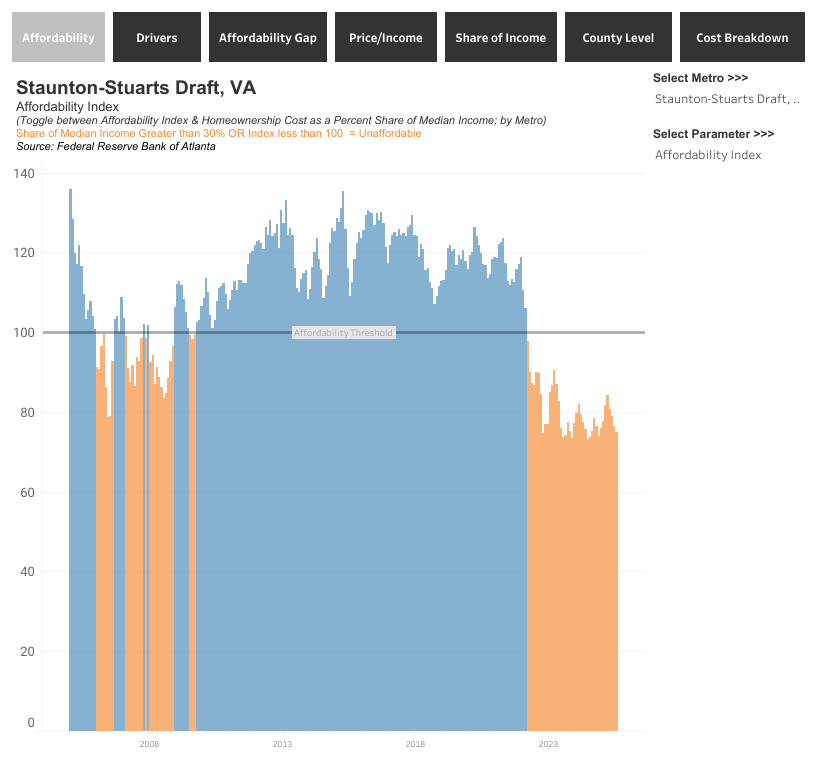
This and other illuminating graphs, compiled by the Federal Reserve Bank of Atlanta, illustrate in several ways how badly we as a society are dealing with our housing issues. For openers, observe that housing today is even more unaffordable than it was in the period leading up to and following a global financial crisis that was triggered by a collapsing U.S. housing market. Although the two crises have differing causes, it’s worth noting that the 2008 collapse resulted in massive government intervention and an all-out effort to stave off another Great Depression. There is nothing comparable today, which means that our housing recession has not only been completely uninterrupted—none of those blue spikes to interrupt a sea of orange—but with no hope that anything’s about to change.

Here’s another way of visualizing the same dynamic, charting the median household income needed to buy a median priced house:

Again, the current lack of affordability exceeds that of the Great Recession. Moreover, the reality is worse than depicted above, since the Atlanta Fed’s statistics include all the components of mortgaged home ownership but do not include utilities. But what is measured is bad enough. The most recent (August, 2025) share of median income going to housing is 39%, the same level reached in July of 2006. By comparison, the lowest share of median income going to housing was in April, 2015, when it dipped to 23%.

With only two statistics going into computing affordability, it’s worth drilling down a bit to see how much each has contributed to our unbalanced ratio. The median household income for our area was $42,819 in mid-2006, $46,661 in April of 2015 and $67,199 a couple of months ago. The median homeownership cost for those same months was $194,033, $164,533 and $308,900. In other words, the cost of homeownership in 2015 was 3.5 times household income, compared to 4.6 times today.

Looked at another way, household income rose 9% over the first near-decade of this comparison, even as homeownership costs dropped 15%. In the decade since? Household income went up 44%, but homeownership costs exploded at twice that rate, by 87.7%. No wonder home ownership has become unaffordable—or that rental rates are likewise skyrocketing, thanks to frustrated homebuyers turning to other shelter options. And just like a rolled-up toothpaste tube, those who can’t keep up get spit out at the other end, ending up couch-surfing or in short-term motel rooms or in their cars or a tent.

Since we’re not about to see a doubling of household income—indeed, given current economic and federal policy trends, we’ll be lucky to see any increase—the only alternative for lowering the affordability threshold is to decrease the cost of homeownership. One way for that to happen is through lower mortgage interest rates, but that’s beyond our meager capabilities, and interest rates are in any case only a secondary factor in housing costs. Even more on the margin are property taxes and home insurance, both of which have climbed over the years but still remain relatively minor components of a monthly mortgage payment. That leaves just one thing we might influence to promote affordable housing: the cost of home building itself. That’s where the conversation should be focused, and it’s also where the conversation has been most lacking.

Home construction is a numbers game that is most profitable when it enjoys economies of scale. As with interest rates, many of the costs that go into that equation—labor, materials, weather—are beyond our control except at the margins. But the one variable over which municipalities have a say is land use. The more housing units that can be built on a particular lot, the lower the per-unit cost of the finished homes. Build a $500,000 house on a half-acre because a lower-cost house won’t pencil out, or build a four-plex with each unit priced at $200,000 and make the same return on investment—and create four times as much housing, each at an affordable price.

That latter option, however, requires a wholesale reexamination of zoning codes and maps, and that’s something Staunton has avoided. The city’s 11-point housing “strategy,” conceived by a working group of housing advocates that not once discussed the role of zoning in driving up housing costs, nibbles around the edges of land-use policies by exploring the possibility of allowing accessory dwelling units. The bulk of the proposed housing strategies, however, merely advocate lots of talking and not so much action: legal services for renters, for instance, or landlord “education.” The nitty-gritty task of grappling with outdated notions of urban planning, meanwhile, apparently proved a step too far.

And so we have moments like Monday’s forum, offered under the hopeful tag line, “I am homeless and still I dream.” Those of us who aren’t homeless are also dreaming—dreaming if we think we’re actually moving the needle on affordable housing, as even a quick look at the charts above should drive home. What’s that phrase, often mis-attributed to Einstein, about the definition of insanity. . . .?

What we need is a matchmaker

(Reading time: 13 minutes)

The growing mismatch between people’s needs and the resources available to them keeps growing, and with Congressional Republicans hell-bent on adopting a “big, beautiful bill” that will slash Medicaid and other social spending, the gap is certain to keep widening. Care to guess who’s getting hurt the most?

Actually, there’s no need for guesses. Dr. Ryan Barber, whose increasingly sad job it is to ensure that homeless school children have their educations disrupted as little as possible, has been speaking out a lot about an increasingly fraught situation. Barber works for the Waynesboro School District, where at this time last year there were 100 children sleeping in cars or hotels or on a relative’s couch. A few weeks ago that number was 107, continuing a steady upward trend. Staunton, meanwhile, has seen a 50% increase in student homelessness over the past three years.

Traumatized children are not likely to be good students, so public servants like Barber do their best to keep disrupted young lives on an even keel. Local public schools have laundry machines for washing limited wardrobes, give out new clothing to replace what’s worn out or embarrassingly unfashionable, provide food for after-school consumption. If a student’s family is forced to shelter outside the district, Barber and his counterparts will pay for transportation so a child can keep attending the same school, with its familiar teachers, friends and routine.

Yet all that costs money—a surprising amount of it. In one case Barber recounted at a recent SAW housing luncheon, a Waynesboro student whose family moved in with relatives in Swoope continued to attend her same school—at a cost to the district of $250 a day for transportation. Funding for such expenses comes partly from Project Hope, a state program that last year disbursed a total of approximately $45,000 to Staunton, Augusta County and Waynesboro schools—a drop in the bucket when $5,000 of that can get eaten up by driving a single student.

Paltry though it is, however, Project Hope is among the funding sources getting cut. So is Title 1 money, which is federal assistance for schools with children from low-income families, of which there is no lack locally. Ditto for Title 6b, which provided funding for educating students with disabilities, which as Barber noted, is a people-intensive business. So too with a slew of other federal programs that have provided Waynesboro schools with $2.9 million a year, the loss of which would mean losing as many as 30 staff positions.

It’s not just public schools that are getting whacked, although their casualties will be the most poignant. Speaking at a Building Bridges for the Greater Good event three weeks ago—at which Barber also appeared—Staunton city manager Leslie Beauregard summarized the current budget cycle as “the most difficult ever.” There won’t be any FEMA funding to repair severe flood damage under the Wharf parking lot, money for digitizing the city library’s archives has evaporated, and Covid-related funding that paid for approximately 10% of local health staffing has been cut as well.

Meanwhile, Beauregard added, the city received $140,000 in additional requests for new funding from non-profits that were casting about for whatever financial help they could get. A grant for extending water and sewer lines to Uniontown is in jeopardy. And while the city’s annual Community Development Block Grant seems stable at the moment, “if that goes away, it will affect our housing programs greatly.”

These are, in other words, bleak and troubled times. So what’s to be done?

MONEY IS ALWAYS NICE, of course, and many times it’s indispensable. But the other great resource available to almost every community is . . . the community. The people who sometimes open their wallets to others, but who also can contribute their time and energy to help each other. Some  people can afford to write a check but don’t have the time to do volunteer work, and some people are just scraping by financially but have time on their hands that they can contribute to their neighbors.

It’s this latter group we need to do a better job of recruiting. And enabling.

When Dr. Barber disclosed that it costs $250 a day to transport a student from Swoope to Waynesboro, the obvious question from an audience member was why that service couldn’t be provided by community volunteers. Oh, that simply wouldn’t be practical, came the flustered response (not from Barber, it should be emphasized), what with liability and insurance issues and the problem of ensuring reliable pick-up and drop-off times and, well . . .  on to another topic. And just like that, a potential gift horse was smacked on its butt and sent on its way.

In plush times, which these are not, that might be an understandable if still unfortunate response. Volunteers can be a real pain in the ass. They don’t always donate their time for the best reasons, they sometimes acquire an off-putting sense of entitlement, they can be fickle and unreliable. Scheduling them can be a nightmare, you can’t always know how they’re representing your organization to the public, and the turnover rate can be nightmarishly high. How much more convenient just to pay someone to do a job!

Yet for all those headaches, fiscally strapped communities have long depended on volunteers to provide some of their most essential services. Even today, a substantial number of volunteers staff ambulances and fire apparatus in the SAW region, working alongside career staff whose ranks are kept lean because of budgetary constraints. Volunteers pick up, sort and distribute groceries at food pantries, swing hammers and saw lumber for home-repair non-profits, deliver blood and plasma for the Red Cross, cook and serve meals at shelters, and perform a hundred other tasks that quite often remain invisible to the general public.

Asserting that volunteers are an impractical resource is a lazy dismissal, and especially so in miserly times like these, when the only alternative may be nothing at all.

Consider, for example, the need for some kind of daytime refuge for the area’s unsheltered homeless population. Some homeless people have jobs to go to during the day, but many don’t and are left to roam the streets, regardless of extreme summer heat or winter cold. Where do they end up going? To the public library or the YMCA, to a Hardees or McDonalds, or riding a Brite bus interminably—to wherever they can keep cool or warm and dry, even if they discomfit those around them. 

How much more humane would it be to provide a day shelter, complementing the emergency night shelters that the Waynesboro Area Refuge Ministry operates from November through March each year?

Several initiatives are underway locally to create just such a facility, including one spearheaded by Staunton Mayor Michele Edwards. A local church has offered use of its space, Edwards and a WARM representative are discussing whether that agency can staff the operation, and the mayor has said city council might be able to provide some start-up funding. There’s also talk of Augusta Health providing visits by a mobile clinic, and of Mary Baldwin social work students playing some role.

It all sounds promising, but look more closely and you’ll see some cracks. The church in question has scheduling conflicts. WARM is in a financial hole following this past winter’s severe weather and seems unlikely to afford additional personnel costs. And Edwards has emphasized that the city won’t be able to cover operating costs, which means that once this boat is pushed into the river, it’s on its own and with no readily identifiable captain to steer it.

Perhaps for these reasons, there are a couple of other preliminary efforts underway to achieve the same goal. Yet woven through all of these initiatives is the same hurdle: who’s going to man the ship? Who’s going to unlock the doors, fill the coffee pot, ensure that the bathrooms are clean, maintain order, provide counsel to those who look for it, sweep the floors and put out the trash? There’s really only one answer: it will have to be community volunteers, and more than just a couple of Mary Baldwin students.   But where will they come from?

WHICH BRINGS ME, at long last, to the underlying thesis of this essay: in Staunton, we do a poor to nonexistent job of matching people willing to work on behalf of others with people who need that help. And we do a similarly poor job of matching people who need help to resources—including volunteers—that could give them what they need.

Consider for a moment that you’re a first-time visitor to Staunton, a tourist, and you want to know what’s worth seeing or doing in the neighborhood. What’s a good place to eat? How can I get to the Frontier Culture Museum? Are there any antique outlets locally? Hey—you’re in luck! The city elders have thoughtfully funded and staffed a centrally located store-front where you can get answers to all these and any other questions you might have, plus brochures, maps, web sites and QR codes that put the entire area at your fingertips.

But if you’re a local without money but with a problem? Good luck finding an equally accessible and helpful resource center.

Got a leaky roof that you can’t afford to repair but don’t know how to tap into possible help? How about needing free food but not knowing where local food pantries are located or their hours of operation?   Or what if you don’t have a car but need to get to Augusta Health for medical attention, and you know there’s a Brite bus that might take you there but not where to catch it or what kind of schedule it follows—and if you go to the new, much ballyhooed “Lewis Street Transit Hub,” there’s neither a route map nor an operating schedule for you to look at? (Huh? How dumb is that?)

Tourists bring money, so perhaps it’s not surprising that we make information so much more accessible to them than to our own residents —unsurprising, but sad, nonetheless. But equally frustrating is that the reverse information flow is also stymied.

Live in Staunton, have some time and want to give back to the community? Maybe you’re a retired accountant or bookkeeper willing to tutor someone in basic financial literacy. Or perhaps you’ve got basic handyman skills and could spend four hours a day for three days a week helping someone with home repairs. Or you’ve got a clean driving record and are willing to spend a day or two a week or month delivering food to the homebound, shuttling supplies for a non-profit, or transporting elderly patients for medical appointments. Maybe you’re even willing to staff a day shelter for the homeless?

Terrific—but you’re on your own figuring out which local agency would benefit most from what you’re willing to offer, much less whom to contact and how to present yourself.

What these examples illustrate is a hole in Staunton’s social fabric whose existence has gone unnoticed. What the city lacks is an information broker to match people who have something to offer with people or organizations who need that something. We do that for visitors via the Staunton Visitor Center, offering a place for strangers to ask questions and get expert help in getting what they want while also providing local businesses and attractions with a way to advertise what they have available. What we don’t have is a Staunton Resource Center that can perform the same services for our neighbors.

Such a resource center could, for example, maintain an inventory of potential volunteers, together with descriptions of what they’re willing to do and their general availability.  The center’s data banks would include such basic personal information as age, sex, educational level and any physical limitations, a description of the kind of volunteer work desired, and preferred work environments, such as indoors or outdoors, or working alone or with a group. Each entry would also describe a volunteer’s special skills or abilities, past volunteer work, language fluency, driving record and other relevant details. With that information in hand, a broker could let a church, school, social agency or other organization know of the best possible candidates for volunteer positions they may be trying to fill, or let a potential volunteer know what openings matching their interests are available.

Conversely, Staunton residents who are thinking of finding a volunteer position could review requests filed with the resource center by local agencies seeking help.

In addition, the staff at such a resource center could respond to local residents’ needs by providing basic information, be it as simple as a bus schedule or as complex as a list of contacts most helpful to someone who’s about to get evicted: legal assistance, emergency shelter, transportation, school personnel, and so on.  By engaging one-on-one with people walking in off the street, resource center staff could identify needs that someone caught up in the emotional turmoil of a crisis hasn’t yet recognized, offering proactive rather than merely reactive assistance.

Yes, a resource center of this sort would cost money—just as the visitor center costs money, currently budgeted at a bit more than $62,000 a year. (That’s in addition to the city’s $665,000 budget for tourism in general.) But just as the money spent on tourism is viewed as seed corn, returning many times more than is expended through visitor spending on local restaurants, lodging, entertainment and so on, so a resource center to mobilize volunteer time and efforts should be recognized as enriching the community.

Unfortunately, the reflexive response to such suggestions is the pretense that online resources and cell phone apps can substitute for face-to-face assistance—which, yes, is cheaper, but hardly effective, as the city itself underscores with its spending on the visitor center. Not everyone has a cell phone, or a charged cell phone. Not everyone is skillful at using digital devices to obtain needed information. Most critically, people who need help often don’t know what they need to know—they don’t know what questions to ask. That’s where human intervention can be critical.

Meanwhile, the brokerage aspect of such a resource center presumably could have an online presence—as the real estate market has, with Zillow and Realtor.com—but ultimately, it’s human beings who create the most productive connections. We’ve got to find a better way to make that human link.

We’re only beginning to see the deprivation that lies ahead, as federal money dries up, the economy stumbles toward possible stagflation and critical community needs go unfunded. This is the time to figure out how we’re going to compensate for the loss of money that typically lubricates our social machinery, and really, the only alternative is the time, effort and concern we have for each other. The days when we can spend $250 a day to transport a homeless student to school are coming to an end, and yet it takes hardly any imagination at all to think of an alternative—it just needs organization.