
(Reading time: 5 minutes)
As far as the U.S. Department of Housing and Urban Development (HUD) is concerned, March came in like a lion.
Starting in late February and continuing into this week, the federal agency responsible for most public housing fired off a volley of proposals guaranteed to make its tenants miserable. The timing, as the economy teeters on the edge of a downturn, affordable housing remains more mythical than real and the war on immigrants continues unabated, couldn’t be more heartless.
The first assault came Feb. 20, when HUD published a proposal to prohibit immigrants who are ineligible for housing assistance from living with family members who are eligible, as is the current policy. The ineligibility list includes immigrants who are otherwise in the U.S. legally, such as immigrants with student visas or those with Temporary Protected Status. Such mixed-status families currently receive prorated housing assistance that covers only the eligible members, which means the family as a whole pays proportionally higher rent than fully eligible families. If adopted, the proposal would force mixed-status families to separate or to leave their homes altogether.
A second shoe dropped just a week later, when HUD took steps to repeal a requirement that public housing agencies and private homeowners accepting vouchers provide their tenants with a 30-day notice before filing for eviction for non-payment of rent. The Feb. 26 announcement was designated an “Interim Final Rule,” which in a ready-fire-aim twist, means that despite a comment period that runs through April, the repeal will go into effect March 30. Although HUD’s notice acknowledges that the 30-day eviction notice “provided tenants with longer runways to undertake remedial actions to become current with their rent,” the agency contends that too many tenants simply took advantage of the additional time to go deeper into arrears.
Besides, HUD added, dropping the 30-day window will improve housing access by “opening up housing opportunities” for people on waitlists for affordable housing. Which fits right in with the Orwellian phrase, “War Is Peace. Freedom Is Slavery. Ignorance Is Strength.”
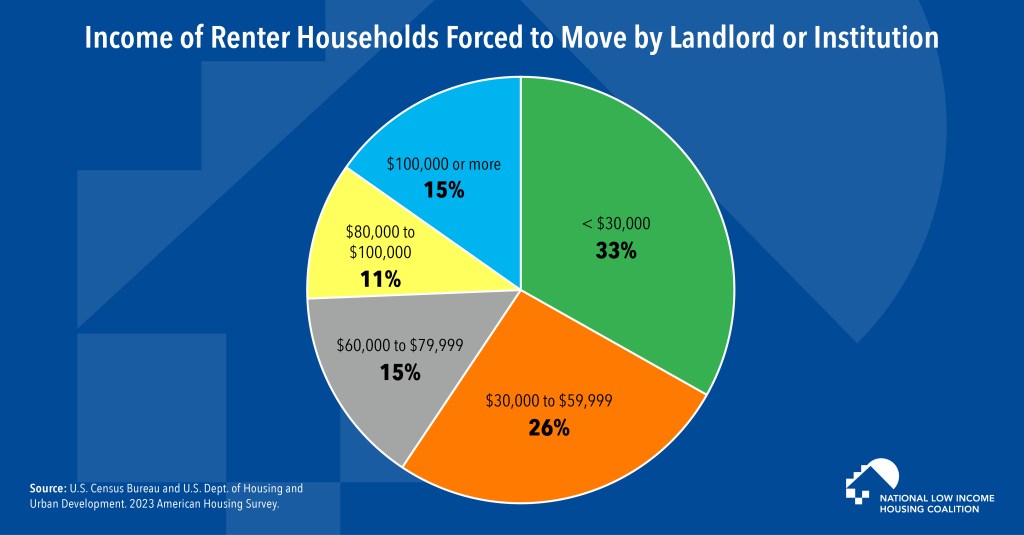
Consider the graph at the top of this page, which shows that a third of all evicted renters have incomes of less than $30,000 a year. Even at the top of that range, monthly rent of more than $750 pushes a tenant into the “rent burdened” category, which leaves little wiggle room for other necessary living expenses or emergencies. Falling behind on rent by even a month creates a nearly insurmountable financial hurdle for catching up.
But that’s not all. While an estimated 80,000 people would lose their housing assistance because of the mixed-status family rule change, and more than 2 million HUD-assisted households will be impacted by the loss of the 30-day eviction notice, an estimated 3.3 million would lose their rental assistance as a result of a March 2 proposal to impose work requirements and time limits on housing assistance. The estimate, based on an analysis by the Center on Budget and Policy Priorities, includes 1.7 million children who could lose their homes.
The proposed work requirement, long embraced by political conservatives who fret about welfare queens, would require “work eligible” adults to put in up to 40 hours a week at programs and projects that “address local needs and goals.” Failure to comply with work requirements would be grounds to terminate housing assistance. But potentially even more onerous is the proposal to allow PHAs and housing owners to establish two-year limits on housing assistance for non-elderly, non-disabled families.
All of these proposals are more nuanced than these brief summaries reflect, but the bottom line is that there are more than 10 million people in the United States who have a roof over their heads primarily because of federal rental assistance programs. Most people in HUD-assisted housing who can work do work: in Virginia, 81% of non-disabled people without young children worked in the past year, according to the National Low Income Housing Coalition. With the minimum wage in the state set at $12.41 an hour, and Virginia’s fair market rent for a two-bedroom home coming in at $1,749, it should be obvious why subsidized housing is the only way many state residents can have a roof over their heads. Now that’s at increased risk.
Nehemias Velez, executive director of the Staunton Redevelopment and Housing Authority, says he knows of no local families that will be threatened by the proposed mixed-status family proposal. The local effects of the other two proposals, however—not to mention other shots HUD might take in the weeks ahead at the people it ostensibly serves—remain to be seen. But it’s already quite clear that the fragile existence of people depending on federal tax dollars to survive is becoming ever more precarious. And as more of them inevitably get pushed out of their homes, it’s going to be up to municipalities like Staunton to pick up the pieces.
That’s not good. We’re not meeting current demand as it is, with long waiting lists at the housing authority, the Valley Mission and Valley Supportive Housing, so where will the new waves of suddenly homeless people go? How many more emergencies like the one we had in late January will it take before we get serious about developing an adequate supply of affordable housing, as well as providing sufficient transitional emergency shelter spaces to tide people over in the short term? Where is the political leadership we need to start beating the drum on these issues?
 Looking askance