
Homelessness as a kick in the pants

(Reading time: 13 minutes)

The calendar may insist that winter won’t arrive for another six weeks or so, but anyone who ventured outside Tuesday morning knew otherwise—not when the temperature hit a bone-chilling 24 degrees Fahrenheit.  Tuesday was a good day, in other words, to be bundled up in a cozy bed or snuggled with a good book under a comforter in an easy chair. If you were that lucky.

It’s ironic, then, that just 12 hours earlier the city had held the third of three public workshops addressing proposed revisions to its comprehensive plan. Dozens of goals and draft strategies were outlined on multiple easels for Staunton residents to ponder and evaluate, spanning everything from land use, housing and economic development to transportation, public infrastructure and education. A section on health and human services stressed “active living, healthy food access and a clean environment.” Public safety, environmental resources, art and recreation all received due consideration.

But nowhere in all this planning and verbiage was there any mention of Staunton’s homeless population, or its needs and how those needs might be met. True, the section on housing gave a vague nod to promoting “affordable housing options for people of all incomes, needs and abilities,” but it remained silent regarding those unable to take advantage of such promotions. Nor did the draft comprehensive plan set a goal of eliminating homelessness by any particular date, and at no point did it acknowledge, much less prescribe, the kinds of services a homeless population requires. As far as the comprehensive plan is concerned, Staunton residents without permanent shelter simply don’t exist.

Winter’s advent will make that fiction harder to maintain.

Let’s take stock. A long-promised day shelter, offering homeless people refuge from extreme weather, remains as elusive as ever, in part because of a crumbling commitment by First Presbyterian Church to allow the use of its premises, but also because of a lack of financial and leadership backing from city council. Meanwhile, the Waynesboro Area Refuge Ministry (WARM), which was to operate the day shelter and which already provides emergency overnight shelters from late November through March, just published its schedule of participating churches for the upcoming season. Two of the week-long slots remain unfilled, at an exceptionally late date in the planning cycle, and there are reports that a third also may fall vacant because one of the congregations got cold feet and is backing out. Meanwhile, eight of the 18 overflow slots, for when the primary host churches receive more than 40 people, likewise remain unclaimed.

The Valley Mission, the area’s transitional shelter for homeless people working on reentry into the workforce and established housing, has 89 residents and is at full capacity—as it has been for several years—and is as far as ever from meeting its goal of a six-month turnover. “Yes, the average length of stay has been much longer than a year,” concedes director Sue Richardson. “In fact, we had two different women who were here four years each,” which puts a whole new meaning on “transitional.”

Then there’s Valley Supportive Housing, which provides affordable housing for clients diagnosed with mental illness, intellectual disabilities or addiction—people, in other words, who otherwise would be prime candidates for living on the streets. It also is at capacity, with 68 tenants, and has a waiting list of 43—the biggest it has been in at least a decade. “Two years ago it would have been half of that,” says director Lou Siegel, who says some of those on the waiting list are at Valley Mission, some are in temporary accommodations with family members, and some are living in their cars.

Both Valley Mission and Valley Supportive Housing are in a perpetual scramble for adequate financial backing, which comes in bits and drabs from local sources such as the city’s Community Development Block Grant (CDBG), the Community Fund and the Community Action Partnership of Staunton, Augusta and Waynesboro (CAPSAW). CDBG is all federal money, while CAPSAW receives nearly half of its funding from the federal government—which means both revenue streams are threatened by the current political climate.

Meanwhile, the area’s homeless population, while always difficult to assess accurately, is almost certainly not diminishing. WARM director Alec Gunn estimated this summer that the SAW region has 250 homeless people.  And while this year’s Point in Time (PIT) count—a one-night snapshot—found fewer unsheltered homeless people than last year, bitterly cold weather the night of the census may have driven them deeper underground. Moreover, as a surprised Lydia Campbell of the Valley Homeless Connection observed, of the 157 sheltered and unsheltered people who were counted by the 2025 PIT census, 71 reported they were homeless for the first time, up from 51 in 2024.

All of which is to say, the Staunton Comprehensive Plan as it’s currently coming together has a gaping hole big enough to push a shopping cart through.

FAILING TO SEE THE CITY’S HOMELESS population means the comprehensive planners also fail to ask why the homeless exist in the first place. If you don’t see a problem, you can’t solve it.

Homelessness, with some rare exceptions, is a signal that the system itself is failing. At its most basic doh! level, homelessness results from an inadequate supply of housing that people can afford. With rental vacancies at or around 2% and housing costs far outstripping the affordability provided by median incomes, the inevitable outcome has been compared to a game of musical chairs, in which the number of available chairs is always less than the number of people circling them. When the music stops, someone always ends up on the floor.

The obvious question: why is that? Why, in a market economy, isn’t more affordable housing being built? The law of supply and demand suggests that when demand exceeds supply, market forces will step up production until the imbalance is corrected. You want to end homelessness? Simple: build more housing at a price that people can afford. So . . . why isn’t that happening in Staunton?

The Staunton Housing Strategy Group spent a year purportedly wrestling with this very issue, ultimately producing this past summer what it optimistically called “Staunton’s Pathway to Affordable Housing and Housing for Working Families.”  Yet it’s notable that of the 19 members of the workgroup, only one, Stu Armstrong, could be categorized as a builder or developer—that is, as someone from the supply side of the supply-demand equation. And Armstrong, as it turned out, didn’t attend a single one of the group’s four meetings.

What that left was an assortment of political leaders, planners and heads of non-profit social agencies holding a one-sided conversation about how best to plug the city’s housing deficits. The result was a set of 11 strategies that, while not entirely without merit, only tangentially address the critical question of how to increase the city’s stock of affordable housing, and do so on a less than urgent timetable. For example, completion of a “strategy” to allow accessory dwelling units (ADUs) in the city is expected to take 18 months, a process that won’t add any new homes but will create the possibility of some down the road.

Foot-dragging over ADUs, which have been given the go-ahead in many municipalities in Virginia and other states, is emblematic of a more fundamental problem that the housing strategy group didn’t address: the city’s zoning code. The main reason Staunton doesn’t have tiny homes or converted garages that can provide additional housing on established home lots is that its rules don’t allow it. Allowing ADUs therefore requires yet another amendment to the zoning code—the default response to every fresh demand for land use, such as creating exceptions to minimum lot size in Uniontown. And just like computer operating systems that over many years become an unwieldy morass of work-arounds, patches and buggy over-writes, zoning codes tend toward increased complexity with every change. What the city’s “pathway to affordable housing” proposes is more tinkering with the underlying code. What the city needs is a new operating system.

It’s not just ADUs that are at issue. Ask developers—as the housing strategy group did not—why they’re not building more affordable homes in Staunton, and the answer you’ll get is a) that the permitting process is too onerous, and b) that they can’t afford to do so. Answer b) to some extent is a consequence of a), because it costs money and time (which is money) to comply with zoning and permitting regulations. But the bigger reason is the zoning itself, which not only limits how a specific piece of land can be used, but which arbitrarily dictates so many other construction variables that the only homes that pencil-out for a builder are expensive ones.

Zoning codes, as the name suggests, create “zones”—a zone for housing, a zone for shopping, a zone for manufacturing, and so on. That made sense when used to keep foundries or slaughterhouses away from residential areas, but it also created artificial divides that segregated functions—stores, homes, offices, apartment buildings, schools, cultural centers—that were all mixed together before zoning codes were created. That mixture, still found and now treasured in downtown Staunton, created a lively, walkable and rich urban environment. The imposition of zones, on the other hand, created land-use monocultures—predominantly large areas of all homes, but also of all mercantile and other activities, as in shopping centers and office parks—that then necessitated a car culture for most people to get to work, do their shopping and go to church or school.

It should be noted that there is nothing intuitively logical about a zoning code’s specific requirements. Staunton’s R-1 residential zoning, for example, is distinguished from R-2 zoning primarily by its minimum lot size, of 15,000 square feet versus 8,750 square feet. But the R-1 lot also must have a minimum lot width of 75 feet at the front and any home built on it must have a minimum 30-foot front set-back, a rear yard at least 35 feet deep and maximum lot coverage of 30%. The same requirements for R-2 homes, meanwhile, are a 70-foot minimum lot width, a 25-foot front setback, a rear yard at least 30 feet deep and maximum lot coverage of, yes, 30%. Why? Why a 25-foot setback for one but a 30-foot setback for the other, or a lot width of at least 70 feet for R-2 but an extra five feet for R-1? What compelling urban mathematics produced these arbitrary requirements?

For builders and developers looking at a lot of 45,000 square feet (just a bit over an acre) zoned R-1, the maximum they can build is three homes. They can’t build cottage courts, fourplexes, townhomes or any number of other configurations increasingly known as “missing middle” housing—housing more dense than single-family homes but smaller than apartment buildings. Instead of 10 or 12 homes they can build just three, so those three are going to be built at a level where they can fetch top dollar, not at a density that would allow at least some affordable homes to be part of the mix.  And in Staunton, the great majority of land is zoned R-1 or R-2, leaving scant room for more modest dwellings.

Zoning’s arbitrary guidelines do preserve a uniformity of appearance that appeals to some people, but which others find stultifying—or as summarized by city planning critic Jane Jacobs, more like taxidermy. Yet their very persistence creates an aura of inevitability, as if the only (unthinkable) alternative is anarchy. And so, even as local feedback to Staunton’s comprehensive plan repeatedly stresses walkability, community, and an integration of work, play and housing, the main obstacle to realizing that vision has gone largely untouched. Despite a proposal to reduce the total number of zoning sub-categories, the comprehensive plan promises to preserve the overall zoning approach. The builders’ dilemma will go unaddressed.

WITHOUT A SERIOUS EVALUATION of how zoning got us into the housing crunch we’re now struggling to overcome, there seems little hope for improvement.

Defenders of the status quo will point to the equivalent of a techie’s work-arounds and system upgrades, including district overlays, special use permits and other ways to game the system while leaving the underlying code untouched. But there’s a reason DOS-based systems have been left behind, not least because they became too expensive to maintain in terms of talent and manpower.

Nor does junking zoning codes mean descending into anarchy. Just as DOS-based systems were replaced by GUI ones—the graphical user interfaces we use without a second thought because they’re so intuitive and user-friendly—so traditional zoning codes are giving way elsewhere to form-based zoning. Traditional zoning codes are a top-down approach that segregates land uses. Form-based zoning is less concerned with regulating land use and instead prioritizes the physical form, scale and character of buildings and public spaces.  Because form-based zoning is a bottom-up approach that regulates how buildings interact with the street and with each other but not what use they’re put to, they tend to encourage infill and the development of walkable, mixed-use neighborhoods and high-quality public spaces.

That doesn’t mean truly disruptive or dangerous industries or businesses can’t be relegated to specific buffered areas, but the landscape is otherwise opened up to a free market constrained primarily by the same kind of rules that apply to coloring books: use whatever color you want but stay within the lines. Observe the regulations we’ve adopted about building height, scale, massing and relationship to the street, but otherwise put your land to the most productive use you can envision.

That may sound radical at first blush, but it is in fact what occurred in what are now the most treasured parts of Staunton—before the zoning code was adopted. It’s also what a growing number of municipalities around the country are adopting, from Mesa, Arizona to Cincinnati, Ohio to parts of Gaithersburg, Maryland. Form-based zoning deserves, at the very least, a serious examination and consideration by those who are revising a comprehensive plan for Staunton that has a 20-year outlook.

Here’s the bottom line: developers aren’t building affordable housing because our zoning code makes it prohibitively expensive to do so. The real-world consequences of sticking with that creaky form of land-use regulation are, quite predictably, more people without homes. And because as a society we apparently have neither the money nor the political will to minister to those people’s most basic needs, every homeless person we see on the streets, huddled in doorways, or sleeping in uninsulated tents or cars, should be a reminder that we’re not addressing root causes of a social disease.

The Staunton Housing Strategy Group failed to do so. The comprehensive plan’s designers are likewise missing the mark. Who’s left?
Ambling toward a housing disaster

(Reading time: 9 minutes)

There’s never a good time to be homeless—but there’s bad, and then there’s infernally bad. We’re now well into Dante territory, hurtling past limbo, lust and gluttony to start ricocheting off greed’s boulders.

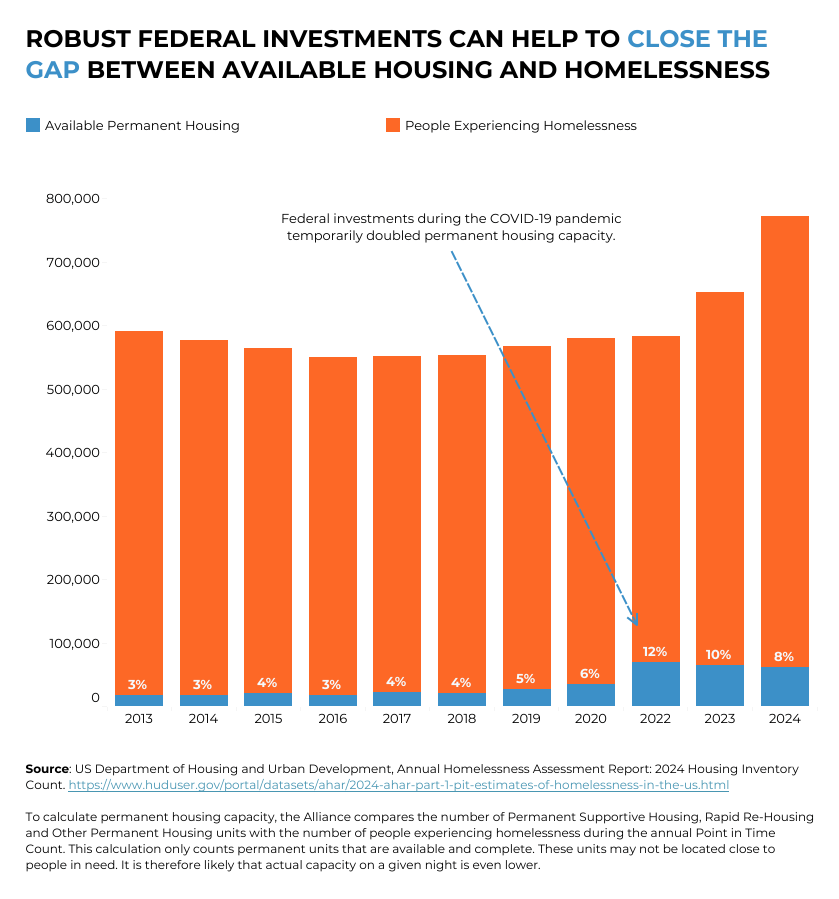
On a federal level, the gap between supply and demand for housing for the homeless was already skyrocketing before the Trump administration took office (graphed above) but exploded in the past year, thanks to a combination of funding rescissions and deep staffing cuts in departments serving the poor and unhoused. That notably includes the departments of Housing and Urban Development (HUD) and of Health and Human Services, which just in the past couple of days have been whacked with further unprecedented layoffs, shredding what little remains of an already tattered social safety net. If there’s any doubt about the local implications of all this, see the Blue Ridge Area Food Bank and its increasingly alarmed appeals for community support.

But there’s also a deeper, more profound shift in housing policy underway that will have the perverse effect of pouring gasoline on the fire. That shift dates back to a July executive order, issued by Donald Trump under the provocative title “Ending Crime and Disorder on America’s Streets,” that ends support for the “Housing First” approach to a growing unsheltered population. While Housing First advocates contend (often with references to Maslow’s hierarchy of needs) that people’s basic needs for food, warmth and shelter must be met before they can effectively address addictions, psychological ills or lack of job training, the executive order claims Housing First policies “deprioritize accountability” and fail to “promote treatment, recovery and self-sufficiency.” The better approach, according to the executive order, is to slash funding for such assistance while instituting sobriety requirements for people living in federally funded housing. Can’t stay straight? It’s back on the street with you, where the physical struggle for survival will take all your energy.

Meanwhile, the current trend toward criminalizing homelessness only adds to the problem. A U.S. Supreme Court decision last year empowered municipal officials to fine, ticket, displace or arrest people sleeping in public spaces, and more than 200 localities around the country have since criminalized homelessness. But other jurisdictions—including Staunton, Waynesboro and Augusta County—already had similar laws on their books. And while our local law enforcement agencies thus far have taken a restrained approach to people camping on public property, acting mostly in response to complaints by directing the offenders to move elsewhere, that could change with any pronounced shift in the political climate.

Homeless people who get jailed for failing to have a sanctioned place to sleep become, ironically, ineligible for certain housing programs. No surprise, then, that once they’ve been incarcerated for not having shelter, many end up in a cycle that perpetuates their homelessness. More than 50,000 people who are released from prison or jail each year go straight into homeless shelters and then into the streets, according to the National Alliance to End Homelessness, which reports that formerly incarcerated people are ten times more likely to become homeless than the general public due to a lack of financial and social support.

What little support for the homeless that still exists is being chopped away almost on a weekly basis. As reported by Politico a couple of weeks ago, the Trump administration is looking to move as much as two-thirds of HUD’s funds designated for permanent housing projects to transitional housing assistance “with some work or service requirements.” Those who can’t meet the requirements—such as a mother with young children, or someone who’s disabled—may end up on the street again, but as explained by a HUD spokesperson, “HUD is no longer in the business of permanently funding homelessness without measuring program success at promoting recovery and self-sufficiency.” That’s consistent with the administration’s overall “suck-it-up-buttercup” approach to social services but does nothing to address root causes, leaving it up to overwhelmed and unfunded local agencies to deal with the fallout.

Some of these issues may be addressed Monday evening at Kate Collins Middle School in Waynesboro, when Building Bridges for the Greater Good will host a forum on teenage homelessness. That’s because homeless teens are supposed to be served by the McKinney-Vento Homeless Assistance Act, which created the Continuum of Care (CoC) program that Politico reports is under attack—indeed, as Politico also noted, Trump’s budget for the next fiscal year proposes cutting all CoC funding. Loss of those funds will mean dozens of students in the SAW region who currently receive emergency housing, transportation and other necessities of life, including food, clothing and personal care supplies, will be at risk of losing their ability to stay in school.

CoC funding also assists 22 households in a program of permanent supportive housing administered by the Valley Community Services Board (VCSB), but their future is equally uncertain. The current funding runs out in December, and while a larger successor grant has been approved, there’s no certainty that money will be released. “If the Politico article is correct, this program would certainly be in jeopardy, but I am not sure what calendar year we will actually feel the impact,” said Lydia Campbell, assistant director of community services at VCSB. “It’s terrible that our community members with the most significant barriers to housing that are finally in their own places could be at risk.”

In the face of this onslaught, local efforts to cope with homelessness and a severe shortage of affordable housing have been lame, at best. That’s partly due to a lack of money, of course, but being cash-poor is insufficient excuse for a city that spends big bucks on a new pool house, golf carts and 50-gallon trash cans for everyone—all welcomed expenditures contributing to Staunton’s quality of life, but at the cost of letting internal sores fester. With only so many tax dollars to go around, expenditures in one area mean belt-tightening in another. In the end, it all comes down to the choices we’re willing to make—or ignore.

Take, for example, the request to city council by Alec Gunn, director of the Waynesboro Area Refuge Ministries (WARM), for financial support for a day center for the homeless at First Presbyterian Church. As initially conceived, this would have been a warm day-refuge in the winter and a cool one in summer for an unsheltered population that otherwise resorts to camping out in the library or in fast food restaurants to escape the weather. Talk of the city providing some modest start-up money for such an effort, perhaps $30,000, has been kicking around since the start of the year, with little to show for it and with ambitions for the day center’s scope of services diminishing with each passing month. More recently, rumblings of resistance from the church’s neighbors have been heard, and Gunn did himself no favors with the skimpy “budget” he presented to city council in early September—but neither has anyone on city council stepped up to press for a resolution. And so. . . still no day center.

As much—or little—can be said of the city’s pursuit of affordable housing, a critical component of any serious effort to eliminate homelessness. A key to this somnolent exercise has been creation of a housing commission that could “provide expertise and guidance regarding the amount and quality of affordable and workforce housing in the City,” an initiative first proposed by Councilor Brad Arrowood in March. That’s March of 2023. This past Thursday the city council finally received a resolution to do just that—but it won’t actually vote on the measure until an unspecified “later date.”

Not that there’s anything to be lost in this slow-walk to another grouping of chin strokers. Six of the proposed nine commission members are to be drawn from the ranks of the housing strategy working group that labored for a whole eight hours spread over 12 months to produce the city’s “housing strategy.” That group served mainly as a sounding board for city planners to present their ideas, and for the most part it resonated in tune; this was not a group brimming with ideas. The new commission will likewise meet only four times a year and, under the influence of its carry-over members, presumably will serve a similar role, with similarly minimal results. If there is to be any hope for the housing commission to provide meaningful input, it will have to come from the three non-working group members, ideally including representatives from the building and development sector and at least one person who has been homeless.

But first, of course, there actually has to be a city council vote to ratify the resolution. Assuming it does so in the next few weeks, and that the housing commission holds its first meeting in January, that will mark nearly three years since Arrowood’s initial proposal.

All this foot-dragging might be tolerable in a slower age, but that’s not where we are today. Instead, we’re hurtling toward a precipice with preternatural speed, the economy teetering toward recession, our political machinery seized up and normal middle-class people growing angry, suspicious and resentful under the weight of a disintegrating social order. How else to explain recent events in Waynesboro, where local residents circulated a letter deploring “the homeless problem” and criticizing St. John’s Episcopal Church for allowing a man to sleep in its bushes and a homeless couple to stay on an empty church lot. The letter expressed concern that mental illness, drug addiction and increased crime rates would put the neighborhood at risk, albeit without linking any of those problems to the three specific people prompting the writers’ angst.

Not all local residents shared that view, and in a couple of meetings pushed back vigorously against such stereotyping. But as the homelessness problem deepens and more people are forced to live in their cars and on the streets, similarly charitable responses may become more strained. We’re in a race against time that community leaders have not yet recognized, for money, effort, planning and initiative, and it would be reassuring to get even a whiff of urgency over what needs to be done.

Winter is coming

(Reading time: 4 minutes)

In another sign that the universe has a dark sense of humor, the Valley Homeless Connection announced last week the results of its annual Point in Time (PIT) survey of the local homeless population. That was on Tuesday. Three days later, the Trumpian chainsaw approach to government slashed funding to an additional half-a-dozen federal agencies, including the U.S. Interagency Council on Homelessness. The council, Trump said, was “unnecessary.”

As government agency budgets go, this won’t save more than pocket change: $3.6 million a year. But as far as meeting a social need, the cut eliminates the only federal agency charged with implementing “the federal strategic plan to prevent and end homelessness.” And yes, there actually is such a plan, adopted Dec. 19, 2022, one that sought to reduce homelessness by 25% by this year. That it has failed to do so is as much a statement about the size of the problem as it is about the government’s effectiveness in addressing systemic issues without adequate funding or political buy-in.

The local PIT count underscores the point. The annual snapshot of how many people are sleeping in homeless shelters and on the streets, in one capacity or another—tents, cars, cardboard boxes—found little change from a year ago, when the 2024 PIT found 157 homeless people in the SAW region of Staunton, Augusta and Waynesboro. This year’s survey, conducted on one of the coldest nights in many years—the temperature in Waynesboro dropped from a high of 22 to just 4 degrees—counted 146 homeless adults in the SAW region (another 10 were counted in Lexington and Rockbridge County). Nine of the adults also had custody of 16 children younger than 18, adding to the total.

The good news is that a greater percentage of the PIT-counted people this year were in emergency shelters, with 82 staying at the Valley Mission, 40 in the overnight shelter operated by WARM, and five staying at the New Directions Center, a shelter for survivors of domestic violence. All the children were sheltered, as well, and two people in the SAW region were put up in motel rooms paid by social agencies. That left just 17 people in the SAW region toughing it out in the cold, compared with last year’s 30 or more. Then again, as observed by Lydia Campbell of the Valley Homeless Connection, the severe weather may have forced any number of homeless people into other alternatives, such as couch-surfing with family or friends. And as always, there’s the question of how many unsheltered people were simply missed in the count, with the extreme cold forcing people to burrow in more tightly wherever they were.

Among the PIT findings that Campbell highlighted was an increase from 51 in 2024 to 71 in 2025 of people who reported they were homeless for the first time. “That is a wild thing,” Campbell said, reflected in such vignettes as the woman who sleeps in a car parked outside her husband’s Verona workplace while he works inside. Indeed, the PIT found “lots” of people sleeping in their cars in the Sheetz and Walmart parking lots, as well as at Cracker Barrel, Martin’s and Lowe’s. Meanwhile, as the number of newly homeless people suggests, the pipeline is filling up faster than it can empty out: the national plan to end homelessness reports that on average, 908,530 people became homeless each year between 2017 and 2020, while 900,895 exited homelessness each of those years.  That’s a remarkable turnaround from the period of 2010-2017, when national homelessness declined 14%.

Meanwhile, meeting the national plan’s goal of a 25% reduction in homelessness would require that this year’s PIT count not exceed 437,000, down from the 582,462 counted in the 2022 PIT census. The trend, alas, has been precisely in the opposite direction, topping out at 770,000 in 2024—and if the local numbers are any indication, the national 2025 PIT results are unlikely to have improved.  But because it takes many months to compile all the national data, just how much worse things have become nationally won’t be known until late this year.

Locally, the outlook is grim. The advent of spring inevitably pushes away concerns about people freezing to death, and the leafing out of the landscape tends to obscure homeless encampments: out of sight, out of mind.  The slash-and-burn practices that are hollowing out—if not completely eliminating—social service budgets and agencies are still to be fully felt locally, but Campbell says Housing and Urban Development funding for permanent housing is already drying up, and an array of services to help people cope with joblessness, substance abuse and poor health is evaporating. Even those who don’t lose sight of the problem can feel hamstrung and helpless to respond in any meaningful way.

Yet as often intoned in Game of Thrones, “Winter is coming.” Even now, on the verge of the spring equinox. What then?