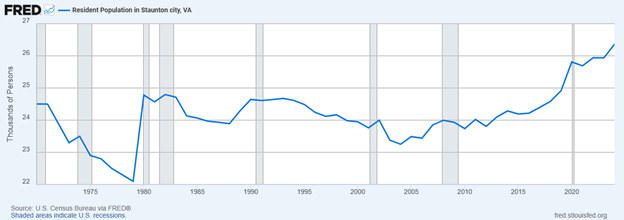
This is what stagnation looks like

(Reading time: 3 minutes)

To understand how Staunton got caught with its pants down when it comes to having an adequate supply of affordable housing, it’s helpful to look at how the city’s population has fluctuated over the years. The graph above, prepared by the Federal Reserve Bank of St. Louis, is eye-opening: from 1980 through 2024, the city’s population grew an average of 0.15% per year. Put another way, over a span of nearly half a century, Staunton’s population increased by just 6.4%.

Nothing in the world grows that slowly. Not tree trunks. Not snail shells. To put things in perspective, Virginia quadrupled its population over the same period, from 2 million to 8.81 million. The U.S. population grew by 50%.

But the reality is even more extreme than that, because as a cursory look at the chart illustrates, all of the city’s population growth has come in the past five years. After the slightest bump in 1982, to 24,796 residents, Staunton’s population began a jagged decline that didn’t regain its previous heights until 2019, when it reached 24,916. That stagnation, it’s further worth noting, occurred despite the city more than doubling in area in 1986, when it annexed 11.1 square miles from the county. By 1987, a mere year later, the city’s headcount had slipped again, to 23,933—even as it was now on the hook for providing city services to a much wider area.

So: lower population density, but more roads, water and sewer lines to build and maintain.

A key significance of these dates is that Staunton’s Comprehensive Plan, which currently is being updated and revised, was most recently adopted in July of 2019—in other words, just as population growth in the city was beginning to take off. A 20-year roadmap for how the city should grow, the Comprehensive Plan views  “effective planning” as a “dynamic process” that apparently doesn’t apply to housing, because why make plans for something that isn’t dynamic? Not only was there no population pressure for more housing, but as the plan blithely asserts, “Housing is primarily a private system that is influenced by factors beyond those controlled by local government.”

So: no planning for zoning, taxation, transportation or other infrastructure changes that might promote more housing construction. Leave that to the market to sort out.

The predictable result, however, was that the stagnation in Staunton’s population growth has been pretty much matched by stagnation in new housing, even as the city’s existing housing stock continues aging. (Indeed, 43% of all housing in Staunton was built prior to 1960.) Here’s how much housing grew over the past 35 years:

Note that this is how many units of new housing of all sizes, from single-family homes to duplexes and townhomes, were permitted in the city. Despite a five-year surge in the early 2000s, presumably driven by the larger U.S. real estate bubble that ended in a recession, all but two years saw only a few dozen permits issued annually. The 35-year total was 2,790 permits—of which more than a third were issued roughly 20 years ago.

Small wonder, then, that Staunton has an inadequate housing supply, especially at the low end. And while the city has gained several new apartment buildings over the past couple of years, roughly 30% of city residents will find them unaffordable at their income levels.

Monday morning quarterbacking always sees things with greater clarity than is possible in the moment, so it’s a cheap shot to now conclude that the 2018-2040 Comprehensive Plan should have anticipated a sharp break in a decades-long trend and come up with proactive policy changes. But the Comprehensive Plan review now underway won’t be able to make that same claim, nor will a laissez-faire dismissal of the city’s role suffice to sidestep housing issues. We’ll see this spring just how much the revised plan learns from its earlier oversights and substantively addresses its shortcomings.

Homelessness as a kick in the pants

(Reading time: 13 minutes)

The calendar may insist that winter won’t arrive for another six weeks or so, but anyone who ventured outside Tuesday morning knew otherwise—not when the temperature hit a bone-chilling 24 degrees Fahrenheit.  Tuesday was a good day, in other words, to be bundled up in a cozy bed or snuggled with a good book under a comforter in an easy chair. If you were that lucky.

It’s ironic, then, that just 12 hours earlier the city had held the third of three public workshops addressing proposed revisions to its comprehensive plan. Dozens of goals and draft strategies were outlined on multiple easels for Staunton residents to ponder and evaluate, spanning everything from land use, housing and economic development to transportation, public infrastructure and education. A section on health and human services stressed “active living, healthy food access and a clean environment.” Public safety, environmental resources, art and recreation all received due consideration.

But nowhere in all this planning and verbiage was there any mention of Staunton’s homeless population, or its needs and how those needs might be met. True, the section on housing gave a vague nod to promoting “affordable housing options for people of all incomes, needs and abilities,” but it remained silent regarding those unable to take advantage of such promotions. Nor did the draft comprehensive plan set a goal of eliminating homelessness by any particular date, and at no point did it acknowledge, much less prescribe, the kinds of services a homeless population requires. As far as the comprehensive plan is concerned, Staunton residents without permanent shelter simply don’t exist.

Winter’s advent will make that fiction harder to maintain.

Let’s take stock. A long-promised day shelter, offering homeless people refuge from extreme weather, remains as elusive as ever, in part because of a crumbling commitment by First Presbyterian Church to allow the use of its premises, but also because of a lack of financial and leadership backing from city council. Meanwhile, the Waynesboro Area Refuge Ministry (WARM), which was to operate the day shelter and which already provides emergency overnight shelters from late November through March, just published its schedule of participating churches for the upcoming season. Two of the week-long slots remain unfilled, at an exceptionally late date in the planning cycle, and there are reports that a third also may fall vacant because one of the congregations got cold feet and is backing out. Meanwhile, eight of the 18 overflow slots, for when the primary host churches receive more than 40 people, likewise remain unclaimed.

The Valley Mission, the area’s transitional shelter for homeless people working on reentry into the workforce and established housing, has 89 residents and is at full capacity—as it has been for several years—and is as far as ever from meeting its goal of a six-month turnover. “Yes, the average length of stay has been much longer than a year,” concedes director Sue Richardson. “In fact, we had two different women who were here four years each,” which puts a whole new meaning on “transitional.”

Then there’s Valley Supportive Housing, which provides affordable housing for clients diagnosed with mental illness, intellectual disabilities or addiction—people, in other words, who otherwise would be prime candidates for living on the streets. It also is at capacity, with 68 tenants, and has a waiting list of 43—the biggest it has been in at least a decade. “Two years ago it would have been half of that,” says director Lou Siegel, who says some of those on the waiting list are at Valley Mission, some are in temporary accommodations with family members, and some are living in their cars.

Both Valley Mission and Valley Supportive Housing are in a perpetual scramble for adequate financial backing, which comes in bits and drabs from local sources such as the city’s Community Development Block Grant (CDBG), the Community Fund and the Community Action Partnership of Staunton, Augusta and Waynesboro (CAPSAW). CDBG is all federal money, while CAPSAW receives nearly half of its funding from the federal government—which means both revenue streams are threatened by the current political climate.

Meanwhile, the area’s homeless population, while always difficult to assess accurately, is almost certainly not diminishing. WARM director Alec Gunn estimated this summer that the SAW region has 250 homeless people.  And while this year’s Point in Time (PIT) count—a one-night snapshot—found fewer unsheltered homeless people than last year, bitterly cold weather the night of the census may have driven them deeper underground. Moreover, as a surprised Lydia Campbell of the Valley Homeless Connection observed, of the 157 sheltered and unsheltered people who were counted by the 2025 PIT census, 71 reported they were homeless for the first time, up from 51 in 2024.

All of which is to say, the Staunton Comprehensive Plan as it’s currently coming together has a gaping hole big enough to push a shopping cart through.

FAILING TO SEE THE CITY’S HOMELESS population means the comprehensive planners also fail to ask why the homeless exist in the first place. If you don’t see a problem, you can’t solve it.

Homelessness, with some rare exceptions, is a signal that the system itself is failing. At its most basic doh! level, homelessness results from an inadequate supply of housing that people can afford. With rental vacancies at or around 2% and housing costs far outstripping the affordability provided by median incomes, the inevitable outcome has been compared to a game of musical chairs, in which the number of available chairs is always less than the number of people circling them. When the music stops, someone always ends up on the floor.

The obvious question: why is that? Why, in a market economy, isn’t more affordable housing being built? The law of supply and demand suggests that when demand exceeds supply, market forces will step up production until the imbalance is corrected. You want to end homelessness? Simple: build more housing at a price that people can afford. So . . . why isn’t that happening in Staunton?

The Staunton Housing Strategy Group spent a year purportedly wrestling with this very issue, ultimately producing this past summer what it optimistically called “Staunton’s Pathway to Affordable Housing and Housing for Working Families.”  Yet it’s notable that of the 19 members of the workgroup, only one, Stu Armstrong, could be categorized as a builder or developer—that is, as someone from the supply side of the supply-demand equation. And Armstrong, as it turned out, didn’t attend a single one of the group’s four meetings.

What that left was an assortment of political leaders, planners and heads of non-profit social agencies holding a one-sided conversation about how best to plug the city’s housing deficits. The result was a set of 11 strategies that, while not entirely without merit, only tangentially address the critical question of how to increase the city’s stock of affordable housing, and do so on a less than urgent timetable. For example, completion of a “strategy” to allow accessory dwelling units (ADUs) in the city is expected to take 18 months, a process that won’t add any new homes but will create the possibility of some down the road.

Foot-dragging over ADUs, which have been given the go-ahead in many municipalities in Virginia and other states, is emblematic of a more fundamental problem that the housing strategy group didn’t address: the city’s zoning code. The main reason Staunton doesn’t have tiny homes or converted garages that can provide additional housing on established home lots is that its rules don’t allow it. Allowing ADUs therefore requires yet another amendment to the zoning code—the default response to every fresh demand for land use, such as creating exceptions to minimum lot size in Uniontown. And just like computer operating systems that over many years become an unwieldy morass of work-arounds, patches and buggy over-writes, zoning codes tend toward increased complexity with every change. What the city’s “pathway to affordable housing” proposes is more tinkering with the underlying code. What the city needs is a new operating system.

It’s not just ADUs that are at issue. Ask developers—as the housing strategy group did not—why they’re not building more affordable homes in Staunton, and the answer you’ll get is a) that the permitting process is too onerous, and b) that they can’t afford to do so. Answer b) to some extent is a consequence of a), because it costs money and time (which is money) to comply with zoning and permitting regulations. But the bigger reason is the zoning itself, which not only limits how a specific piece of land can be used, but which arbitrarily dictates so many other construction variables that the only homes that pencil-out for a builder are expensive ones.

Zoning codes, as the name suggests, create “zones”—a zone for housing, a zone for shopping, a zone for manufacturing, and so on. That made sense when used to keep foundries or slaughterhouses away from residential areas, but it also created artificial divides that segregated functions—stores, homes, offices, apartment buildings, schools, cultural centers—that were all mixed together before zoning codes were created. That mixture, still found and now treasured in downtown Staunton, created a lively, walkable and rich urban environment. The imposition of zones, on the other hand, created land-use monocultures—predominantly large areas of all homes, but also of all mercantile and other activities, as in shopping centers and office parks—that then necessitated a car culture for most people to get to work, do their shopping and go to church or school.

It should be noted that there is nothing intuitively logical about a zoning code’s specific requirements. Staunton’s R-1 residential zoning, for example, is distinguished from R-2 zoning primarily by its minimum lot size, of 15,000 square feet versus 8,750 square feet. But the R-1 lot also must have a minimum lot width of 75 feet at the front and any home built on it must have a minimum 30-foot front set-back, a rear yard at least 35 feet deep and maximum lot coverage of 30%. The same requirements for R-2 homes, meanwhile, are a 70-foot minimum lot width, a 25-foot front setback, a rear yard at least 30 feet deep and maximum lot coverage of, yes, 30%. Why? Why a 25-foot setback for one but a 30-foot setback for the other, or a lot width of at least 70 feet for R-2 but an extra five feet for R-1? What compelling urban mathematics produced these arbitrary requirements?

For builders and developers looking at a lot of 45,000 square feet (just a bit over an acre) zoned R-1, the maximum they can build is three homes. They can’t build cottage courts, fourplexes, townhomes or any number of other configurations increasingly known as “missing middle” housing—housing more dense than single-family homes but smaller than apartment buildings. Instead of 10 or 12 homes they can build just three, so those three are going to be built at a level where they can fetch top dollar, not at a density that would allow at least some affordable homes to be part of the mix.  And in Staunton, the great majority of land is zoned R-1 or R-2, leaving scant room for more modest dwellings.

Zoning’s arbitrary guidelines do preserve a uniformity of appearance that appeals to some people, but which others find stultifying—or as summarized by city planning critic Jane Jacobs, more like taxidermy. Yet their very persistence creates an aura of inevitability, as if the only (unthinkable) alternative is anarchy. And so, even as local feedback to Staunton’s comprehensive plan repeatedly stresses walkability, community, and an integration of work, play and housing, the main obstacle to realizing that vision has gone largely untouched. Despite a proposal to reduce the total number of zoning sub-categories, the comprehensive plan promises to preserve the overall zoning approach. The builders’ dilemma will go unaddressed.

WITHOUT A SERIOUS EVALUATION of how zoning got us into the housing crunch we’re now struggling to overcome, there seems little hope for improvement.

Defenders of the status quo will point to the equivalent of a techie’s work-arounds and system upgrades, including district overlays, special use permits and other ways to game the system while leaving the underlying code untouched. But there’s a reason DOS-based systems have been left behind, not least because they became too expensive to maintain in terms of talent and manpower.

Nor does junking zoning codes mean descending into anarchy. Just as DOS-based systems were replaced by GUI ones—the graphical user interfaces we use without a second thought because they’re so intuitive and user-friendly—so traditional zoning codes are giving way elsewhere to form-based zoning. Traditional zoning codes are a top-down approach that segregates land uses. Form-based zoning is less concerned with regulating land use and instead prioritizes the physical form, scale and character of buildings and public spaces.  Because form-based zoning is a bottom-up approach that regulates how buildings interact with the street and with each other but not what use they’re put to, they tend to encourage infill and the development of walkable, mixed-use neighborhoods and high-quality public spaces.

That doesn’t mean truly disruptive or dangerous industries or businesses can’t be relegated to specific buffered areas, but the landscape is otherwise opened up to a free market constrained primarily by the same kind of rules that apply to coloring books: use whatever color you want but stay within the lines. Observe the regulations we’ve adopted about building height, scale, massing and relationship to the street, but otherwise put your land to the most productive use you can envision.

That may sound radical at first blush, but it is in fact what occurred in what are now the most treasured parts of Staunton—before the zoning code was adopted. It’s also what a growing number of municipalities around the country are adopting, from Mesa, Arizona to Cincinnati, Ohio to parts of Gaithersburg, Maryland. Form-based zoning deserves, at the very least, a serious examination and consideration by those who are revising a comprehensive plan for Staunton that has a 20-year outlook.

Here’s the bottom line: developers aren’t building affordable housing because our zoning code makes it prohibitively expensive to do so. The real-world consequences of sticking with that creaky form of land-use regulation are, quite predictably, more people without homes. And because as a society we apparently have neither the money nor the political will to minister to those people’s most basic needs, every homeless person we see on the streets, huddled in doorways, or sleeping in uninsulated tents or cars, should be a reminder that we’re not addressing root causes of a social disease.

The Staunton Housing Strategy Group failed to do so. The comprehensive plan’s designers are likewise missing the mark. Who’s left?

Seeking your thoughts—kinda

(Reading time: 7 minutes)

It’s a fair guess that most Stauntonians have never heard of the city’s comprehensive plan, much less seen it, and that’s not really surprising. The 450-page document states quite explicitly on its cover page that it was prepared for the Staunton Planning Commission, which makes it sound more arcane than it is. The current version is five years old, so a whole lot of water has gone under the bridge—quite literally, in the case of downtown—since it was drafted. And all the people who you might expect would be most involved in its implementation are no longer there: every city council member, the city manager and the city’s director of community development have moved on since the plan was completed.

Then again, much of Staunton’s Comprehensive Plan actually doesn’t, well . . . plan anything, so it’s easy to ignore. While the Commonwealth of Virginia requires every municipality to prepare such plans “with the purpose of guiding and accomplishing a coordinated, adjusted and harmonious development of the territory,” the Commonwealth Code also states that that the plan should be a survey of that municipality’s assets and challenges—and that’s the basket in which Staunton placed most of its eggs. The result is more descriptive than prescriptive, an inventory of the Staunton that existed in 2018 but with few attempts at guidance for the near future, never mind to the plan’s supposed end date of 2040.

But now we have a chance for a do-over. Starting last year, city staff, consultants and a small group of Staunton residents have been revising the plan to make it more up-to-date and, we can hope, make it more of a planning tool than it has been. That process has included seeking input from Stauntonians as to what they think should be in the plan, through online surveys and a series of public meetings, and the next such meeting—an open house at Staunton High School—is less than a month off. Anyone concerned about the city’s future should make an effort to be there: Wednesday, June 25, between 5:30 and 7 p.m.

That said, I wouldn’t be my usual curmudgeonly self if I didn’t add a cautionary note. Despite the city’s apparently diligent attempts to solicit public opinion about various plans, these efforts often have an unfortunately performative aspect to them. The ritual involves lots of easels covered with large white sheets of paper, lots of small stick-on dots in various colors, and an abundance of post-its of obviously limited size on which to scribble fresh ideas. Those in attendance are asked to respond to various questions about whatever the city thinks should be of greatest concern to them, and the answers are subsequently collated, summarized, mentioned in final plan documents—and, generally, thereafter ignored.

Does that sound harsh? Consider, then, the West End Revitalization Plan, completed last summer and subsequently adopted by the city council. That plan also went through a pro forma attempt to get input from West End residents, including public meetings and an online survey. The meetings made it abundantly clear that public “concerns about property upkeep and affordable housing” were among the area’s most notable “challenges.” The online survey disclosed that of eight possible concerns, West End respondents thought that “improved upkeep of existing housing” was the second most “important” or “very important,” just four votes behind the 194 cast for “adding new shops, stores and services.”

How seriously were those views taken? The final, adopted plan is big on retail improvements but scarcely gives a nod to housing concerns. Indeed, only one of 17 proposed actions in the plan directly addresses housing rehabilitation, and does so in the most dismissive way possible by suggesting simply that the city “connect residents to existing resources.” Which is to say, the West End doesn’t have a problem with property upkeep and affordable housing, it has a communication problem.

It therefore will be interesting to see to what extent public input registers in this far broader, city-wide planning document. One possible marker was provided by the Jan. 22 open house, the first of three, when 106 local residents registered their attendance (although city officials believe the actual number attending was higher) and repeatedly voiced support for mixed-use development. Attendees emphasized “the need for mixed-use areas that integrate homes, shops, and parks to create vibrant neighborhoods,” according to a summary of comments under “land use.”  Similarly, in a summary under “economic resources & development,” attendees “highlighted the need for increased mixed-use development and support for small businesses in less densely populated areas.”

The summarized comments about housing, meanwhile, illustrate an increasingly sophisticated understanding of what it takes to create a truly dynamic community. Attendees “highlighted the need for affordable housing for their workforce, concerns about rising prices, the lack of options for low-income and middle-income households, and . . . a pressing need for better connectivity between residential areas [and] increased density of housing.”

The emphasis on mixed-use developments and increased housing density, in a city largely mired in a century-old land-use philosophy known as Euclidean zoning, is in some ways revolutionary. Euclidean zoning (the name comes from a village in Ohio, not the Greek mathematician) separates land uses by type—residential, commercial, retail, industrial, etc.—each into their own zones or areas. That may be desirable in preventing a factory or a slaughterhouse from being plopped down next to a church or apartment complex, but it also creates the largely fragmented land-use pattern we have today, with the notable exception of downtown. Add to that a residential zoning preference for detached single-family homes, with broad swaths of the city’s 20 square miles zoned R-1 (maximum of three homes per acre) and R-2 (maximum of five), and the result is a pleasantly bland, dispersed suburban landscape on which builders can’t afford to build homes for low- and middle-income families.

One possible work-around for developers is to seek special use permits so they can build the mixed-use and denser housing that city residents attending these sessions say we need—but for several presumably obvious reasons, that’s not an attractive option. Nor is it happening in any meaningful way. The alternative, therefore, is for those working on the comprehensive plan update to rework the city’s zoning code—to revise the rules and maps that keep things the way they are—so that standards for higher density and mixed-use developments are written into the code, creating “by right” options for developers. No more having to say “Mother, may I please?”

Whether that in fact will happen is . . . let’s just say not likely. One problem with these sounding-board sessions with the public is that they come at a time when the plan revisions are already well underway, so there’s a natural resistance to taking on big new projects—and rewriting zoning ordinances is just about as big as they come. Then there’s the problem of public backlash. Although the Stauntonians attending these open houses may be largely in favor of such changes, they also tend to be more actively engaged in civic affairs than the majority of the population—and a lot of those folks would be aghast at the idea that there could be a wholesale reordering of the land-use landscape ( just one of the problems facing developers seeking special use permits). Winning them over, or at least muting their resistance, would take time, public education and reassurance.

So I’m not optimistic that these open houses and other attempts to solicit public input will make any meaningful difference. The ship’s course is fairly well set, and any comments that might adjust its bearings are no more likely to change the outcome than occurred with the West End Revitalization Plan. But still. The arguments are worth making, if only to lay one more brick against the day when they finally will make a difference.

Throw a party but ignore the guests?

(Reading time: 9 minutes. Written to the city council.)

Imagine you’re planning a lavish themed gala. You obsess over every detail. The driveway, decorated with torches and flower stands, valets dressed in period attire. The dining hall, with its linens, centerpieces and place settings specified to the smallest escargot fork. A small dance orchestra inside, complemented by a string quartet on the outdoor patio.  An elaborate menu of multiple servings of hot and cold entrees and side dishes, preceded by consommé and followed by flambéed desserts.

Everything neatly planned—everything, that is, except for the actual guest list.

That’s pretty much what you’ll be considering at tomorrow’s city council meeting, when you’ll be asked to lay the groundwork for amending the city’s Comprehensive Plan 2018-2040 by incorporating the West End Revitalization Strategies Plan as an addendum. A favorable vote will allow scheduling of a public hearing, to be followed by a council vote Dec. 12 to make it all official.

I have two thoughts about this that I hope you’ll consider.

First, the process of updating the Comprehensive Plan has just started. Assuming this is a goodwill effort to rework a flawed document, as briefly outlined in the white paper I submitted to you last week, it would seem that the comprehensive plan’s committee should get first crack at this revitalization plan as part of its overall mandate. As it is, the council is building an addition to a dwelling even as it’s being renovated, which is putting the cart before the horse (pardon the mixed metaphor).

 But the greater concern I have is more substantive than procedural. The West End Revitalization Strategies Plan, while more comprehensive and detailed than most city planning efforts, falls woefully short in addressing the needs of those whose most pressing needs made the plan necessary in the first place: the people who live in the West End. It’s as though the consultants who prepared the plan, EPR, had planned a banquet down to the smallest detail but had inexplicably forgotten to devise a guest list. Who’s coming? What food preferences or allergies do they have? Who shouldn’t be seated next to whom? Will any of the guests have disabilities that must be accommodated?

Yes, there is a brief nod to the area’s demographics: older, poorer, with a higher proportion of non-white residents than is true in the rest of Staunton. And there’s an equally succinct summary of the homes these residents inhabit—homes that on average are valued at less than two-thirds the overall median for the city overall. (A median, statistics buffs will note, that would be even higher were it not dragged down by this millstone.) But throughout the document, the implications of this soft (to use a kind word) housing stock are ignored. At best, the West End is glibly dismissed as having “more affordable housing than the city,” implying that there’s lemonade to be made from these lemons but without any attempt to ascertain how many of those lemons are long past their sell-by day.

Sometimes “affordable” just means crap.

But how could it have been otherwise? The West End Revitalization Strategies plan, like most such efforts, built on what came before. And as I’ve already established, housing historically has not been viewed by Staunton and its planners as a proper city concern. Consider the many plans that EPR consulted in formulating its conclusions: the Cole Avenue stream restoration plan, the intersection improvement study, the long-range transportation plan, a brownfields assessment, the greenway plan, the Gypsy Hill stream restoration plan, the bicycle and pedestrian plan, a city flood analysis, the Comprehensive Plan itself—what’s the common thread here? Not one of these plans or studies examined the condition and distribution of the city’s housing stock, or where it might benefit from timely city intervention.

Small wonder, then, that the revitalization study’s “vision” is as blind to housing issues as those other documents, the statement focusing almost exclusively on multimodal transportation needs, local shops and commercial corridors, and the condition of streets and sidewalks. These concerns are propelled by a “local narrative that the West End feels ‘run down,’” a theme that “was persistent during the engagement process” and therefore a driver of “this planning effort to revitalize the area.”

It’s not that the feedback EPR solicited didn’t include housing concerns. Time and again the plan refers to the “persistent” demand for help with housing. “Throughout the engagement process, community members expressed concern about vacant or unmaintained properties and believed they were reducing the West End’s appeal,” the report summarizes at one point, adding, “those participating in the meetings expressed concern for absentee landlords and renters’ rights violation.” Similarly, the study elsewhere notes community “concerns about the expense of renovating their homes and the appearance of homes in their neighborhoods.”

Yet when the study states that the community “requested additional housing rehabilitation resources,” city staff “noted several programs already exist.” Nothing to see here!

Ironically, that last quote is followed a page later by this observation: “The city currently does not have a program that helps homeowners and landowners improve their properties’ sustainability, health and affordability.” That apparent contradiction presumably may be attributed to the plethora of non-profit and charitable groups—some of which, to be fair, receive some funding from the city—that form the basis of the plan’s only “action” item under “Support Home Renovations”: “Connect Residents to Existing Resources.”  (Having a heart attack? Here’s a list of local health providers, but you’ll have to figure out which ones may actually be able to help you. Podiatrists? Not so much.)

Are those existing resources adequate for the job of improving housing “sustainability, health and affordability?”  The plan doesn’t say, because it doesn’t evaluate either the size of the job or the finances, manpower and management skills needed by those numerous agencies. Nor does it suggest how best to coordinate those disparate efforts, to minimize duplication and leverage what resources are available in the most efficient manner, beyond speculating that the Booker T. Washington Community Center “could” help local residents “access various local, state and federal programs and services for housing needs.” But however and whenever that might work out, the strategy plan makes it clear that the city sees no reason to get more involved than it already is.

This kind of “you got into this mess, now you figure out how to get out of it” approach is not, of course, what EPR outlines in the rest of the plan. The section on creating a “vibrant commercial center” prescribes three action plans, all involving the city’s direct involvement, while its advice to “raise awareness of existing programs”—the only “action” item under home renovations—is in this more favored subject area relegated to a secondary, “other action” mention. Meanwhile, the section on health and safety connections has five action items, four which require city funding; and the section on green neighborhoods likewise has five action items, at least three of which require city funding. One has to assume that the creativity well had run dry by the time EPR reached the end of its problem categories.

It should go without saying that if the driving force behind this study is “a local narrative that the West End feels ‘run down,’” then that perception must apply just as readily to housing as to commercial and public properties. Fixing up storefronts and painting some murals won’t be sufficient to turn the eye away from overgrown vacant lots, houses with peeling roofs and crumbling porches or rusted-out vehicles sitting in unkempt front yards. (The phrase “lipstick on a pig” would come to mind, were it not so overused.) As long as the revitalization study overlooks this significant area of concern, its job is only half-done and the study should be returned to EPR to finish its work. The gala banquet has been fully prepped, but where, oh where, are the guests?

Which brings me to my final point. You would never know, from reading this revitalization study, that part of the reason why the West End may feel run-down is the small but readily visible number of homeless people on its streets. You would never know, from the study, that there is a homeless encampment behind the Food Lion. You would never know that the area has several social agencies targeting the homeless and the near-homeless, including the Valley Mission and the Salvation Army. You wouldn’t know that the West End is where much of the city’s subsidized and public housing is located. You have, right there, a reverse description of the slippery slope on which people living in homes they can no longer afford may find themselves, sliding through Section 8 rental units (if they’re lucky) to a homeless shelter and then onto the streets. All within a “revitalized” West End.

The homeless also have needs, and meeting those needs would go some way toward shedding some of the area’s “run-down” appearance. For example, the need for more shelter space similar to the Mission’s temporary housing is obvious, but there’s also a need for overnight warm shelters and for “cold shelters,” where homeless people can go during winter days. Without that, they end up congregating anywhere they can find some warmth—riding Brite buses, hanging out in fast-food restaurants, the library, the YMCA or the community center in Verona—undoubtedly discomfiting the “regular” patrons of those establishments or services. Moreover, as summers get hotter, there will be a growing need for cooling shelters, not just for the homeless but for the many poverty-level residents of the West End without air conditioning.

The West End Revitalization Strategies Plan has many admirable and even exciting proposals, but it suffers from the same blind spots that afflict other city planning documents. Central to all of them has been Staunton’s distorted embrace of government’s role in the private sector, in which it is all for providing tax incentives, zoning concessions, planning services, and recruitment and outreach to commercial interests, but becomes myopic when turning its gaze on the working poor and the impoverished, who together make up a majority of the West End population.

Quite simply, more is needed. This plan should be returned as incomplete, and while it’s being reworked, maybe updating of the Comprehensive Plan can proceed in relative peace.

The white paper that kicked it off

(Reading time: 31 minutes)

“A slow sort of country!” said the Queen. “Now here, you see, it takes all the running you can do to keep in the same place. If you want to get somewhere else, you must run at least twice as fast as that!”—from Alice in Wonderland

AFFORDABLE HOUSING for Staunton, it might seem, is having its moment in the sun.

At least two of the current candidates for Staunton City Council have made the subject a central part of their campaign platforms. A 20-member working group has been appointed to develop a housing strategy for Staunton and, possibly, a housing commission. City leaders are exploring the ramifications of creating a community land trust as an innovative approach to building affordable housing. Two housing “summits” for the Staunton-Augusta-Waynesboro (SAW) area, last October and again in June, drew more than 170 people, attesting to a growing recognition of how serious a problem this has become. A massive housing survey of the region is being prepared by the Central Shenandoah Planning District Commission (CSPDC), holding out a promise of greater clarity about the area’s housing needs.

And all not a moment too soon.

For despite the recent activity and flurry of concern about affordable housing, the region generally and Staunton specifically have been moving in reverse for many years.  Consider, for example, that the most recent ALICE (Asset Limited, Income Constrained, Employed) report from the United Way, released this past May, found that only 54% of Staunton’s residents spend no more than 30% of their income on housing, widely considered as the benchmark for housing affordability. Significantly, the United Way also reported that this represents a decline from the 60% who were above that threshold in 2010. Indeed, the percentage of Staunton households that qualify as “the working poor”—people who are above the poverty threshold but whose housing costs are above the affordability benchmark—is at 34%, the highest it’s been in more than a decade

Let that sink in. This statistic means that fully a third of Stauntonians are working and trying to provide for themselves but can’t reliably afford to meet their basic needs; for many, one misstep—a car accident, a broken bone, a sick child—can mean ending up on the street for lack of any financial reserves to tide them over. (This cohort of 3,728 households is in addition to the 1,408 households that fall below the poverty threshold.) And, indeed, that’s exactly what’s been happening. As shared by Pastor Elaine Rose at a community forum last month titled, “Living on the Edge of Homelessness,” 55 evictions are on September’s court dockets for the SAW area, 15 of them in Staunton.

Not all those potential evictees will end up homeless, of course—but it’s almost certain that at least some will. And while there is a remarkable lack of reliable statistics about Staunton’s homeless population, one indicator of the problem’s pervasiveness can be found in the schools, which receive federal funds under a program called the McKinney-Vento Homeless Assistance Act, intended to ensure all children have equal access to public education. Dr. Ryan Barber, assistant superintendent for the Waynesboro School District, told the “edge of homelessness” forum that 100 students in his city were classified as homeless at the end of the last school year. Most were living in motel rooms or were doubled up with other family members, sometimes in violation of leasing agreements; nine were in shelters, and two apparently were living in tents or cars. Now, after just two weeks of a new school year, the homeless-child count was already up to 62, which Barber said is the fastest uptick he’s ever seen.

Comparable numbers for Staunton, meanwhile, identified 58 of the district’s 2,698 students as homeless at the end of the last school year—as are 35 currently, according to Nate Collins, executive director of student services. Like Barber, he also sees “a bit of an upswing” this early in the school year.

Homelessness, of course, is just one measure of a society’s unraveling economic fabric, indicating a hopeless endpoint for those who have been unable to navigate life’s complexities. Their failure may be due to bad luck, physical or medical infirmities, psychological demons, victimization by others or any number of other causes beyond their control. But their failure is also the most visible face of a deeper social malaise, one in which a significant but largely invisible proportion of city residents routinely must triage life’s necessities—food, medical care, rent, utilities, child-care—despite working for a living.

It’s fair to ask why, in the richest country in the world and despite all the local outpouring of concern, so many thousands of our neighbors are just one step away from destitution. It’s fair to question why Staunton’s past efforts to address these problems, as well as those of the city’s neighbors, have had so little overall effect. And it’s more than fair to wonder if the current spate of concern and planning is intrinsically any different from what’s gone before, or whether it all amounts to more of the same old meaningless platitudes and ineffectual expressions of concern.

TO UNDERSTAND how we got to where we are, it’s useful to look at where we’ve been. In Staunton’s case, that means a city that historically has dealt with social issues in a fragmented fashion, sorting problems and solutions into various silos rather than viewing them all as part of one ecosystem. And when it comes to silos, some are taller or bigger than others.

The biggest silo of them all has been “economic development,” which has few natural enemies (unlike “affordable housing,” with its undertones of class warfare and government “handouts”) but which can mean different things to different people, and often is exceedingly two-dimensional. The most glaring example of this is provided by the city council’s “Vision for 2030,” which came on the heels of the Comprehensive Plan it adopted in 2019 and which unabashedly sings the praises of “one of the most beautiful places on earth.” Indeed, as it rhapsodizes from the outset, “Staunton is blessed by a palpable sense of creative energy that animates our civic life and enriches our culture,” one “manifested in a vibrant arts scene, a future-oriented business environment, and a governance philosophy that honor’s the city’s rich historical legacy while investing in an exciting future of innovation, growth and resilience.”

That future, alas, seems entirely reliant on doing everything the city can to develop the Staunton Crossing site, support local businesses, be business friendly and attract investment to its vaguely defined “opportunity zones.” The vision’s only mention of housing, on the other hand, is the claim that Staunton “has housing affordable to a full range of households.” End of story. Subject closed—except, it turns out, when the lack of affordable housing repeatedly deters the new businesses Staunton so ardently woos. With one potential employer after another expressing concern over the lack of workforce housing, it turns out that housing and economic growth are just opposite sides of a single coin.

Meanwhile, the Comprehensive Plan meant to guide Staunton in its quest to become a shining city on the hill makes its position explicitly clear, even as it proves remarkably short on actual planning. Although the “plan” devotes 22 pages to an Economy chapter, leading with the claim that its purpose “is to set goals and to establish policies which promote economic vitality” for Staunton, the 16-page chapter on Housing contends at the outset that “[h]ousing is primarily a private system that is influenced by factors beyond those controlled by local government.” What follows is a menu of census-derived enumerations of the city’s housing units, their age and market value and number of occupants per household. About the condition of those homes or how many of them meet federal standards of “decent, safe and sanitary,” there is nothing.

As to the relationship between housing and economic development, the “comprehensive” plan’s analysis boils down to just this one shockingly obvious statement: “A community’s housing policies can have significant impact on economic development efforts. Housing costs should be consistent with prevailing wages, and low levels of housing availability can diminish the ability of local businesses to retain or expand a productive work force.” Indeed.

Another indication of the city’s blinkered priorities can be seen in its organizational chart and annual budget, which relegate housing and its attendant issues to being an appendage of the economic development department. Even the library, the city’s parks and the tourist development office get higher organizational billing. The significance of this can be seen in each year’s budget proposals, which this year included the observation, “Budgets are all about choices. Staunton’s budget process begins with the submittal of each department’s budget request in December.” That’s another way of saying that how the city determines where to spend money is inherently conservative of the status quo, its choices shaped by its existing departmental structure and its needs. Without a housing department, there is no natural constituency to advance those needs.

A different window on the city’s superficial concern for affordable housing can be seen in its application for federal housing funds through the Community Development Block Grant (CDBG) program, which may be its most comprehensive assessment of the city’s housing needs. Unfortunately, the CDBG program has three potentially disparate goals—to provide decent housing, to provide suitable living environments, and to expand economic opportunities—but it’s fair to say that the first of those generally is considered primary. Given its track record to date, however, Staunton’s use of the CDBG program for decent housing has been remarkably lax.

First alerted to the possibility of tapping into this free pot of money in 2018, but apparently concluding it didn’t have the expertise to jump through the Department of Housing and Urban Development’s (HUD) hoops, the city sought consultant help by issuing a request for proposals (RFP) on March 22, 2019. The RFP provided only a two-week window in which to respond, so perhaps it wasn’t surprising that it resulted in only one bid, from Mullin & Lonergan Associates, which is headquartered in Pennsylvania but has several Virginia contracts. What is surprising is the city council’s willingness to accept a non-competitive bid to manage more than $1.6 million on its behalf, as it readily agreed to a two-year contract that paid M&L Associates 20% of the grant money it would receive—the maximum overhead payout allowed by HUD. Two years later, Staunton and M&L further agreed to two, 2-year renewals of the same deal.

Here’s what Staunton got in exchange for paying M&L to administer its grant money:

  • For the federal fiscal year ending Sept. 30, 2020, it received $354,433 in CDBG funds, of which it expended just $97,654. Expenditures included $70,887 for “general administrative and planning,” all or almost all of which went to M&L Associates. The balance spent provided 719 meals on wheels, 840 one-way rides for 37 social services clients, security deposits or first-month’s rent for 12 formerly homeless people moving into housing, and advocacy services for 29 youths.
  • For the fiscal year ending September 30, 2021, the city received $352,830 in CDBG funds, of which it expended $112,875; $49,642 of that was assigned to general administrative and planning. M&L Associates reported that work had begun on a project for new sidewalks on a significant stretch of West Beverley Street, as well as building infrastructure for the “A Street Aging in Place” project, which is intended eventually to provide 25 new affordable housing units. (The Beverley Street project is in limbo as of March of this year, when the city failed to get any bids to actually do the work.) CDBG funds also were used to replace roofs on two homes and to provide 120 meals on wheels, 252 one-way rides to 29 clients, 10 security deposits for homeless people transitioning into rental housing and advocacy services for 48 youths.
  • Fiscal year ending September 30, 2022, the city got $344,362 in funding and spent $133,249, of which only $29,811 went to planning overhead. There is no mention of the Beverley Street sidewalk project progressing, and only 4 new roofs were installed, against a projected five-year total of 50. “Identifying contractors has been a challenge, and the costs of materials have impacted the program,” M&L Associates explained, adding, “Homeowners are still reluctant to have contractors at the home due to the pandemic.” There is no record that anyone questioned this assertion. Meanwhile, site prep for the A Street project continued, and 230 Staunton residents received social services, including 17 free legal help, 122 meals on wheels, 37 free rides, 46 youth advocacy and 7 rent deposits.
  • For the fiscal year ending last September, 2023, Staunton received $317,340 in CDBG funds and, for the first time, spent all it was given—and then some, finally drawing down a bit of the $707,848 in its unspent balance. Money was spent on completing a waterline on Rockaway Street that serves 26 homes and 14 multifamily units, as well as on upgrading the Salvation Army’s soup kitchen and service delivery area. Another 6 homes got new roofs, bringing the grand total to 12. Services were provided to 112 people, with meals on wheels continuing a downward trend to just 103 people served, 27 people getting fee rides, 12 getting legal services, 36 youths receiving advocacy help, and only 6 homeless people helped with rental security deposits. Oh—and $65,185 was expended on general administration and planning.

For those keeping track, all this adds up to $1.37 million dollars received by Staunton over the first four years of a five-year program, of which roughly half ($675,031) was not spent in the program years it was awarded. And of the money that was expended, nearly a third ($215,524) went to overhead, which essentially means M&L Associates. Other big chunks went to water and sewer projects ($150,642) and to the Salvation Army ($55,000), while most of the rest went to various client services, which HUD caps at 15% of its grants—a cap the city apparently is bumping up against, if it hasn’t already exceeded it.  Money spent on actual housing? Not so much.

There are, to be sure, numerous reasons for this sad history, not least a pandemic that derailed all of society, and its effects on Staunton should not be discounted. But nor should the pandemic become an all-encompassing excuse for sloppy oversight by an outside contractor that nevertheless ensured its own financial needs were met, or a city administration and political leadership that never seriously questioned the work that was done on its behalf.

That’s not to say the money was spent outside of HUD guidelines, and we have yet to see what the program accomplished in this, its fifth year, which we won’t know for another two to three months. Moreover, the people who got hot meals or free rides and legal services undoubtedly were grateful for the help. But the opportunity to use a big pot of money to make lasting affordable housing improvements has been largely squandered, and thus far there’s no sign that anything is going to change any time soon, as M&L Associates is continuing its relationship with Staunton and recently finished preparing the next five-year CDBG spending plan.

In summary, then, one might reasonably question Staunton’s diligence in tackling its affordable housing problem to date.

WHY HAS THE city been so inept at dealing with this situation?

Part of the reason, as already argued, was a failure to recognize that the city had a problem in the first place—of all the aspects of city life described in various city documents, housing historically has been all but invisible. Nor has the city, until relatively recently, considered that it has a role to play in ensuring there is adequate housing for the people working in its stores and industrial plants, playing in its parks and attending its schools. It’s hard to fix something if you don’t first acknowledge that it’s broken, and it’s hard to fix something when you do recognize a problem but don’t have an appropriate response mechanism.

But even without those limitations, having accurate, reliable information on which to base solutions is critical—and when it comes to housing, that information is absolutely rife with bad data and outdated statistics. Moreover, the gatekeepers overseeing this information swamp are either oblivious to its inconsistencies or too lazy to care.

Not to pick on M&L Associates, but consider the work it put into the two Consolidated Plans it has prepared thus far. The 2019 plan relied on information about populations, housing stock, income levels and other variables that predated the plan by several years—and the 2024 plan persists in using a substantial number of statistics from 2017 or earlier, even when more recent data is available, as for example from the 2020 U.S. census. That means its findings have completely missed this decade’s explosion in real estate prices, rise in unemployment and other pandemic and post-pandemic economic trends. Moreover, because it used a cut-and-paste approach in assembling Staunton’s second five-year plan, uncritically lifting large blocks of copy from the first plan it had prepared, M&L Associates overlooked some critically important developments, such as Virginia’s increase in the minimum wage. That meant less work for M&L, to be sure, even as it continued raking in its 20% fees, but it also seriously skewed its subsequent calculations of housing affordability

To its credit, M&L Associates corrected the mistake when it was pointed out—but only in the passage called to its attention. The original, misleading assumption that the minimum wage remains at $7.25 an hour—in Virginia it’s now $12—persists elsewhere, including in a so-called “analysis.” Then again, the 2019 consolidated plan also included some howlers that were never intercepted, such as the statement that “there were 9,260 persons with disabilities in Staunton in 2015, representing 16.7% of the population”—which, if true, would more than double Staunton’s total headcount, to 55,449. Or take the plan’s statement that “9,676 housing units in the City of Staunton are at risk of flood hazards (approximately 2% of the housing stock)”—which would credit Staunton with 483,000 homes, comparable to Spokane or Boise.

Such casual pronouncements have a way of getting picked up and repeated uncritically by others, muddying the data pool. Garbage in, garbage out. They also attest to the problem of reporting from a distance by people who don’t have hands-on proximity to a situation, raising the question of why so much money is being spent on an outside consultant with a tendency toward phoning it in. That very question was raised by Staunton’s housing planner and grants coordinator, Vincent Mani, in a Sept. 23, 2022 memo to the city’s director of community and economic development, just a month after he was hired. The memo detailed Mani’s frustrations with dispersing CDBG funds that he attributed to administrative errors by M&L Associates, which he might have been able to defend, had he not also gone on to accuse the community development department of “acting like a hostage” to consultants who viewed the city as “a cash cow.” That didn’t go well. A little more than three months later, Mani was out of a job, and no one has held M&L’s feet to the fire since.

But the problem isn’t just one sloppy consultant. Meaningful numbers are hard to come by because most of the housing statistics everyone uses are drawn from U.S. Census Bureau data, and those statistics aren’t granular enough to zero in on specific properties—at best, they describe housing conditions across a census tract in order to protect personal privacy. So, for example, planners can tell you how many homes in an area are overcrowded or have inadequate bathroom or kitchen facilities, but they can’t tell you which homes those are. That makes targeting relief to those who need it the most problematic, at best, and so funds get funneled (if they get funneled at all) to more easily observable problems, such as which roofs need replacing.

The numbers game also ends up producing some wildly disparate pictures of the housing market. The recent SAW Housing Summit, for example, was informed that there are 2,184 “long-term vacancies” in the Central Shenandoah region, which is another way of describing houses that are sitting empty and in some cases abandoned, falling even further into disrepair. But the CSPDC Housing Program Report 2023-24, released in late August, reported that the region has 115,000 households and 130,000 housing units—or 15,000 housing units more than the number needed. How to account for that discrepancy?

The CSPDC’ s new head planner, Jeremy Crute, contends that a “healthy” housing market will have a 5%-8% vacancy rate, meaning homes that are empty but not abandoned. Yet even an 8% vacancy rate brings us to only two-thirds of the 15,000 gap, and in any case, the area’s housing market is “among the tightest” in the country, with a median time of just six days for homes to stay on the market, compared to the 30- to 60-day supply in a “healthy” housing market. Staunton’s rental market, meanwhile, has a 1.1% vacancy rate.

Knowing which numbers to trust is essential to formulating sound housing policy. In this case, perhaps 2,000 of those 15,000 excess housing units might benefit from rehabbing—but of the balance, how many are second homes? How many are being used as investment properties, as short-term vacation rentals, like Airbnbs, or just being left empty for a year or two before being flipped? Are those possibilities something that city leaders should investigate and perhaps seek to control, as other communities across the country are doing, to preserve affordable housing for local teachers, cops, firefighters and other essential workers to live in?

The tight supply of homes for sale, a problem not unique to Staunton, is made worse for many potential buyers by a wealthier class of all-cash buyers, who squeeze out lower-income households who need to secure financing before they can buy. But that squeeze also puts more pressure on the rental market, which is in equally short supply. This results in rents being higher than they would be in a less constrained market, and also has a long-term add-on effect of contributing to the deterioration of borderline properties, as landlords have less incentive to spend on maintenance and repairs.   

Keeping in mind the unreliability of housing statistics, it’s nevertheless suggestive that the SAW housing summit also reported a mismatch between household size and housing stock, much of which was built decades ago for significantly larger families than is true today. So, for example, 81% of Staunton households today have three or fewer family members, whereas only 30% of housing units have two or fewer bedrooms, underscoring a need for additional smaller (and presumably less expensive) housing units to accommodate smaller households.

Other clues about the dangers facing the city’s housing stock are reflected in the 2022 American Community Survey, one of the few exceptions to the otherwise outdated statistics compiled by the city. According to the survey, 4,096 households in Staunton—or roughly 40% of the total—consist of a single person living alone; of those, 21.5% have incomes below the poverty level, a rate nearly double the city’s overall 11.4% poverty rate. One can only imagine the condition of many of these homes, since there is no hard information, but the following survey comment is suggestive: “Repeatedly during the public outreach process, the poor condition of existing housing stock was also [i.e. in addition to its cost] identified as a concern, particularly among the elderly who lack the financial resources to maintain their property.”

In other words, Staunton is experiencing a silent downward spiral of a population at growing risk of homelessness, largely hidden within a Potemkin Village of disintegrating homes. As one decays, so does the other—with ominous consequences for the city at large. Intervening with this population therefore should be seen not just as a compassionate response to human fragility, but as a self-interested move by the city to prevent the proliferation of slums and to present an attractive, vibrant housing market to the economic interests it’s trying to attract.

WHAT IS THE CITY doing in response to all this? And what can it do that it isn’t currently doing?

To the first question, the bleak answer is: “not nearly enough.” Perhaps because of the “hands-off” attitude enshrined in the Comprehensive Plan, in which housing was seen as something best left to the private sector, city staffing for housing needs has been minimal, as has its allocation of resources. No surprise, then, that the backlog of issues keeps growing.

For example, the city’s version of public housing, the Staunton Redevelopment and Housing Authority, currently owns 150 housing units for low-income tenants and administers an additional 248 Section 8 housing vouchers, for a theoretical total of 398 low-income households served. But only 214 Section 8 vouchers were actually being used as of this past May, apparently because HUD’s increases in the Section 8 voucher budget have not kept pace with rising market rents. Less federal money means the authority’s resources “are insufficient to meet the local need,” which in plain English means there were 1,337 families on the Section 8 waiting list as of May, plus an additional 325 families on the public housing list. Even more of a shortfall is expected after Oct. 1, when the next federal fiscal year begins.

Meanwhile, an unspecified “some” of the authority’s units will need renovations in the “near future,” including replacement of HVAC units that are 12 to 13 years old, sidewalk repairs, and roof repairs or replacement.

When it comes to underwriting large capital improvement projects, the city has a highly conservative approach that hews to a mostly “pay as you go” philosophy that relies on special funds. Some of these funds have dedicated, user-funded income streams—e.g. stormwater improvements—but others rely on annual transfers from the general fund that often don’t keep pace with rising prices.  This latter approach currently is funding three capital improvement reserves, at $287,261 per project per year, only one of which—the Uniontown Neighborhood Improvements Reserve—explicitly contemplates renovating existing houses, as well as building up to 40 new single-family homes, presumably by private developers. Or that’s the “plan.”

A second capital improvement fund, the West End Revitalization Reserve, might appear at first glance to be a natural for addressing similar housing improvements, especially in census tract 2, which has a median household income of just $35,000—two-thirds that of Staunton overall—and a median home value roughly 75% of the city-wide median. Yet the revitalization plan, at least thus far, is more fixated on improving roads and sidewalks and on attracting retail and commercial development than on fixing up houses or building new ones.

Meanwhile, the mismatch between reserved funds vs. the anticipated costs of Uniontown redevelopment can make one think this is little more than a cynical exercise in placating neighborhood activists. The plan’s own calculations estimate that providing necessary water and sewer extensions to the area—a prerequisite for home construction—will cost more than $5 million, while necessary road improvements and construction of a pedestrian/bicycle bridge over the railroad tracks that split Uniontown in half will cost many millions more. The five-year reserve, meanwhile, is projected to accumulate just $1,436,305 over that time, with no explanation of how the shortfall will be made up.

And while one might expect the community development budget, because of that department’s proclaimed attention to “housing and quality of life needs,” to include at least some resources for affordable housing, that doesn’t appear to be the case, apart from some planning functions. By comparison, the city’s annual allocation to the tourism office is more than double the Uniontown annual reserve set-aside, and departmental spending just on advertising is $232,000 a year. That’s not to say such money isn’t well spent, but simply to observe that how it’s spent underscores Staunton’s actual priorities. Housing is not on that list.

Against that backdrop, the city council seems to be pinning its hopes on shaking things up with a “housing strategy” prepared by its relatively new housing planner and grants coordinator, Rebecca Joyce, who was hired in May last year to replace Vincent Mani. More than a year later, that initiative may finally be getting off the ground, with the naming of a 20-member working group tasked with developing “an action plan for implementing housing policy objectives,” including the possible creation of a housing commission. An uncharitable description of this effort would be to call it “planning for more planning,” but given the overly large size of the “working group,” its composition—heavily weighted with the same non-profit housing advocates that have been kicking these issues around for years—and its lightweight schedule of a mere four two-hour meetings over the next eight months, that description may be all too apt.

Further handicapping this effort is the city’s lack of accurate and timely data, as already described above, especially when it comes to describing housing inventory. The massive housing study that the CSPDC has been promising since late spring, initially projected to be available in July, then August, and now by late September, was intended to provide much of the working group’s jumping-off point, although as already mentioned, it likely will not have enough detailed information to be as useful as needed. Indeed, the repeated delays in releasing the study suggest it is an unwieldy data dump, hobbling not just the city’s planning but the next SAW Housing Summit meeting, scheduled for Sept. 4, which has reconfigured its format to have just two working groups instead of the four that were originally planned.

It doesn’t have to be this way. The City of Lexington, for example, applied early this year for a $50,000 CDBG planning grant to conduct what is commonly described as a “windshield survey” of all city housing. The grant was awarded in March, an RFP was published in April, and after receiving four bids, Lexington awarded a contract to Summit Design and Engineering. The expectation now is that the street-level survey will be completed by March—or just about the time Staunton’s housing working group will be holding the fourth of its meetings—and will give Lexington officials the kind of detail they need to assess their housing stock and determine how best to upgrade it.

Would that Staunton were in a similar position!

ONE WAY that affordable housing advocates have been consoling each other is by citing the starfish parable—the one in which a young boy is walking along the beach and tossing stranded starfish back into the ocean, one by one. His companion, on seeing how many thousands of starfish nevertheless won’t be saved and are doomed to die, points this out to the boy and observes that his efforts won’t make any difference in the larger scale of things. “To this one it will,” the boy replies, heaving yet another starfish into the sea.

For those advocates, whether from the Shenandoah Valley Partnership, Habitat for Humanity, Valley Mission, Valley Community Services Board, Valley Supportive Housing, Renewing Homes for Greater Augusta, and many faith-based organizations, the difference they make is in the individual lives they touch, and that work should be acknowledged and honored. But at the same time, starfish analogies should not suffice for elected officials and policy makers, whose ambition should be to make such individual interventions unnecessary, or at the very least unusual.

Staunton’s affordable housing issue is a systemic problem, and lasting remedies have to be systemic in nature. For that to happen, however, the city must acknowledge its conflicted history of dealing with housing issues—or its hypocrisy in acknowledging it has a problem, but then failing to address it in any meaningful way. For example, the committee that is currently rewriting the Staunton Comprehensive Plan should acknowledge that the existing plan’s contention that housing problems are beyond the reach of local government is a cop-out. And in making that acknowledgment, the committee should do what the existing “plan” so widely fails to do . . . which is to plan.

The second missing piece in the city’s response is its lack of an accurate and actionable database. The regional housing study that CSPDC is preparing was viewed by some as providing that information, but it’s become clear that it will be too broad and non-specific for Staunton’s needs, and in any case probably won’t be ready for the housing working group’s first meeting, planned for later this month. That meeting was planned to provide working group members with a “housing data review and regional housing study,” but the working group’s time might be better spent discussing how it might apply for the same kind of CDBG grant that Lexington landed.

The third and truly critical reason why Staunton keeps spinning its wheels on the housing issue is its lack of a centralized overseer for its housing needs, leaving those needs—and the people who have them—at a severe disadvantage when it comes to budgeting and policymaking. There is no champion for affordable housing when the city’s spending plans are being formulated—unlike, say, for the library or city parks. The current “housing strategy” initiative, with its bloated working group and stingy meeting schedule, may result in creation of a housing “commission,” which may be a good start. But such a protracted process is overly complex and not reflective of the urgency of the problem that’s being addressed: it would be enough to reshuffle the city’s organizational structure to create a new housing department, with its own director, its own staff and its own budget line, and it wouldn’t take a year or more to do so.

With those three prerequisites in place, Staunton might finally put an end to its scattershot response to housing issues and the people who are battered by them. The things the city does to deal with homelessness and the lack of affordable housing are not just insufficient, but also fragmented and uncoordinated, a pastiche of band-aid remedies with little relationship to each other. There is no context, no comprehensive plan, despite all the documents that display that noun on their title pages. And because there’s no overall plan, no overall direction and only limited data, there’s also no readily available way of determining whether progress is being made, or whether things are moving in reverse. The ALICE report referenced at the beginning of this white paper indicates, alas, that it’s the latter.