When it comes to its plans for Staunton Crossing, the city is being less than forthright. Coy, even.
Making this evident was session six of Staunton Citizen University, held last week and focused on all things economic. That, of course, meant paying special attention to Staunton Crossing, the hugely ambitious but largely vacant crown jewel in the city’s efforts to gin up economic development. With its roots dating back to 2009, when the Staunton Economic Development Authority (EDA) shelled out $15 million in a land swap with Western State Hospital, Staunton Crossing now represents an investment of roughly twice that amount. The number of jobs attributed to Staunton Crossing over the past 16 years? Perhaps 200—and some unknown number of those aren’t new to Staunton, since they merely involved a move from one city location to another.
At its best, then, the money sunk into Staunton Crossing currently works out to a per-job cost of approximately $150,000. That’s hardly a bargain, and even less so considering that most of those jobs are on the low end of the wage scale: desk clerks and housekeepers at two hotels, food servers and salesclerks at a handful of fast-food franchises and retail outlets. But to be fair, the Crossing still has another 275 empty acres just waiting for someone to move in. And city officials say that could mean more than 3,000 additional jobs coming to Staunton, resulting in an enormous shift in any cost-benefit analysis, so perhaps it’s still early days when it comes to doing the math.
But that’s where the coyness comes in. What new businesses is the city trying to recruit, and at what additional cost?
Among the six types of industries advertised on Staunton Crossing’s internet pitch is “logistics and transportation,” which sounds an awful lot like a warehouse distribution center. That’s low-hanging fruit, one might imagine, given the Crossing’s touted “easy access to the East Coast and Midwest” because of interstate and railroad proximity. But apparently it’s also forbidden fruit, at least for now. Asked when a large tenant for the Crossing might be recruited, economic development director Amanda DiMeo responded that a warehouse operation could have been landed “yesterday” if that’s all the city was after. Clearly, there’s hope that there are bigger fish to fry.
Which brings us to the second questionable industry on the Crossing wish list: Data Centers & IT. When it comes to recruiting this latest “must have” industry, the EDA marketing push goes all out in playing the environmental hazards card without any apparent irony. Staunton Crossing, declares its website, “is a prime location for data centers due to its low risk of natural disasters. The area is not prone to earthquakes, hurricanes, or severe weather events, which can disrupt data center operations. This provides peace of mind to organizations that rely on the secure and continuous operation of their data centers.”
And that’s not all! Staunton Crossing has an irresistible supply of low-cost and reliable electrical service, according to its website. It has state-of-the-art fiber internet infrastructure. It has “a large pool of highly educated and experienced IT professionals,” which might be expected to raise quizzical eyebrows among the relatively sparse IT workforce currently in the city. But notably lacking in this recitation of virtues is any mention of the copious amounts of water that data centers require, although the website does give assurances elsewhere that the city can provide 2 million gallons a day.
And that’s a problem.
Two million gallons a day represents the entire output of one of the city’s two major water sources, drawn from the headwaters of the North River in the George Washington National Forest. The possibility of such an outsized claim on a critical natural resource, in an age of global warming and greater weather instability, including droughts, has not gone down well with community residents with a less boosterish outlook. There have been rumbles of discontent—which may explain a curious comment about the matter by Rodney Rhodes, the city’s director of community development.
Speaking immediately following DiMeo’s presentation, Rhodes led off with the observation that Staunton’s zoning ordinance does not permit data centers. Any attempt to bring in such a center therefore would require that the zoning code be amended—and that, he assured the class, would be “a hard slog.” Not impossible, of course. But hard, so nothing to get excited about.
Nothing to see here!
And yet, why would Staunton keep chasing after a substantial capital investment that its own rules do not permit? Does the question answer itself? A substantial capital investment of the sort represented by a data center wouldn’t provide much in terms of permanent employment, but it would add handsomely to the tax base. And given the many millions already spent on the Crossing with remarkably little return to date, the promise of a big chunk of tax revenue might be expected to transform a hard slog into a greased done-deal.
There was something forlorn about the forum earlier this past week, sponsored by Building Bridges for the Greater Good, which was intended to spotlight teenage homelessness. The microphones offered frequent bursts of loud, jarring static. The stage of the Kate Collin Middle School in Waynesboro, where a similar forum was held a year ago, was more sparsely inhabited this time around—and looked it. The youngest person to take a mic was no longer a teenager, although finding someone of school age to bare his or her soul to several dozen onlookers might have been too much to expect.
Still, without the first-hand testimony of young lives wounded by the uncertainties and instability of homelessness, all that was left were the same old arid statistics that shock but often fail to move: 52 unhoused students in Waynesboro as of Oct. 13, 28 of them living in hotels and motels. Another 26 Waynesboro students living in foster homes, which Ryan Barber, the district’s assistant superintendent, described as “homeless adjacent.” Nearly 200 families across three schools turning to local food pantries each Friday.
No one from Staunton spoke on behalf of that city’s homeless youths. A social worker from Augusta county schools had little to add, seemingly content to let Barber do most of the heavy lifting.
If there was any strong audience reaction to what was said at the forum, it came—twice, with hearty rounds of applause—in response to statements that the long-term solution to such problems is more affordable housing. It’s hard to argue otherwise, since it’s obvious that without affordable housing more people will end up in the streets, but it’s also a term that goes largely undefined and unexplored. The upshot locally has been at least two years of hand-wringing and unfocused discussion that rarely gets at the heart of the issue, which at its core is nothing more than the mismatch between household incomes and housing costs.
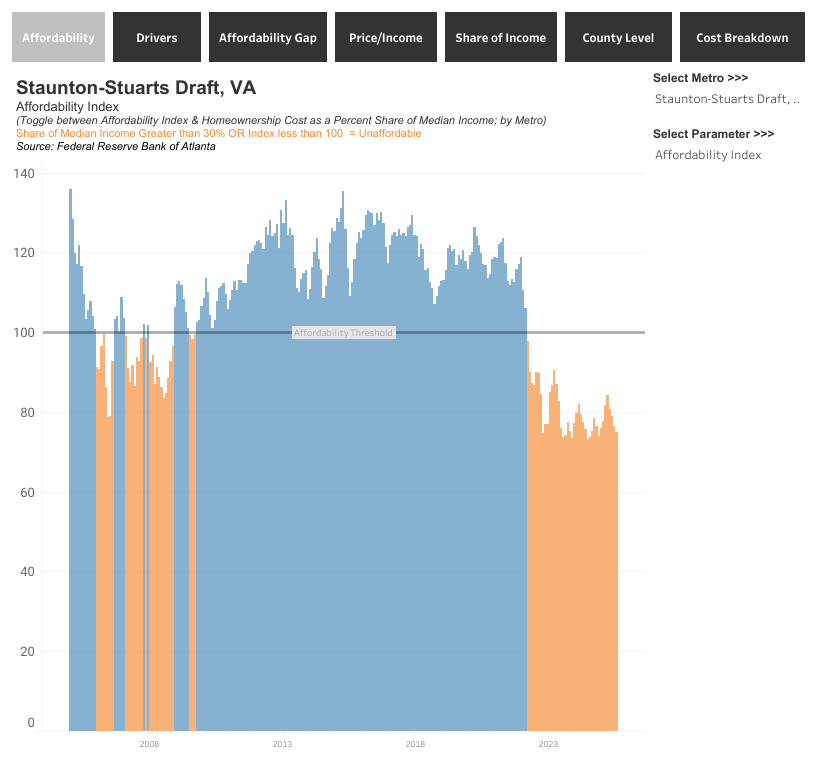
“Affordable” housing, including rent or mortgage plus utilities, is typically defined as housing that doesn’t exceed 30% of one’s income. More than that and other basic needs get strained or unmet, including food, clothing, medical expenses, transportation, child care and so on. The sad part is that we haven’t seen anything close to that 30% ratio since March, 2022, when affordability fell of a cliff (see chart below) to levels not seen since the Great Recession of 2008.
This and other illuminating graphs, compiled by the Federal Reserve Bank of Atlanta, illustrate in several ways how badly we as a society are dealing with our housing issues. For openers, observe that housing today is even more unaffordable than it was in the period leading up to and following a global financial crisis that was triggered by a collapsing U.S. housing market. Although the two crises have differing causes, it’s worth noting that the 2008 collapse resulted in massive government intervention and an all-out effort to stave off another Great Depression. There is nothing comparable today, which means that our housing recession has not only been completely uninterrupted—none of those blue spikes to interrupt a sea of orange—but with no hope that anything’s about to change.
Here’s another way of visualizing the same dynamic, charting the median household income needed to buy a median priced house:
Again, the current lack of affordability exceeds that of the Great Recession. Moreover, the reality is worse than depicted above, since the Atlanta Fed’s statistics include all the components of mortgaged home ownership but do not include utilities. But what is measured is bad enough. The most recent (August, 2025) share of median income going to housing is 39%, the same level reached in July of 2006. By comparison, the lowest share of median income going to housing was in April, 2015, when it dipped to 23%.
With only two statistics going into computing affordability, it’s worth drilling down a bit to see how much each has contributed to our unbalanced ratio. The median household income for our area was $42,819 in mid-2006, $46,661 in April of 2015 and $67,199 a couple of months ago. The median homeownership cost for those same months was $194,033, $164,533 and $308,900. In other words, the cost of homeownership in 2015 was 3.5 times household income, compared to 4.6 times today.
Looked at another way, household income rose 9% over the first near-decade of this comparison, even as homeownership costs dropped 15%. In the decade since? Household income went up 44%, but homeownership costs exploded at twice that rate, by 87.7%. No wonder home ownership has become unaffordable—or that rental rates are likewise skyrocketing, thanks to frustrated homebuyers turning to other shelter options. And just like a rolled-up toothpaste tube, those who can’t keep up get spit out at the other end, ending up couch-surfing or in short-term motel rooms or in their cars or a tent.
Since we’re not about to see a doubling of household income—indeed, given current economic and federal policy trends, we’ll be lucky to see any increase—the only alternative for lowering the affordability threshold is to decrease the cost of homeownership. One way for that to happen is through lower mortgage interest rates, but that’s beyond our meager capabilities, and interest rates are in any case only a secondary factor in housing costs. Even more on the margin are property taxes and home insurance, both of which have climbed over the years but still remain relatively minor components of a monthly mortgage payment. That leaves just one thing we might influence to promote affordable housing: the cost of home building itself. That’s where the conversation should be focused, and it’s also where the conversation has been most lacking.
Home construction is a numbers game that is most profitable when it enjoys economies of scale. As with interest rates, many of the costs that go into that equation—labor, materials, weather—are beyond our control except at the margins. But the one variable over which municipalities have a say is land use. The more housing units that can be built on a particular lot, the lower the per-unit cost of the finished homes. Build a $500,000 house on a half-acre because a lower-cost house won’t pencil out, or build a four-plex with each unit priced at $200,000 and make the same return on investment—and create four times as much housing, each at an affordable price.
That latter option, however, requires a wholesale reexamination of zoning codes and maps, and that’s something Staunton has avoided. The city’s 11-point housing “strategy,” conceived by a working group of housing advocates that not once discussed the role of zoning in driving up housing costs, nibbles around the edges of land-use policies by exploring the possibility of allowing accessory dwelling units. The bulk of the proposed housing strategies, however, merely advocate lots of talking and not so much action: legal services for renters, for instance, or landlord “education.” The nitty-gritty task of grappling with outdated notions of urban planning, meanwhile, apparently proved a step too far.
And so we have moments like Monday’s forum, offered under the hopeful tag line, “I am homeless and still I dream.” Those of us who aren’t homeless are also dreaming—dreaming if we think we’re actually moving the needle on affordable housing, as even a quick look at the charts above should drive home. What’s that phrase, often mis-attributed to Einstein, about the definition of insanity. . . .?
There’s never a good time to be homeless—but there’s bad, and then there’s infernally bad. We’re now well into Dante territory, hurtling past limbo, lust and gluttony to start ricocheting off greed’s boulders.
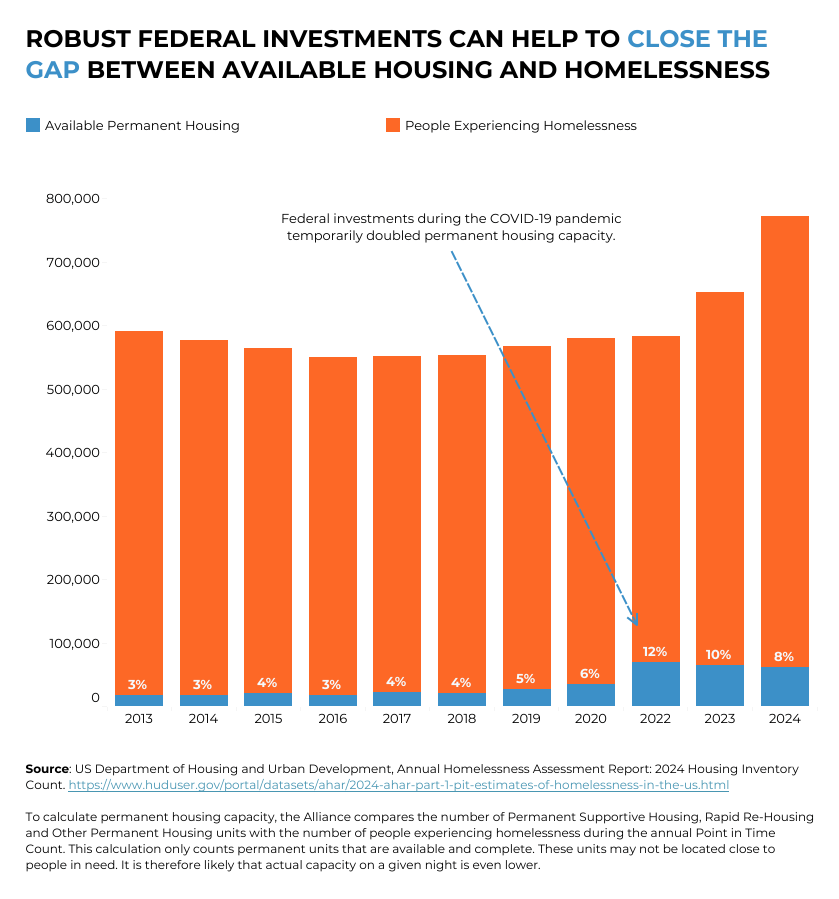
On a federal level, the gap between supply and demand for housing for the homeless was already skyrocketing before the Trump administration took office (graphed above) but exploded in the past year, thanks to a combination of funding rescissions and deep staffing cuts in departments serving the poor and unhoused. That notably includes the departments of Housing and Urban Development (HUD) and of Health and Human Services, which just in the past couple of days have been whacked with further unprecedented layoffs, shredding what little remains of an already tattered social safety net. If there’s any doubt about the local implications of all this, see the Blue Ridge Area Food Bank and its increasingly alarmed appeals for community support.
But there’s also a deeper, more profound shift in housing policy underway that will have the perverse effect of pouring gasoline on the fire. That shift dates back to a July executive order, issued by Donald Trump under the provocative title “Ending Crime and Disorder on America’s Streets,” that ends support for the “Housing First” approach to a growing unsheltered population. While Housing First advocates contend (often with references to Maslow’s hierarchy of needs) that people’s basic needs for food, warmth and shelter must be met before they can effectively address addictions, psychological ills or lack of job training, the executive order claims Housing First policies “deprioritize accountability” and fail to “promote treatment, recovery and self-sufficiency.” The better approach, according to the executive order, is to slash funding for such assistance while instituting sobriety requirements for people living in federally funded housing. Can’t stay straight? It’s back on the street with you, where the physical struggle for survival will take all your energy.
Meanwhile, the current trend toward criminalizing homelessness only adds to the problem. A U.S. Supreme Court decision last year empowered municipal officials to fine, ticket, displace or arrest people sleeping in public spaces, and more than 200 localities around the country have since criminalized homelessness. But other jurisdictions—including Staunton, Waynesboro and Augusta County—already had similar laws on their books. And while our local law enforcement agencies thus far have taken a restrained approach to people camping on public property, acting mostly in response to complaints by directing the offenders to move elsewhere, that could change with any pronounced shift in the political climate.
Homeless people who get jailed for failing to have a sanctioned place to sleep become, ironically, ineligible for certain housing programs. No surprise, then, that once they’ve been incarcerated for not having shelter, many end up in a cycle that perpetuates their homelessness. More than 50,000 people who are released from prison or jail each year go straight into homeless shelters and then into the streets, according to the National Alliance to End Homelessness, which reports that formerly incarcerated people are ten times more likely to become homeless than the general public due to a lack of financial and social support.
What little support for the homeless that still exists is being chopped away almost on a weekly basis. As reported by Politico a couple of weeks ago, the Trump administration is looking to move as much as two-thirds of HUD’s funds designated for permanent housing projects to transitional housing assistance “with some work or service requirements.” Those who can’t meet the requirements—such as a mother with young children, or someone who’s disabled—may end up on the street again, but as explained by a HUD spokesperson, “HUD is no longer in the business of permanently funding homelessness without measuring program success at promoting recovery and self-sufficiency.” That’s consistent with the administration’s overall “suck-it-up-buttercup” approach to social services but does nothing to address root causes, leaving it up to overwhelmed and unfunded local agencies to deal with the fallout.
Some of these issues may be addressed Monday evening at Kate Collins Middle School in Waynesboro, when Building Bridges for the Greater Good will host a forum on teenage homelessness. That’s because homeless teens are supposed to be served by the McKinney-Vento Homeless Assistance Act, which created the Continuum of Care (CoC) program that Politico reports is under attack—indeed, as Politico also noted, Trump’s budget for the next fiscal year proposes cutting all CoC funding. Loss of those funds will mean dozens of students in the SAW region who currently receive emergency housing, transportation and other necessities of life, including food, clothing and personal care supplies, will be at risk of losing their ability to stay in school.
CoC funding also assists 22 households in a program of permanent supportive housing administered by the Valley Community Services Board (VCSB), but their future is equally uncertain. The current funding runs out in December, and while a larger successor grant has been approved, there’s no certainty that money will be released. “If the Politico article is correct, this program would certainly be in jeopardy, but I am not sure what calendar year we will actually feel the impact,” said Lydia Campbell, assistant director of community services at VCSB. “It’s terrible that our community members with the most significant barriers to housing that are finally in their own places could be at risk.”
In the face of this onslaught, local efforts to cope with homelessness and a severe shortage of affordable housing have been lame, at best. That’s partly due to a lack of money, of course, but being cash-poor is insufficient excuse for a city that spends big bucks on a new pool house, golf carts and 50-gallon trash cans for everyone—all welcomed expenditures contributing to Staunton’s quality of life, but at the cost of letting internal sores fester. With only so many tax dollars to go around, expenditures in one area mean belt-tightening in another. In the end, it all comes down to the choices we’re willing to make—or ignore.
Take, for example, the request to city council by Alec Gunn, director of the Waynesboro Area Refuge Ministries (WARM), for financial support for a day center for the homeless at First Presbyterian Church. As initially conceived, this would have been a warm day-refuge in the winter and a cool one in summer for an unsheltered population that otherwise resorts to camping out in the library or in fast food restaurants to escape the weather. Talk of the city providing some modest start-up money for such an effort, perhaps $30,000, has been kicking around since the start of the year, with little to show for it and with ambitions for the day center’s scope of services diminishing with each passing month. More recently, rumblings of resistance from the church’s neighbors have been heard, and Gunn did himself no favors with the skimpy “budget” he presented to city council in early September—but neither has anyone on city council stepped up to press for a resolution. And so. . . still no day center.
As much—or little—can be said of the city’s pursuit of affordable housing, a critical component of any serious effort to eliminate homelessness. A key to this somnolent exercise has been creation of a housing commission that could “provide expertise and guidance regarding the amount and quality of affordable and workforce housing in the City,” an initiative first proposed by Councilor Brad Arrowood in March. That’s March of 2023. This past Thursday the city council finally received a resolution to do just that—but it won’t actually vote on the measure until an unspecified “later date.”
Not that there’s anything to be lost in this slow-walk to another grouping of chin strokers. Six of the proposed nine commission members are to be drawn from the ranks of the housing strategy working group that labored for a whole eight hours spread over 12 months to produce the city’s “housing strategy.” That group served mainly as a sounding board for city planners to present their ideas, and for the most part it resonated in tune; this was not a group brimming with ideas. The new commission will likewise meet only four times a year and, under the influence of its carry-over members, presumably will serve a similar role, with similarly minimal results. If there is to be any hope for the housing commission to provide meaningful input, it will have to come from the three non-working group members, ideally including representatives from the building and development sector and at least one person who has been homeless.
But first, of course, there actually has to be a city council vote to ratify the resolution. Assuming it does so in the next few weeks, and that the housing commission holds its first meeting in January, that will mark nearly three years since Arrowood’s initial proposal.
All this foot-dragging might be tolerable in a slower age, but that’s not where we are today. Instead, we’re hurtling toward a precipice with preternatural speed, the economy teetering toward recession, our political machinery seized up and normal middle-class people growing angry, suspicious and resentful under the weight of a disintegrating social order. How else to explain recent events in Waynesboro, where local residents circulated a letter deploring “the homeless problem” and criticizing St. John’s Episcopal Church for allowing a man to sleep in its bushes and a homeless couple to stay on an empty church lot. The letter expressed concern that mental illness, drug addiction and increased crime rates would put the neighborhood at risk, albeit without linking any of those problems to the three specific people prompting the writers’ angst.
Not all local residents shared that view, and in a couple of meetings pushed back vigorously against such stereotyping. But as the homelessness problem deepens and more people are forced to live in their cars and on the streets, similarly charitable responses may become more strained. We’re in a race against time that community leaders have not yet recognized, for money, effort, planning and initiative, and it would be reassuring to get even a whiff of urgency over what needs to be done.
I was fast enough to secure one of 25 slots at this year’s Staunton Citizen University, which are parceled out on a first come-first serve basis and are in surprisingly high demand. Last year I waited until the early afternoon on the first day of registration, and by then all 25 had been snatched up. This time I called at 8:05 a.m. and was glad I did, as this is a really great opportunity for city residents to look behind the curtain and see what makes Staunton tick .
A 10-week program that meets for two hours (and sometimes longer!) once a week, Staunton U trots out a parade of elected officials and city employees and a welter of statistics and budget figures to explain how the various components of city government mesh together. Field trips take class participants to the water treatment plant, city parks, a fire house, the landfill and other key facilities. Questions are encouraged.
Revelations abound.
One of the most disturbing, especially in the context of the recent water main break, is the D-minus rating that municipal water infrastructures have received from the American Society of Civil Engineers (ASCE)—not just this year, but every year since at least 2009. That’s much more than a decade of being graded just a hair above failing, a track record succinctly summarized in the report’s title, “Failure to Act.” Any child with that kind of track record would be attending remedial classes, working with tutors and mourning the loss of their cellphone and internet access, but America’s cities have been blithely rolling along as if nothing is amiss.
Staunton is no exception—indeed, it may be worse than average, given the age of its system. The Aug. 14 water main break, which resulted in a multi-day “boil-water advisory,” a two-day public school closure and untold economic impact on local businesses, should have been a wake-up call. But any appropriate sense of alarm was undercut by self-congratulatory relief over the swiftness with which the rupture was repaired, which was understandable; and by the widely accepted explanation that this was, in essence, an act of God, which it wasn’t. As explained to city council members by public works director Dave Irvin, “It would be great if we could predict breaks like this. We can’t.” And with that, everyone seems to have moved on.
But as I wrote a few weeks ago, that dismissal of predictability is accurate only in the most technically narrow sense: whether a water main will break in this spot or that, on this date or another, is indeed unknowable. What is known, with a high degree of certainty, is that there will be more breaks—indeed, there already are, on average, 40 a year somewhere in the 160 miles of the city’s water distribution system. Most simply aren’t on the same scale as the Aug. 14 rupture, but that doesn’t mean we’ll avoid “the big one,” as the ASCE report should underscore.
Nor should we be oblivious to the cumulative impact of smaller losses. Staunton overall is experiencing an ongoing 28% loss in its distribution system, day in and day out, as measured by the difference between the amount pumped out of the water treatment plant and the total amount recorded by customers’ meters. The lowest loss he’s ever seen in Staunton, Irvin said, was 12%, and that was quite a few years ago. The national average loss is 15%. In other words, more than a quarter of all the water Staunton pulls out of its reservoir and pumps from Gardner Springs, an average total of 4 million gallons a day, simply disappears, at nearly double the national rate. That’s more than a million gallons a day that just goes poof.
To put that in perspective, the Aug. 14 break spilled perhaps a million gallons before the supply was cut off.
Where do those millions of gallons of water go? Some of it is legitimately unmetered use, as when firefighters hook up to a hydrant or the city waters its golf course. Some of it is stolen—often from those same fire hydrants, by unscrupulous developers or others, but also by people rigging systems to bypass their meters. But most of it spurts out undetected from a rotting distribution network considerably past its “sell by” date, then quickly disappears into a karst topography without leaving a surface clue to the loss.
This is the month in which the city begins its annual budget planning—a month in which, it should be noted, we also are under drought watch. Again. It remains to be seen if more than a decade of near-failing grades for our water system, a major pipeline break and an ongoing loss of 28% of our treated water will be enough to jolt city planners and political leadership into paying pertinent attention to the way they raise and allocate funds. That includes not just taxes but also water and sewer rates, which by all accounts are comparable to or lower than those set by similarly sized Virginia municipalities.
Nobody wants to pay higher prices for life’s essentials, but as any homeowner knows, deferred maintenance saves money only in the short-term and always, always exacts a higher price down the road.
Bureaucrats do love their studies and surveys. A cynic might conclude that’s because searching for information is a heckuva lot easier than actually doing something with information that might already be at hand. “We’re looking into it” is at least an answer, if not a particularly satisfying one, to complaints about one thing or another.
Take Staunton’s ongoing fumbling of the housing situation. More than a year ago, the city announced the creation of the grandly named “Staunton Housing Strategy Workgroup,” a meandering exercise that culminated, this past July, in the optimistically titled “Pathway to Affordable Housing and Housing for Working Families.” But that pathway, it turns out, is littered with potholes.
One of the tripping hazards is the action plan’s repeated references to the City Housing Commission as the lead organization for developing nearly a dozen initiatives. Unfortunately, the city doesn’t have a housing commission. It may eventually get around to creating one, as soon as someone figures out what it should look like and what its responsibilities would be, but that hasn’t happened yet. Meanwhile, the implementation clock for those initiatives, divided into six neat segments of three months each, started running July 1—which means the first quarterly period is now ending and a second is beginning, all without a housing commission to lead the way.
Then there’s the plan’s section titled “Redevelopment Strategies,” which projected that the second quarter—the one that starts Wednesday—would see the results of a “windshield survey” of the city’s housing stock. Such an inventory sounds like a good idea, a necessary baseline to inform housing policy and action. But as with the nonexistent housing commission, there is no windshield survey of the sort envisioned by the plan. Nor is there going to be one before next spring, at the earliest, because the city has yet to prepare its grant application to underwrite such a project.
If all this conveys a certain lassitude and lack of urgency about addressing a problem that is only getting worse with each passing month—well, you might understand why nothing much seems to change. Consider, as another example, that the “action plan matrix” describes an 18-month process just to formulate a “strategy” (that term really should be retired) for amending the zoning code to allow Accessory Dwelling Units (ADUs) as one approach to increased housing density.
ADUs may be an exotic addition to Staunton’s housing mix, but they’ve been around for quite a few years elsewhere, and researching best practices shouldn’t take a year or more. Nor does anyone have to look far for examples. Lexington, just a few miles down I-81, adopted its ADU ordinance this past winter, and just for good measure added a cottage-court provision in March. Staunton’s city planners, on the other hand, apparently felt they had to secure Planning Commission approval merely to research the cottage-court concept, never mind coming up with a specific zoning proposal. They got the go-ahead last week to start looking around, but are making no predictions of when their exploration will be finished.
“Research” is, however, a superficially defensible way to excuse inaction. After all, how can one make informed decisions about complex matters without having all the relevant facts? And even if other municipalities already have implemented “strategies” that Staunton is only beginning to contemplate, how much of that experience is transferable to our own situation? Lexington may be two or more years ahead of Staunton in adopting innovative approaches to housing, but it also has less than a third of Staunton’s population and a fraction of its surface area. What could such a pipsqueak of a city have to teach us?
I’d argue that while there obviously are differences of scale, our qualitative similarities far outweigh matters of size—that there’s much that Staunton could learn not just from Lexington, but from numerous other Virginia cities that have forged ahead while we dither. We don’t have to reinvent the wheel each time we want to build a wagon. But it’s not just that Staunton seems incapable of learning from others. It seems that it can’t learn from itself, apparently overlooking or dismissing the information it already has at its municipal fingertips.
Consider again the example of the windshield survey, on whose completion rests the pursuit of “redevelopment strategies for underutilized properties.” That’s high falutin’ language for identifying homes so run-down they should be demolished, in the worst case, or significantly upgraded to prevent further deterioration. How many such homes are there in Staunton? Where are they located? What kind of condition are they in, and how much would it cost for their remediation?
Staunton planners say they don’t have this most basic information, which is why they want a windshield survey, which is pretty much what the name suggests: a drive-by of every residential property in the city to visually assess its soundness. Or as Lexington’s finished survey explained, dispersed throughout the city “are homes that are in poor condition hidden on many residential streets,” including those that are “vacant or are inhabited by older individuals who no longer have the physical capability or the financial means to perform the maintenance needed for their homes.” We really should know more about that—right?
Lexington therefore applied for, and received, a $50,000 grant from the federal government to assess its housing stock. The findings, released this past spring, consist primarily of a ranking system in which homes rated 1 are sound and those rated 5 are “dilapidated,” suffering from severe damage or decay “with defects requiring clearance.” “Clearance” is a gentle way of saying “demolition.” The ratings are based on three categories, assessing a home’s foundation, roof and exterior walls. Just 72 of the city’s homes were rated 3, 4 or 5, representing 3.5% of Lexington’s overall housing stock.
That’s essential information to have. The problem is that Staunton already has it—it’s just not in the planning department. It’s in the assessor’s office, which every two years recalculates the taxable value of every property in the city, using several metrics and assessment methods that include its own visual appraisal. As assessor Douglas Flinn explains, his staff will “take a neighborhood at a time and ride up and down the streets to look at each property,” averaging “about 100 to 120 homes per day during a concentrated five-month period”—which is to say, the staff conducts its own windshield survey of all 11,695 parcels in the city.
And as with Lexington’s $50,000 windshield survey, the Staunton assessor’s biannual survey includes “a rating system that incorporates the aggregate condition of the home [that] would include the roof, siding, doors and windows and the general overall condition of the home.” Which is to say, yet again, pretty much what Lexington’s federally funded survey accomplished.
So how does the assessor’s data differ from the data that Staunton’s planners hope to gain from their own windshield survey? Good question. Asked what information he expects to gather that isn’t already available, community development director Rodney Rhodes could say only that his department will work closely with the assessor’s office to figure that out before submitting a grant application. “We expect the windshield survey to gather more detailed information than what is currently on hand,” he added, without getting any more specific.
Well, one should hope so. But as seems quite clear, the many months of wheel-spinning by the Staunton Housing Strategy Workgroup might have found some traction had anyone walked from one part of city hall to another to obtain basic housing data that was there all along. Because that didn’t happen, and because the city now will be chasing that same information with yet another study, the pathway to affordable housing just gets longer and longer.
The story in the Augusta Free Press last week was buoyantly misleading. “The City of Staunton will open a day shelter for unhoused persons in the fall,” it announced.
Would that it were so.
Prompting the article’s optimistic declaration was a presentation to city council Sept. 11 by Alec Gunn, director of the Waynesboro Area Refuge Ministry (WARM), who had been invited to outline WARM’s plans for a “day center” for unsheltered homeless people. Gunn’s presence followed a reminder to city council a couple of weeks earlier that that it still had $50,000 in a discretionary fund that needed spending. As I wrote Aug. 24, city manager Leslie Beauregard noted that the council had discussed possibly appropriating $30,000 of that amount for a WARM day shelter for the homeless—perhaps the subject could be revisited? Yes, yes, good idea, council members responded. But first, let’s hear a concrete proposal and budget.
And so Gunn spoke, and from the outset illuminated several problems. Staunton city council’s interest in a day shelter had been triggered most recently by the severe cold we experienced last winter, with homeless people who had been housed overnight by WARM’s network of church-based emergency shelters typically turned out at 7 a.m. the following morning. With nowhere else to go, they resorted to frequenting area libraries, fast-food restaurants, Brite buses and any other accessible public place where they could get out of the wind and cold—frequently to the discomfort of other patrons. Could they not be provided with a refuge of their own?
Yet as Gunn repeatedly stressed—although council members did not obviously pick up on the distinction—WARM was looking to create something different. What he envisioned, Gunn said, specifically was not a “homeless shelter” but rather a place in which people could “work themselves out of” homelessness, through some unspecified combination of classes and workshops. Indeed, “shelter” seemed a word better left unsaid, with all the negative baggage it carries. It was all “center” and “day center” and “welcoming environment.”
Definitions or goals aside, Gunn’s sketchy outline—calling it a “proposal” is too generous—seemingly was aimed more at securing the $30,000 that had been bandied about than at detailing just what the day center would do. As if by coincidence, $30,000 was exactly the amount WARM envisioned for “support staff,” although how many staff members would be employed or what they would be doing was left unsaid. An additional $18,500 would be needed for utilities, supplies, transportation, insurance and so on, including $1,500 for those undefined classes and workshops. Where would the additional money be found? Unknown.
Meanwhile, although Gunn said this would be a year-round program, he conceded under questioning that at least initially the center would be open only two or three days a week, so definitely not a “shelter” as that term is generally understood. Eventually, he added, WARM hopes to expand operating hours to five days a week—so still not a shelter, which should be accessible every day. And while discussions earlier this year about a day shelter had included proposals for building showers and a laundry facility at the First Presbyterian Church, where all this supposedly is happening, Gunn said last week that he “hopes” Habitat for Humanity will make available a mobile shower system it sometimes uses.
Creating a program to help homeless people get out of their unsheltered circumstances is admirable and necessary, but it’s not at all clear that WARM’s unfocused efforts will accomplish that. Worse yet, there’s a real danger that an uncritical acceptance of WARM’s proposal will convince city council members that if they approve the $30,000 Gunn is seeking they’re actually providing a day shelter that can get homeless people off the streets, just as the Augusta Free Press assumed in its reporting. So far the city council hasn’t done that, but the broadly approving comments from council members after Gunn’s presentation suggest such an appropriation may be in the works.
What the unsheltered homeless population in Staunton, and the SAW region generally, lacks is not complicated: a readily accessible place they can go seven days a week, from 7 a.m. to 5 p.m., in the heat of summer and the freeze of winter. A shelter without preconditions, such as having to participate in a well-intentioned program of one kind or another, and without any expectation that those seeking such shelter will spend their time working themselves into or out of anything. A refuge.
It took me a while to check out the explanation given to Staunton City Council about the August 14 water-main break (viewable here), but it’s still worth watching, if only to see a notable example of a kicking-the-can-down-the-road approach to municipal governance.
The presentation August 28 by public works director Dave Irvin included a detailed timeline, lots of numbers and appropriate praise for his department’s “all hands on deck” rapid response and hard work. The 16-inch cast-iron pipe that ruptured was at least 80 years old, shattering with such force that it blew itself apart and “self-excavated,” with water rushing out of the trench it created at a rate of 16 million gallons a day—four times its normal flow. Thanks to the department’s quick action, with valve closures starting within an hour of the estimated break, perhaps a million gallons were discharged into the surrounding neighborhood.
But what caused the break? “We don’t know,” Irvin said, contending that “the possible causes are many.” The extensive damage, he added, made a postmortem impossible. A council member chimed in with a helpful metaphor: drive a car long enough, and sooner or later you can expect a flat tire—you just won’t know when, or which tire will go, until it happens.
It all was, the consensus appeared to be, an act of God. Something you just have to roll with.
But here’s the thing: the August 14 incident was Staunton’s second flat tire over the past couple of decades. A 2007 break in Cherry Hill also ruptured a 16-inch main, also one of cast iron, and also described as the result of “unknown causes.” That break took more than 12 hours to shut off and resulted in a slew of state-issued regulatory changes, directly contributing to the quick resolution this time around. That’s the good outcome. The bad outcome is that we’re still accepting the excuse that such breaks are because of “unknown causes.”
We know the cause. Cast-iron pipes, which were standard issue when much of Staunton’s water works were built, are brittle. The industry standard is a 100-year life span. Nearly half of the city’s water is supplied by the North River Reservoir, which is tapped by a 20-inch cast-iron pipe threaded through a 6-foot tunnel burrowed through Lookout Mountain, then connected to a 14-mile cast-iron pipeline that runs to the city. Next year will mark the centennial of that project—100 years since a system with a 100-year life span was completed. Miles more of cast-iron pipes of varying vintage and various diameters, including 16- 14- and 12-inch, run throughout the city.
Moreover, the karst topography that underlies our region is not kind to brittle systems. The 6-foot tunnel that once buffered the 20-inch main is no more, gradually settling around the pipe over the past 10 decades. That much was publicly known at least a decade ago, when Nancy Sorrells wrote about it in an apparent response to proposed fracking in the George Washington National Forest that alarmed city officials because of its threat to a crucial water supply. The fracking threat retreated, but the land continues to shift and settle nonetheless, putting more stress on a water distribution system that is hurtling toward its past-due date.
The flat-tire metaphor may be reassuring when all four tires are brand-new. In this case, that’s hardly the case. These tires have been hitting the road for many, many decades, and we’ve now had two flats. Every bit of Lincoln’s head—and then some—rides above a non-existent tread on the other two.
Why do people drive on bald tires? Usually because they can’t afford new ones, which may be why Staunton’s city council has been unwilling to take a closer look at an increasingly untenable situation. Although a city council member asked Irvin how much cast-iron pipe is out there, he didn’t get an answer—quite possibly because an exact number is unknown. But what is known is that replacing cast-iron mains with more flexible ductile-iron pipe is expensive. Hugely expensive. The Richmond Avenue project, for example, will replace less than two miles of a 6-inch cast-iron main and a 10-inch cast-iron main—because of their frequent breaks—with a single 16-inch ductile-iron main; that project is budgeted at $13 million. The city overall has more than 150 miles of pipeline.
Faced with such an imponderable financial overhang, council members have been only too willing to avoid asking the hard questions. And Irvin made it easier for them, announcing at the outset, “It would be great if we could predict breaks like this. We can’t.” Narrowly speaking, he’s correct.
But what we can predict, as we drive down the road on our well-worn slicks, is that more breaks are coming. They’ll come more frequently and sooner than we expect. And we really won’t be able to continue insisting that their causes are unknown.
I don’t pretend to be a business genius, having come to running one only late in life, after decades of working for others. But I’ve always been interested in how a business works, and I’ve seen enough to know when a business decision is short-sighted, self-defeating or just plain ignorant.
Take Bed, Bath & Beyond, one of those themed big-box stores that once aspired to dominate a market segment but which went into bankruptcy a couple of years ago, shuttering its stores in Waynesboro and Harrisonburg and all across the country. Its assets were subsequently purchased by Overstock.com, but as with so many things, the company lived on as a digital ghost, marketing its wares on the internet.
That’s how we came to order a new kitchen table, paying less attention to the source than to the fact that it had the right combination of size, color and price. And boy, was the response prompt! Two days after I’d placed the order, and much to my wife’s delight, two men in a FedEx truck lugged a large, 78-pound box box into our hallway. After assuring myself the carton was intact, I was ready for the relatively simple task of attaching the legs to the tabletop.
But no. When I sliced open the tape and peeled back the box cover, I saw that one of the long frame pieces had broken in half and part of it was separating from the top itself. The break wasn’t catastrophic; had it been a bone, it would have been a simple rather than a compound fracture. A repair would have been as simple as tapping the separated half back into place, perhaps with a spot of carpenter’s glue where it met the table top, then screwing in a reinforcing one-by-three on the inside of the break, where it couldn’t be seen from the outside. That would have been a serviceable fix, leaving only a relatively minor cosmetic blemish where the two halves came together—but did I want to do that? Doing so might be less work than reboxing the whole thing and going through the hassle of contacting BB&B to replace the table, but still, did I want to pay full price for damaged goods?
I did not. And so, girding myself for a long telephone joust and arming myself with pictures of the damage, I called Bed, Bath & Beyond and eventually spoke to a very polite, very efficient and heavily-accented woman. I’ll spare you the details. Suffice to say that my bottom line was that I was willing to keep the table as is, in return for a substantial discount—say, 40% to 50% off my original purchase price of $330. My counterpart, even after a full explanation of the situation and a review of the photographs I sent her, was unable to reward me with any more than a $73 store credit. Not a refund, mind you, but a credit, which presumed I would be rushing back to buy more of BB&B’s wares. Somehow, I wasn’t tempted.
I wound up sending back the damaged goods, for which BB&B had to pay the shipping. BB&B sent me a replacement table, for which it also had to pay the shipping. And then, of course, BB&B now has a broken table in its inventory that it has to figure out how to dispose of. Given that, I think a $132 refund would have been a bargain. And given the company’s inability to recognize that simple math, I think that perhaps this post-bankruptcy revival is not going to end well, either.
P.S. I subsequently learned that Overstock.com has been rebranded as Beyond Inc., which is owned by Marcus Lemonis, star of stage and screen—well, screen, as in appearances on “The Profit” and “The Celebrity Apprentice.” That puts him in the company of people like Donald J. Trump, another businessman who talks bigly but delivers far less.
Lemonis reportedly plans to continue BB&B’s resurrection by opening new storefronts around the country—but not in California, which he faults for having created “one of the most overregulated, expensive and risky environments for businesses in America.” Maybe, maybe not. But it’s not unlike Lemonis to blame others for his mismanagement of a business, as I learned when I was a campground owner and watched him run Good Sam Enterprises into the ground. His other day job, as the CEO of Camping World, isn’t looking much better. So—no surprise here that BB&B has such a self-defeating business model.
P.P.S. When our new table arrived, it was again delivered by FedEx—but with only one man on the truck to manhandle the box. Which he dropped. Which mildly crunched a table corner.
We kept it anyway. But there’s another story to be written about the way FedEx is understaffing its trucks and abusing its employees.
When it comes to the problem of housing affordability—which is to say, to the insufficient supply of such housing—those without a home at all tend to get the shortest shrift. Most of the public fretting is about people being forced to pay 30% or 40% or more of their already meager incomes for shelter. Or about the shelters themselves, which despite their high price tags too often are poorly maintained, inadequately insulated and ringed by sketchy neighbors. Meanwhile, those who sleep in cars, or in tents tucked into patches of vegetation behind shopping centers or supermarkets, simply drop out of sight and out of mind.
Consider, for example, the Staunton Housing Workgroup, which labored mightily over the past year to produce a list of “strategies” to put the city on the “pathway to affordable housing and housing for working families.” We apparently must gird ourselves for a long and arduous trek. As explained by city planner Rebecca Joyce when she presented the group’s strategic vision to city council a few weeks ago, “This is a plan for a start, not a plan for completion”—and oh, by the way, an additional strategy had been added belatedly to the original ten, to provide services for unhoused persons.
Why the late insertion? Because homelessness had not been discussed by the workgroup, despite such a condition being the natural consequence of unaffordable housing.
Just how sluggish and tone-deaf the city can be on the subject can be seen in the workgroup’s proposed timetable for meeting the needs of the homeless, laid out in a six-step approach divided into neat three-month segments. Step one, to run through the end of September: “Compile current list of resources and organizations that serve unhoused community members in the City.”
That should make for a busy morning.
Meanwhile, step six, scheduled for October through December of 2026, proposes to “conduct assessment of current state of needs of unhoused community members in the City and create an action plan of next steps.”
One might think that talking to the people you want to help would be a first step, not the last, but as the rest of this “strategy” makes clear, the city’s focus is on helping organizations, not individuals. As step two explicitly prescribes, for example, “Survey organizations that serve unhoused community members in the City regarding their most pressing needs [emphasis mine].” Steps three, four and five , which are identical, are all about helping organizations apply for funds.
Another example of kicking the can down the road was exhibited at the city council’s last meeting, when city manager Leslie Beauregard reminded everyone that the last budget had appropriated $50,000 for the council to use “at its discretion.” The council had been so discreet that none of the money had been spent. Perhaps the council should revisit the matter and use the funds in a productive manner? Perhaps, as had been previously discussed, some portion—$30,000 had been mentioned—of that unappropriated fund could go toward a WARM day center for the homeless “as part of a broader housing strategy”?
As summarized in the session’s minutes, “Council members agreed on the urgency in supporting the day center but questioned the need to allocate funds immediately,” which suggests the council has a creatively relaxed definition of “urgency.” The council instead tabled the proposal and “expressed desire to invite a representative from WARM to present a proposal and budget for the day center at a future council meeting.” One can only hope that “desire” will translate into action.
The underlying problem all this illustrates is a lack of urgency or assertive leadership by city officials and staff in addressing a problem that has festered for years. Staunton’s default position is one of passivity rather than initiative, waiting for someone to bring up an issue rather than proactively intervening in something everyone knows is awry. Somnolent staff can propose an 18-month timetable for the city to reach out to “unhoused community members,” and council members uncritically accept that as reasonable. Meanwhile, WARM will start operating its emergency overnight shelters in less than three months, but the “urgent” need for a day center will have to wait for the thinly staffed and inadequately resourced agency to get an invitation from the council to appear in its chambers.
Would it be too much for the city, having recognized a problem, to reach out to WARM directly? This week? To sit down with WARM staff and find out what’s needed, how much it will cost and who will be running the show?
Staunton’s laissez-faire approach to social needs is just as pronounced on the supply side as it is on the demand end of things. Lydia Campbell, at the Valley Community Services Board (VCSB), has been peppering the internet with emails pleading with local municipalities and social service agencies to apply for a Homeless Reduction Grant. Such grants, which date back to 2013 as part of Virginia’s Housing Trust Fund, are intended to “ensure homelessness is rare, brief and non-recurring.” Eligible projects include “rapid rehousing for literally homeless households, innovative projects for unaccompanied homeless youth or older adults experiencing homelessness, and rental assistance and stabilization services for chronically homeless households residing in permanent supportive housing.”
The response has not been encouraging.
True, as such things go this is not a wealthy program, disbursing just $12.9 million across all of Virginia in 2023, the most recent full accounting available. But that amount underwrote 69 projects that year, serving 3,997 people. Among them was (and is) Hope House, a rapid rehousing project in partnership with the Shenandoah LGBTQ Center that serves unaccompanied homeless youth, ages 18-24. On the other hand, over the past five years only one other program application has been filed (albeit not awarded) in our four-county region, according to Campbell.
In other words, when it comes to free money to address homelessness, local governments, non-profit organizations, housing developers (yes, developers, both profit and non-profit alike) and single purpose organizations—all of whom are eligible to file applications—can’t be bothered.
The current application period has a Sept. 12 deadline, but to date Campbell has not received any requests for a letter of support, which the state requires from VCSB to prevent duplication of services. Given the late date, that seems unlikely to change, although it’s always possible that Staunton staffers have been working feverishly but unobtrusively to . . . nah. Just kidding.
Here’s a final irony. Staunton’s 2023 legislative program, an annual exercise in which the city’s governing body communicates its priorities to the Virginia general assembly, urged an increase in funding for permanent supportive housing. “The Governor’s Housing Trust Fund should become a consistent funding stream for these individuals,” council members contended.
“Just don’t make us ask for it,” they could have added.
Last Wednesday I posted about the million-gallon water tank that’s being erected alongside I-81, principally to provide an adequate amount of water and pressure to supply a proposed data center at Staunton Crossing. In that column I questioned the wisdom of chasing after such a resource-hogging industry, contrasting the $10 million+ cost of the tank and its associated plumbing with the $40 million+ cost of replacing a century-old pipeline that supplies Staunton with most of its drinking water.
The next day, an unexplained break in a 16-inch water main above Stocker Street left the city and parts of Augusta County without potable water. As I write this the city has just lifted a four-day-long “boil water advisory,” which required boiling any water we could end up ingesting, as in preparing meals, adding ice cubes to our drinks or brushing our teeth. The effects of this break were significant. Schools were closed for two days, disrupting the lives of working parents. Restaurants either closed or significantly reduced service—half of Cranberry’s was in the dark Sunday morning, which was rather eerie—and businesses generally took a hit.
The city’s response to all this was admirable, as it issued frequent advisories via email, its website, Facebook and other social media, and it quickly provided free bottled water at three dispersed locations in the city. The break was repaired within hours, and much of the subsequent disruption was due to flushing the system and mandated repeat tests of the water for residual chlorine and bacteria. I’m sure that the response was an all-hands-on-deck affair, leaving little time or resources to address less immediate concerns.
But now that the worst of this incident is behind us, we really need to get a description of what actually happened. Nowhere in the city’s communications has there been any attempt to explain why a major water main suffered such a disastrous break—in the middle of the summer, not in the winter, when freezing often accounts for such mishaps. Was this the result of a tree uprooting? A karst topography-related ground collapse? A heavy truck rolling over an inadequately buried pipe?
Or was this a critical-point failure?
If the root cause (no pun intended) was a one-off incident, such as those I just listed, okay. Regrettable, to be sure, but also fitting squarely within the “stuff happens” matrix. But if it was the latter, if this was the inevitable result of aging infrastructure and the predictable collapse of a system long past its due date, then the implication is that this sort of thing can—and will—happen again. The only things we don’t know for sure in that case are when, and where.
As with the unanticipated but equally predictable closure of parts of the Wharf parking lot because of an eroded system of pipes and tunnels, the power of water to overwhelm our attempts to funnel, channel and exploit it requires constant attention and care. Without it, we court disaster. Yet because those attempts are largely buried underground, and therefore unseen, and because they’re so frickin’ expensive to maintain and upgrade as needed, it’s easy to devote what money we have to the next shiny thing rather than to spend it on something we already have that seems to be working just fine. Until it isn’t.
We can’t say we haven’t been warned. Staunton’s capital improvement budget, approved just a few months ago, quite explicitly listed 13.4 miles of 16-inch and 20-inch pipeline that should be replaced, at an estimated cost of $41.5 million, but the budget neither scheduled nor funded such a project. Similar unfunded nods to the necessity of such an undertaking have been made for at least the past five years, the price tag growing larger with each iteration, yet with no apparent follow-through.
It’s unclear at this date whether last week’s pipeline break lies within this stretch, although its comparable size suggests it is. But if that’s not the case, the even more troubling implication is that there’s much more work to be done than the city has acknowledged to date.
* * * * *
On a related but equally timely note, I want to call attention to today’s substack post by Paul Krugman, who despite being an astute economist has an extraordinarily accessible writing style.
While my focus last week on the resource-sucking depredations of data centers was on their thirst for water, Paul today writes about their vampire-like need for ever more electricity. Thanks to the enormous and exponentially increasing power needs of “the cloud,” artificial intelligence and cryptocurrency, none of which are in huge demand from the general public, the electric grid and the power plants that support it face a rapid build-out that will be underwritten by, yes, the general public.
That means much higher electricity rates for homeowners and small business owners, who won’t see any return on that investment. Just one more reason, it seems, to revisit the Staunton Crossing master plan and ask ourselves just what we’re trying to achieve with it.


 Looking askance