
(Reading time: 3 minutes)
Is there a relationship between property ownership and civic involvement? Or to put it another way, are people who rent their homes less likely to become involved in social issues and less likely to vote—to integrate themselves into the social and political fabric of their community—than people who own their homes?
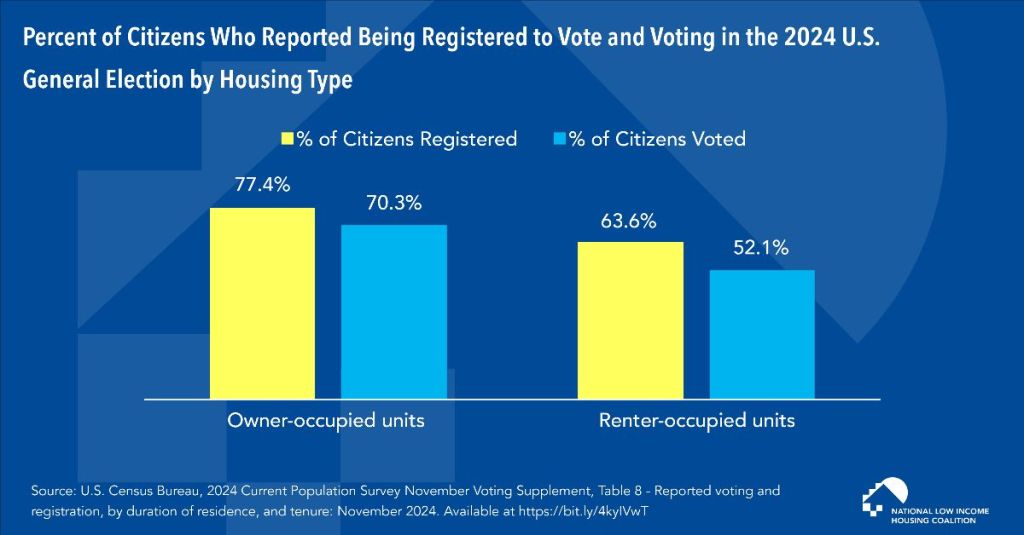
That seems intuitively true. People who are renting are generally viewed as more transient, as having few local roots and as having less of a stake in the larger community’s future. They’re not as invested. And indeed, voting results from 2024, as graphed below, seem to bear this out: people who own their homes are not only significantly more likely than renters to be registered voters, but even more likely than renters to cast a ballot. Indeed, just slightly more than half of all renters voted in 2024 compared with more than two-thirds of homeowners.
That difference has significant implications for our area. Consider that roughly 40% of Staunton’s residents are renters, which is twice the percentage of renters in Augusta County. With Staunton a largely more progressive, Democratic-leaning area and Augusta a rock-ribbed supporter of Trumpism, the city’s home-owner deficit only further exacerbated last week’s electoral results.
But here’s another largely unnoted—if unsurprising—aspect of that disparity. The poorer the renter, the more financially stressed he or she will be by housing costs. That may seem too obvious to comment on, but consider the graph below, also incorporating 2024 data. AMI means Average Median Income per household, which in Staunton was approximately $65,000 that year. “Cost burdened” meant households paying more than 30% of their income for housing, while “severely cost burdened” meant they were paying more than 50% of their income on housing.
Consider what that means, as summarized by the graph. More than 8 in 10 households making less than 30% of AMI—or $19,500 in Staunton that year—were cost burdened by their rent, and three-quarters were severely cost-burdened. But things didn’t get much better for households making 30% to 60% of AMI, which in Staunton would have meant an annual income of $19,500 to $39,000. More than a third of the renters in that income group were severely cost burdened, meaning that in Staunton they would have spent between $810 and $1,600 a month for rent. Given that the average rent for a two-bedroom apartment in Staunton these days is around $1,200 and apartments for less than $1,000 are all but mythological, the conclusions you can draw are pretty grim.
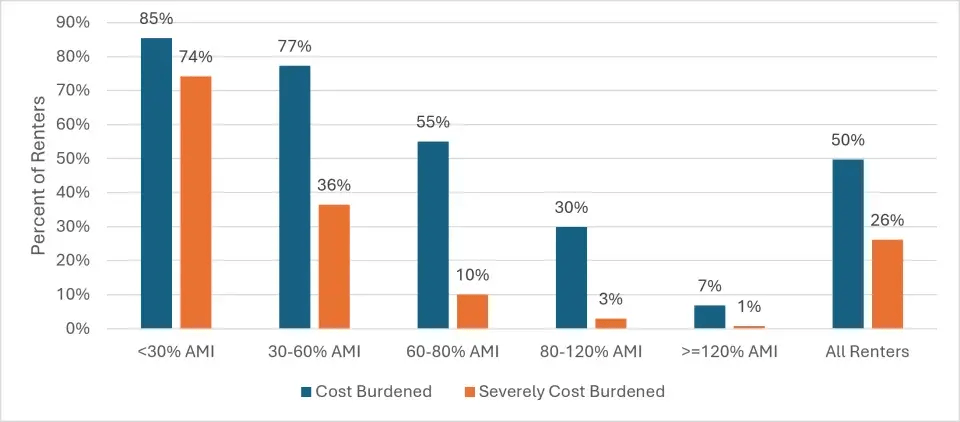
What relationship is there between the two graphs? Just this: people who are hanging on by their fingernails, unsure where their next meal may come from because their rent is driving them over a financial cliff, may not spend a lot of time worrying about who will be the next seat-warmer in city hall or in Richmond or Washington. Renters may be less apt to vote not because they don’t have local roots or because they don’t care about their community’s future, but because they’re too busy trying to ensure that they and their families have a future at all.
There’s more than one way to be disenfranchised, and among the more insidious is a lack of sufficient affordable housing.

