(Reading time: 6 minutes)
Tired yet of hearing about El Niño? Better get used to it, because it’s only going to get more mentions in the weeks ahead.
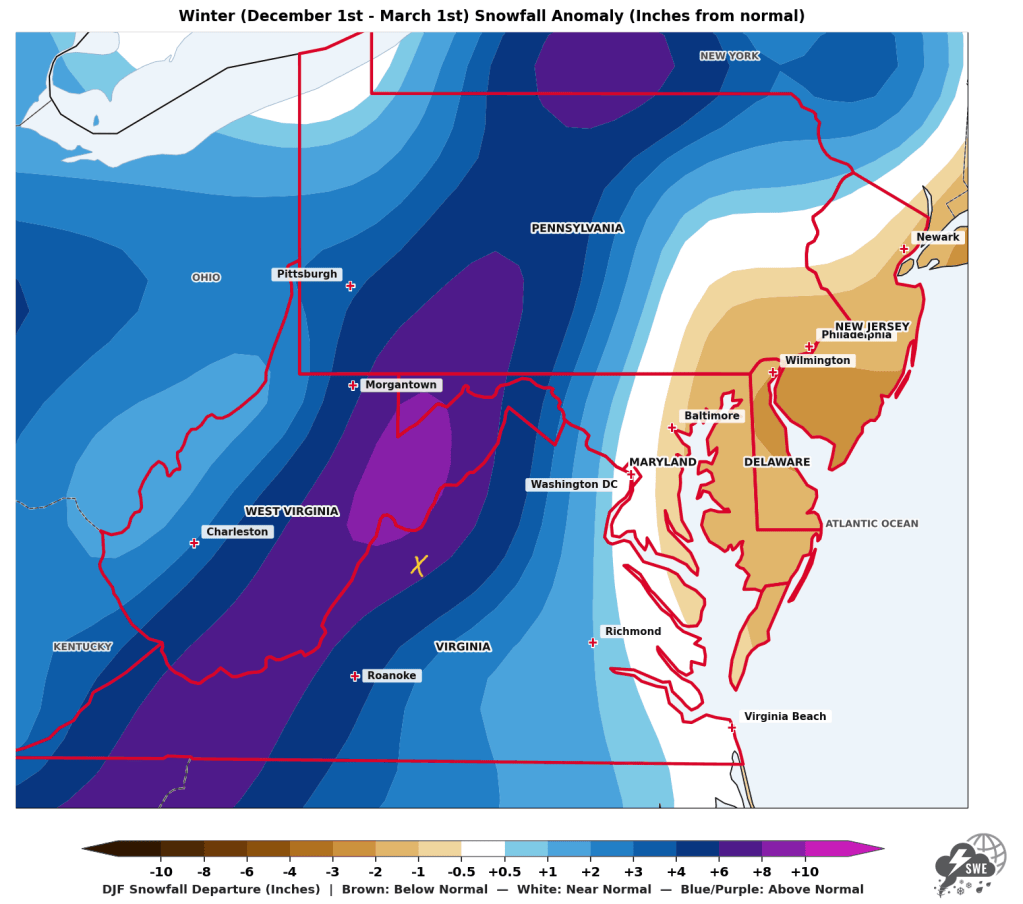
The ominous map above, in which the yellow ‘X’ marks our spot, is courtesy of the European Space Agency (ESA), which increasingly is being consulted by big business as a more reliable source than our gutted U.S. forecasting agencies. It was released within the past week, and while there’s invariably a lot of scientific guesswork involved in looking at weather patterns two to five months in the future, the bigger trend it’s affirming is that our neck of the woods can expect a colder and snowier winter than “normal.” El Niño is largely to blame for that, including its destabilizing effect on the Polar Vortex, another weather phenomenon about which we’ll be hearing a lot more.
What makes this topical is that our local emergency cold weather shelter, operated by the Waynesboro Area Refuge Ministry (WARM), will open for the new season Nov. 23—which is to say, a little more than a week from now, or just after the first extended spell of subfreezing overnight temperatures. Moving a week at a time from one church to another—with a one-week detour to Augusta Expo—throughout the Staunton-Augusta-Waynesboro (SAW) area, the shelter will provide overnight cots and meals for up to 50 local residents who otherwise would be huddling for warmth in doorways, cars or nylon tents. The WARM program will run through the end of March.
Anyone living locally will remember the state of emergency that was declared in Staunton this past January, when the entire region was gripped by a storm that started as a snowfall and ended as an icy straitjacket. Circumstances were so dire that Staunton mayor Michele Edwards convened an emergency meeting of local providers to come up with a plan for housing those who couldn’t be accommodated by WARM, with Central United Methodist Church filling the gap for almost two weeks. Ironically, the deep freeze was so bad that the local Point in Time (PIT) count, an annual mid-winter census of homeless people, didn’t even attempt to locate homeless people not already in a shelter. That resulted in a laughably lower headcount than in 2025.
With the ESA predicting an additional 8 to 10 inches of snow above the norm for us this winter, the odds of another emergency with a disparate impact on the homeless are daunting. But the number of shelter options has not increased, which means there’s still a shortage of 70 to 90 beds in our area even with WARM’s seasonal participation. We also still don’t have a warming shelter in which homeless people can take refuge during the day, which for WARM’s clients starts at 7 a.m., when they are required to leave their overnight quarters. And we have limited transportation available for those who need to reach a cold weather shelter that moves to a new location every Monday, across a geographic expanse stretching from Lyndhurst to Mt. Sidney.
You might think that last January would have been a wakeup call to local officials and service agencies, a call to arms to avert a possible tragedy, but you’d be wrong. Any momentum for addressing the root causes of homelessness—most prominent among them a lack of sufficient affordable housing—has steadily dribbled away. The turgid Staunton Housing Commission, for example, a substantial part of its work preempted by state legislation that mandates some of the initiatives it was just beginning to contemplate, went four months between its two most recent meetings and won’t meet again until February. That’s not the kind of eager restlessness needed to meet a challenge that is not sitting still.
Then there’s the amorphous SAW Housing group, an outgrowth of two enthusiastically attended housing conferences a couple of years ago that has dwindled in size and energy ever since, and now likewise convenes just every three to four months. Its website is untended and outdated—there is no mention, for example, of the group’s next “Lunch ’n’ Learn” program, scheduled for this coming Wednesday at Augusta Expo. There is no formal structure, so no one to hold accountable—indeed, no leadership names or contact information are anywhere to be found. And the minutes for the group’s most recent meeting, Oct. 7, could have been describing a year-old discussion with their description of “defining gaps in the local housing landscape,” as though that remains a mystery.
The debilitating effect of such lassitude is hard to overstate. A few weeks ago I received an email from one of my readers that read, in part: “I have been in the saw housing group for over a year. I’m irritated by having meetings and having nothing be done. I’m not sure how to help. . . . I joined the housing group hoping to meet others who could invest or change zoning to have manufactured homes or to get grants. Anything to help, but it just has been a lesson in futility.”
Meanwhile, WARM itself is struggling, unable to attract a qualified applicant to become executive director, following Alec Gunn’s health-related resignation several months ago. And Staunton city council, despite an unexpected abundance of excess revenues over the fiscal year that ended Sept. 30—8% over budget from local sales tax, nearly 7% over budget from its meals tax and 14% over budget from its lodging tax—never once suggested applying the $1.1 million windfall to addressing the city’s homelessness issues. Having city visitors help pay for school improvements by raising the sales tax was a winning political slogan, but apparently not winning enough when applied to people living in the streets.
(If the needs of kids are an effective way of tugging at heart/purse strings, perhaps city leaders should pay attention to the past week’s release of a report by the SchoolHouse Connection on infant and toddler homelessness. Based on U.S. Census data from 2023-2024, the group concluded that more than 513,000 U.S. children experienced homelessness from birth though age three, or roughly one in 29. More than 7,000 of those children were in Virginia.)
El Niño is a shortened form of El Niño de Navidad, which translates as “the Christ child” because of the season in which it reaches maximum strength. That, too, is ironic, if unhappily so.


