Kicking the ADU can down the road

(Reading time: 8 minutes)

To better understand why Staunton can’t get a handle on its lack of sufficient affordable housing, consider the June 18 meeting of its Planning Commission. Dominating the 90-minute session was a meandering and inconclusive conversation about a subject the commission has largely ignored, over which it has little control, but about which it is willing to entertain dystopian fantasies. In doing so, it made an inadvertent argument for renaming itself, perhaps as the Reaction Commission. Or the Let’s-First-See-What-Everyone-Else-Is-Doing Commission.

Among Staunton’s most pressing problems is its largely acknowledged if imprecisely documented shortage of housing that local residents making local wages can actually afford. There just isn’t enough of it to go around in the first place, so what’s available is priced out of reach. The obvious solution is to build more housing that is smaller and less expensive, leading to the equally obvious question: why isn’t that happening? And the obvious candidate to answer that question is the provocatively named Planning Commission (there’s also the newly formed Housing Commission, but that bunch is still trying to figure out what it’s doing), which one might think is currently consumed with trying to cut the Gordian knot of failed housing policy. One would be mistaken.

True, there are numerous reasons why Staunton has an insufficient housing supply, reasons that are at work all across the country and most of which are quite out of reach of a mere five Stauntonians meeting once a month, mostly to review rezoning requests. The cost of construction materials has sky-rocketed since the pandemic, the ranks of skilled construction workers have been depleted by Trump’s xenophobic deportation policies, interest rates are high and apparently poised to go higher. Those aren’t things a local planning commission can affect. But there’s also the matter of housing design and density, and that fits squarely within the planning commission’s wheelhouse. It’s also something the commission avoids looking at too closely.

Strange though it might seem, there’s not enough land available for building small homes in Staunton. With an average population density of just over two people per acre, it might appear that Staunton has lots of room for additional housing. But parks and agricultural districts and heavy industry whittle down the amount of land suitable for development. So too with land devoted to roads and parking lots, as well as land that’s too steep or too rocky or subject to flooding. There is land available for sizeable developments, as evidenced by the recently announced 267-home  McIntosh Village, but that’s big money chasing market-rate housing that will be too big and too expensive for empty nesters or service worker paychecks.

But then there’s our fondness for zoning that deliberately spaces homes far apart, allowing few homes per acre and dictating setbacks and minimum lot sizes and maximum lot coverage—our self-imposed limitations on what’s possible, in other words. Not geography or geology, but the very sort of thing that a planning commission concerned about an adequate housing supply for its existing population should be examining.

Just how inadequately it is doing so was on display June 18, when the commission was presented with a proposed amendment of the city zoning code that would clear the way for accessory dwelling units (ADUs) to be built pretty much anywhere Staunton allows housing.  The proposed revision was not something the Planning Commission had solicited. Nor was it sought by the Housing Commission, which has been slow-walking the ADU idea to some future chin-stroking evaluation. It was instead mandated by the Virginia General Assembly, which to its credit got fed up with all the wheel-spinning in the provinces and adopted this past session a bill that overrides local zoning authority.

Most succinctly, the state is mandating that as of July 1, 2027, ADUs are to be permitted by right—that is, without requiring “May I?” special-use review—in all zoning districts throughout the Commonwealth that allow single family use. ADUs are defined as “an attached or detached dwelling” that provides “complete independent living facilities for one or more individuals.” There are restrictions on size and placement, as well as parking and building code requirements, but basically the new law opens the door for homeowners to double their capacity. It could be with a backyard cottage, a basement apartment, a garage with a second-floor apartment. The additional space could be rented out, or it could house an aging parent or adult child. Best of all, the increase in the city’s housing stock will come without requiring any of the new roads, storm water management, water and sewer lines and other infrastructure that come with a new subdivision.

Planning commission reaction? Mixed but generally aghast. Commission member Dale Hansen, fantasizing about slap-dash cabins with hot plates and composting toilets popping up in backyards, said he wants to see some kind of allowance for ADUs “but not getting too crazy, and I don’t know how to regulate crazy,” eliciting sympathetic chuckles from other commissioners. The way the law is written, Hansen complained, “It’s sort of the Wild West—anyone who wants one can get one.” Well, yeah. That’s the idea.

Commission chair Jessica Robinson summarized the commission’s approach to the idea of getting ahead of an issue by asserting, “I don’t want to be a trailblazer.” No fear there—the state has already taken on that mantle—but because Staunton doesn’t have to amend its zoning code before next July, Robinson clearly is hoping to kick the can down the road. “I don’t think it’s impossible that people will start pushing back on this and that at the next General Assembly session it gets put off further?” she suggested, albeit on a questioning note. “And I think we should wait and see and make sure it survives all that.”

There was talk among the commissioners about seeing what zoning amendments other cities are writing—“Let them fail first, before we fail,” Hansen offered helpfully—and a suggestion that perhaps the Housing Commission could provide helpful insights. There was musing about feeling like “deer in the headlights.” None of it grappled with the fact that Virginia now has an explicit law to which Staunton must conform, without a lot of room for creative embellishments or escape clauses, which means there are only so many ways the city’s zoning code can be amended to be in compliance. The rest is wishful thinking.

Unfortunately, it’s not at all clear that the planning commission comprehends just how much the regulatory landscape is shifting beneath its feet. For the state to wade into a zoning issue—one of the few areas of responsibility reserved for localities—is huge. (See also the new state law that gives churches the by-right power to build affordable housing on their property.) At the same time, the commission’s tone-deaf approach to ADUs suggests its members haven’t been paying attention either to the ADU concept or to the housing needs of their neighbors.  ADUs as a relief valve for housing pressures have been around for years—long enough to be a significant part of the conversation at last year’s Virginia Governor’s Housing Conference, as I wrote last fall, and long enough to be discussed by the city’s Housing Strategy Group and in Comprehensive Plan ruminations. The problem locally is that it’s been just that—talk—and little more, as if a bunch of old folks were sitting around discussing the desirability of going to heaven.

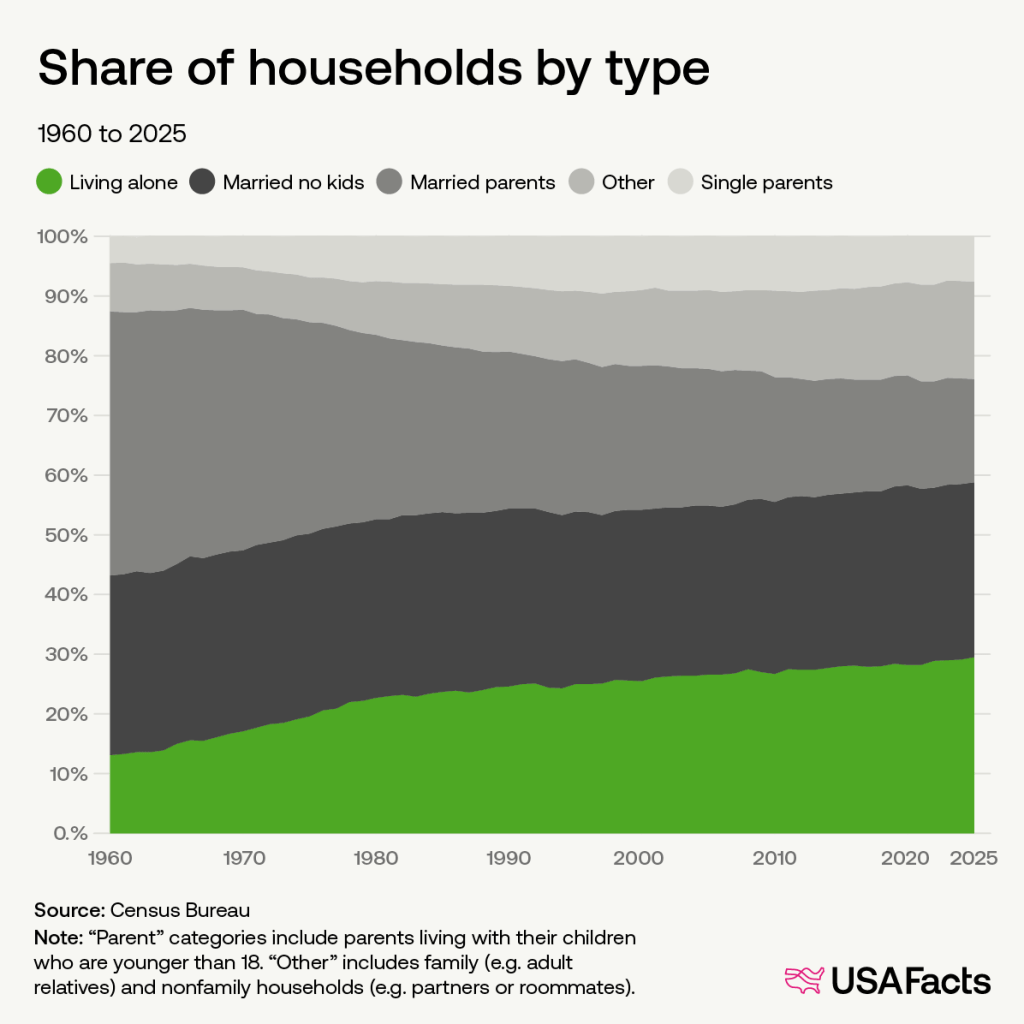
The green and (to a lesser extent) the black area in the graph above are prime sources of potential tenants for ADUs and now comprise substantially more than 50% of all households.

Nor will ADUs be the end of it. In addition to having a high percentage of relatively low-wage workers, Staunton has a higher percentage of elderly residents than the national average. It’s sobering, therefore, to learn that the fastest growing group of people entering homelessness are those 55 and older—people increasingly on fixed incomes, often in poor health, who can no longer afford to live in the city in which they were raised or worked or raised their own families. ADUs are not only more appropriately sized for these populations, which don’t need multiple bedrooms or a backyard, but can be built more cheaply and therefore rented for less than single-family homes. But they’re only one possible approach.

Other housing variations that are excluded from permitted uses within current zoning regulations, such as cottage courts, may be next. Expect pressure to grow for allowing single-family home conversions into duplexes or triplexes by right, or for eliminating lot size minimums in established neighborhoods, or for eliminating all parking mandates for housing, thereby freeing up more land for infill development. None of these are novel concepts in the wider world, although they are locally. All should enter into the planning (and housing) commission’s awareness if it wants to avoid future “deer in the headlights” moments, and if it intends to take seriously the “planning” part of its mandate.    

Instead, the commission won’t be meeting again until August, when it’s not clear whether the proposed ADU revisions to the city code it receives will be substantively different from what it’s already seen. The city’s community development planners have been given next to no guidance on what changes to make, beyond a vaguely worded request to “keep refining it.” At some point the commission will have to hold a public hearing on the proposed changes; next April was suggested as a good choice.

No sense in rushing things. Or starting them, for that matter.

West End suffers from city’s ADD

(Reading time: 6 minutes)

Rereading the West End Revitalization Plan, as I did over the past week in preparing my last post, was a stark reminder of how much we suffer an institutional version of attention deficit disorder. Two examples from that document will make my point: the brownfields study, and the tax increment financing district.

The brownfields study has been cited repeatedly in Staunton planning documents as a critical tool for redeveloping the West End. Funded by $300,000 from the EPA, the three-year Brownfields Assessment Grant was intended to “return vacant or underutilized properties to productive reuse” by assessing West End sites for possible environmental hazards. That would be followed by remediation, which, grandly, would “incentivize investment and jumpstart redevelopment and area-wide revitalization.” Study oversight was to be provided by a consortium of nine West End groups and organizations. Monthly and quarterly reports would keep everyone apprised of the progress made.

Or not.

Because as I wrote a year ago, local oversight never occurred because the Brownfields Redevelopment Advisory Group never met, there have been no monthly reports, and the quarterly reports are remarkably repetitive while also being short on detail. The initial three “high priority” sites targeted for assessment became just one, which in fact was developed and now is home to the city’s new court building on West Beverley, but of the other two sites there has been no public accounting.  The good news, if you can call it that, was that at least the grant money was not completely squandered—indeed, so little of it was spent that by the end of the three-year grant period more than half was still available. That led to a requested one-year grant extension—and then to a second.

With the now five-year grant period set of expire this coming Sept. 30, as of the end of April—the most recent available account—the city had yet to spend almost a fourth of the original grant amount. What it might be doing with approximately $70,000 is anyone’s guess. From the skimpy documentation that’s available, city officials in April were still trying to find suitable sites to assess, with four possible candidates lined up—none of which, it bears noting, are actually in the West End, with the possible exception of an old pump station building near the main entrance to Gypsy Hill Park. The others, however, include the former Coca Cola bottling plant on North Augusta Street; a site on Richmond Road [sic]; and the art school at 219 West Beverley Street, adjacent to the Central United Methodist Church.

It’s possible some or all of these sites should be assessed for environmental contamination, although “brownfield” is not the first image that comes to mind when contemplating a park pumphouse or an art school. But whatever the merits of these four candidates as posing environmental hazards, the bottom line is that federal money once touted as a needed economic shot in the arm for the West End is going to be funneled elsewhere, apparently because there are no more environmental hazards to be found in the West End itself.

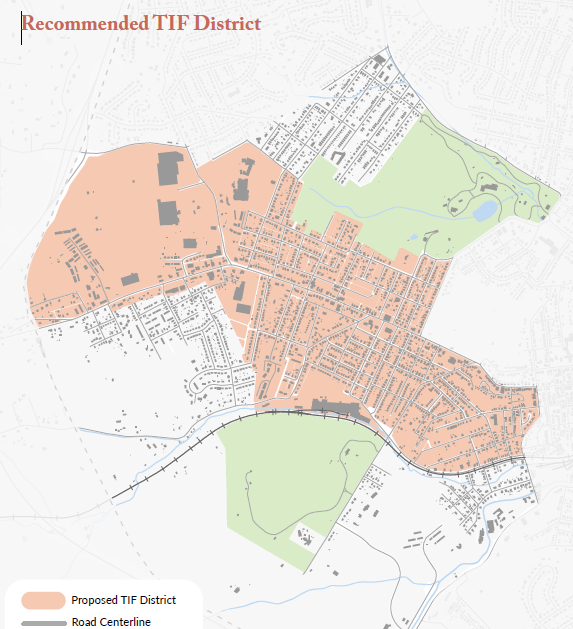
But let me not quibble. Let’s instead take a look at tax increment financing, which one might think would interest a city council that often cites the Dillon Rule as a major reason why we can’t have nice things. (Without getting too much in the weeds, the Dillon Rule is a governing principle that essentially means city and county governments in Virginia don’t have the authority to do anything that hasn’t been explicitly permitted by the state legislature. Which means, among other things, that the city council can’t just levy whatever taxes it wants.) Yet tax increment financing (TIF) is one of the taxing authorities that the state has given the city, and among the West End Revitalization Plan’s key recommendations is for Staunton to “research and establish a TIF district” in the West End to “finance infrastructure needs and improve public amenities.”

From page 35 of the ignored West End Revitalization Plan

As the revitalization plan explains, TIFs have been used throughout Virginia since 1988, typically to “finance infrastructure improvements in blighted and disinvested areas.” Here’s how they work: a “TIF district” is established via a city ordinance, in this case encompassing much of the West End, from which property tax revenue to the city is capped at existing levels for the life of city-issued bonds. Revenue from those bonds pays for eligible projects in the TIF district, including public infrastructure like streets, sidewalks, and sewer and water lines, as well as land acquisition and demolition, structured parking or plazas and, yes, brownfield remediation. As new buildings are constructed and renovations occur, property values in the district rise, as does the amount of property taxes collected—but the difference between the capped tax revenue and the increased revenue due to improvements is used to retire the bonds that funded them. This difference is the “increment,” hence the name.

Such a self-financing mechanism would address one of the biggest obstacles to Staunton’s efforts at revitalization, which is its lack of financial reserves. It’s also, despite being explored at some length in the revitalization plan, a concept quite foreign to city planners and officials. The Staunton Housing Strategy Group, for example, despite reviewing literally dozens of possible funding mechanisms as it laid the groundwork for what is now the city’s Housing Commission, never once considered TIFs. The city’s Economic Development Authority likewise never examined the possibility. It’s not as though city officials considered the pros and cons of such an approach to the West End’s needs and reached a reasoned conclusion—they just ignored the concept altogether.

None of this is to say that TIF is a panacea. While creating such a district in the West End could short-circuit the on-again, off-again piecemeal approach to revitalizing the area that has characterized Staunton’s efforts to date, it would tie up incremental revenue increases to pay off the bonds instead of using that money for other critical public services, some of which would face increased demand precisely because of TIF-enabled growth. Yet it scarcely needs to be pointed out that without the TIF approach that growth is less likely to occur in the first place, and with it a growth in jobs and in the long-term tax base.

More to the point, the lack of discussion about TIF districts raises the question of why efforts like the Revitalization Plan are undertaken in the first place. Staunton hardly needs more dust-catchers, which is the fate that awaits ignored plans and recommendations (take heed, those of you laboring on the Comprehensive Plan update). City councilman Jeff Overholtzer, the council’s liaison to the Economic Development Authority, said in response to my questions that he will “start a conversation” with that body about a possible TIF approach, which is certainly overdue more than 18 months after the city council signed off on the Revitalization Plan. But then again, given the city’s track record with its brownfields grant spending, maybe we shouldn’t expect too much even now.

Warring against willful ignorance

(Reading time: 11 minutes)

Staunton’s census tracts, showing homeownership percentages (in black) and poverty levels (in red), with Census Tract 2 highlighted in pink at left; from Anna Leavitt’s presentation to Staunton City Council on June 25.

For several weeks now—ever since the latest American Community Survey statistics were released—I’ve been thinking about writing something tentatively titled “A Tale of Two Cities.” The piece would have focused on the West End generally, and on Census Tract 2 specifically, and on the various disparities between that area writ small and Staunton overall. And then this past week Anna Leavitt beat me to the punch, at least partly, with a presentation to city council that was an unexpected and bright counterpoint to Staunton’s generally sluggish approach to such matters.

Leavitt, former director of CAPSAW (Community Action Partnership of Staunton, Augusta and Waynesboro), apparently has an affinity for complex acronyms: these days she identifies herself as Staunton’s EMOSA, which stands for Economic Mobility and Opportunity Special Assistant. She’s been in that position only since January, yet already has done more to fill in the terra incognita portions of Staunton’s demographic map than any of the numerous studies and plans generated over the past decade. That’s truly good news. But it’s only a start.

The bottom line in Leavitt’s presentation on Thursday was that it doesn’t matter where you live in Staunton, a median household income is no longer enough to buy you affordable housing. That holds true regardless of whether you’re a lower-income single parent with one child, a two-earner moderate- or middle-income household with two children, or a retired senior living on a fixed income: in each case, expenses outstrip income by several hundred dollars a month. In some parts of the city, however, the deficits are larger than others, and Leavitt’s analysis thus far is only scratching the surface of what that means.

Look at the statistics for Staunton’s seven census tracts, and you’ll be immediately struck by the extremes of Census Tract 2. This is the area south of West Beverley Street often recognized as a major part of the West End, which as defined by the city also includes a hefty chunk of Census Tract 3, on the north side of West Beverley. But Census Tract 2 is considerably more immiserated than its counterpart, as evidenced by median household incomes—$49,470 for tract 2, $80,914 for tract 3—and other indicators of economic well-being. As a result, discussions about the West End generally blur many significant variations; they also obscure the even more stark comparisons between Census Tract 2 and Staunton overall.

For starters (and as Leavitt pointed out), Census Tract 2 has the highest poverty rate of any Staunton census tract, at 19.2%, compared to the city’s overall rate of 12.6%. It also has one of the city’s lowest homeownership rates, at 43%, compared to a citywide average of 61%. That means nearly three of every five homes in Census Tract 2 are owned by someone who lives elsewhere, whether that’s in the house next door or in Virginia Beach, accounting for the large number of complaints from area residents about absentee landlords and neglected properties. It also means the tract’s 4,000 residents have limited financial resources, and therefore limited mobility, to improve their living conditions.

Moreover, the housing that exists, for renters and homeowners alike, ain’t that grand. Of the census tract’s approximately 1,120 rentals, nearly half have what the Census Bureau calls a “condition”: either a lack of complete bathroom facilities, a lack of complete kitchen facilities, an occupancy higher than one person per room, or rent that takes more than 30% of their tenants’ income. Homeowners aren’t faring a whole lot better, with nearly a quarter living in a home with a “condition.” Overall, then, it’s safe to conclude that a huge chunk of Census Tract 2 residents are living in crowded conditions or are paying way more for housing than is financially sustainable for the long term.

 Other Census Tract 2 statistics further underscore the challenges its residents face. Eleven percent of the population was without healthcare coverage in 2024—a percentage sure to have climbed this year because of the federal government’s decision to end Obamacare subsidies—as against 6.4% for Staunton overall. Sixteen percent of Census Tract 2 residents are disabled, which is not that much higher than the city’s rate of 15.2%, but which is more consequential in the context of all the other problems they face. It’s also noteworthy that 45.5% of Census Tract 2 residents have never married, a metric typically associated with household stability and individual health and longevity, compared with a citywide average of 33.9%. And a bit more than 15% of the area’s adults older than 25 don’t have high school diplomas.

The residents of Census Tract 2, in other words, face numerous obstacles that are more limiting than those found elsewhere in the city.  

THE POOR HOUSING SITUATION in the West End generally, and in Census Tract 2 specifically, is no secret. Indeed, having recognized the area’s potential to go into an economic tailspin, the city in 2020 embarked on a four-year exercise to forestall disaster by studying the area and formulating a remediation plan. The result was the 115-page West End Revitalization Plan that the Staunton city council formally adopted at the end of 2024. Woven throughout the plan are the concerns and complaints of area residents about a lack of available and affordable housing, as well as the widespread deterioration of existing housing stock.

But housing, as it turned out, was only a small part of the plan’s remit. And the final plan’s remedial housing recommendations are . . . superficial, to say the least. The leading “action item” regarding housing, for instance, calls for connecting West End homeowners “to existing resources” that would help them address “building and property maintenance code violations.” Only one of the plan’s proposals directly addresses renters, and then by suggesting they should be educated about their rights, presumably so they could hold their landlords accountable for providing decent, safe and sanitary quarters. Indeed, when you parse the handful of housing-related recommendations, it all boils down to a lot of talk but no action or any commitment to provide new city assistance.

It should go without saying that people one step away from being homeless are hardly in a position to insist that their rights be respected. When you’re scraping by at a job that pays less than $20 an hour but still have to fork over more than $1,000 a month for rent because there’s nothing available for less, your airy “rights” take a back seat to more pressing concerns when your landlord won’t get around to fixing the AC. You suck it up. And as I wrote 18 months ago, while the wool-gathering that went into the West End Revitalization Plan encountered repeated complaints of unscrupulous landlords and neglected properties, little of that got more than a passing acknowledgment in the plan itself, apparently because anecdotal stories are easier to ignore than hard numbers.

The lack of hard data should by now be a matter of civic embarrassment. Roughly six years after the revitalization study was started, city planners still do not have an inventory of vacant and developable land in the West End, or an inventory of deteriorating or abandoned dwellings that should be refurbished or condemned. (The city tax assessor presumably has that data, but that speaks to another city problem, of siloed information.) The city has no idea how many rental properties are owned by people who live outside of Staunton. And then there’s the problem of information bias creeping into studies like the Revitalization Plan: of approximately 170 responses to a community survey conducted for the plan, for example, only 78% were from people who actually live in the West End—and of those, nearly 90% were homeowners. In other words, responses from the renters comprising the majority of Census Tract 2 residents were vanishingly few.

Little wonder, then, that the revitalization plan’s proposed remedies regarding housing instability are so toothless. A meaningful recommendation, for example, might have called for adoption of a rental inspection program specifically targeting Census Tract 2, similar to programs operating in Roanoke, Winchester, Hopewell, Colonial Heights, Petersburg—cities throughout the Commonwealth that are both larger and smaller than Staunton. Such programs focus on specific areas in each city where older residences, absentee ownership and low incomes create an environment conducive to property neglect and housing deterioration.

Although the Virginia Landlord and Tenant Act makes landlords largely responsible for the living conditions in their properties, it doesn’t have a mechanism for tenants to enforce its provisions when a landlord ignores complaints. So a tenant’s options when faced with an intolerable living situation are to move—not exactly an alternative in the current market—or to file a lawsuit, which is an even more burdensome proposition. In cities that have rental inspection programs, however, rental units are subject to periodic inspections to ensure they conform with the state’s Maintenance Code, providing some assurance that such problems are less likely to crop up in the first place.

Waynesboro seemed about to adopt such a program three years ago, but then scrapped the effort amid claims that it would be too expensive to implement and that it would raise the already high cost of housing. That sounds remarkably like the fallacious arguments often made against increasing the minimum wage, serving mainly as a rationale for paying people slave wages or, in this instance, keeping them in blighted housing. But it gets repeated uncritically by those who don’t believe government should get involved in housing issues in the first place.

So, for example, asked why Staunton doesn’t have a rental inspection program, John Glover, whose job title is Building Official in the city’s Community Development department, replied that city staff had looked at the possibility in the past and “decided it was not necessary.” Having such a program, he wrote in an email that echoed Waynesboro’s rationale, “can increase the cost of rentals, which is detrimental to affordable housing.” It would require additional staffing, “which can be costly for the city.” A more cost-effective approach, he maintained, is complaint-based enforcement of the state’s Maintenance Code, which can result in the city taking legal action against property owners who don’t remedy violations.

Without providing any specifics about how many complaints have been investigated or how many times a property owner has been taken to court, Glover concludes that “this approach has proven to be very effective for many years.” Perhaps. But as with so many city responses to the West End’s problems, that assertion is made without a factual grounding. It assumes that people living in deficient housing not only know of the city’s complaint-based enforcement of the Maintenance Code—a code that gets only a single, unexplained mention in the Revitalization Plan—but that they have enough courage or desperation to risk calling attention to themselves by filing a complaint. A scarcity of complaints does not necessarily indicate the lack of a problem.   

ALL OF THE ABOVE presupposes that indeed there are unattended housing problems in Census Tract 2. Given the area’s general economic data and the anecdotal feedback received by the Revitalization Plan, that seems like a pretty safe bet. But that very wobbly assertion also attests to the city’s willingness to not look at things too closely.

If you can say with a straight face that you don’t see a problem, then no one can fault you for not fixing it, and that’s pretty much how Staunton has approached its housing problems in the past. That’s true city-wide, but especially so in the West End, and Census Tract 2 more specifically. That’s why the hard data is so spotty. It’s why city staff can so blithely declare that city intervention or oversight “is not necessary.” It’s how residents’  feedback can be superficially acknowledged but ignored when spending and policy-making decisions are made. It’s why planning study after planning study ends up gathering dust on a shelf somewhere.

That changes are afoot, albeit at a glacial pace, is not due to any sudden epiphany, but because at some point being oblivious stopped being an option. Our homeless population is not going away, and indeed—as may be confirmed mid-July in a special Point in Time census—appears to be growing. The state, which historically has left zoning decisions up to localities, is now mandating that Staunton and other cities allow construction of accessory dwelling units—essentially a second home—anywhere they allow single-family homes, an option over which Staunton has been dithering for at least the past year. Another state initiative, signed into law last month, allows churches and other tax-exempt nonprofits to build affordable multifamily housing on their property without prior city approval. And meanwhile the gap between what people are paid and what they have to pay to keep body and soul together is widening.

Staunton’s new EMOSA seems intent on plugging some of those data holes, which will make a deliberate ignoring of the problem much, much harder to sustain. Good luck, Anna!

Staunton’s curse of low expectations

(Reading time: 6 minutes)

It’s been a week since Staunton’s city council got together with members of its Comprehensive Plan Committee to review the status of the comprehensive plan update, and I’m still trying to figure out what that was all about.

One problem facing city council members is that they can’t just sit around a table and discuss the issues of the day. Aside from a limited set of circumstances, any occasion in which more than two of them exchange views becomes a public meeting, subject to all the constraints that implies. That’s great from the viewpoint of public transparency and avoiding the appearance of back-room deals, but not so great when it comes to a frank exchange of ideas and opinions on issues that require foresight and leadership. So when the council scheduled a meeting about the plan that’s supposed to guide the city for the next 20 years, the implication was that this would be a chance for Staunton leaders to air their concerns and offer suggestions for a supposedly seminal document.

Nah.

The June 3 meeting was held not at city hall but at the public library, where apparently it was not videotaped. No more than a handful of Staunton residents observed the session, which was notable mostly for its low energy and a PowerPoint presentation punctuated by long silences in response to the question, “Any questions?” To be fair, however, the bar was set incredibly low right from the start, when Rodney Rhodes, Director of Community Development, explained that the Virginia Code doesn’t actually require the plan to be updated. All that’s needed is a “review” of the plan every five years, which in essence could amount to a quick flip of the pages of a document adopted in 2019 and an equally quick “yup, looks good.”

Or not. Point being, anything that the Comprehensive Plan Committee had come up with was already far more than mandated, so don’t sweat the small stuff. Or that’s pretty much how it sounded.

It also was in marked contrast to the stress placed on the document by Will Cockrell, the consultant with EPR PC in Charlottesville who ran the PowerPoint. The comprehensive plan “is not a policy document—it’s the policy document” undergirding all other city policies, spending choices and investments, Cockrell emphasized, before lapsing into an increasingly monotoned overview of a revised plan that is “significantly shorter” than the original. Indeed, the revised plan’s greater brevity, generous use of artwork, larger type and more graphic design were all lauded as major improvements over the original, which by implication has been moldering in a musty drawer somewhere, unread and unappreciated.

To be fair again, the council was not completely without comment, starting with the revised plan’s glaring omission of any reference to Staunton Crossing. Noting that the city faces $300 million in unfunded capital needs, councilman Jeff Overholtzer pointed out that getting some tenants into Staunton Crossing could go a long way toward generating much-needed additional revenues for those needs—although what businesses should be pursued, and how, remained unspoken. Councilman Adam Campbell echoed that concern, but also noted the plan’s silence about Staunton’s unhoused population and its many vacant buildings. Councilwoman Alice Woods said she worried about the plan’s failure to more rigorously address the city’s lack of sufficient “middle housing” for its essential teachers, firefighters, cops and other service workers.

Yet such observations were relatively few and elicited scant discussion, suggesting little consensus about the purpose of a comprehensive plan. Indeed, Mayor Michele Edwards opined that the comprehensive plan isn’t a plan at all—that it’s “more a guidepost, a vision.” She received no push-back on that interpretation, just as there was no back-and-forth on any of the few other comments or opinions. The evening was, as already noted, a rather low-energy event—which only begs the question: why was it even held? What was the point?

One possible answer is that this meeting, like so many of the others having to do with the comprehensive plan, was more about process than content. About establishing a paper trail attesting to public input and official attention, regardless of substance. The June 3 city council meeting was merely one of a string of get-togethers dating back to Sept. 19, 2024, when the 11-member citizen steering committee met for the first of 15 sessions, not to mention several public presentations and workshops, all of which seems to attest to weighty substantive debate. Yet a close reading of the minutes—when they’re available, that is—suggests that much of the time was devoted to discussions of “branding,” how to word various outreach materials, reviewing survey results, and other logistical matters.  As for the plan’s actual content? That seems to have been generated largely by the consultants, who presented committee members—and later the public—with menus from which to choose their preferences.   

(Apparently the consultants were unable to come up with a branding idea that would “honor Staunton’s past while looking towards the future,” so it remains the “Comprehensive Plan 2045.”)

The comprehensive plan isn’t supposed to be just a gauzy vision of the future. Nor should its scope be defined by outside consultants, who despite their best efforts at tapping into the local zeitgeist are necessarily limited by what is reflected back to them. In that sense this whole process has been a hall of mirrors, with the consultants conducting polls and issuing questionnaires to learn what city residents want, then drafting proposals that summarize the feedback they received and asking residents what they think. If nothing else, we can conclude that city residents who have kids in school and have to get from home to work and back again don’t spend a lot of time thinking about Staunton Crossing—or about homeless people or vacant buildings or a host of other issues I raised a month ago, and again more recently.

That’s where political leadership should play a role, and thus far has not. Just as the 2019 comprehensive plan suffered from the lack of anyone at a policy-setting level stating that the plan needed to address housing issues, the current review/update has numerous blind spots that limit its effectiveness. The $300 million in unfunded capital needs mentioned by councilman Overholtzer is just one stark example—but now that it’s been raised, what’s next?

Looks like Cline won’t have to worry

(Reading time: 4 minutes)

Would-be politician Beth Macy spoke before a packed and supportive Staunton audience last night, in what should have been a rousing call to arms to unhorse the horse’s ass currently representing Virginia’s Sixth Congressional District. Unfortunately, the former journalist seems to have forgotten one of the prime directives drilled into all cub reporters, “Show, don’t tell.” In doing so, she foreshadowed yet another easy win for MAGA Republican Ben Cline.

Holding forth at The Frenchmen restaurant in Staunton’s old railroad station at an event hosted by the Staunton Democratic Committee, Macy appeared not to have received the news that she has no primary opponents—that a May 15 U.S. Supreme Court decision had put a last nail into Virginia Democrats’ redistricting efforts. That ended any chance the Sixth District would be reconfigured this year to make it less of a red swamp, resulting in an exodus of potential contenders. And, just like that, Macy became the last Democratic candidate standing in a district that Cline has carried by 60% or more in four consecutive elections.

So why is Macy still so intent on introducing herself as if this were last November? Given an opportunity to rally several dozen potential shock troops with an impassioned denouncement of her only opponent, Macy instead chose once again to put her major focus on burnishing her working-class credentials, while also—yet again—recounting her risk-taking journalism in going after Big Pharma. She had grown up Appalachian-poor in a small Ohio town. Her dad was a military vet, her husband a schoolteacher. She had raised one child who is trans and another who is gay. All her life and that of her family has been a struggle, Macy kept repeating, and that’s why she’s a fighter and that’s why she’ll be a fighter on behalf of the rest of us.

But someone else wrote Hillbilly Elegy first, and it’s all old news by now, anyway. And for all her talk of being a fighter, Macy landed only a single, glancing blow against her opponent, in lambasting him for taking corporate campaign funding.

That’s not to say that Macy didn’t offer the expected round of complaints about the abysmal state of the union, from cuts to Medicaid and food stamps to the diminished helpfulness of Pell grants to the evisceration of the Veterans Administration and its medical resources. But it was all rather bloodless, with few connections linking such carnage to Cline. Where was the itemization of particularly callous Cline votes, the recitation of Cline’s dismissive statements about the very real needs of his constituents, the detailed condemnation of Cline’s coziness with political and religious extremists and zealots?  And on other pressing issues of direct importance to a largely rural, agricultural district, there was barely a murmur. What, for example, has Cline done for farmers battered by soaring costs of fuel oil and fertilizer—or just as much to the point, what would Macy do in his stead?

We’re past the point of introducing ourselves to voters. With less than five months until the election, it’s time to re-introduce Cline to his constituents, and in such a way that even his most ardent supporters understand just how much he has waged war on their best interests.

In failing to unleash the dogs of war and taking the battle to Cline, Macy lost an opportunity this week to hone that message with a much friendlier audience than the ones she’ll confront this summer in huge swaths of the Sixth. Out in the rural precincts, where the Stars and Bars are still more prevalent than the Stars and Stripes and MAGA’s stench has yet to penetrate, Macy’s “I’m one of y’all” pitch will come across merely as Cline-lite. Unless, of course, she comes out swinging and shows herself to be the fighter she claimed to be this week. Unless, that is, she does more than merely ask us to take her word for it.

Fate can teach us fiscal sustainability

(Reading time: 5 minutes)

In a somewhat puzzling change of venue, Staunton’s city council will be meeting Wednesday evening to discuss the Comprehensive Plan update not at city hall—where its chambers have more room, better seating and the proceedings can be readily videotaped—but in the second-floor meeting room of the Staunton Public Library. The ostensible reason for this choice is to bring the discussion into more of a community setting, which doesn’t speak well of the council’s perspective on its own digs. But given that the community is invited to watch but not speak at this last public airing of the update before a council vote later in the month, you do have to wonder about the logic of it all.

But let me not quibble. With the deadline for public input now past, it will be interesting to see just which of the plan’s shortcomings will be addressed and how, and whether they will be deemed sufficient to send the whole exercise back to the Comprehensive Plan Commission for revisions. That seems unlikely, even though some of the update’s omissions are rather glaring, as I recently documented. That’s not how these meetings usually work.  But one of those omissions—any  acknowledgment of the city’s huge unfunded liability to replace a leaky and brittle century-old water delivery system—when viewed in the context of the McIntosh Village development, which recently received qualified approval, underscores an even more fundamental hole at the center of the plan: its failure to address issues of fiscal accountability. And that all by itself should compel a do-over.

Just as the “comprehensive” plan conveniently ignores major capital improvement expenses that will become unavoidable over the next 20 years, so the McIntosh Village application was processed without any true understanding of what it ultimately will cost the city. Unlike infill development, which is how the comprehensive plan assumes the city will add most new housing over the next couple of decades, and which benefits from existing city infrastructure, McIntosh Village will add 267 new homes over a five-year period. That’s 267 homes that will have to be serviced by thousands of feet of new roads, new curbs, new water lines, new sewer lines and new storm water management systems. Once in place, all that new infrastructure will become the city’s responsibility in perpetuity to maintain, upgrade as needed and eventually replace.  

How much will that cost? No clue. But as with the ignored water mains that supply Staunton with its water, this is the kind of predictable but significant expense that the Comprehensive Plan doesn’t recognize—not just at McIntosh Village, but in numerous other parts of the city where such development can be reasonably expected, such as the large open tracts zoned for low-density residential housing along Springhill Road. There simply is no city policy that requires a staff assessment of what financial obligations Staunton is accepting when it approves a new development.

A housing development isn’t only a financial burden, of course. Improved property adds to the real estate tax base, the residents who fill its homes presumably spend money in local businesses and thereby pay city sales tax, and so on. But just as any well-run business won’t undertake a significant expansion without preparing a spreadsheet that balances expected costs against anticipated revenues, a city shouldn’t willy-nilly take on 40- or 50-year obligations without a clear-eyed understanding of what that means for city residents.

This isn’t a revolutionary idea, although admittedly it remains somewhat rare among municipalities. But consider the example of a city northeast of Dallas, Texas, with a population of roughly 23,000, or just a bit smaller than Staunton. Fate—yes, that’s the name of the city—adopted its first comprehensive plan in 2015, then updated it five years later. It’s worth a look, if only to dispel any notion that the Lone Star State is completely allergic to any kind of land use planning. Apparently, that’s true for only some parts of the state.

As Fate would have it (sorry, couldn’t resist), any proposed developments within the city have to provide answers to four basic questions:

  • What infrastructure costs will be created?
  • What long-term maintenance obligations will result?
  • What tax revenue will be generated?
  • Does the math work over the long-term?

Or as the city explains at more length, its comprehensive plan includes a “fiscal sustainability” policy, which “means that over a long-term period the City of Fate will be able to cover its cost obligations and provide high service quality for its residents without major increases in property tax rates, high levels of debt through bond issuances, or degradation of city facilities due to lack of maintenance staff or resources. To maintain fiscal sustainability it is therefore critical that we  evaluate new development proposals not only against our adopted development regulations and construction standards but also in relation to the fiscal productivity of the project” [emphasis added].

There’s a whole lot more explanation in Fate’s comprehensive plan for anyone who wants to get into the weeds, including a definition of fiscal productivity and a sample of the spreadsheet the city uses in its evaluation, but the bottom line is simply this: “These contributions and costs are compared to one another to ultimately determine if a project is going to contribute to the long-term fiscal sustainability of the city, or whether it will serve as a financial drain on our city’s taxpayers.”  The remarkable thing about that statement is that it comes from a city marked by explosive growth, with a population that is expanding almost 8% annually—precisely the kind of city most susceptible to the municipal version of a Ponzi scheme, in which current residents get the benefit of a sudden infusion into the tax base while the cost of paying for its long-term obligations are kicked down the road.

We’re seeing now how that works out long-term, and it’s not pretty. But that doesn’t mean that we can’t adjust course for the benefit of future Stauntonians by having a comprehensive plan that adds fiscal sustainability to inclusivity, harmony, and all of the other aspirational values it embraces.

Absentee owners vs. Staunton NIMBY

(Reading time: 6 minutes)

One of the biggest housing developments ever proposed for Staunton recently cleared a number of procedural hurdles, gaining preliminary planning commission and city council approval to move forward with plans to build 267 single-family homes on the city’s south side. But despite providing a much-needed addition to the city’s housing stock, McIntosh Village is bringing with it a whole lot of angst and hair-pulling—and, we may hope, a lesson about property rights and the importance of being aware of what’s going on around us.

The city’s tentative thumbs-up to this outsized development comes with a score of caveats and requirements, many of which any project of this size would command, but many in response to objections raised by residents of the adjacent Green Spring Valley development. That includes such understandable concerns as the insufficient number of access roads to the property and the effects on neighboring homes of the blasting that will be needed for site development, as well as more conventional worries about increased stormwater run-off and increased local traffic.

But then there are the objections that suggest, bottom-line, that the only acceptable use of the 77-acres at issue is to leave them . . . undisturbed. To not build anything. One local resident said she had moved to Green Spring valley for its “quiet, peaceful nature.” Another lamented the destruction of the area’s “natural beauty” and urged that more trees in the development be preserved and a wider buffer be required. A third declared that he was “Staunton born and bred” and that while he wanted to see the city grow, he did not want it to change.  A fourth insisted that the reason the land in question had not been developed was because it isn’t suitable for development, which amounted to a snake-eating-its-tail kind of logic.

All this and more was delivered in public hearings and without obvious embarrassment at such a stunning display of entitled behavior. These were supposedly reasonable objections by one set of property owners about plans by other property owners to develop their land in conformity with existing zoning and other regulations—but what they really were was a complaint that someone was robbing them of a pastoral idyll that wasn’t theirs in the first place. Maybe, just maybe, they should have bought that land themselves . . .

. . . which is not as far-fetched as it might sound. It would, however, require more thought than the Green Spring Valley complainers exhibited. It also suggests that the neighbors of any sizeable piece of vacant land in Staunton should be asking the questions that Green Spring Valley residents didn’t: Who owns it? How much did they pay for it? What are their plans for how that land is to be used?

A first clue in this instance is the working name for the proposed development, McIntosh Village. That’s a reference to Bruce McIntosh II, a wealthy resident of Loudon County who lived in a 5,000-square-foot 1860 colonial house on 133 acres in Waterford until he died, three years ago. More than 30 years ago he sold one of this family’s two farms and invested the proceeds in Staunton and Augusta County real estate, but he never lived here. His land just sat there, idle, lulling folks into thinking this would be the status quo forever—until September of 2024, when Bruce McIntosh’s estate sold 11 contiguous parcels, amounting to slightly more than 100 acres, to Staunton Augusta Properties for a mere $500,000.

Let that sink in a moment. For less than the assessed value of just two of the homes backing onto the proposed new development, all the land for McIntosh Village—and then some—could have been purchased by the people who now are complaining that someone will be paving their paradise. Whether individually or as a group, perhaps united under the umbrella of a non-profit limited liability corporation, the people who are predicting a coming onslaught of noise, dust, earth tremors and radon gas could instead have bought their very own private park. But of course, that would have required forethought, research and planning, for which developers apparently have cornered the market. It would have meant someone looking out a window and musing, “Gee, I wonder what’s going to happen to all that empty land zoned R-2 just sitting there?”

Make no mistake: this isn’t the last time this sort of thing may happen. For all the nonsense emanating from city officials about Staunton running out of empty land, there’s still a surprising amount of it, and that’s without harping on whether it makes sense to have an ag-forestal area inside the city limits. And a fair proportion of that vacant land is owned by people who don’t live in Staunton, nor in Augusta County—people who, like Bruce McIntosh, view it merely as an investment, which is not the same as investing in Staunton.

Some of the vacant land is quite extensive, like the 34.3- acre parcel at 502 Old Greenville Road, or the 21.32 acres at 70 Carann Street, both zoned R-2 and both adjacent to the future McIntosh Village. The owner of the first parcel lives in Alabama. The owner of the second lives in Sacramento.  Or consider a couple of smaller parcels, such as the vacant four acres, zoned R-2 and R-3, directly behind the city’s new J&DR Court building. That owner lives in South Carolina. Then there’s a vacant 6.3 acres, zoned R-2, at 721 Paul Street, owned by someone in Charlottesville—closer to home, to be sure, but still at a remove. How much concern will any of those absentee owners have for the sensibilities of their neighbors when the time comes to unload their property?

Are there more absentee owners? Undoubtedly, but it doesn’t appear that anyone at the city has made an effort to track them, which means we’re always vulnerable to surprises like McIntosh Village. And absentee ownership, it should be noted, can carry negative consequences for developed property, too, as reflected in recurring complaints of neglect and deferred maintenance of rental housing, especially in the West End. When someone living in another state, or even in a distant part of Virginia, owns a rental property in Staunton solely as an “investment,” there’s little incentive in an extraordinarily tight housing market to do more than the bare minimum to maintain it.

At least the folks who eventually move into McIntosh Village will have paid for the property they live in. Maybe by then their neighbors will get over their resentments and make them feel welcome.

Seeking Dominion with a $25 bribe

(Reading time: 3 minutes)

To the many reasons we already had to be wary of the siren call of data centers, we now can add this week’ s announcement of a proposed $67 billion merger of Dominion Energy with NextEra Energy. The combination would create the world’s largest regulated utility, on a par with the world’s largest oil companies, which right there should give us pause. When the elephants in the room start their mating rituals, it’s time for the rest of us to rush for the exits to avoid getting trampled.

NextEra, already this country’s largest utility,is known as its biggest developer of renewable energy even as it assiduously contributes to the rapid build-out of natural gas-fired power stations. That apparent contradiction is a result of its partnership with Google Cloud to provide electricity to its data centers, a partnership with gas turbine maker GE Vernova to develop power plants to serve data centers, and its early efforts to develop 10 gigawatts of natural gas capacity in Pennsylvania and Texas to fire up the turbines that power those data centers. So, not exactly a “green” power company.

Dominion, meanwhile, supplies electricity to the world’s largest concentration of data centers, right here in Virginia. What could be a better fit? Unless, of course, you’re one of the 3.6 million homes and businesses currently served by Dominion, which bumped up residential rates $11.24 a month this past January. Or as summarized by state assemblyman Suhas Subramanyam, whose district includes the data center megaplex in northern Virginia, “A company that specializes in building energy infrastructure just bought a company that likes to increase rates for new infrastructure.”

The merger is so clearly not in the best interests of Virginia ratepayers that the utilities are proposing to sweeten the pot with $2.25 billion in bill credits to ratepayers over two years—a seemingly impressive number that works out to just $25 a month per customer. After that, of course, it’s back to business as usual, albeit with an even more imposing multi-state behemoth than we have now flexing its lobbying and campaign contributions muscles to get its way.

Industry consultant Arif Gasilov, who sees data center electricity demand as fundamentally restructuring utility ownership, told POWER Magazine this week that mergers like the one now on the table threaten to overturn public restraint on critical utility monopolies. “Virginia’s SB 253, signed into law this spring, was specifically designed to shift more of those infrastructure costs onto data centers and away from residential customers,” he said. “The question now is how NextEra [a company whose growth thesis is built on serving large-load customers] implements a law that was designed to make those same customers pay more and more. That inequality between the new owner’s business model and the state’s cost allocation policy is what stakeholders should be watching.”

The merger won’t be a done deal for at least another year, as it must be approved by shareholders of both corporations and pass muster with a bevy of regulatory agencies, including the Nuclear Regulatory Commission, the Federal Energy Regulatory Commission and the U.S. Dept. of Justice, as well as state regulators in Virginia—notably the State Corporation Commission—and both Carolinas. But as imposing as that sounds, it comes in the context of a White House that is more than receptive to corporate mergers and whose favorite adjective is “big.”

It also comes at a time when the massive data center build-out is driving electricity bills steadily higher, with Americans paying an average of 8.5% more for electricity in December than a year earlier, and 28% more over the past five years.  The National Energy Assistance Directors Association is projecting that U.S. households will pay an estimated $778 to cool their homes this summer, also an 8.5% increase over last year.

Roof-top solar has never looked more attractive. The proposed data center at Staunton Crossing has never looked uglier.

Follow the colored-dot road . . .

(Reading time: 17 minutes)

A draft of Staunton’s revised and updated Comprehensive Plan is out for review, following 18 months of data collection, meetings and pulse-taking—including hundreds of colored dots on a wall of easels—and presumably is heading for rapid city council adoption in early June. Public comments are being received until May 26. We should hope there are many.

As plans go, this latest iteration is an improvement over the original, which was adopted July 11, 2019—before Covid and before the post-pandemic explosion in real estate prices, an affordable housing crisis, devastating downtown floods and numerous other shifts in the firmament. That initial “plan” was far more descriptive than prescriptive, more a gazeteer than a road map suitable for navigating two decades. Its conservative approach meant the original plan avoided being derailed by the Covid era, but even on those few occasions when it tried to peer into the future it often missed the mark, as when it projected that Staunton’s population in 2040 would be 25,442—a number the current draft revises upward by 10%.

Predicting the future is tricky business, to be sure. But the 2019 plan also was hindered by its blinkered view of what properly falls within the city government’s scope of responsibilities, a perspective shaped at least as much by philosophy as by financial limitations. The plan’s view of housing, as “primarily a private system that is influenced by factors beyond those controlled by local government,” is perhaps the most egregious example of a hands-off attitude that produced a planning document with obvious blind spots. The result was a soulless slab of prose, devoid of vision or inspiration, suffocated by the expectation that the Staunton of 2040 would be just like Staunton in 2020 only more so.

The new draft, by contrast, takes a more expansive view of the city’s role, which is a welcome change. But it also goes to the opposite emotional extreme, so devoted to “vision” that it often reads like a romantic ode, a fulsome psalm to a city that is welcoming, vibrant, empowering, resilient, inclusive, thriving, harmonious, sustainable . . .  and on and on.  Fair enough—who wouldn’t want to live in a place like that?—but at some point it does become a repetitive blur. The new draft also is big on graphics and states forthrightly it intends to “minimize text,” which may be a nod to shortened attention spans but which undermines its credibility as a planning document. We think, analyze and plan more with words than with images, although images do provide a better complement to the whole “vision” thing.

But whether dry or frothy, both the original and the revision fall short of being either “comprehensive” or of being a “plan.” The update is more aspirational than the original, to be sure, but its attention to detail is erratic and uneven, ranging from the highly specific—even providing exact dollar amounts for specific sidewalk expenditures—to the kind of broad-brush statements of intent with which no one can quibble but with little or no guidance regarding how to get there. The lack of sufficient affordable housing, to offer just one example, is acknowledged as being “a foundational theme that touches nearly all chapters” of the plan, yet the housing section has the least number of proposed “tactics” of any of them, and even those few are wan at best.

Does it matter? On the plan’s own terms, it should. The Comprehensive Plan, according to its introduction, “guides Staunton’s efforts to update local ordinances, justifies city programs and initiatives, helps officials set budget priorities, and directs decisions or development applications.” In other words, the plan defines what’s important and what isn’t. If something isn’t in the plan, it doesn’t exist and stands a good chance of being overlooked. Any evaluation of the plan therefore should pay as much attention to what isn’t there as to what is.

Land Use

In the news business, it’s called burying the lede: starting a story with peripheral details, only getting around to the core concept many paragraphs later.  In the section on land use, the lede is buried in a grey table of “tactics” that makes passing but repeated mention of “updates to the Zoning Ordinance” to solve various problems (infill, residential development in commercial districts, cottage courts, accessory dwelling units, etc.) without any prior narrative introduction of the ordinance, its limitations, or whether the whole thing should be overhauled rather than be subjected to a thousand tweaks and cuts. Instead, the explanatory text preceding the “tactics” (recommendations) is replete with mostly generic drawings of various land uses and how they might be improved, seemingly borrowed from the Cincinnati Urban Design and Architecture Studio, together with concepts like “building to street ratios” that it doesn’t explain. It’s all very colorful, but given the lack of a comprehensive review of the zoning code, mostly unhelpful.

How much more useful would this have been if the plan’s drawings were of actual Staunton city blocks, the streets and existing buildings clearly labeled, together with a vigorous discussion of how Staunton currently assigns land use and how it might do so differently? As it is, an ostensibly comprehensive plan casually presents information that should—but doesn’t—elicit sharp questioning, such as its unquestioned endorsement of reserving nearly a quarter of the city’s land for “heritage farmland.” Should it?  Why? How is it sensible to set aside municipal acreage for cattle grazing when we’re surrounded by the state’s second largest agricultural county?

That’s not to say that the misleadingly labeled “ag-forestal” (much more ag than forest) corner of the city should be turned into suburbs, but that there is no sign that the comprehensive plan even considered alternative uses for the land.  It also plays into repeated nonsense like this statement: “Trends analysis indicates that roughly 86% of Staunton’s land is already developed, meaning future housing growth will rely primarily on reinvestment, infill development, and reuse of existing structures.”  That sounds dire, doesn’t it? But given that 22% of Staunton’s land mass is, as just noted, undeveloped agricultural land, it’s also absurd.

A more accurate—and helpful!—statement would be that “roughly 86% of Staunton’s land is already developed under current zoning constraints,” which opens the door to all kinds of fresh possibilities.  Zoning is something we invented. It’s something we could change. And if we did, it’s amazing how much land would abruptly be available for all sorts of urban designs.

Farmland aside, there are numerous examples of ostensibly “developed” but underutilized land in Staunton. Consider, for example, the commercially zoned dog-leg rectangle between N. Central and Augusta that runs from West Frederick to Pump Street. Covering approximately 7.5 acres, this three-block area is immediately adjacent to the much more densely occupied multi-use downtown area that is generally regarded as an example of enlightened land use. But what do we find here? Five financial institutions, two fast-food restaurants and a store-front church—eight buildings altogether, with a combined footprint a tad over 35,000 square feet, covering just 11% of the land they occupy. As for the other 289,000 square feet of that “developed” land? Mostly asphalt parking lots and driveways.

Imagine if, instead of all those borrowed graphics, the plan had mapped out this three-block expanse and showed how it could be redeveloped for maximum use and return on the dollar. Yes, the land is privately owned. But the private sector, more readily than government, recognizes how it benefits economically from greater density and its synergistic effect on business. What the private sector doesn’t have is the overarching vision and resources to assemble such a transformation. That’s where the comprehensive plan could make a difference.

Blind Spots

The unquestioned acceptance of continuing the ag-forestal land-use designation is symptomatic of a bigger problem within the comprehensive plan: that of failing to see or question what’s right in front of our faces.

Decaying churches

Staunton is chock-a-block with churches, many with congregations that are aging out and increasingly unable to support large sanctuaries. Some are relatively modest, others may include spacious grounds and additional buildings. But like aging parents with a house stuffed full of belongings that no one will know what to do with when they die, too many will pass away without proper dispensation of their assets.  For one example of what that looks like, see the former Bibleway Community Church on West Beverley, vacant for all of this decade and increasingly showing it.

Aging churches can be revitalized or repurposed in various ways, most notably but not solely as affordable housing. But whatever transformation may occur often requires the intervention of an outside agency, such as the city, working from an inventory that assesses which churches can continue to flourish and which ones need hospice care. Most critically, repurposing church properties typically requires someone else to initiate the conversation, since most aging congregations are reluctant to acknowledge they can no longer support their long-established houses of worship. That’s an understandably delicate exchange to have, but it only gets harder the longer it’s postponed.

Even without an inventory of an estimated 76 Staunton churches, there are a couple of obvious places where the comprehensive plan could get the ball rolling. The Marquis Memorial United Methodist Church on West Beverley, for instance, has more than two acres fronting on one of the city’s principal gateways, as well as several vacant and near-vacant buildings. It also has a dwindling congregation and can afford only a part-time pastor. Heating and cooling costs for its large sanctuary are so high that the church frequently holds services in other spaces on the property that have lower ceilings. How much more productively could that property be used?

Or consider Christ United Methodist Church on Churchville Avenue, also a Staunton gateway. A potential candidate for revitalization rather than repurposing, Christ United sits on five acres that present several development possibilities. Some of that land, for example, could be used for housing or a mixed-use development that would generate revenue for the church, thereby creating an income stream that offsets declining financial support from a diminishing congregation. But here, too, it might take creative city outreach to set such a change in motion.

Other iffy assets

Numerous though they are, Staunton’s churches are hardly the only large buildings that are under-utilized or facing obsolescence. Two of the most notable are the vacant and decaying Ingleside Resort, on the north end of town, and the spooky, shuttered sanitarium next to the Frontier Culture Museum. The former apparently is mentioned nowhere in the comprehensive plan. The latter gets a nod in one of the two appendices, in which attendees at an open house suggested the “DeJarnette campus” has development potential. No explanation or context is provided for that description, which would be meaningless for Staunton residents without a good historical grounding, and no attempt is made in the plan to explore the development potential of either property.

An even larger property within the city, widely referenced by the plan as a notable asset while avoiding a direct examination of its precarious outlook, is Mary Baldwin University. The plan does make a brief suggestion that the city should “develop plans for what to do if the worst-case scenarios unfold,” but then fails to describe what those scenarios might be or how the city might respond. That’s unfortunate. The university encompasses 58 acres of prime land and multiple buildings, including dorms that could be repurposed as low-income housing. While closing the campus would be a significant loss to the city, it would open other possibilities to which Staunton should be ready to respond in a timely fashion.

In addition to such major examples, Staunton has numerous vacant buildings whose existence the plan acknowledges but doesn’t address, beyond mentioning that it would be a good idea to inventory them. We’ve known that for years, of course, but for some reason such an inventory has yet to be assembled, which means the city is often flying blind when trying to match unmet needs with unused assets. One example is the city’s recurring failure to find space for a day shelter for the homeless—even though there is, and has been for quite some time, a vacant storefront right next to city hall, as well as several vacant buildings on South Augusta Street, all of which would be more than sufficient for the purpose. And then there’s the former Coca Cola bottling plant at the intersection of Augusta and Churchville streets, which at one point was eyed as a possible brewery but which remains empty year after year.

How is that we have people who need a roof over their heads, and buildings that have roofs but no tenants? And how is it that such an obvious pairing of needs and resources goes unaddressed in the city’s “comprehensive” plan?

Infrastructure

Sewer and stormwater systems are among the infrastructure elements that make it possible for more than 25,000 people to live in close and supportive proximity to each other. But so is the network of water mains and pipes that delivers potable water to every city home and business, and while the comprehensive plan has much to say about storm water it is almost entirely silent about the drinking kind.

That may be the inevitable result of the very visible destruction caused by recent flooding, leading to the plan’s emphasis on storm water management, versus the comparative invisibility of the water that’s being moved underground. On the other hand, last year’s major water-main break came in the middle of the comprehensive plan’s drafting process and should have been top of mind. Instead, the plan says nothing at all about pipes that are now more than a century old, or about a water delivery system that loses more than one in every four gallons that are pumped into it—a rate nearly twice the national average—or about the $40 million to $50 million the city says it will need to fix these problems.

The city shows no sign of knowing where that money will come from. This plan won’t be any help in that regard.

Economic development

To read the comprehensive plan, you might think that the only economic vitality in Staunton is centered on the downtown area, and that the only kind of business the city wants to attract is the kind that plays well with tourists: outdoor recreation, arts and music festivals, restaurants, galleries, theaters, pop-up markets and so on. If the city wants to attract manufacturing of any sort, you wouldn’t know it from this document. Nor would you know what kind of business development the city would like to see along Greenville Avenue or Route 250.

But the plan’s biggest economic oversight is the blind-eye it turns toward Staunton Crossing, which it mentions not at all despite the millions of dollars already poured into that industrial park’s development. That may be because among the park’s targeted industries is a data center, with all the electricity and water consumption issues and controversy that entails—reason enough, perhaps, to just pretend that there’s no “there” there. Unfortunately, that also means there is no consideration in the plan of possible alternatives for the park, such as manufactured housing or solar panels and batteries, which would create many more long-term jobs than a data center and at a far lower social and environmental cost.  

 Ignoring the inevitable

Unlike blind spots, which refer to things the plan simply doesn’t acknowledge, there are several problems or issues the comprehensive plan does see—and then ignores.  

Homelessness

As mentioned above, the new comprehensive plan goes where the old one didn’t by recognizing the centrality of housing to virtually every aspect of the city’s vitality, from economic development to meeting educational needs to community health. And as have other plans that seek community input, the draft plan acknowledges public concern about the consequences of inadequate affordable housing. When plan consultants conducted what they describe as “public intercepts,” housing was the number one concern voiced by the people they encountered, by far. Attendees at an open house highlighted “the lack of focus on vulnerable populations, particularly homelessness, in current plans.”   Vision statements for the city called for “more services for the unhoused.”

So it comes as a surprise that the comprehensive plan presents not even one suggestion for meeting the needs of people who lose their homes, even as it gives pro forma recognition to “the challenges faced by people facing homelessness.” Instead, it deflects. Housing is a “national issue,” the plan explains, presumably as much beyond local control as climate change. “Local efforts are unlikely to ‘solve’ the housing affordability problem.” (Bye-bye, Staunton Housing Commission?)

But failing to “solve” the housing affordability problem, it should go without saying, only guarantees that the number of people who are homeless will continue to grow. Indeed, Alec Gunn, executive director of the Waynesboro Area Relief Ministries, says that demand this past winter for overnight emergency shelter grew 26% over the previous year, even as the number of churches willing to provide such shelter is declining. Efforts to create a day shelter for the homeless have been even more ragged, with a church that was intermittently open for that purpose last summer—a first—declining to do so again this year.

Regarding all this and more having to do with homelessness, the comprehensive plan is silent.

Student population growth

While the plan draft acknowledges that Staunton’s public schools are at or beyond “functional capacity,” its forecast of what that means for the future is tentative at best—even as it cites the possibility of “urgent space management.” “If” current population growth continues, the plan states, “further modular units and long-term facility expansions will be necessary.” But the plan makes no effort to project how much the student population may grow, or in what parts of the city, basically deferring to Staunton City Schools to “assess current conditions and identify future infrastructure, modernization and capacity needs.”

That may be appropriate in jurisdictions where there is greater distance between municipal and pedagogical governance, but the two are intertwined more tightly in Staunton. The city, because of its planning and zoning responsibilities, is in a better position than the school district to assess future growth patterns. At the same time, the city inevitably will be involved in whatever financing is needed for new school buildings, and possibly for expansion or renovation of existing facilities, suggesting that city planning for such developments should be more proactive than the comprehensive plan contemplates.

In closing . . .

To the extent that the revised comprehensive plan is more user-friendly than its predecessor, thanks to more graphics and minimized text, it may pull in more eyeballs and thereby increase public engagement. That’s a good thing. The not-so-good thing is that such overly visual and summarized presentations tend to diminish critical analysis, acting like cotton candy for the brain: long on mouth-feel, but neither filling nor nutritious.

Much of what the comprehensive plan presents is a distillation of the aspirational and critical comments it received from the public in multiple forums—and yes, that’s also a good thing. But most of that feedback was in response to alternatives presented by the plan’s architects (for this feature, do you prefer A or B?), which means public input was largely limited to the subjects and choices it was given. That’s why the plan has so many blind spots, and presumably many more than the few I’ve offered. And when the public was given a more open-ended opportunity to voice concerns, subjects it raised that didn’t fit within the plan’s parameters often would be acknowledged but then ignored.

Making 20-year decisions based on how many colored dots ended up on a series of easels, which was one of the primary methods used to solicit public feedback,  is better than casting a series of animal bones onto a blanket to divine the future. But not that much better.

When data centers pull the plug

(Reading time: 2 minutes)

Although my biggest concern about a data center possibly setting up shop in Staunton has been the enormous amount of water such centers consume, their voracious consumption of electricity also is top of mind. It’s notable, therefore, that the North American Electric Reliability Corp. yesterday issued its highest level of warning about the risks that data centers pose to the electric grid. The rare Level 3 alert followed several incidents over the last two years in which more than a gigawatt of data center load simultaneously and unexpectedly disconnected, destabilizing the grid and creating a potential blackout.

The North American Electric Reliability Corp. (NERC), often described as the continent’s “grid watchdog,” issued its alert after analyzing disruptions of electric service in Virginia and Texas caused by data centers abruptly pulling the plug in 2024 and 2025. Such disconnects may occur when data centers respond to relatively minor grid disturbances, such as a local lightning strike or line fault, by switching to backup power supplies so they can maintain consistent voltage flow to sensitive computing equipment—but the sudden load loss stresses grid infrastructure, like transformers, that consequently may shut down as well, triggering a cascade of system failures.

Currently, data centers don’t have to follow the rules that require power plants to inform grid monitors when they are going on- and off-line, even though some centers can add or subtract as much or more power than a power plant. And while the data center contemplated for Staunton is hardly on that scale—measured in megawatts rather than gigawatts—it could be part of a wider network of such centers triggered by a common disruption. An analysis by dozens of scientists from the largest AI companies warned last year that their industry’s power swings could physically damage the grid.

Yesterday’s Level 3 alert was only the third in NERC’s history. It was followed by the corporation’s call for transmission planners to develop a detailed list of “modeling data, settings and parameters needed from computational loads” and to study the grid stability “margin” at least annually in areas with large AI infrastructure, such as Virginia.

Such developments don’t happen in a vacuum. As evidence of the outsized negative impact of data centers on communities, electricity rates, water supplies and the electric grid become unavoidably in your face, resistance to new centers is snowballing. At least 20 proposed new centers were canceled the first three months of this year due to local pushback, as tracked by Heatmap, with more than a hundred new fights added within the same time frame. Recruiting a data center for Staunton, in other words, means inviting a whole lot of problems the city can do without.